Evolution – Class 12 Biology Notes
Chapter – 6
Evolution
1. Origin of Life
The universe is very old; the Earth is believed to have formed about 4.5 billion years ago. Life is thought to have appeared about 500 million years after the formation of the Earth, i.e. almost 4 billion years back.
Theories: special creation; panspermia (life came from outer space as spores); spontaneous generation (disproved by Louis Pasteur, who showed life comes only from pre-existing life); and chemical evolution proposed by Oparin and Haldane, according to which the first form of life came from pre-existing non-living organic molecules.
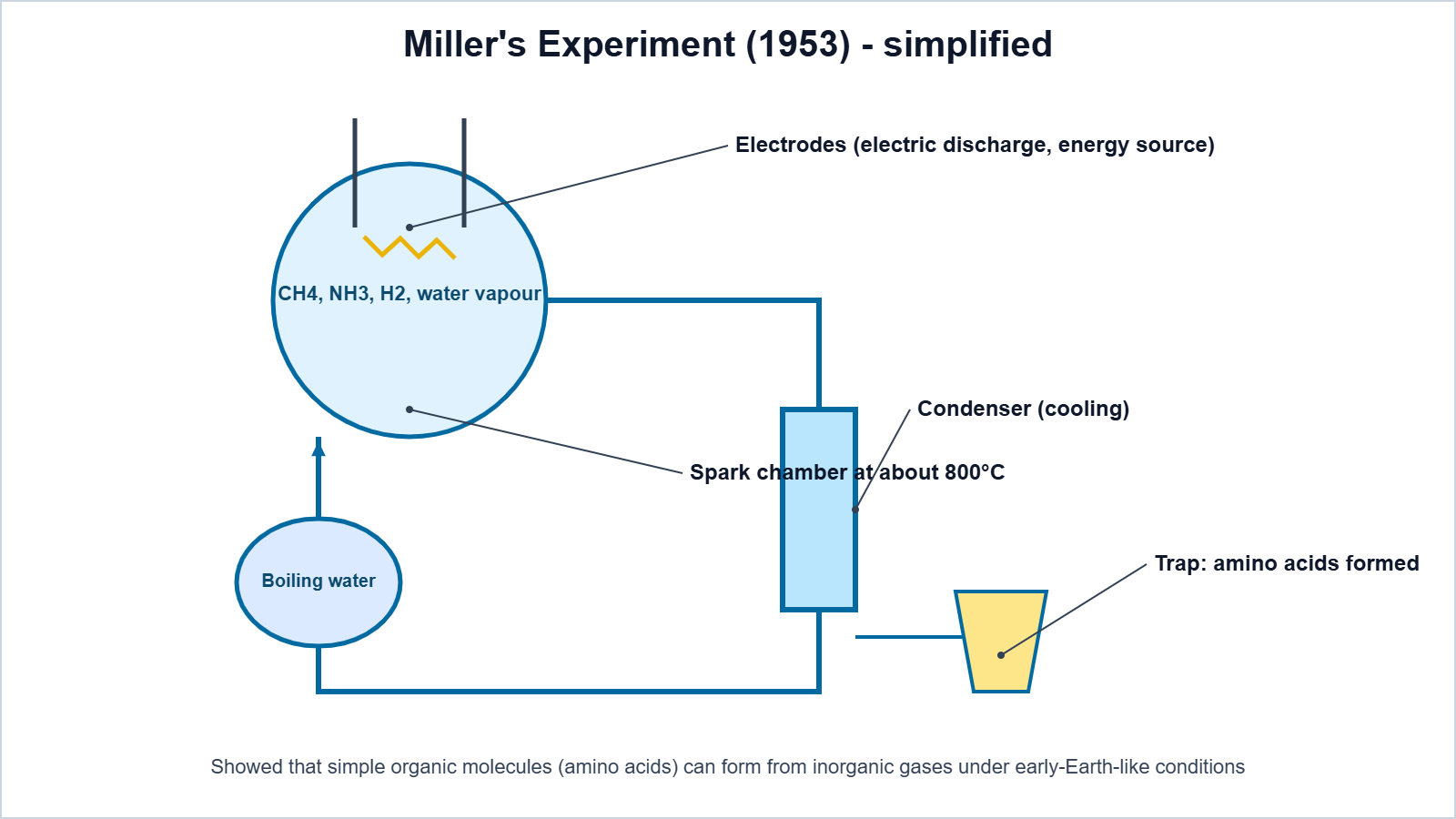
Remember: In Miller’s experiment, the atmosphere was reducing (no free oxygen), as on the early Earth.
2. Evidences for Evolution
- Palaeontological evidence: Fossils in rocks of different ages show different life forms; they show that life forms have changed over time.
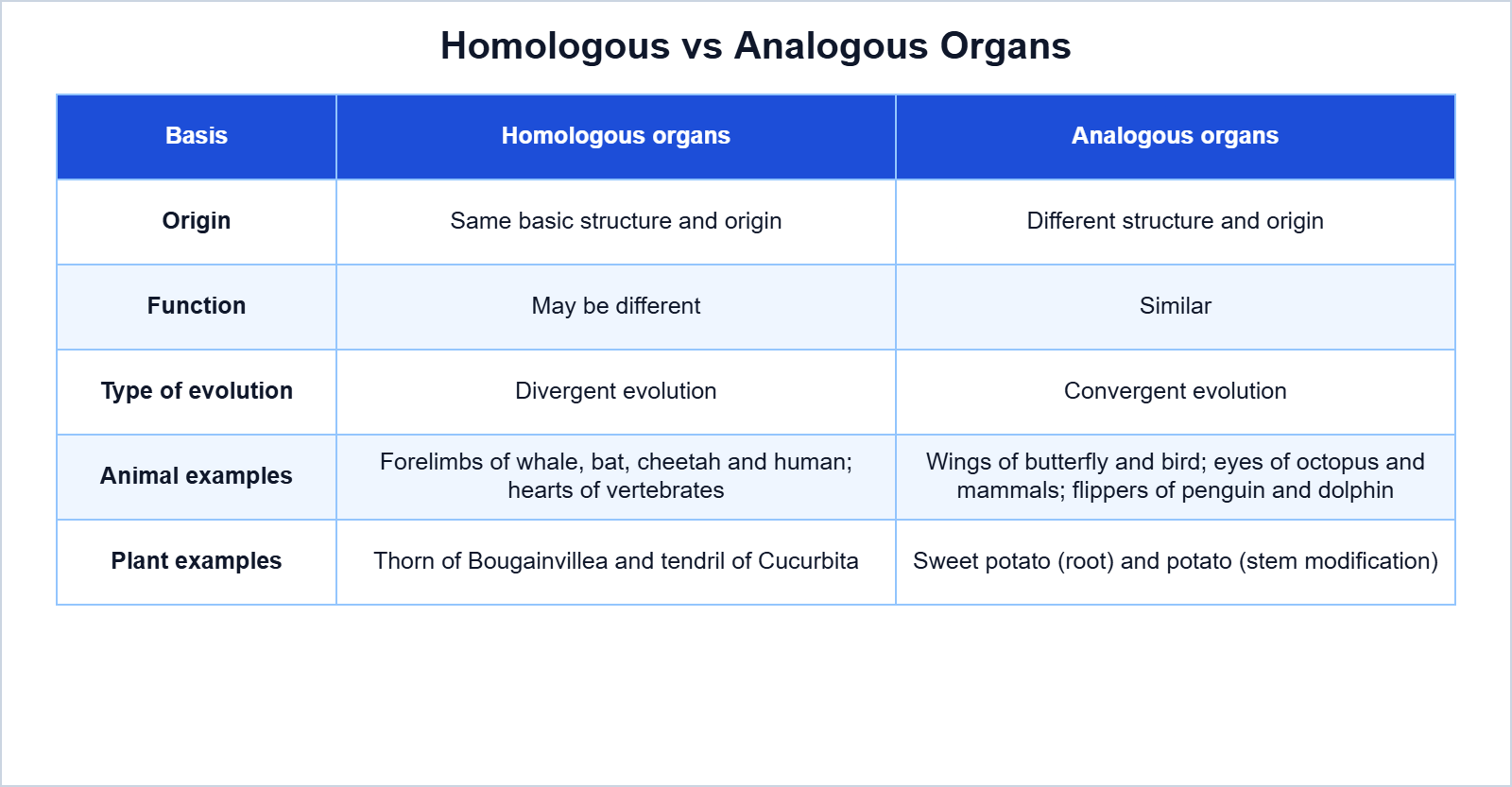
- Comparative anatomy and morphology: homologous and analogous organs.
- Biochemical evidence: similarities in proteins and genes among diverse organisms.
- Natural selection in action: industrial melanism in moths, and resistance to herbicides, pesticides and antibiotics.
Industrial melanism: In England, before industrialisation, white-winged moths were more common than dark-winged moths on lichen-covered trees. After industrialisation, tree trunks became dark with smoke and soot, and dark-winged moths became more common, as predators could not easily spot them.
3. Adaptive Radiation and Convergent Evolution
Adaptive radiation is the evolution of different species from a common ancestor in a given geographical area, spreading into different habitats. Examples: Darwin’s finches of the Galapagos Islands (different beak types from a seed-eating ancestor) and Australian marsupials. When adaptive radiation in different areas produces similar forms (for example, placental and marsupial mammals), it is convergent evolution.
4. Theories of Evolution
Theory | Main idea |
|---|---|
Lamarck | Use and disuse of organs; acquired characters are inherited (e.g., the long neck of the giraffe) |
Darwin (natural selection) | Variations, struggle for existence and survival of the fittest; organisms better fit in an environment leave more progeny |
Hugo de Vries (mutation) | Large sudden variations (mutations) cause speciation (saltation); based on studies of Oenothera |
Modern synthetic theory | Combines variation, mutation, recombination, natural selection and isolation |
Exam point: Darwin and Alfred Wallace independently arrived at the theory of natural selection. Fitness in Darwin’s sense means reproductive fitness.
5. Hardy-Weinberg Principle
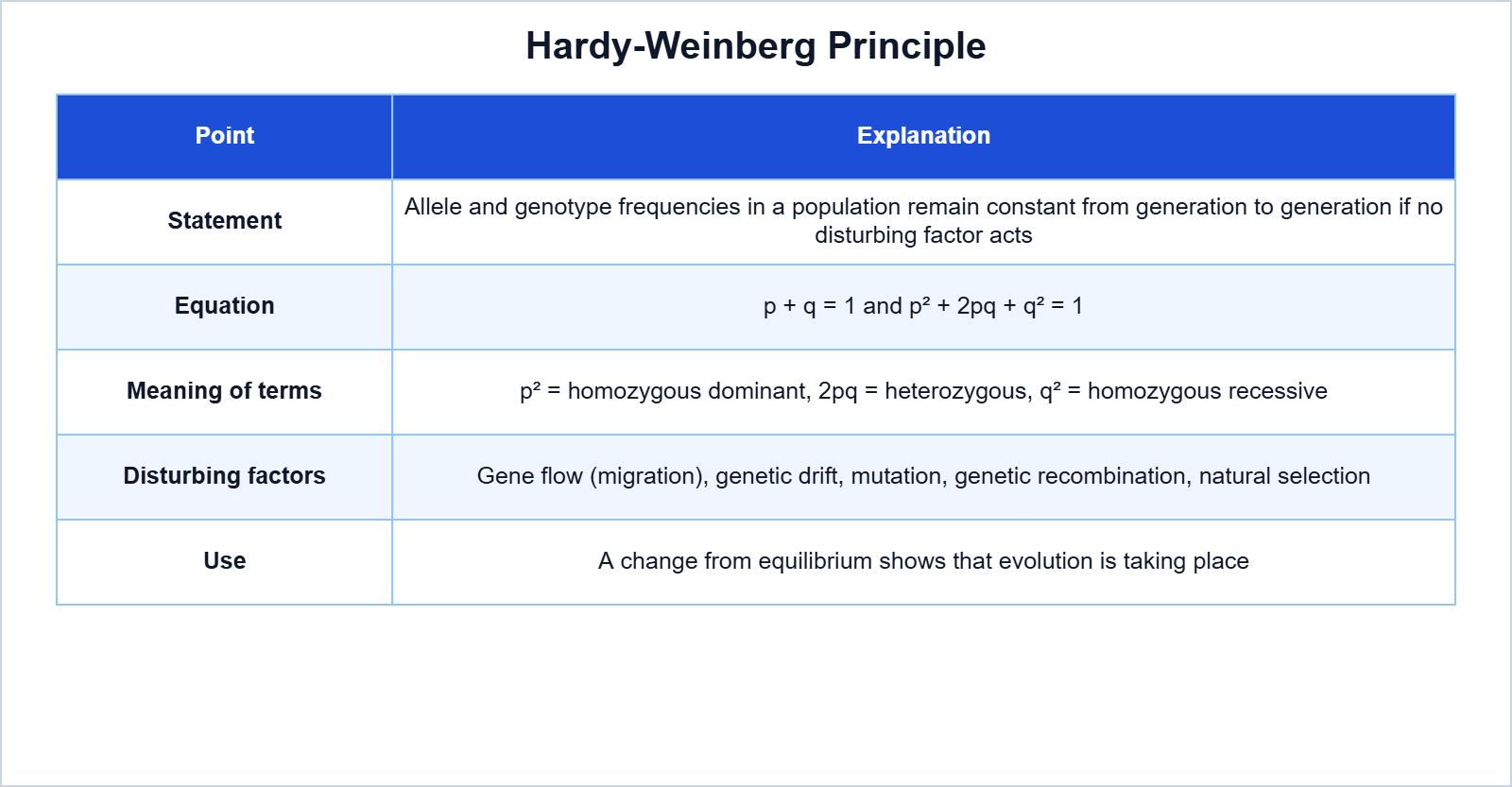
Worked Problem 1: In a population, 16% of individuals show a recessive trait (aa). Find the allele frequencies and the percentage of carriers.
Solution: q² = 0.16, so q = 0.4 and p = 1 – 0.4 = 0.6. Carriers (Aa) = 2pq = 2 x 0.6 x 0.4 = 0.48 (48%). Homozygous dominant (AA) = p² = 0.36 (36%).
Worked Problem 2: In a population of 1000 individuals, 90 show the recessive phenotype. How many are heterozygous and homozygous dominant?
Solution: q² = 90/1000 = 0.09, q = 0.3, p = 0.7. Heterozygous = 2pq x 1000 = 0.42 x 1000 = 420. Homozygous dominant = p² x 1000 = 0.49 x 1000 = 490. (Check: 490 + 420 + 90 = 1000.)
6. Natural Selection: Types
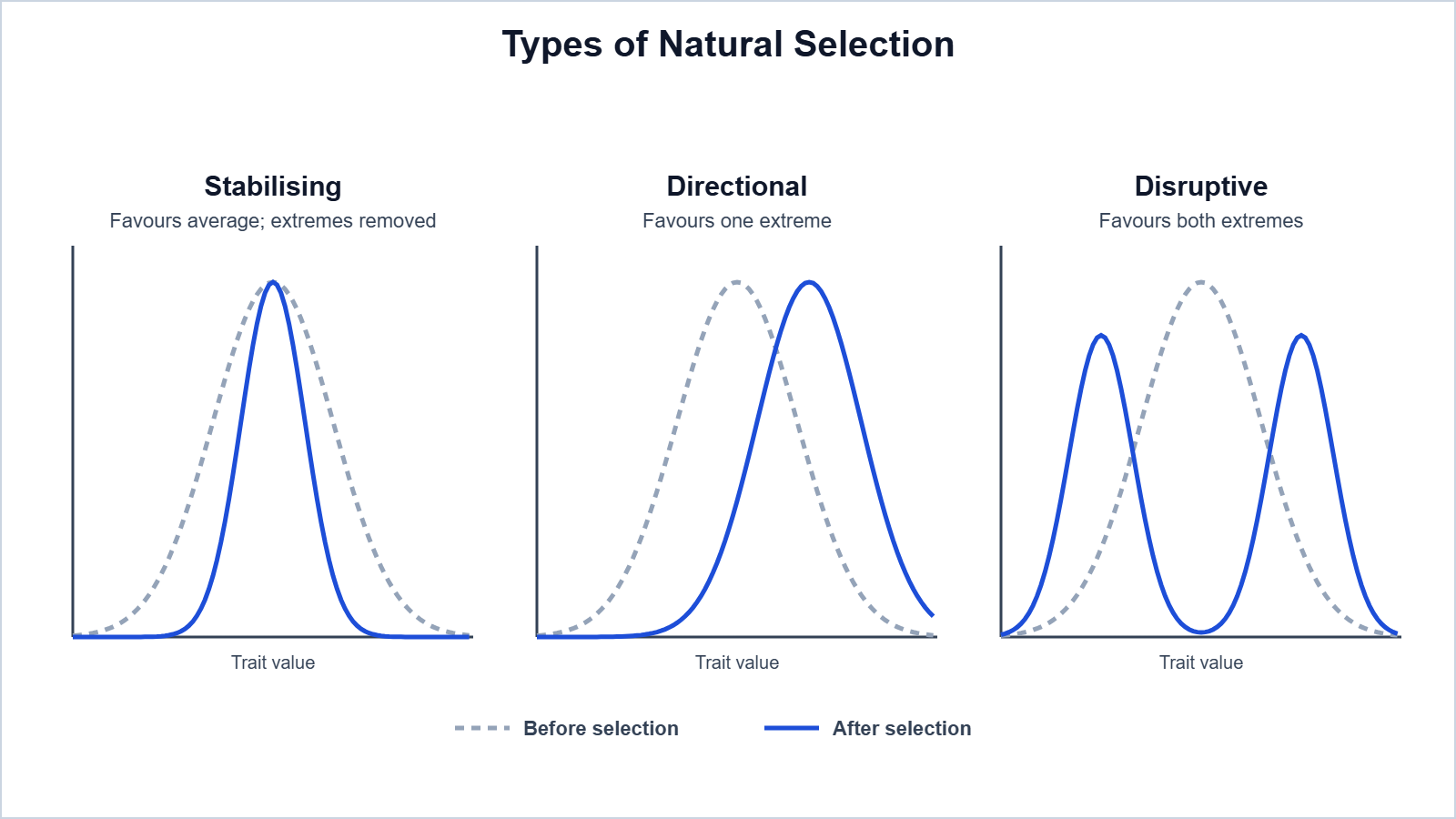
Stabilising selection favours the average (e.g., birth weight in humans); directional selection shifts the mean to one side; disruptive selection favours both extremes, which may lead to two forms.
7. A Brief Account of Evolution and Human Evolution
Life began in water; jawless fish, lobefins, amphibians, reptiles, mammals and birds evolved over time. In human evolution:
Form | Key features |
|---|---|
Dryopithecus, Ramapithecus (about 15 mya) | Hairy, walked like gorillas and chimpanzees; Ramapithecus more man-like |
Australopithecines (about 2 mya) | Lived in East African grasslands; probably used stone weapons, ate fruit |
Homo habilis | First human-like being; brain about 650-800 cc; probably did not eat meat |
Homo erectus (about 1.5 mya) | Brain about 900 cc; probably ate meat |
Neanderthal man | Brain about 1400 cc; lived about 1,00,000-40,000 years ago; buried their dead |
Homo sapiens | Arose in Africa and spread to other continents; cave art about 18,000 years ago; agriculture about 10,000 years ago |
Easy Memory Trick: “Homologous = Same origin, divergent; Analogous = Same function, convergent.”
8. Important Questions
Q1. What did Miller’s experiment show?
Ans. That simple organic molecules such as amino acids could form from a mixture of CH4, NH3, H2 and water vapour with electric discharge, supporting chemical evolution.
Q2. Differentiate between homologous and analogous organs with examples.
Ans. Homologous organs have the same origin but may differ in function (forelimbs of whale and bat); analogous organs have similar function but different origin (wings of bird and butterfly).
Q3. What is industrial melanism?
Ans. In England after industrialisation, dark-winged moths increased because they were camouflaged on soot-covered tree trunks, while light moths were eaten by birds.
Q4. What is adaptive radiation? Give an example.
Ans. Evolution of different species from one ancestor in a geographical area, radiating into different habitats; e.g., Darwin’s finches of the Galapagos and Australian marsupials.
Q5. State the Hardy-Weinberg principle.
Ans. Allele frequencies in a population are stable and constant from generation to generation in the absence of disturbing factors; p² + 2pq + q² = 1.
Q6. Name five factors that affect Hardy-Weinberg equilibrium.
Ans. Gene migration, genetic drift, mutation, genetic recombination and natural selection.
Q7. What is the founder effect?
Ans. When a small group separates from a population, its allele frequencies may differ from the original population and it may become a different species.
Q8. How does Darwin’s theory differ from de Vries’ theory?
Ans. Darwin: evolution by small, gradual, directional variations and natural selection; de Vries: evolution by large, sudden mutations (saltation).
Q9. What was the brain capacity of Homo habilis and Homo erectus?
Ans. About 650-800 cc for Homo habilis and about 900 cc for Homo erectus.
Q10. Give an example of evolution by anthropogenic action.
Ans. Resistance of insects to pesticides and of microbes to antibiotics.
Conclusion: Evolution explains the origin and diversity of life through chemical evolution, variation, natural selection and other factors, supported by fossil, anatomical, biochemical and observed evidence.