Organisms and Populations – Class 12 Biology Notes
Chapter – 11
Organisms and Populations
1. Organism and its Environment
Ecology studies the interactions among organisms and between organisms and their environment. Major abiotic factors are temperature, water, light and soil. Organisms tolerant of a wide range of temperature are eurythermal; those with a narrow range are stenothermal. Similarly for salinity: euryhaline and stenohaline.
Responses to abiotic factors: regulate (maintain homeostasis, like mammals), conform (body temperature changes with surroundings), migrate (move temporarily to a better habitat, like birds coming to Keoladeo National Park, Bharatpur), or suspend (hibernation, aestivation, diapause in zooplankton).
Example: The kangaroo rat of North American deserts meets its water needs through internal fat oxidation (metabolic water) and can concentrate its urine. Many desert plants have CAM photosynthesis, so their stomata remain closed during the day.
2. Population Attributes
A population is a group of individuals of the same species in a given area that share or compete for resources and can interbreed. Its attributes are: population density, birth rate (natality), death rate (mortality), sex ratio and age distribution.
Worked Problem 1 (Density): 80 plants are counted in a sample area of 20 m². Density = 80 / 20 = 4 plants per m².
Worked Problem 2 (Birth and death rates): (a) A pond has 20 lotus plants; 8 new plants are added through reproduction in a year. Birth rate = 8 / 20 = 0.4 offspring per lotus per year. (b) 4 out of 40 fruit flies die in a week. Death rate = 4 / 40 = 0.1 individuals per fruit fly per week.
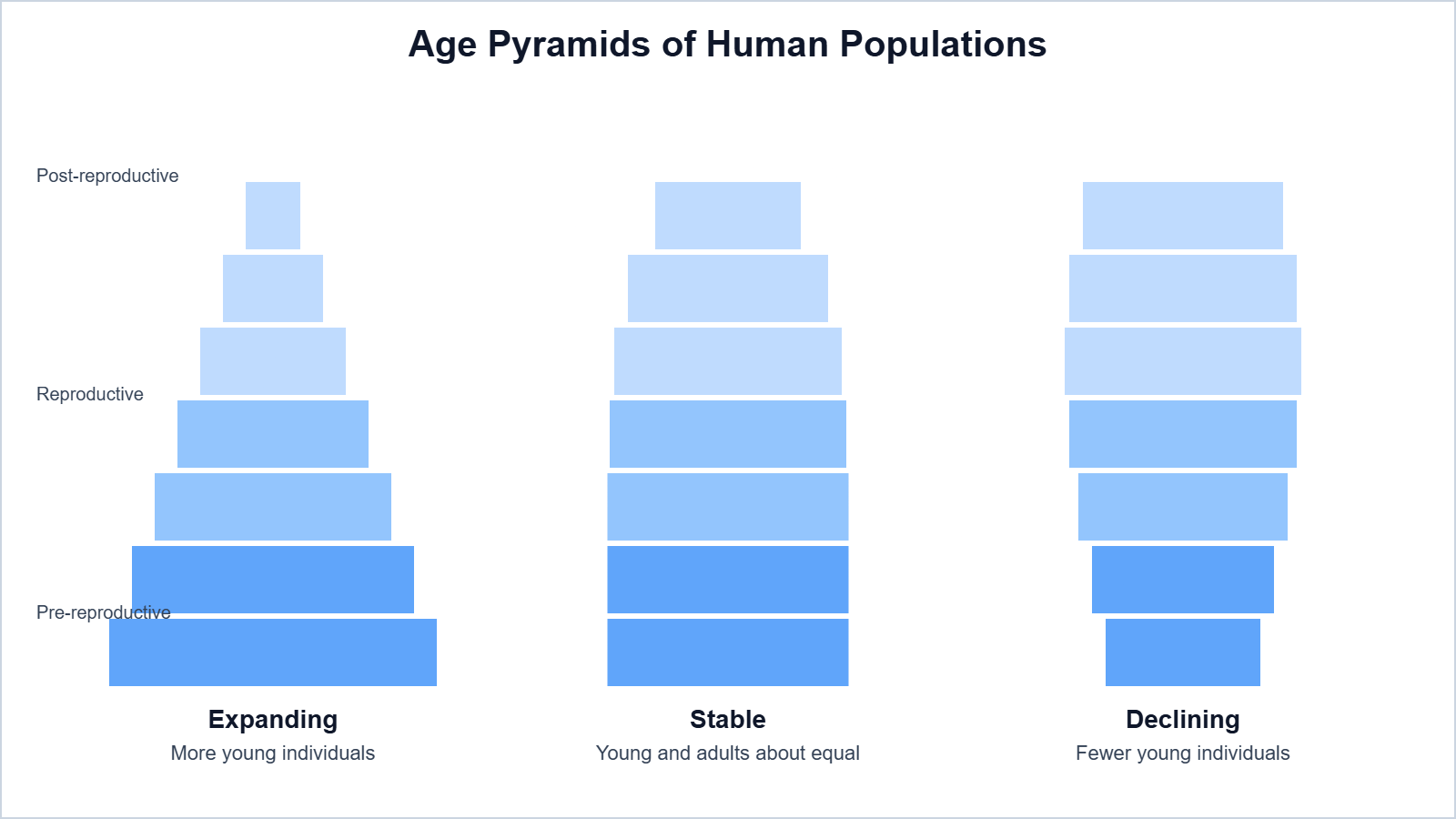
Remember: The shape of the age pyramid shows whether a population is growing, stable or declining.
3. Population Growth
Population size changes due to four factors: natality (B) and immigration (I) increase it; mortality (D) and emigration (E) decrease it.
Nt+1 = Nt + [(B + I) – (D + E)]
Worked Problem 3: A population of 1000 has 60 births, 10 immigrants, 40 deaths and 20 emigrants in a year. Nt+1 = 1000 + (60 + 10) – (40 + 20) = 1010.
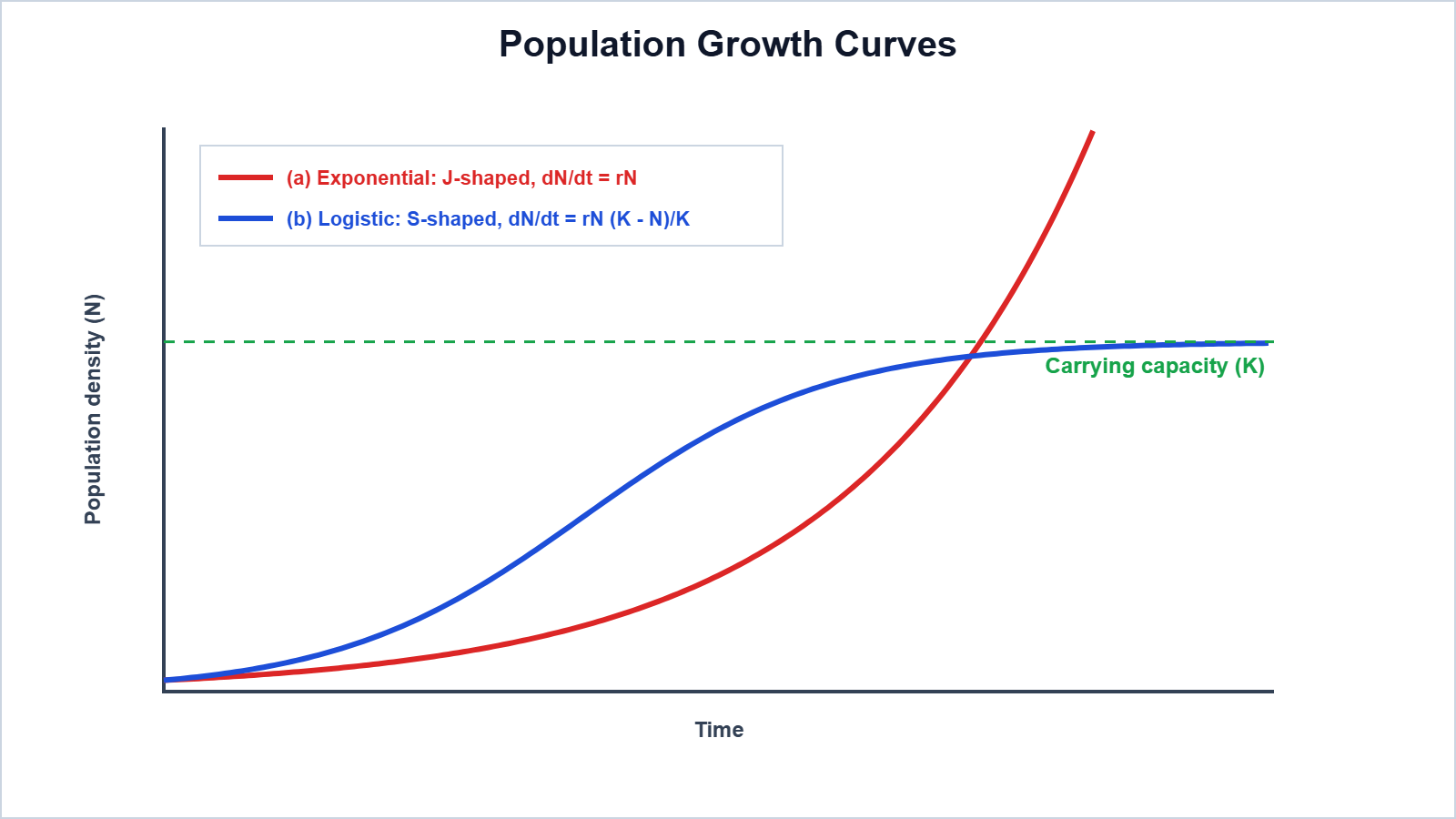
Exponential growth: When resources are unlimited, dN/dt = rN, and Nt = N0ert, where r is the intrinsic rate of natural increase.
Worked Problem 4: (a) N = 500 and r = 0.2 per year. dN/dt = 0.2 x 500 = 100 individuals per year. (b) N0 = 100, r = 0.1 per year, t = 10 years. Nt = 100 x e1 = 100 x 2.718 = about 272.
Logistic growth: With limited resources, growth slows near the carrying capacity: dN/dt = rN (K – N)/K (the Verhulst-Pearl logistic growth).
Worked Problem 5: r = 0.2, N = 200, K = 1000. dN/dt = 0.2 x 200 x (1000 – 200)/1000 = 0.2 x 200 x 0.8 = 32 individuals per unit time.
Exam point: In logistic growth, the growth rate is highest at the middle (inflexion) and becomes zero when N = K.
4. Life History Variation
Populations evolve to maximise reproductive fitness. Some species breed only once in a lifetime (Pacific salmon, bamboo), others many times (most birds and mammals). Some produce a large number of small offspring (oysters, pelagic fishes), others a small number of large offspring (birds, mammals).
5. Population Interactions
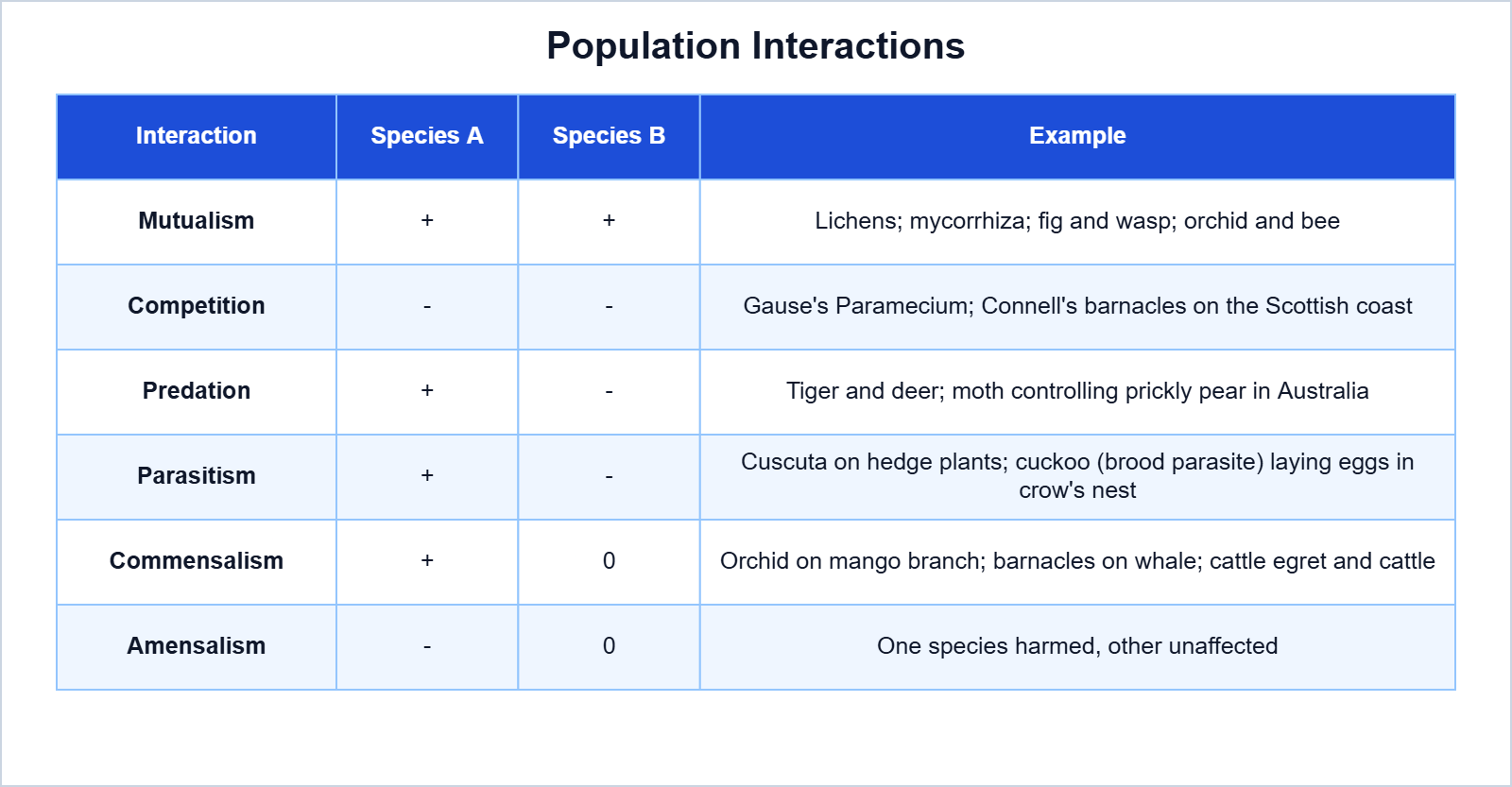
- Predation: keeps prey populations under control and maintains species diversity. When the prickly pear cactus spread in Australia, it was controlled by introducing a cactus-feeding predator (a moth). Prey defend themselves by camouflage, poisons (monarch butterfly) and chemicals (Calotropis produces cardiac glycosides).
- Competition: may occur even when resources are not limiting, through interference. Connell showed that the larger barnacle Balanus excludes the smaller Chthamalus from the intertidal zone on the rocky coast of Scotland.
- Parasitism: parasites may have special adaptations (loss of unnecessary sense organs, suckers, high reproductive capacity). Cuscuta has no chlorophyll and derives nutrition from the host plant.
- Commensalism: one benefits, the other is unaffected (cattle egret and grazing cattle; clownfish and sea anemone).
- Mutualism: both benefit. The Mediterranean orchid Ophrys uses sexual deceit to get pollinated by a species of bee.
Easy Memory Trick: “J for jumping (exponential), S for slowing (logistic).”
6. Important Questions
Q1. What is population density? How is it measured?
Ans. The number of individuals per unit area; measured by direct counting, quadrats, percent cover, or indirect indicators like pug marks and faecal pellets.
Q2. Write the formula for population change.
Ans. N(t+1) = N(t) + [(B + I) – (D + E)], where B = births, I = immigration, D = deaths, E = emigration.
Q3. What do r and K mean in population growth?
Ans. r is the intrinsic rate of natural increase; K is the carrying capacity, the maximum population the environment can support.
Q4. Why is logistic growth more realistic?
Ans. Because resources are limited, so growth slows as the population approaches the carrying capacity, giving an S-shaped curve.
Q5. What does an urn-shaped age pyramid indicate?
Ans. A declining population with fewer young individuals.
Q6. State Gause’s competitive exclusion principle.
Ans. Two closely related species competing for the same limited resources cannot coexist indefinitely; the competitively inferior one is eventually eliminated.
Q7. What is resource partitioning? Give an example.
Ans. Coexisting species avoid competition by using resources differently, as MacArthur showed in five warbler species feeding on different parts of the same tree.
Q8. Give an example of brood parasitism.
Ans. The cuckoo lays its eggs in the nest of the crow, which incubates them.
Q9. How do monarch butterflies protect themselves from predators?
Ans. They are distasteful to predators because of a chemical they get by feeding on a poisonous weed as caterpillars.
Q10. Explain the mutualism between the fig tree and the wasp.
Ans. The female wasp pollinates the fig flowers while laying eggs in them, and the developing seeds feed the wasp larvae.
Conclusion: Populations have measurable attributes and grow exponentially or logistically depending on resources. Interactions such as predation, competition, parasitism and mutualism shape communities in nature.