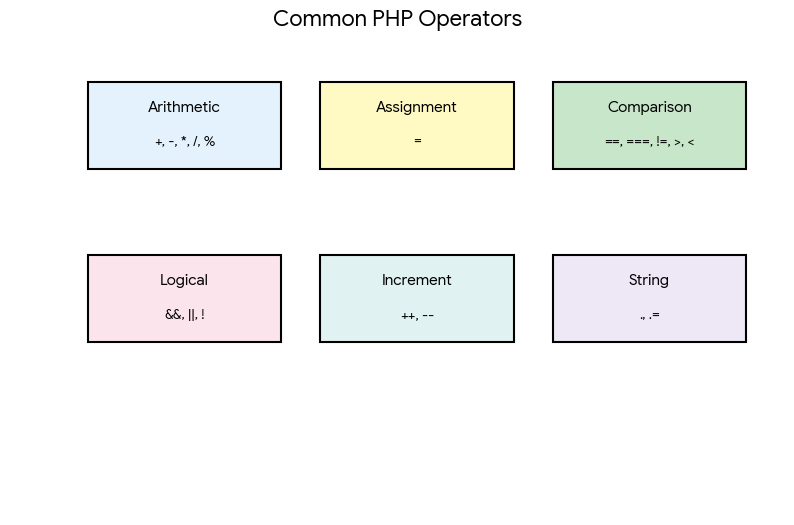
Operators in PHP
Operators in PHP are special symbols used to perform calculations and manipulate data. They are categorized based on their function:
1. Arithmetic Operators
Used for standard mathematical operations:
+(Addition),-(Subtraction),*(Multiplication),/(Division)%(Modulus): Returns the remainder of a division (e.g.,10 % 3is1).**(Exponentiation): x to the power of y (e.g.,2 ** 3is8).
2. Assignment Operators
Used to write values to variables:
=: Standard assignment ($x = 10).+=,-=,*=,/=: Combined operators. For example,$x += 5is the same as$x = $x + 5.
3. Comparison Operators
Used to compare two values, returning
true or false:==(Equal): Checks if values are the same.===(Identical): Checks if values and data types are the same.!=or<>(Not equal).>,<,>=,<=(Greater than, Less than, etc.).
4. Increment/Decrement Operators
Used to increase or decrease a variable’s value by one:
++$x(Pre-increment) or$x++(Post-increment).--$x(Pre-decrement) or$x--(Post-decrement).
5. Logical Operators
Used to combine conditional statements:
and/&&: True if both statements are true.or/||: True if at least one statement is true.!(Not): Reverses the result (true becomes false).
6. String Operators
Specifically for manipulating text:
.(Concatenation): Joins two strings together (e.g.,"Hello" . " World")..=(Concatenation assignment): Appends a string to a variable.