Data Types in PHP
PHP stands for Hypertext Preprocessor (originally it stood for Personal Home Page). At its core, PHP is a server-side scripting language. This means the code doesn’t run on your computer or phone; it runs on the web server where the website is stored.
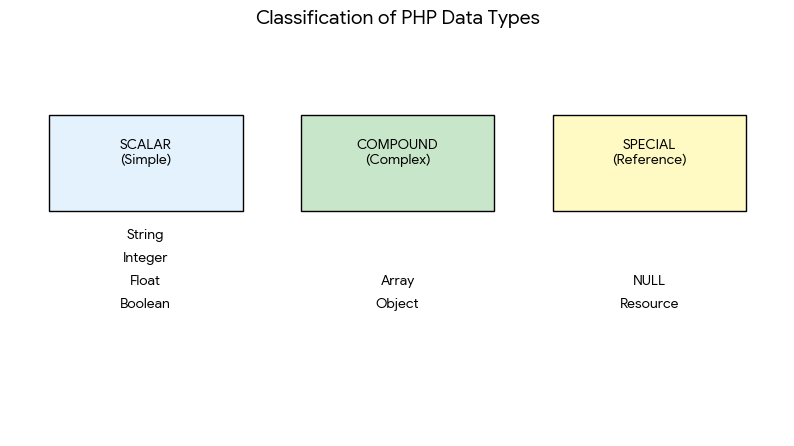
1. Scalar Types (Single Value)
These are the most common types used for basic data storage:
- String: A sequence of characters wrapped in quotes.
- Example:
$name = "Amit";
- Example:
- Integer: A whole number (positive or negative) without decimals.
- Example:
$age = 25;
- Example:
- Float (Double): Numbers with a decimal point or in exponential form.
- Example:
$price = 19.99;
- Example:
- Boolean: Represents two possible states:
trueorfalse.- Example:
$is_logged_in = true;
- Example:
2. Compound Types (Multiple Values)
These allow you to group multiple data points into a single variable:
- Array: Stores multiple values in one single variable.
- Example:
$colors = array("Red", "Green", "Blue");
- Example:
- Object: Instances of user-defined classes that can store both data and functions.
3. Special Types
- NULL: A special type that has only one value:
NULL. It represents a variable with no value assigned to it. - Resource: A special variable holding a reference to an external resource (like a database connection or a file handle).