Sound editing – The nature of sound
Sound editing – The nature of sound
Sound is a form of energy produced by vibrations and travels in the form of waves through a medium like air. In sound editing, understanding how sound behaves helps in recording, analyzing, and improving audio quality.
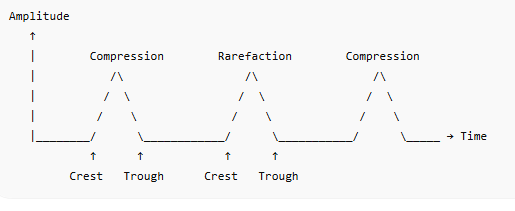
Characteristics of Sound
Frequency (Hz): Number of vibrations per second; determines pitch
Amplitude: Height of the wave; determines loudness
Wavelength: Distance between two compressions or rarefactions
Timbre: Quality that distinguishes different sounds
What is Sound?
Sound is a form of energy that travels as vibrations (waves) through a medium such as air, water or solids. It cannot travel through a vacuum.
Characteristics of Sound
- Frequency: number of vibrations per second, measured in Hertz (Hz). It decides the pitch. Humans can hear roughly 20 Hz to 20,000 Hz.
- Amplitude: the height of the wave. It decides the loudness, measured in decibels (dB).
- Wavelength: distance between two consecutive peaks of the wave.
- Timbre (tone quality): lets us tell apart two sounds of the same pitch and loudness, such as a guitar and a flute.
Analog and Digital Sound
Natural sound is analog (continuous). A computer stores sound in digital form by taking samples of the wave many times a second.
- Sampling rate: samples taken per second, e.g. 44.1 kHz for CD quality.
- Bit depth: bits used per sample, e.g. 16-bit. Higher values give better quality and larger files.
Sound File Formats
WAV and AIFF (uncompressed), MP3 and AAC (compressed), MIDI (stores musical instructions, not actual sound). Audacity is a free software used for sound editing.
Important Questions
Q. What decides the pitch of a sound?
Ans. Its frequency.
Q. What is the sampling rate of CD-quality audio?
Ans. 44.1 kHz (44,100 samples per second).
Q. What is the difference between WAV and MP3?
Ans. WAV is an uncompressed, high-quality format with large files. MP3 is a compressed format with much smaller files and slightly lower quality.