Number System
In computer science, a number system is a structured method for representing numerical values using a unique set of symbols or digits.
- Binary (Base 2): The most fundamental system, using only two digits: 0 and 1. It is the “native language” of computers because electronic circuits have only two states: on (1) and off (0).
- Decimal (Base 10): The standard system used by humans in everyday life, featuring ten digits (0-9). Computers convert human input from decimal to binary for processing.
Some Examples:
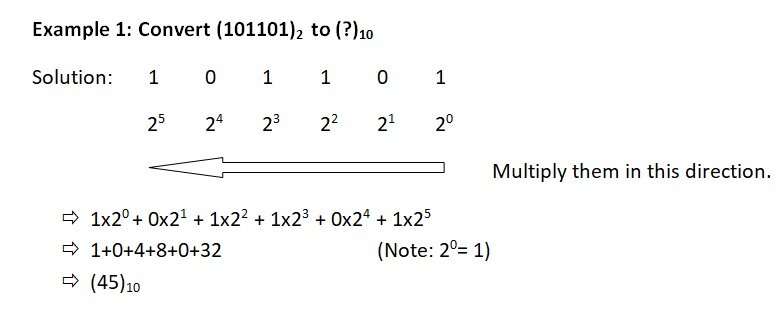
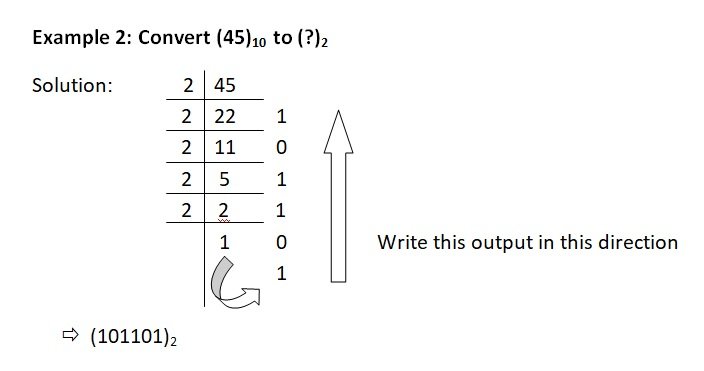
Types of Number Systems
- Decimal (base 10): digits 0–9. Used in daily life.
- Binary (base 2): digits 0 and 1. Used by computers.
- Octal (base 8): digits 0–7.
- Hexadecimal (base 16): digits 0–9 and A–F, where A = 10 and F = 15.
Decimal to Binary
Divide the number by 2 repeatedly and write the remainders from bottom to top.
Example: 13 → 13/2 = 6 r1, 6/2 = 3 r0, 3/2 = 1 r1, 1/2 = 0 r1. So (13)10 = (1101)2.
Binary to Decimal
Multiply each bit by its place value (powers of 2) and add.
Example: (1011)2 = 1×8 + 0×4 + 1×2 + 1×1 = (11)10.
Binary to Octal and Hexadecimal
- For octal, group bits in threes from the right: (110101)2 = 110 101 = (65)8.
- For hexadecimal, group bits in fours from the right: (11010110)2 = 1101 0110 = (D6)16.
Units of Memory
1 bit = 0 or 1; 4 bits = 1 nibble; 8 bits = 1 byte; 1024 bytes = 1 KB; 1024 KB = 1 MB; 1024 MB = 1 GB; 1024 GB = 1 TB.
Important Questions
Q. Convert (25)10 to binary.
Ans. (11001)2
Q. Convert (1110)2 to decimal.
Ans. 8 + 4 + 2 + 0 = (14)10
Q. What is the base of the hexadecimal number system and which symbols does it use?
Ans. Base 16. It uses 0–9 and A–F.