Need of computer network
A computer network is a collection of computers and devices connected together to share resources and information. The primary “need” for a network is to break the isolation of a single computer, allowing for collaboration and efficiency.
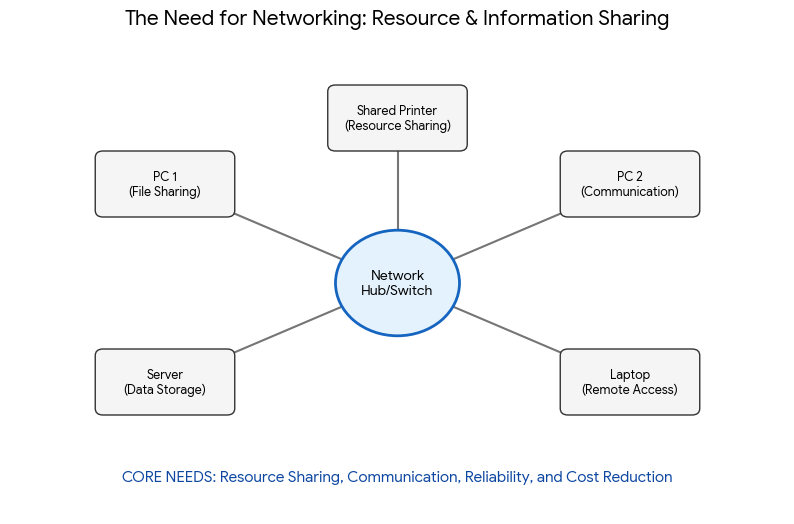
- Resource Sharing
- File Sharing & Management
- Improved Communication
- Cost-Effectiveness
- Reliability
- Security
Why do we need computer networks?
Computers are connected into a network so that people and devices can share information and resources. The main needs are:
- Resource sharing: one printer, scanner or internet connection can be used by many computers.
- File and data sharing: users can access the same files from different computers instead of copying them on pen drives.
- Communication: email, chat, video calls and messaging all depend on networks.
- Cost saving: expensive hardware and software licences can be shared.
- Centralised data and backup: data can be stored on a server and backed up in one place.
- Reliability: if one computer fails, the data is still available from another computer or server.
Types of networks by size
- PAN (Personal Area Network): a few metres, e.g. a phone connected to Bluetooth earphones.
- LAN (Local Area Network): a room, building or school campus.
- MAN (Metropolitan Area Network): a city, e.g. a cable TV network.
- WAN (Wide Area Network): countries and continents. The Internet is the largest WAN.
Important Questions
Q. Define a computer network.
Ans. A computer network is a group of two or more computers and devices connected together to share data, resources and communication.
Q. List any four advantages of a computer network.
Ans. Resource sharing, file sharing, communication, and reduced cost.
Q. What is the difference between a LAN and a WAN?
Ans. A LAN covers a small area such as a building and is usually privately owned, while a WAN covers a very large area such as countries, often using public communication links.