Basics of Computer
A computer is an electronic device that takes raw data (input), processes it using a set of instructions, and produces a result (output).
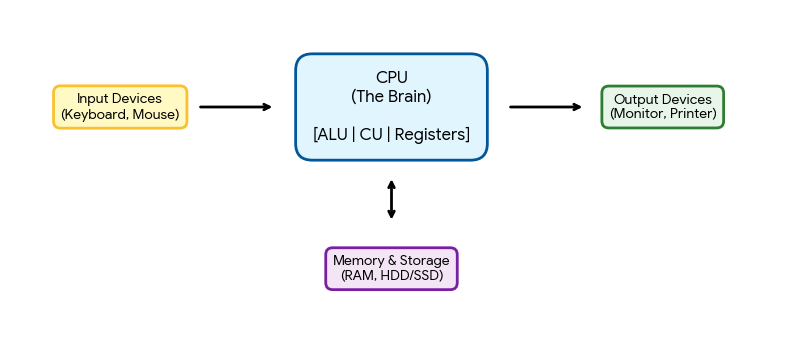
At its core, a computer follows the IPO cycle (Input-Process-Output).
The Computer System Architecture
The following diagram illustrates how the hardware components interact to turn data into information:
Characteristics of Computer
1. Speed
Computers can perform millions of calculations in a fraction of a second. While a human might take hours to solve a complex math problem, a computer handles it in nanoseconds or microseconds.
2. Accuracy
As long as the input and instructions are correct, a computer is 100% accurate. Errors usually occur due to human mistakes in programming or data entry, a concept known as GIGO (Garbage In, Garbage Out).
3. Diligence
Unlike humans, computers do not suffer from tiredness, lack of concentration, or boredom. They can perform the same repetitive task for days without losing efficiency or making errors.
4. Versatility
Computers are multipurpose machines. You can use the same device to write a document, edit a high-definition video, simulate a flight, or play music—often at the same time.
5. Storage (Memory)
Computers can store massive amounts of data in a very small physical space. This information can be retrieved instantly, whether it was saved five seconds ago or five years ago.
Applications of Computer
- Education: Enables online learning, digital research, and interactive teaching tools.
- Healthcare: Used for medical imaging, patient records, and robotic surgeries.
- Banking: Facilitates 24/7 online transactions, ATM services, and fraud detection.
- Business: Manages inventory, financial accounting, and global e-commerce operations.
- Communication: Powers email, instant messaging, and high-definition video conferencing.
- Defense: Controls missile guidance systems, secure communications, and strategic planning.
- Entertainment: Supports video streaming, high-end gaming, and digital content creation.