Nuclei – Physics Class 12 Notes
Chapter – 13
Nuclei
1. Composition and Size of the Nucleus
A nucleus contains protons (Z, the atomic number) and neutrons (N); together they are called nucleons, and A = Z + N is the mass number. A nuclide is written AZX. Atomic masses are measured in atomic mass units: 1 u = 1/12 of the mass of a 12C atom = 1.660539 × 10⁻²⁷ kg. The neutron was discovered by Chadwick (1932).
Term | Same | Example |
|---|---|---|
Isotopes | Z (different A) | 1H, 2H, 3H |
Isobars | A (different Z) | 3H and 3He |
Isotones | N (different Z) | 198Hg and 197Au (N = 118) |
Size: scattering experiments show R = R0A1/3, with R0 ≈ 1.2 fm (1 fm = 10-15 m). Hence the volume is proportional to A, and the nuclear density is nearly the same for all nuclei (about 2.3 × 10¹⁷ kg m-3), enormously greater than that of ordinary matter.
Numerical 1: Find the radius of the 56Fe nucleus. (R0 = 1.2 fm)
Given: A = 56, R0 = 1.2 fm
Formula: R = R0A1/3
Solution: 561/3 = 3.826; R = 1.2 × 3.826
Answer: R ≈ 4.59 fm = 4.59 × 10⁻¹⁵ m
2. Mass-Energy Equivalence and Binding Energy
Einstein’s relation E = mc2 shows that mass is a form of energy. The energy equivalent of 1 u is 931.5 MeV.
The mass of a nucleus is always less than the sum of the masses of its separate nucleons. The difference is the mass defect: Δm = [Zmp + (A − Z)mn] − M. The energy equivalent Eb = Δm c2 is the binding energy: the energy needed to separate the nucleus into its nucleons (or released when it is formed). Binding energy per nucleon Ebn = Eb/A measures the stability of a nucleus.
Numerical 2: Find the energy equivalent of 1 g of matter.
Given: m = 10-3 kg, c = 3 × 10⁸ m s-1
Formula: E = mc2
Solution: E = 10-3 × 9 × 1016
Answer: E = 9 × 10¹³ J
Numerical 3: Find the binding energy and the binding energy per nucleon of 42He. (m(1H) = 1.007825 u, mn = 1.008665 u, m(4He) = 4.002603 u, 1 u = 931.5 MeV)
Given: Z = 2, N = 2 (atomic masses used, so electron masses cancel)
Formula: Δm = 2m(1H) + 2mn − m(4He); Eb = Δm × 931.5 MeV
Solution: Δm = 2.015650 + 2.017330 − 4.002603 = 0.030377 u; Eb = 0.030377 × 931.5
Answer: Eb ≈ 28.3 MeV; Ebn ≈ 7.07 MeV per nucleon
3. Binding Energy Curve
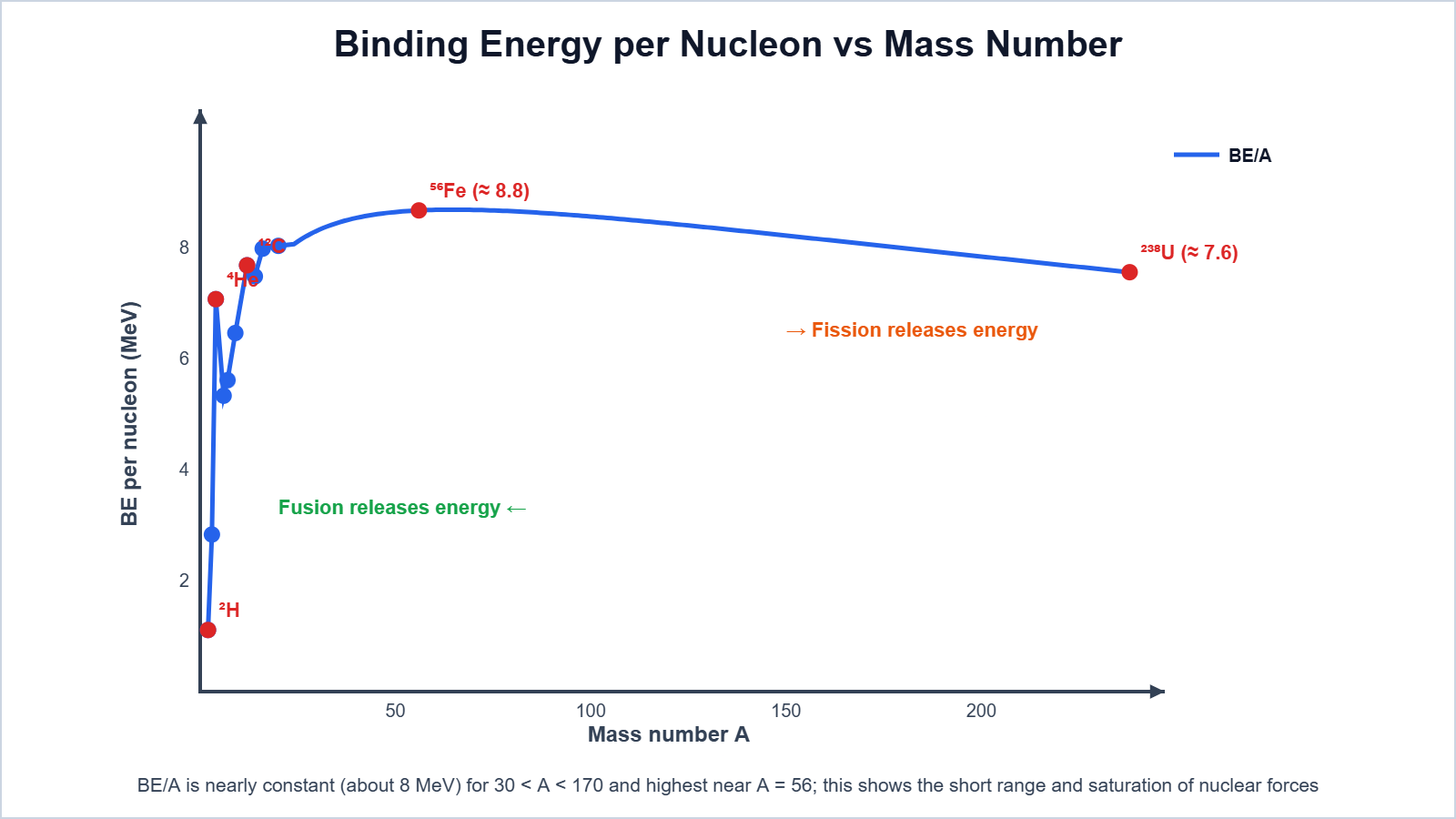
- Ebn is nearly constant (about 8 MeV) for 30 < A < 170: the nuclear force is short-ranged and saturates – each nucleon interacts only with its near neighbours.
- Ebn is maximum (about 8.75 MeV) near A = 56 (iron): such nuclei are the most stable.
- For heavy nuclei (A > 170) Ebn decreases; splitting them into medium nuclei (fission) releases energy.
- For light nuclei (A < 30) Ebn is low; combining them into heavier nuclei (fusion) releases energy.
4. Nuclear Force
- It is the strongest force in nature, much stronger than the Coulomb repulsion between protons.
- It is short-ranged (a few femtometres): attractive for separations above about 0.8 fm and strongly repulsive below it.
- It is nearly the same between n-n, p-p and n-p pairs (charge independent).
- It does not depend on electric charge and cannot be described by a simple formula like Coulomb’s law.
5. Radioactive Decay
Unstable nuclei change spontaneously into other nuclei by emitting alpha particles (4He nuclei), beta particles (electrons or positrons) or gamma rays (high-energy photons). Radioactivity was discovered by Becquerel (1896).

Derivation: Law of radioactive decay
- The rate of decay is proportional to the number N of undecayed nuclei present: dN/dt = −λN, where λ is the decay constant.
- Separating variables: dN/N = −λ dt; integrating from N0 at t = 0: ln(N/N0) = −λt.
Result: N = N0e−λt. Half-life (time for N to fall to N0/2): T1/2 = ln 2/λ = 0.693/λ. Mean life τ = 1/λ = T1/2/0.693. Activity R = λN (unit becquerel, 1 Bq = 1 decay per second; 1 curie = 3.7 × 10¹⁰ Bq). After n half-lives, N = N0/2n.
Numerical 4: A radioactive sample has a half-life of 5 days. What fraction remains after 20 days?
Given: T1/2 = 5 days, t = 20 days
Formula: N/N0 = (1/2)t/T
Solution: n = 20/5 = 4 half-lives; N/N0 = (1/2)4
Answer: 1/16 of the sample remains
Numerical 5: The half-life of radium is 1600 years. Find its decay constant.
Given: T1/2 = 1600 y
Formula: λ = 0.693/T1/2
Solution: λ = 0.693/1600
Answer: λ ≈ 4.33 × 10⁻⁴ per year
Numerical 6: A nuclide has a half-life of 10 h. Find its mean life.
Given: T1/2 = 10 h
Formula: τ = T1/2/0.693
Solution: τ = 10/0.693
Answer: τ ≈ 14.4 h
6. Nuclear Fission and Fusion
Fission: a heavy nucleus splits into two medium nuclei when struck by a neutron, releasing about 200 MeV and 2-3 neutrons, e.g. 235U + n → 141Ba + 92Kr + 3n + energy. The released neutrons can cause further fissions – a chain reaction. In a nuclear reactor the chain reaction is controlled: a moderator (heavy water, graphite) slows down neutrons, control rods (cadmium, boron) absorb extra neutrons, and a coolant removes heat to produce steam for electricity.
Fusion: light nuclei combine to form a heavier nucleus with release of energy, e.g. the proton-proton cycle in the Sun, in which four protons ultimately form a helium nucleus releasing about 26.7 MeV. Fusion needs extremely high temperatures (about 107 K) so that nuclei can overcome their Coulomb repulsion – hence it is called a thermonuclear reaction. The energy of stars comes from fusion.
Numerical 7: Each fission of 235U releases about 200 MeV. How many fissions per second are needed to produce a power of 1 MW?
Given: E = 200 MeV = 200 × 1.6 × 10-13 J = 3.2 × 10⁻¹¹ J; P = 106 W
Formula: n = P/E
Solution: n = 106/(3.2 × 10-11)
Answer: n ≈ 3.1 × 10¹⁶ fissions per second
Easy Memory Trick: “Iron is the peak – Heavy Halves (fission), Light Link (fusion)”.
7. Practice Numericals (Answers Only)
- Find the radius of a nucleus of mass number 125. Ans: 6 fm.
- What fraction of a radioactive sample remains after 3 half-lives? Ans: 1/8.
- What is the energy equivalent of 1 u? Ans: 931.5 MeV.
- What is the ratio of the densities of two nuclei of mass numbers 27 and 125? Ans: 1 : 1.
- A nucleus with A = 56 has a binding energy per nucleon of 8 MeV. Find its total binding energy. Ans: 448 MeV.
8. Board-pattern Practice Questions
(a) Multiple Choice Questions
1. Nuclear radius is proportional to
(A) A (B) A2 (C) A1/3 (D) A2/3
Ans. (C)
2. Binding energy per nucleon is maximum for nuclei near
(A) A = 4 (B) A = 56 (C) A = 120 (D) A = 238
Ans. (B)
3. The nuclear force is
(A) long-ranged (B) short-ranged and attractive at about 1-2 fm (C) purely repulsive (D) dependent on charge
Ans. (B)
4. The half-life and decay constant are related by
(A) T = λ/0.693 (B) T = 0.693/λ (C) T = 0.693λ (D) T = 1/λ
Ans. (B)
(b) Assertion-Reason
Options: (A) Both A and R are true and R is the correct explanation of A. (B) Both A and R are true but R is not the correct explanation of A. (C) A is true but R is false. (D) A is false but R is true.
1. Assertion (A): The density of all nuclei is nearly the same.
Reason (R): Nuclear radius R ∝ A1/3, so nuclear volume is proportional to A.
Ans. (A)
2. Assertion (A): Energy is released when heavy nuclei undergo fission.
Reason (R): The binding energy per nucleon of the products is greater than that of the heavy nucleus.
Ans. (A)
(c) Match the Columns
Column I | Column II |
|---|---|
(i) Isotopes | (p) same A |
(ii) Isobars | (q) same N |
(iii) Isotones | (r) same Z |
(iv) Moderator | (s) slows down neutrons |
Ans. (i)-(r), (ii)-(p), (iii)-(q), (iv)-(s)
(d) Case Study
Case: In a nuclear power station, uranium-235 nuclei undergo fission when they absorb slow neutrons. Each fission releases about 200 MeV of energy and two or three fast neutrons. Heavy water slows these neutrons, and cadmium rods are moved in or out to keep the reaction steady.
(i) Why are neutrons slowed down?
Ans. Slow neutrons are much more likely to cause fission of 235U.
(ii) What is the role of cadmium rods?
Ans. They absorb neutrons and control the rate of the chain reaction.
(iii) Where does the energy of fission come from?
Ans. From the mass defect: the products have less total mass, and the difference appears as energy (E = Δmc2).
(iv) What would happen if the chain reaction were uncontrolled?
Ans. The energy release would grow very rapidly, as in an atom bomb.
(e) Long Answer Questions
Q1. Define mass defect and binding energy. Draw the binding energy per nucleon curve and use it to explain why energy is released in fission and fusion.
Ans. See Sections 2 and 3.
Q2. State the law of radioactive decay. Derive N = N0e−λt and obtain the relation between half-life and decay constant.
Ans. See Section 5.
9. Important Questions
Q1. What are nucleons?
Ans. Protons and neutrons.
Q2. Write the relation for nuclear radius.
Ans. R = R0A1/3.
Q3. Define binding energy.
Ans. The energy needed to break a nucleus into its separate nucleons.
Q4. What is mass defect?
Ans. The difference between the total mass of the nucleons and the mass of the nucleus.
Q5. Why is nuclear density independent of A?
Ans. Because R3 ∝ A, so mass/volume is constant.
Q6. Give two properties of nuclear forces.
Ans. Short range; charge independent (also strongest force).
Q7. What is a chain reaction?
Ans. A self-sustaining series of fissions caused by neutrons released in earlier fissions.
Q8. Why does fusion need very high temperature?
Ans. To give nuclei enough kinetic energy to overcome Coulomb repulsion.
Q9. Define half-life.
Ans. The time in which half the nuclei of a radioactive sample decay.
Q10. Define one becquerel.
Ans. One decay per second.
Conclusion: The nucleus is tiny, dense and held by the short-range nuclear force. Mass defect and binding energy explain nuclear stability, and the binding energy curve shows why both fission of heavy nuclei and fusion of light nuclei release energy.