Moving Charges and Magnetism – Physics Class 12 Notes
Chapter – 4
Moving Charges and Magnetism
1. Magnetic Force on a Moving Charge
Oersted (1820) found that a current-carrying wire deflects a compass needle: moving charges produce magnetic fields. A charge q moving with velocity v in fields E and B experiences the Lorentz force: F = q[E + v × B]. The magnetic part F = q(v × B) has magnitude qvB sinθ and is perpendicular to both v and B, so it does no work and does not change the speed.
SI unit of B: tesla (T) = N s C-1 m-1 = N A-1 m-1; 1 gauss = 10-4 T.
Motion in a uniform magnetic field: if v ⊥ B, the charge moves in a circle: qvB = mv2/r, so r = mv/qB, angular frequency ω = qB/m and period T = 2πm/qB (independent of speed). If v has a component along B, the path is a helix with pitch p = v∥ × T.
Numerical 1: A proton moves at 3 × 10⁶ m s-1 perpendicular to a field of 0.5 T. Find the force on it and the radius of its path.
Given: v = 3 × 10⁶ m s-1, B = 0.5 T, q = 1.6 × 10⁻¹⁹ C, mp = 1.67 × 10⁻²⁷ kg
Formula: F = qvB; r = mv/qB
Solution: F = 1.6 × 10-19 × 3 × 106 × 0.5; r = 1.67 × 10-27 × 3 × 106 / (1.6 × 10-19 × 0.5)
Answer: F = 2.4 × 10⁻¹³ N; r ≈ 0.063 m = 6.3 cm
2. Cyclotron

A cyclotron accelerates charged particles such as protons and deuterons. Two hollow D-shaped electrodes (dees) are placed in a uniform magnetic field perpendicular to them, and an alternating voltage is applied across the gap. Inside a dee the particle moves in a semicircle (no field inside, as the dee is a conductor); each time it crosses the gap it is accelerated, so the radius increases. Since T = 2πm/qB does not depend on speed, the particle always reaches the gap in step with the oscillator (resonance condition).
Cyclotron frequency f = qB/2πm. At the maximum radius R, v = qBR/m, so Kmax = q2B2R2/2m. Uses: producing high-energy particles for nuclear reactions, radioactive isotopes for medicine.
Remember: A cyclotron cannot accelerate electrons (their mass increases appreciably at high speed, so they fall out of step) and cannot accelerate neutral particles.
Numerical 2: A cyclotron has B = 1.5 T and dee radius 0.5 m. Find the oscillator frequency needed for protons and the maximum kinetic energy of the protons.
Given: B = 1.5 T, R = 0.5 m, q = 1.6 × 10⁻¹⁹ C, m = 1.67 × 10⁻²⁷ kg
Formula: f = qB/2πm; K = q2B2R2/2m
Solution: f = (1.6 × 10-19 × 1.5)/(2π × 1.67 × 10-27) = 2.29 × 10⁷ Hz; K = (1.6 × 10-19 × 1.5 × 0.5)2/(2 × 1.67 × 10-27) = 4.31 × 10⁻¹² J
Answer: f ≈ 22.9 MHz; K ≈ 4.31 × 10⁻¹² J ≈ 26.9 MeV
3. Biot-Savart Law

The magnetic field dB due to a current element I dl at a point at displacement r is: dB = (μ0/4π) I dl sinθ / r2; vector form dB = (μ0/4π) I (dl × r)/r3. μ0 = 4π × 10-7 T m A-1 (permeability of free space).
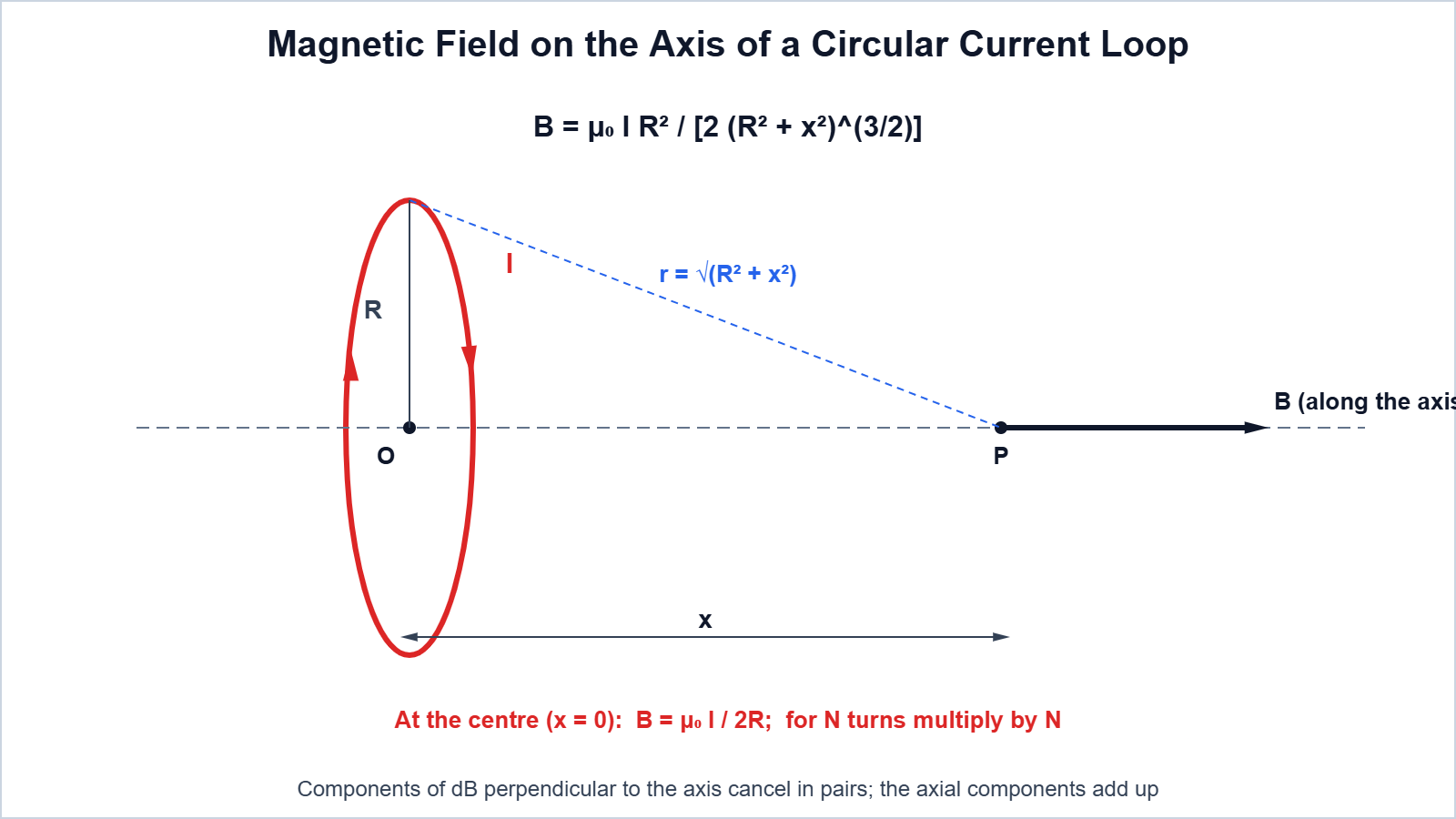
Derivation: Field on the axis of a circular current loop
- Loop of radius R carries current I; point P is on the axis at distance x from the centre.
- For every element dl, dl ⊥ r and r2 = x2 + R2, so dB = (μ0/4π) I dl/(x2 + R2).
- By symmetry the components perpendicular to the axis cancel; the axial components dB cosθ add, with cosθ = R/(x2 + R2)1/2.
- B = ∮ (μ0/4π) I dl R/(x2 + R2)3/2, and ∮dl = 2πR.
Result: B = μ0IR2/[2(x2 + R2)3/2], along the axis. At the centre (x = 0): B = μ0I/2R; for N turns B = μ0NI/2R. Direction by the right-hand thumb rule (curl fingers along current, thumb gives B).
Numerical 3: A circular coil of 100 turns and radius 10 cm carries 2 A. Find the field at its centre.
Given: N = 100, R = 0.10 m, I = 2 A
Formula: B = μ0NI/2R
Solution: B = 4π × 10-7 × 100 × 2 / 0.20
Answer: B ≈ 1.26 × 10⁻³ T
4. Ampère’s Circuital Law
The line integral of B around any closed loop equals μ0 times the net current threading the loop: ∮B · dl = μ0Ienclosed.
Long straight wire: taking a circle of radius r around the wire, B(2πr) = μ0I, so B = μ0I/2πr. The field lines are concentric circles (right-hand rule).
Numerical 4: Find the magnetic field 5 cm from a long straight wire carrying 10 A.
Given: I = 10 A, r = 0.05 m
Formula: B = μ0I/2πr
Solution: B = 2 × 10-7 × 10/0.05
Answer: B = 4 × 10⁻⁵ T

Derivation: Field inside a long solenoid
- Take a rectangular loop abcd with side ab (length h) inside the solenoid parallel to its axis, and cd outside.
- Inside, B is uniform and along the axis; outside, B ≈ 0. On bc and da, B is either perpendicular to dl or zero.
- ∮B · dl = Bh. Current enclosed = (nh)I, where n is the number of turns per unit length.
- Bh = μ0nhI.
Result: B = μ0nI (uniform inside; at the ends it is half this value).
Numerical 5: A solenoid 0.5 m long has 500 turns and carries 5 A. Find the field inside it.
Given: N = 500, l = 0.5 m, so n = 1000 m-1; I = 5 A
Formula: B = μ0nI
Solution: B = 4π × 10-7 × 1000 × 5
Answer: B ≈ 6.28 × 10⁻³ T
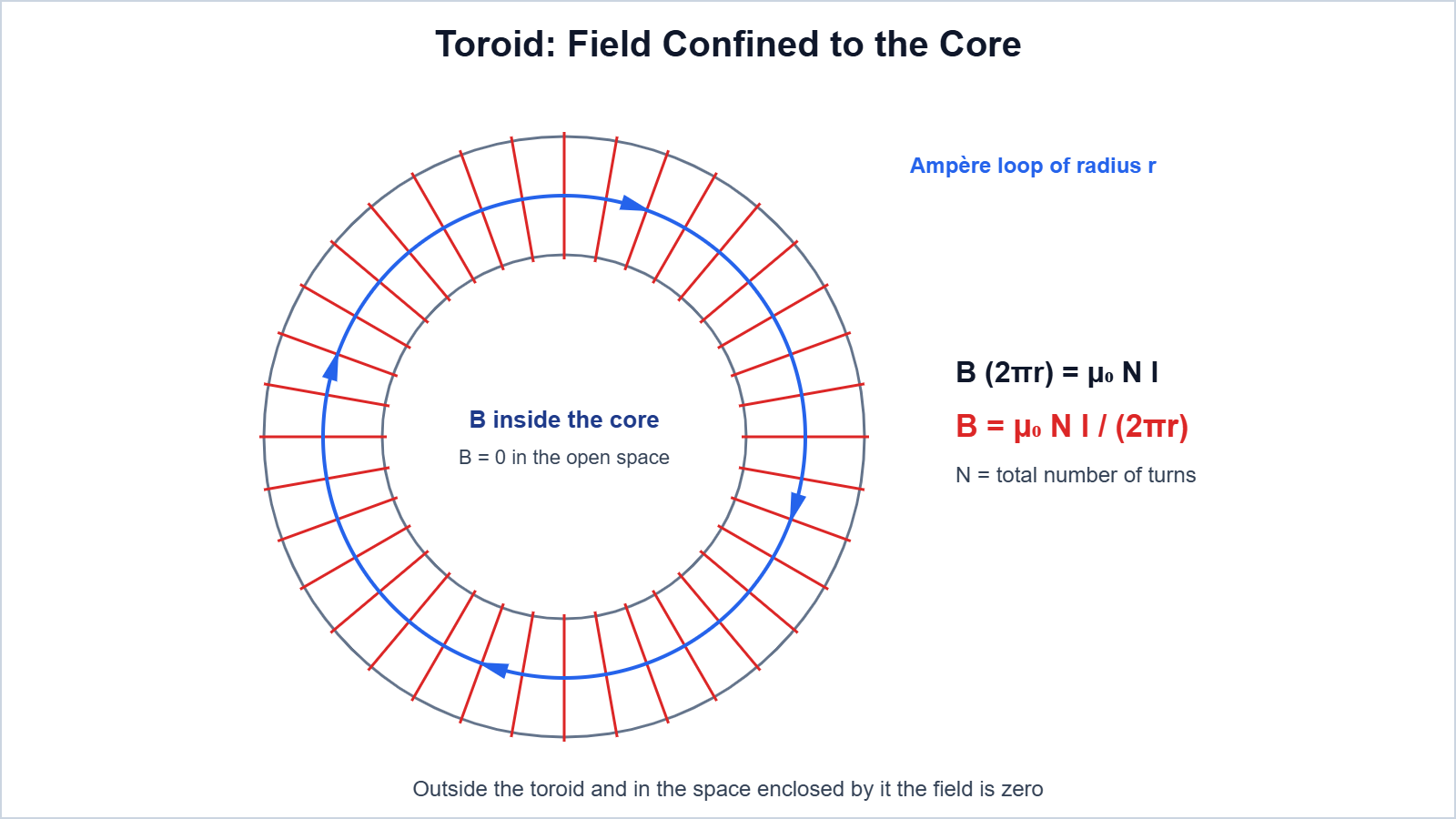
Toroid: applying Ampère’s law to a circle of radius r inside the core, B(2πr) = μ0NI, so B = μ0NI/2πr; the field is zero in the open space inside and outside the toroid.
Numerical 6: A toroid has 3000 turns and a mean radius of 15 cm. Find the field in its core for a current of 2 A.
Given: N = 3000, r = 0.15 m, I = 2 A
Formula: B = μ0NI/2πr
Solution: B = 2 × 10-7 × 3000 × 2 / 0.15
Answer: B = 8 × 10⁻³ T
5. Force between Two Parallel Currents
Wire 1 (current I1) produces B1 = μ0I1/2πd at wire 2. The force on length L of wire 2 is F = I2LB1, so F/L = μ0I1I2/2πd. Currents in the same direction attract; opposite currents repel.
Definition of the ampere: one ampere is the current which, flowing in two very long parallel straight conductors 1 m apart in vacuum, produces a force of 2 × 10⁻⁷ N per metre between them. (In the revised SI, the ampere is now fixed through the value of e, but this force relation still holds.)
Numerical 7: Two long parallel wires 10 cm apart carry 10 A and 5 A in the same direction. Find the force per metre.
Given: I1 = 10 A, I2 = 5 A, d = 0.10 m
Formula: F/L = μ0I1I2/2πd
Solution: F/L = 2 × 10-7 × 10 × 5 / 0.10
Answer: 1 × 10⁻⁴ N m-1, attractive
6. Torque on a Current Loop; Magnetic Dipole
A rectangular coil of N turns, area A, carrying current I in a uniform field B experiences zero net force but a torque τ = NIAB sinθ, where θ is the angle between the normal to the coil and B. In vector form τ = m × B, where m = NIA is the magnetic dipole moment (A m2), directed along the normal by the right-hand rule. A current loop therefore behaves like a magnetic dipole.
Numerical 8: A rectangular coil of 50 turns, size 4 cm × 5 cm, carries 2 A in a field of 0.2 T, with its plane parallel to the field. Find the torque.
Given: N = 50, A = 2 × 10⁻³ m2, I = 2 A, B = 0.2 T; plane parallel to B means θ = 90°
Formula: τ = NIAB sinθ
Solution: τ = 50 × 2 × 2 × 10-3 × 0.2 × 1
Answer: τ = 0.04 N m
7. Moving Coil Galvanometer

A coil on a soft-iron core is suspended in a radial magnetic field between concave pole pieces, so the plane of the coil is always parallel to B and the torque is NIAB at every position. A spring provides a restoring torque kφ. At equilibrium: NIAB = kφ, so φ = (NAB/k) I – the deflection is proportional to current (linear scale).
Current sensitivity = φ/I = NAB/k; voltage sensitivity = φ/V = NAB/(kG). Increasing N increases current sensitivity but also increases resistance G, so voltage sensitivity may not increase.
Conversion to an ammeter: connect a small resistance (shunt) S in parallel: IgG = (I − Ig)S, so S = IgG/(I − Ig). Conversion to a voltmeter: connect a high resistance R in series: V = Ig(G + R), so R = V/Ig − G.
Numerical 9: A galvanometer of resistance 50 Ω gives full-scale deflection for 5 mA. How can it be converted into (i) an ammeter of range 0-5 A, (ii) a voltmeter of range 0-10 V?
Given: G = 50 Ω, Ig = 5 × 10⁻³ A
Formula: S = IgG/(I − Ig); R = V/Ig − G
Solution: S = (0.005 × 50)/(5 − 0.005) = 0.25/4.995; R = 10/0.005 − 50 = 2000 − 50
Answer: (i) shunt ≈ 0.05 Ω in parallel; (ii) 1950 Ω in series
Easy Memory Trick: “Ammeter – Small Shunt Side by side; Voltmeter – Very big resistor in line”.
8. Practice Numericals (Answers Only)
- An electron moves at 106 m s-1 perpendicular to a 10-3 T field. Find the radius of its path. Ans: about 5.7 mm.
- Find B at the centre of a single circular loop of radius 5 cm carrying 1 A. Ans: 1.26 × 10⁻⁵ T.
- Find B at 2 m from a long wire carrying 50 A. Ans: 5 × 10⁻⁶ T.
- A coil of 20 turns and area 0.01 m2 carries 0.5 A. Find its magnetic moment. Ans: 0.1 A m2.
- Find the shunt needed to convert a 100 Ω, 1 mA galvanometer into an ammeter of range 1 A. Ans: about 0.1 Ω.
9. Board-pattern Practice Questions
(a) Multiple Choice Questions
1. The work done by a magnetic field on a moving charge is
(A) qvB (B) zero (C) qvB sinθ (D) negative
Ans. (B)
2. The period of revolution of a charge in a uniform magnetic field depends on
(A) speed (B) radius (C) q/m and B (D) kinetic energy
Ans. (C)
3. Two parallel wires carrying currents in opposite directions
(A) attract (B) repel (C) do not interact (D) rotate
Ans. (B)
4. A galvanometer is converted into a voltmeter by connecting
(A) low resistance in series (B) high resistance in series (C) low resistance in parallel (D) high resistance in parallel
Ans. (B)
(b) Assertion-Reason
Options: (A) Both A and R are true and R is the correct explanation of A. (B) Both A and R are true but R is not the correct explanation of A. (C) A is true but R is false. (D) A is false but R is true.
1. Assertion (A): A cyclotron cannot accelerate neutrons.
Reason (R): Neutrons are uncharged, so the electric and magnetic fields exert no force on them.
Ans. (A)
2. Assertion (A): The scale of a moving coil galvanometer is linear.
Reason (R): The radial field keeps the torque NIAB for all positions of the coil.
Ans. (A)
(c) Match the Columns
Column I | Column II |
|---|---|
(i) Long straight wire | (p) μ0nI |
(ii) Centre of a circular loop | (q) μ0NI/2πr |
(iii) Solenoid | (r) μ0I/2πr |
(iv) Toroid | (s) μ0I/2R |
Ans. (i)-(r), (ii)-(s), (iii)-(p), (iv)-(q)
(d) Case Study
Case: In a mass spectrometer, ions of the same charge and speed enter a uniform magnetic field perpendicular to their velocity. They move along semicircles and strike a photographic plate. Heavier ions land farther from the entry slit.
(i) Write the expression for the radius of the path.
Ans. r = mv/qB.
(ii) Why do heavier ions land farther away?
Ans. r is proportional to m for the same q, v and B.
(iii) Does the magnetic field change the speed of the ions?
Ans. No; the force is perpendicular to the velocity, so it does no work.
(iv) If B is doubled, what happens to the radius?
Ans. It becomes half.
(e) Long Answer Questions
Q1. Using the Biot-Savart law, derive the field on the axis of a circular current loop. Deduce the field at its centre.
Ans. See Section 3: B = μ0IR2/[2(x2 + R2)3/2]; at x = 0, B = μ0I/2R.
Q2. Explain the principle, construction and working of a cyclotron. Show that the cyclotron frequency is independent of the speed of the particle.
Ans. See Section 2: T = 2πm/qB, so f = qB/2πm, which does not depend on v or r.
10. Important Questions
Q1. Write the expression for the Lorentz force.
Ans. F = q(E + v × B).
Q2. When is the magnetic force on a moving charge zero?
Ans. When v is parallel or antiparallel to B, or the charge is at rest.
Q3. State Ampère’s circuital law.
Ans. ∮B · dl = μ0Ienclosed.
Q4. Define one tesla.
Ans. The field in which a charge of 1 C moving at 1 m s-1 perpendicular to it experiences a force of 1 N.
Q5. What is the magnetic moment of a current loop?
Ans. m = NIA, directed along the normal (right-hand rule).
Q6. Why is a radial field used in a galvanometer?
Ans. To make the torque independent of the coil’s orientation, giving a linear scale.
Q7. Why should an ammeter have low resistance?
Ans. So that inserting it in series does not change the circuit current appreciably.
Q8. What is the path of a charge entering a magnetic field at an angle other than 0° or 90°?
Ans. A helix.
Q9. Define current sensitivity.
Ans. Deflection per unit current: φ/I = NAB/k.
Q10. What is the field inside a toroid’s enclosed open space?
Ans. Zero.
Conclusion: Moving charges and currents produce magnetic fields (Biot-Savart and Ampère laws) and experience magnetic forces (Lorentz force). These ideas explain the cyclotron, forces between currents, torque on current loops and the moving coil galvanometer.