Current Electricity – Physics Class 12 Notes
Chapter – 3
Current Electricity
1. Electric Current
Electric current is the rate of flow of charge through a cross-section: I = dq/dt. SI unit: ampere (A) = C s-1. Conventional current flows in the direction of motion of positive charge (opposite to electron flow). Current is a scalar. Current density j = I/A (A m-2) is a vector.
2. Drift Velocity and Ohm’s Law
Free electrons in a metal move randomly with high speeds, so their average velocity is zero. When a field E is applied, they acquire a small average velocity opposite to E, called the drift velocity vd. Relaxation time τ is the average time between successive collisions.
Derivation: Drift velocity
- Acceleration of an electron: a = −eE/m.
- Velocity of the i-th electron after time ti since its last collision: vi = ui − eEti/m.
- Averaging over all electrons: the average of ui is zero and the average of ti is τ.
Result: vd = −eEτ/m; magnitude vd = eEτ/m. Mobility μ = vd/E = eτ/m (m2 V-1 s-1).
Derivation: Relation between current and drift velocity; Ohm’s law
- In time Δt, electrons within a length vdΔt of a conductor of area A cross a section. Number = nAvdΔt (n = free electrons per m3).
- Charge crossing = neAvdΔt, so I = neAvd.
- Substituting vd = eEτ/m: I = (ne2τ/m)AE. With E = V/l: I = (ne2τA/ml)V.
- Hence V = [ml/(ne2τA)] I = RI.
Result: Ohm’s law V = IR, with R = ρl/A and resistivity ρ = m/(ne2τ). Conductivity σ = 1/ρ; in vector form j = σE.
Numerical 1: A copper wire of cross-section 1.0 mm2 carries a current of 1.5 A. If n = 8.5 × 1028 m-3, find the drift speed of electrons.
Given: I = 1.5 A, A = 1.0 × 10⁻⁶ m2, n = 8.5 × 1028 m-3, e = 1.6 × 10⁻¹⁹ C
Formula: vd = I/(neA)
Solution: vd = 1.5 / (8.5 × 1028 × 1.6 × 10-19 × 10-6) = 1.5/13600
Answer: vd ≈ 1.1 × 10⁻⁴ m s-1 (very small; but the field that drives electrons is set up almost at the speed of light, so a bulb glows instantly)
3. Resistance and Resistivity
R = ρl/A. Resistance depends on length, area, material and temperature; resistivity ρ (Ω m) depends only on the material and temperature.

Ohmic conductors give a straight-line I-V graph through the origin. Non-ohmic devices (diode, filament lamp, thermistor) have non-linear graphs or depend on the sign of V.
Temperature dependence: for metals, ρT = ρ0[1 + α(T − T0)], where α is the temperature coefficient of resistivity (positive for metals, because τ decreases as collisions increase). For semiconductors α is negative (n increases with T). Alloys such as nichrome and manganin have very small α and high ρ, so they are used in heaters and standard resistors.
Numerical 2: Find the resistance of a copper wire 2 m long with cross-section 1 mm2. (ρ = 1.7 × 10⁻⁸ Ω m)
Given: l = 2 m, A = 1 × 10⁻⁶ m2, ρ = 1.7 × 10⁻⁸ Ω m
Formula: R = ρl/A
Solution: R = 1.7 × 10-8 × 2 / 10-6
Answer: R = 0.034 Ω
Numerical 3: A wire of resistance 5 Ω is stretched uniformly to double its length. Find its new resistance.
Given: l’ = 2l; volume constant, so A’ = A/2
Formula: R = ρl/A
Solution: R’ = ρ(2l)/(A/2) = 4ρl/A = 4R = 4 × 5
Answer: R’ = 20 Ω
Numerical 4: A wire has a resistance of 10 Ω at 20 °C. Find its resistance at 70 °C if α = 4 × 10⁻³ °C-1.
Given: R0 = 10 Ω, ΔT = 50 °C, α = 4 × 10⁻³ °C-1
Formula: R = R0(1 + αΔT)
Solution: R = 10(1 + 4 × 10-3 × 50) = 10 × 1.2
Answer: R = 12 Ω
4. Electrical Energy and Power
Power dissipated in a resistor: P = VI = I2R = V2/R (watt). Energy W = Pt; commercial unit 1 kWh = 3.6 × 10⁶ J. Power is transmitted at high voltage so that the current, and hence the I2R loss in the lines, is small.
Numerical 5: A bulb is rated 100 W, 220 V. Find its resistance and the current it draws.
Given: P = 100 W, V = 220 V
Formula: R = V2/P; I = P/V
Solution: R = 2202/100 = 48400/100; I = 100/220
Answer: R = 484 Ω; I ≈ 0.45 A
5. Cells, EMF and Internal Resistance
EMF ε of a cell is the potential difference between its terminals when no current is drawn. Internal resistance r is the resistance offered by the electrolyte. With an external resistance R: I = ε/(R + r) and terminal voltage V = ε − Ir (V < ε while discharging; V = ε + Ir while charging).
Numerical 6: A cell of EMF 2 V and internal resistance 0.5 Ω is connected to a 3.5 Ω resistor. Find the current and the terminal voltage.
Given: ε = 2 V, r = 0.5 Ω, R = 3.5 Ω
Formula: I = ε/(R + r); V = ε − Ir
Solution: I = 2/4 = 0.5 A; V = 2 − 0.5 × 0.5
Answer: I = 0.5 A; V = 1.75 V

Derivation: Cells in series
- Two cells (ε1, r1) and (ε2, r2) carry the same current I.
- VAB = ε1 − Ir1, VBC = ε2 − Ir2; VAC = (ε1 + ε2) − I(r1 + r2).
Result: εeq = ε1 + ε2; req = r1 + r2 (if one cell is reversed, εeq = ε1 − ε2).
Derivation: Cells in parallel
- Same terminal voltage V across both: I1 = (ε1 − V)/r1, I2 = (ε2 − V)/r2.
- I = I1 + I2 = (ε1/r1 + ε2/r2) − V(1/r1 + 1/r2).
- Compare with V = εeq − Ireq.
Result: 1/req = 1/r1 + 1/r2; εeq = (ε1r2 + ε2r1)/(r1 + r2)
Numerical 7: Cells of (2 V, 1 Ω) and (1.5 V, 0.5 Ω) are connected in parallel (like terminals together). Find the equivalent EMF and internal resistance.
Given: ε1 = 2 V, r1 = 1 Ω, ε2 = 1.5 V, r2 = 0.5 Ω
Formula: εeq = (ε1r2 + ε2r1)/(r1 + r2); req = r1r2/(r1 + r2)
Solution: εeq = (2 × 0.5 + 1.5 × 1)/1.5 = 2.5/1.5; req = 0.5/1.5
Answer: εeq ≈ 1.67 V; req ≈ 0.33 Ω
6. Kirchhoff’s Rules
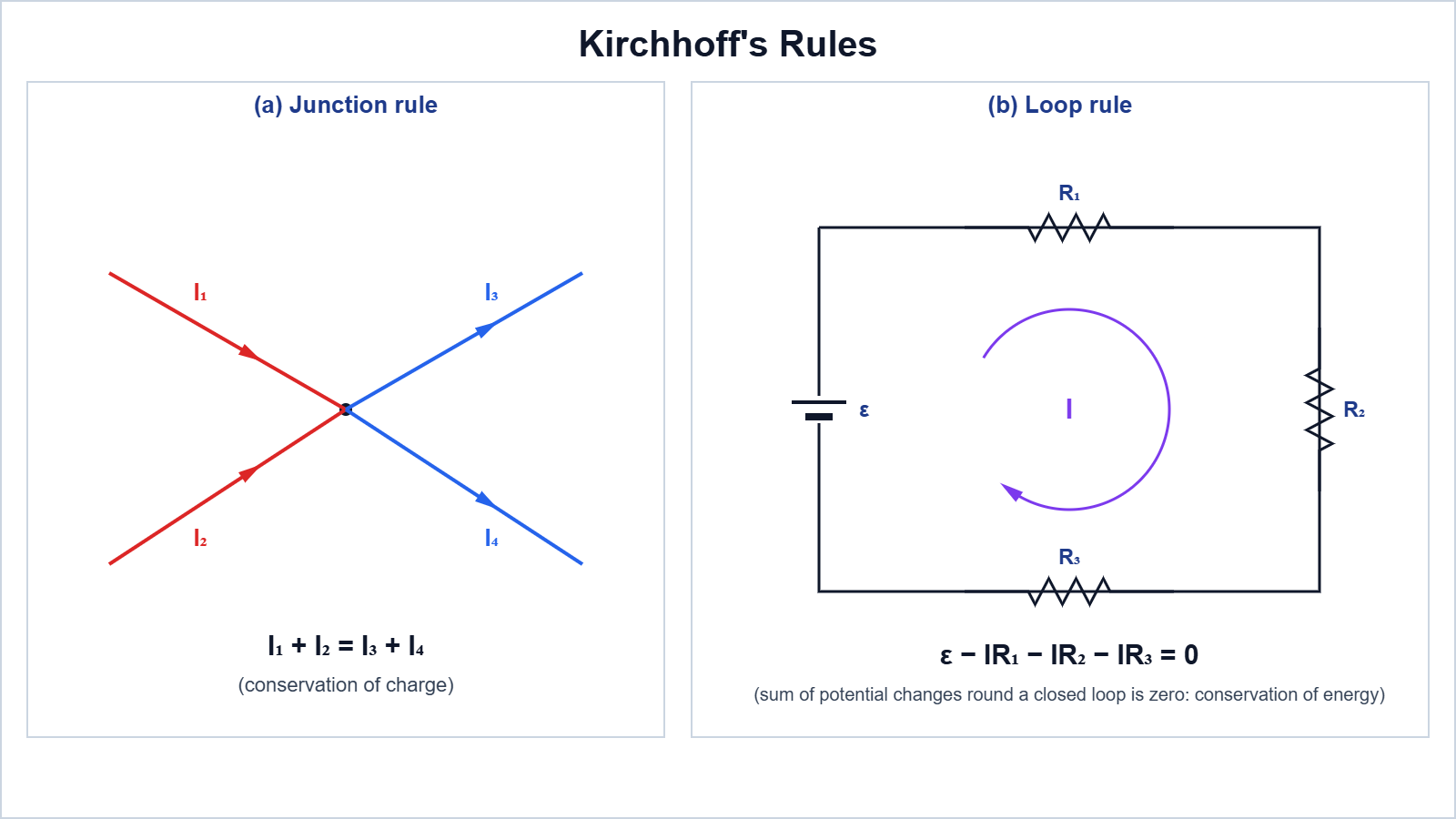
Junction rule (KCL): the sum of currents entering a junction equals the sum leaving it (conservation of charge). Loop rule (KVL): the algebraic sum of changes in potential around any closed loop is zero (conservation of energy).
Sign convention: Going through a resistor in the direction of current: −IR; against the current: +IR. Going through a cell from − to +: +ε; from + to −: −ε.
Numerical 8: Three branches join two nodes A (top) and B (bottom). Branch 1: a 10 V cell (positive terminal towards A) in series with 2 Ω. Branch 2: a 4 Ω resistor. Branch 3: a 5 V cell (positive terminal towards A) in series with 1 Ω. Find the current in each branch.
Given: Let V = VA − VB; currents I1, I3 flow up through the cells and I2 down through 4 Ω
Formula: KCL: I1 + I3 = I2; branch equations: I1 = (10 − V)/2, I3 = (5 − V)/1, I2 = V/4
Solution: (10 − V)/2 + (5 − V) = V/4. Multiply by 4: 20 − 2V + 20 − 4V = V, so V = 40/7 V. Then I1 = 15/7 A, I3 = −5/7 A, I2 = 10/7 A
Answer: I1 ≈ 2.14 A (up), I2 ≈ 1.43 A (down through 4 Ω), I3 ≈ 0.71 A flowing downward through the 5 V cell (it is being charged). Check: 2.14 − 0.71 = 1.43 A.
7. Wheatstone Bridge

Derivation: Balance condition
- Four resistors P, Q, R, S form a quadrilateral ABCD; a cell is connected across AC and a galvanometer across BD.
- At balance, Ig = 0, so P and Q carry the same current I1, and R and S carry the same current I2.
- Loop ABDA: −I1P + I2R = 0 (since Ig = 0), so I1P = I2R.
- Loop BCDB: −I1Q + I2S = 0, so I1Q = I2S.
- Dividing: P/Q = R/S.
Result: P/Q = R/S (balanced Wheatstone bridge). The balance point does not depend on the EMF of the cell.
Numerical 9: In a balanced Wheatstone bridge P = 10 Ω, Q = 20 Ω and R = 15 Ω. Find S.
Given: P = 10 Ω, Q = 20 Ω, R = 15 Ω
Formula: P/Q = R/S
Solution: S = RQ/P = 15 × 20/10
Answer: S = 30 Ω
8. Metre Bridge

A metre bridge is a practical Wheatstone bridge using a 1 m uniform wire. If the balance point is at length l from end A, the wire segments act as P and Q with P/Q = l/(100 − l). So R/S = l/(100 − l) and R = S l/(100 − l). Best accuracy is obtained when the balance point is near the middle of the wire. Resistivity can then be found from ρ = RA/L.
Numerical 10: In a metre bridge, the null point is at 40 cm from end A when an unknown resistance R is in the left gap and S = 10 Ω is in the right gap. Find R.
Given: l = 40 cm, S = 10 Ω
Formula: R = S l/(100 − l)
Solution: R = 10 × 40/60
Answer: R ≈ 6.67 Ω
Easy Memory Trick: “KCL counts Charge, KVL counts Volts”: the junction rule conserves charge, the loop rule conserves energy.
9. Practice Numericals (Answers Only)
- How many electrons pass a point per second when a current of 1 A flows? Ans: 6.25 × 10¹⁸.
- A wire 1 m long with area 0.5 mm2 has a resistance of 2 Ω. Find its resistivity. Ans: 1 × 10⁻⁶ Ω m.
- Find the equivalent of 2 Ω, 3 Ω and 6 Ω in parallel. Ans: 1 Ω.
- A 1 kW heater runs for 2 h. Find the energy used. Ans: 2 kWh = 7.2 × 10⁶ J.
- In a metre bridge with S = 12 Ω, the balance point is at 60 cm. Find R. Ans: 18 Ω.
10. Board-pattern Practice Questions
(a) Multiple Choice Questions
1. Resistivity of a metal
(A) decreases with temperature (B) increases with temperature (C) is independent of temperature (D) depends on length
Ans. (B)
2. Kirchhoff’s junction rule is based on conservation of
(A) energy (B) momentum (C) charge (D) mass
Ans. (C)
3. Mobility of electrons is
(A) eτ/m (B) m/eτ (C) eEτ/m (D) neτ
Ans. (A)
4. A wire is stretched to three times its length. Its resistance becomes
(A) 3R (B) R/3 (C) 9R (D) 6R
Ans. (C)
(b) Assertion-Reason
Options: (A) Both A and R are true and R is the correct explanation of A. (B) Both A and R are true but R is not the correct explanation of A. (C) A is true but R is false. (D) A is false but R is true.
1. Assertion (A): A bulb glows almost immediately when switched on although the drift speed is very small.
Reason (R): The electric field is set up in the whole circuit almost instantly, so all free electrons start drifting at once.
Ans. (A)
2. Assertion (A): The terminal voltage of a cell is always less than its EMF.
Reason (R): Some potential drop occurs across the internal resistance when current is drawn.
Ans. (D) (While a cell is being charged, V = ε + Ir, which is greater than ε, so A is false; R is true.)
(c) Match the Columns
Column I | Column II |
|---|---|
(i) Drift velocity | (p) m/(ne2τ) |
(ii) Resistivity | (q) eEτ/m |
(iii) Current | (r) ε/(R + r) |
(iv) Circuit current with a cell | (s) neAvd |
Ans. (i)-(q), (ii)-(p), (iii)-(s), (iv)-(r)
(d) Case Study
Case: Electric heaters and toasters use nichrome coils. Nichrome has a high resistivity and a very small temperature coefficient, and does not oxidise easily when red hot. Household wiring, on the other hand, uses copper.
(i) Why is nichrome used for heating elements?
Ans. High resistivity gives large heating (I2R) in a short coil; it does not oxidise at high temperature.
(ii) Why is copper used for connecting wires?
Ans. Its low resistivity keeps the heating and voltage drop in the wires small.
(iii) A 1100 W heater works on 220 V. Find the current.
Ans. I = P/V = 1100/220 = 5 A.
(iv) What happens to the power if the supply voltage falls to 110 V (assume R constant)?
Ans. P = V2/R becomes one-fourth, i.e. 275 W.
(e) Long Answer Questions
Q1. Define drift velocity. Derive the relation I = neAvd and hence deduce Ohm’s law.
Ans. See Section 2: vd = eEτ/m; I = neAvd; V = (ml/ne2τA)I = IR.
Q2. State Kirchhoff’s rules. Use them to obtain the balance condition of a Wheatstone bridge.
Ans. KCL and KVL as in Section 6; applying KVL to loops ABDA and BCDB with Ig = 0 gives P/Q = R/S.
11. Important Questions
Q1. Define relaxation time.
Ans. The average time between two successive collisions of a free electron.
Q2. How does drift velocity change if the length of a wire is doubled at the same potential difference?
Ans. It becomes half (E = V/l halves).
Q3. Why do semiconductors have a negative temperature coefficient of resistivity?
Ans. The number of charge carriers increases rapidly with temperature.
Q4. State the condition for maximum current from a combination of identical cells.
Ans. Series if R ≫ r; parallel if R ≪ r.
Q5. Why is the metre bridge most sensitive near the middle?
Ans. The percentage error in measuring l and (100 − l) is then least.
Q6. What is the SI unit of conductivity?
Ans. S m-1 (siemens per metre).
Q7. Why is power transmitted at high voltage?
Ans. For the same power the current is lower, so I2R losses are smaller.
Q8. Write the expression for current density in terms of conductivity.
Ans. j = σE.
Q9. Can the terminal voltage of a cell be greater than its EMF?
Ans. Yes, while the cell is being charged: V = ε + Ir.
Q10. Name two non-ohmic devices.
Ans. Semiconductor diode and filament lamp (also thermistor).
Conclusion: Current in conductors arises from the slow drift of free electrons, which leads to Ohm’s law and the idea of resistivity. Kirchhoff’s rules solve any network, and the Wheatstone and metre bridges use a balance condition for accurate measurement of resistance.