Wave Optics – Physics Class 12 Notes
Chapter – 10
Wave Optics
1. Wavefront and Huygens’ Principle
A wavefront is a surface of constant phase. Rays are perpendicular to wavefronts. A point source gives spherical wavefronts; a line source gives cylindrical wavefronts; a distant source gives plane wavefronts.
Huygens’ principle: (i) every point on a wavefront acts as a source of secondary wavelets that spread out with the speed of the wave; (ii) the new wavefront at a later time is the forward envelope (common tangent) of these wavelets.
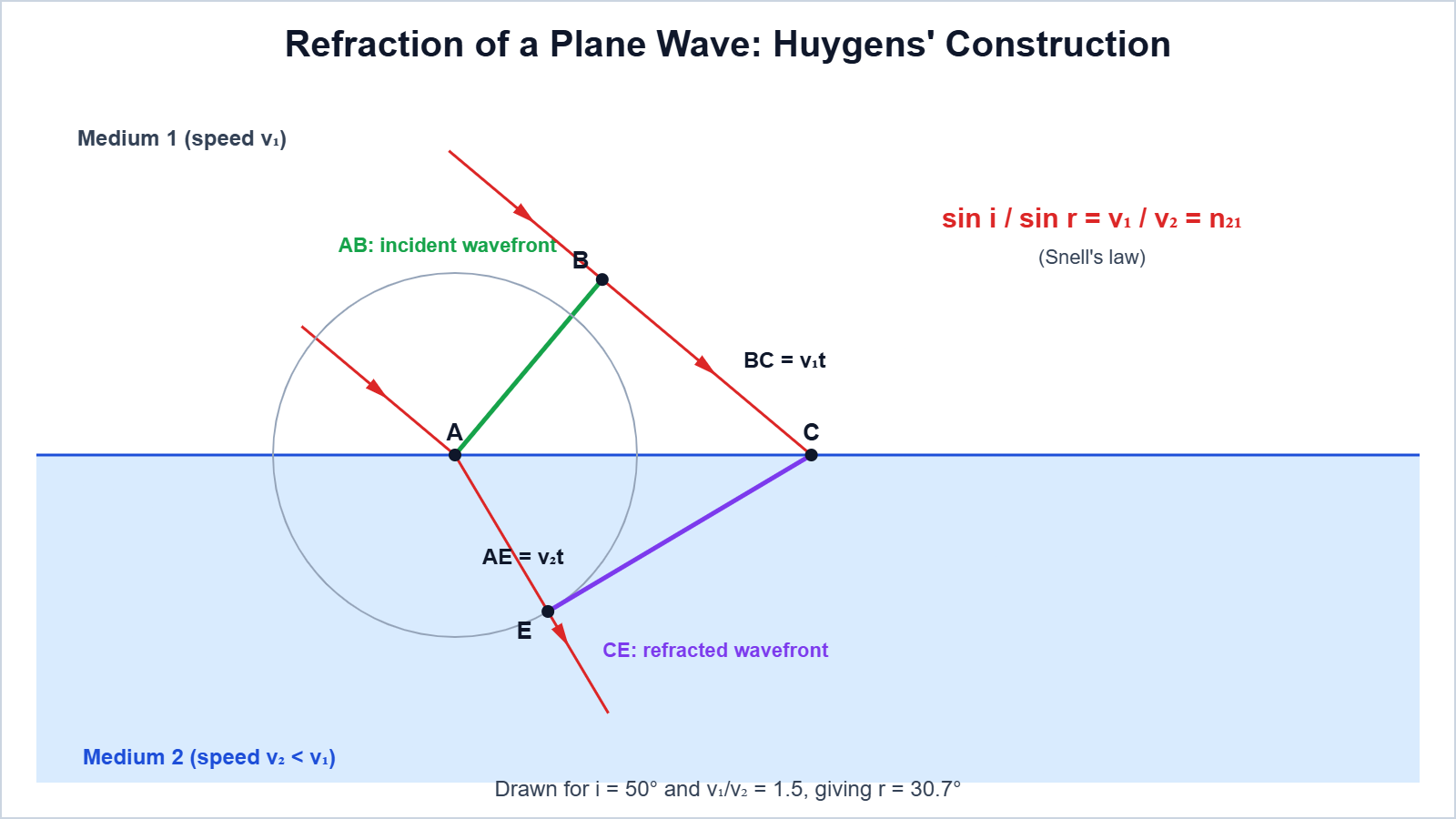
Derivation: Snell’s law from Huygens’ principle (refraction)
- A plane wavefront AB meets the boundary at A at angle i. While the disturbance from B travels to C in medium 1 (BC = v1t), the wavelet from A spreads into medium 2 with radius AE = v2t.
- The refracted wavefront CE is the tangent from C to this wavelet; it makes angle r with the boundary.
- In triangle ABC: sin i = BC/AC = v1t/AC. In triangle AEC: sin r = AE/AC = v2t/AC.
- Dividing: sin i/sin r = v1/v2.
Result: sin i/sin r = v1/v2 = n2/n1 (Snell’s law), with n = c/v. The frequency stays the same, so λ2 = λ1v2/v1: light has a shorter wavelength in a denser medium. A similar construction for reflection gives i = r.
Numerical 1: Light of wavelength 600 nm in air enters glass of refractive index 1.5. Find its wavelength and speed in glass.
Given: λ = 600 nm, n = 1.5, c = 3 × 10⁸ m s-1
Formula: λ’ = λ/n; v = c/n
Solution: λ’ = 600/1.5; v = 3 × 10⁸/1.5
Answer: λ’ = 400 nm; v = 2 × 10⁸ m s-1 (frequency unchanged)
2. Interference and Coherent Sources
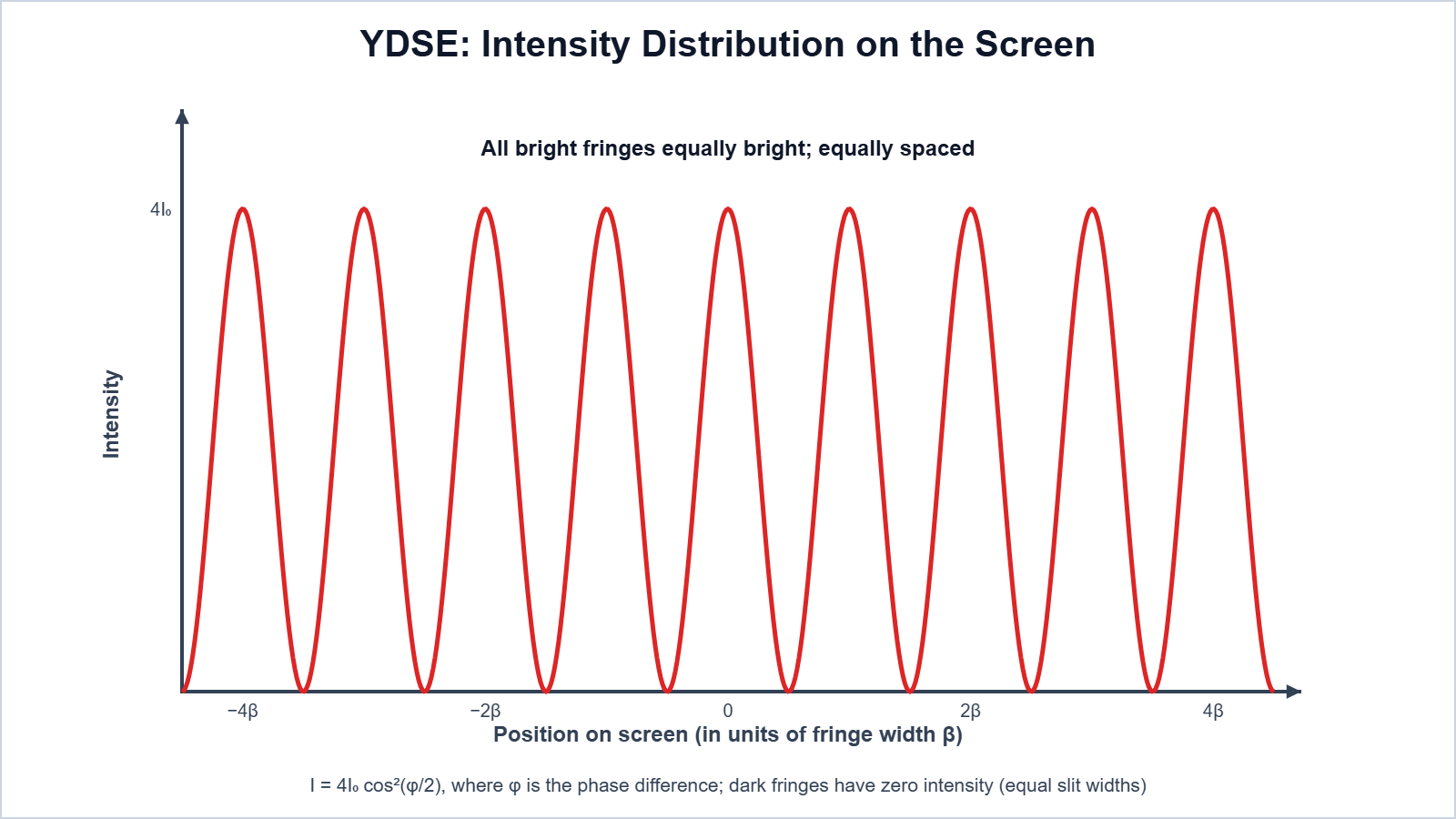
When two waves overlap, the resultant displacement is the sum of individual displacements (superposition). For two waves of equal amplitude, phase difference φ gives resultant intensity I = 4I0 cos2(φ/2): constructive interference (I = 4I0) when φ = 0, 2π, 4π … (path difference nλ) and destructive interference (I = 0) when φ = π, 3π … (path difference (n + ½)λ).
Coherent sources have a constant phase difference. Two independent bulbs are incoherent because the phase of light from each changes randomly about 108 times a second, so the pattern averages out to uniform illumination. In Young’s experiment, coherence is obtained by deriving two sources from a single slit.
3. Young’s Double Slit Experiment

Derivation: Fringe width
- Slits S1 and S2 are separated by d; the screen is at distance D (D ≫ d). Point P is at height y from the central point O.
- (S2P)2 − (S1P)2 = [D2 + (y + d/2)2] − [D2 + (y − d/2)2] = 2yd.
- Since S2P + S1P ≈ 2D, the path difference S2P − S1P = yd/D.
- Bright fringe: yd/D = nλ, so yn = nλD/d. Dark fringe: yd/D = (n − ½)λ, so yn = (2n − 1)λD/2d.
- Distance between consecutive bright (or dark) fringes: β = yn+1 − yn.
Result: Fringe width β = λD/d. Bright and dark fringes are equally spaced. Angular fringe width θ = λ/d.
Numerical 2: In Young’s experiment the slits are 0.5 mm apart and the screen is 1 m away. For light of wavelength 600 nm, find the fringe width.
Given: d = 0.5 × 10⁻³ m, D = 1 m, λ = 600 × 10-9 m
Formula: β = λD/d
Solution: β = 600 × 10-9 × 1/(0.5 × 10-3)
Answer: β = 1.2 × 10⁻³ m = 1.2 mm
Numerical 3: For the arrangement in Numerical 2, find the distance of (i) the third bright fringe and (ii) the second dark fringe from the central maximum.
Given: β = 1.2 mm
Formula: yn(bright) = nβ; yn(dark) = (2n − 1)β/2
Solution: (i) y = 3 × 1.2; (ii) y = (3/2) × 1.2
Answer: (i) 3.6 mm; (ii) 1.8 mm
Numerical 4: The whole apparatus of Numerical 2 is immersed in water (n = 4/3). Find the new fringe width.
Given: β = 1.2 mm, n = 4/3
Formula: β’ = λ’D/d = β/n
Solution: β’ = 1.2/(4/3) = 1.2 × 3/4
Answer: β’ = 0.9 mm (fringes come closer)
Numerical 5: Two coherent waves have amplitudes in the ratio 3 : 1. Find the ratio of maximum to minimum intensity in the interference pattern.
Given: a1 : a2 = 3 : 1; I ∝ a2
Formula: Imax/Imin = (a1 + a2)2/(a1 − a2)2
Solution: (3 + 1)2/(3 − 1)2 = 16/4
Answer: 4 : 1
4. Diffraction at a Single Slit
Diffraction is the bending of light around the edges of an obstacle or aperture whose size is comparable to the wavelength. For a single slit of width a illuminated by a plane wavefront, the pattern on a distant screen has a bright central maximum with weaker secondary maxima on both sides.

Derivation: Positions of minima and maxima
- Divide the slit into two halves. For a direction θ with a sinθ = λ, each point in the upper half has a partner in the lower half (a/2 away) with path difference λ/2, so their contributions cancel: first minimum.
- In general, minima occur at a sinθ = nλ (n = ±1, ±2, …); for small angles θ = nλ/a.
- Secondary maxima occur approximately at θ = (n + ½)λ/a; their intensity falls rapidly with n.
- Angular width of the central maximum = 2λ/a; its linear width on a screen at distance D is 2λD/a.
Result: The central maximum is twice as wide as the other maxima. Diffraction becomes noticeable only when a is comparable to λ; this limits the sharpness of images formed by optical instruments.
Numerical 6: A single slit of width 0.2 mm is illuminated by light of wavelength 500 nm. Find the width of the central maximum on a screen 1.5 m away.
Given: a = 0.2 × 10⁻³ m, λ = 500 × 10-9 m, D = 1.5 m
Formula: Width = 2λD/a
Solution: Width = 2 × 500 × 10-9 × 1.5/(0.2 × 10-3) = 7.5 × 10⁻³ m
Answer: 7.5 mm
Interference | Diffraction |
|---|---|
Superposition of waves from two coherent sources | Superposition of wavelets from different parts of the same wavefront |
Fringes of equal width | Central maximum twice as wide as others |
All bright fringes of equal intensity | Intensity of maxima falls rapidly |
Dark fringes completely dark (equal amplitudes) | Minima not perfectly dark in practice |
5. Polarisation
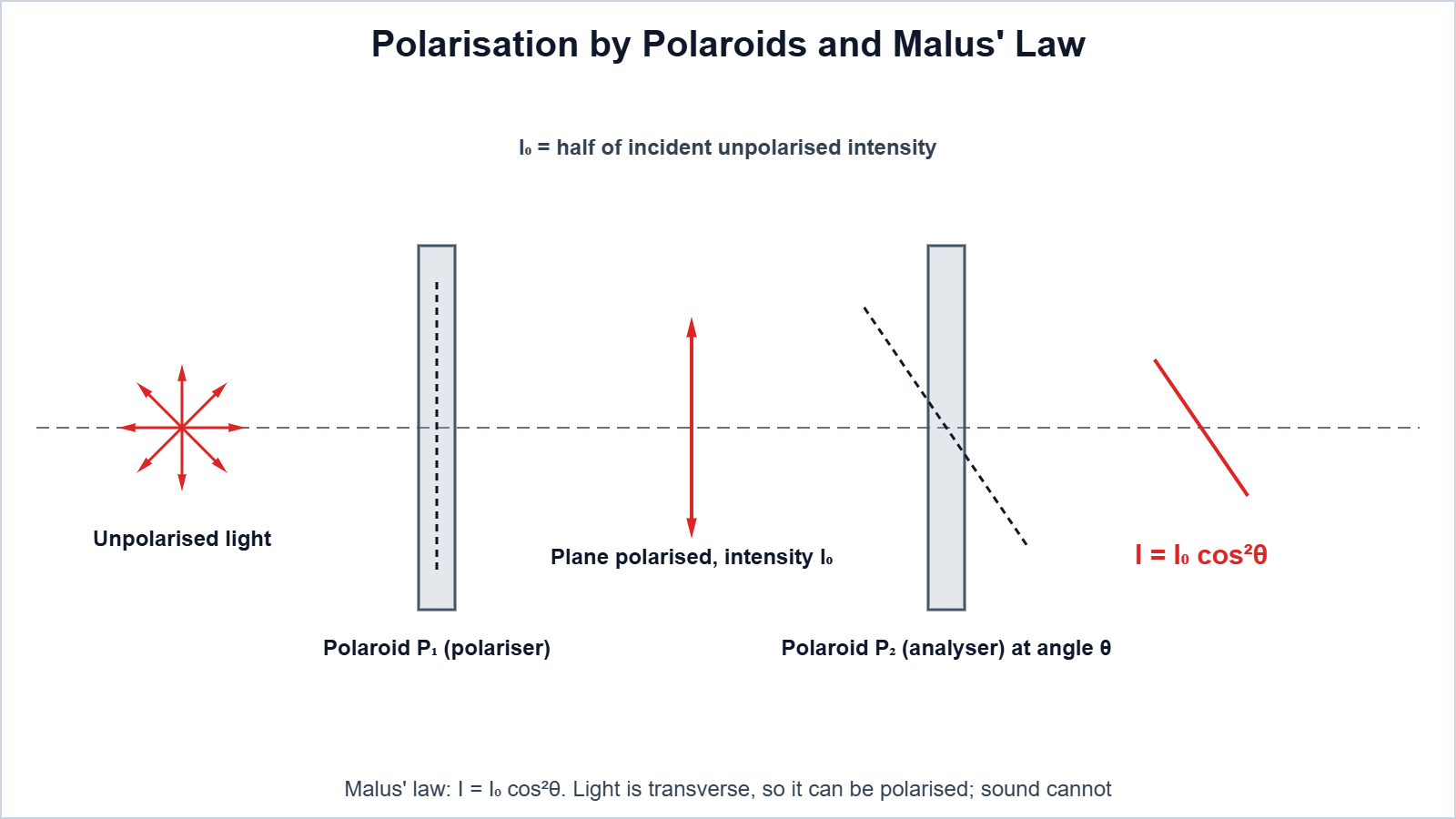
Light is a transverse wave, so its electric field can vibrate in many directions perpendicular to the direction of propagation. In unpolarised light (from ordinary sources) the vibrations occur in all such directions; in plane polarised light they are confined to one direction. A polaroid allows only the component of E along its pass axis. Unpolarised light of intensity I passing through a polaroid emerges plane polarised with intensity I/2.
Malus’ law: when plane polarised light of intensity I0 passes through an analyser whose axis makes angle θ with the plane of polarisation, the transmitted intensity is I = I0 cos2θ. When two polaroids are crossed (θ = 90°), no light passes.
Polarisation by reflection (Brewster’s law): when light is incident at the angle iB for which tan iB = n, the reflected light is completely plane polarised and the reflected and refracted rays are perpendicular. Uses of polaroids: sunglasses that cut glare, camera filters, 3-D movie glasses.
Numerical 7: Unpolarised light of intensity 32 W m-2 passes through a polariser and then an analyser whose axis is at 60° to the polariser axis. Find the intensity of the light emerging from the analyser.
Given: I = 32 W m-2, θ = 60°
Formula: After polariser: I0 = I/2; after analyser: I0 cos2θ
Solution: I0 = 16 W m-2; I’ = 16 × (0.5)2
Answer: I’ = 4 W m-2
Numerical 8: Find the Brewster angle for glass of refractive index 1.5.
Given: n = 1.5
Formula: tan iB = n
Solution: iB = tan-1(1.5)
Answer: iB ≈ 56.3°
Easy Memory Trick: “β = λD/d – Bigger Distance, Bigger fringes; bigger d, Dwarf fringes”.
6. Practice Numericals (Answers Only)
- Find β for λ = 500 nm, d = 1 mm, D = 2 m. Ans: 1 mm.
- How does the fringe width change if the slit separation is halved? Ans: It doubles.
- Light of 600 nm falls on a slit of width 1.2 μm. Find the angle of the first minimum. Ans: 30°.
- What is the intensity transmitted through two crossed polaroids? Ans: Zero.
- Find the speed of light in a medium of n = 2. Ans: 1.5 × 10⁸ m s-1.
7. Board-pattern Practice Questions
(a) Multiple Choice Questions
1. The shape of the wavefront from a distant star is
(A) spherical (B) cylindrical (C) plane (D) elliptical
Ans. (C)
2. In YDSE, if the wavelength is increased, the fringe width
(A) decreases (B) increases (C) remains same (D) becomes zero
Ans. (B)
3. The width of the central maximum in single-slit diffraction is
(A) λD/a (B) 2λD/a (C) λD/2a (D) 4λD/a
Ans. (B)
4. Polarisation shows that light waves are
(A) longitudinal (B) transverse (C) stationary (D) mechanical
Ans. (B)
(b) Assertion-Reason
Options: (A) Both A and R are true and R is the correct explanation of A. (B) Both A and R are true but R is not the correct explanation of A. (C) A is true but R is false. (D) A is false but R is true.
1. Assertion (A): Two independent sodium lamps do not produce a sustained interference pattern.
Reason (R): Light from them is not coherent.
Ans. (A)
2. Assertion (A): Sound waves cannot be polarised.
Reason (R): Sound waves in air are longitudinal.
Ans. (A)
(c) Match the Columns
Column I | Column II |
|---|---|
(i) Fringe width | (p) I0 cos2θ |
(ii) First minimum (single slit) | (q) λD/d |
(iii) Malus’ law | (r) tan iB = n |
(iv) Brewster’s law | (s) a sinθ = λ |
Ans. (i)-(q), (ii)-(s), (iii)-(p), (iv)-(r)
(d) Case Study
Case: Sunglasses with polaroid lenses greatly reduce glare from roads, water and car windscreens. Light reflected from such horizontal surfaces is largely polarised with its electric field horizontal, and the lenses are made with their pass axis vertical.
(i) Why does a polaroid cut down glare?
Ans. The reflected light is partly polarised horizontally, and the vertical pass axis blocks this component.
(ii) What fraction of unpolarised light passes through one ideal polaroid?
Ans. One half.
(iii) If two such lenses are held one behind the other and one is rotated by 90°, what is seen?
Ans. Darkness, as the polaroids are crossed.
(iv) At what angle is light reflected from water (n = 4/3) completely polarised?
Ans. tan iB = 4/3, so iB ≈ 53.1°.
(e) Long Answer Questions
Q1. State Huygens’ principle. Using it, prove Snell’s law of refraction.
Ans. See Section 1.
Q2. Describe Young’s double slit experiment and derive the expression for fringe width. What happens to the pattern if (i) the source is replaced by white light, (ii) one slit is covered?
Ans. See Section 3: β = λD/d. (i) The central fringe is white and the others are coloured; (ii) the interference pattern disappears and only the single-slit diffraction pattern remains.
8. Important Questions
Q1. Define a wavefront.
Ans. The locus of points vibrating in the same phase.
Q2. What are coherent sources?
Ans. Sources with a constant phase difference and the same frequency.
Q3. Write the condition for constructive interference.
Ans. Path difference = nλ.
Q4. How does fringe width change if D is doubled?
Ans. It doubles.
Q5. What is the angular width of the central maximum in single-slit diffraction?
Ans. 2λ/a.
Q6. What is diffraction?
Ans. Bending of waves around obstacles or apertures comparable to the wavelength.
Q7. State Malus’ law.
Ans. I = I0 cos2θ.
Q8. What is Brewster’s angle?
Ans. The angle of incidence for which reflected light is completely polarised; tan iB = n.
Q9. Does frequency change on refraction?
Ans. No; speed and wavelength change.
Q10. Give two uses of polaroids.
Ans. Sunglasses; 3-D movie glasses (also camera filters).
Conclusion: Treating light as a wave explains refraction (Huygens), interference (Young’s experiment), diffraction and polarisation. Polarisation confirms that light is a transverse wave.