Electrostatic Potential and Capacitance – Physics Class 12 Notes
Chapter – 2
Electrostatic Potential and Capacitance
1. Electrostatic Potential
The electrostatic force is conservative: work done in moving a charge between two points does not depend on the path. Potential difference VB − VA = WAB/q, where WAB is the work done by an external agent in moving charge q slowly from A to B. Electrostatic potential at a point is the work done in bringing a unit positive charge from infinity to that point. Unit: volt (V) = J C-1. It is a scalar.
Derivation: Potential due to a point charge
- Bring a unit positive charge from infinity to point P at distance r from charge q along the radial line.
- At distance x, the force on the unit charge is kq/x2 (outward). The external force needed is −kq/x2.
- Work done W = −∫∞r (kq/x2) dx = kq/r.
Result: V = kq/r = q/4πε0r. V is positive for a positive charge and negative for a negative charge; V → 0 as r → ∞.
Derivation: Potential due to an electric dipole
- Consider point P at distance r from the centre, with OP making angle θ with p.
- Distances from +q and −q are approximately r − a cosθ and r + a cosθ (for r ≫ a).
- V = kq/(r − a cosθ) − kq/(r + a cosθ) = kq × 2a cosθ/(r2 − a2cos2θ).
- For r ≫ a: V = kp cosθ/r2.
Result: V = kp cosθ/r2: on the axis (θ = 0) V = kp/r2; on the equatorial line (θ = 90°) V = 0. A dipole potential falls as 1/r2.
Potential due to a system of charges: V = k(q1/r1 + q2/r2 + … ) (scalar sum). For a charged spherical shell: V = kq/r outside and V = kq/R (constant) everywhere inside.
Numerical 1: Find the potential at a point 9 cm from a charge of 4 nC.
Given: q = 4 × 10⁻⁹ C, r = 0.09 m
Formula: V = kq/r
Solution: V = 9 × 109 × 4 × 10-9 / 0.09 = 36/0.09
Answer: V = 400 V
Numerical 2: How much work is done in moving a charge of 2 μC from a point at 100 V to a point at 300 V?
Given: q = 2 × 10⁻⁶ C, VA = 100 V, VB = 300 V
Formula: W = q(VB − VA)
Solution: W = 2 × 10-6 × 200
Answer: W = 4 × 10⁻⁴ J
2. Equipotential Surfaces
A surface on which the potential is the same at every point is an equipotential surface.

- No work is done in moving a charge on an equipotential surface.
- The electric field is always normal to the equipotential surface.
- Two equipotential surfaces never intersect.
- For a point charge they are concentric spheres; for a uniform field they are parallel planes perpendicular to the field.
Relation between field and potential: E = −dV/dr. The field points in the direction in which potential decreases most steeply; its magnitude is the potential gradient. For a uniform field, E = V/d.
Numerical 3: The potential changes uniformly by 50 V over a distance of 2 mm along the field. Find the field strength.
Given: ΔV = 50 V, Δr = 2 × 10⁻³ m
Formula: E = ΔV/Δr
Solution: E = 50 / 0.002
Answer: E = 2.5 × 10⁴ V m-1
3. Potential Energy
Two charges: the potential energy of a system is the work done in assembling it from infinity: U = kq1q2/r12. For three charges, U = k(q1q2/r12 + q2q3/r23 + q1q3/r13).
A charge in an external field: U = qV(r).
Derivation: Potential energy of a dipole in a uniform field
- Torque on the dipole is τ = pE sinθ.
- Work done in rotating it slowly from θ0 to θ1: W = ∫ pE sinθ dθ = pE(cosθ0 − cosθ1).
- Taking θ0 = 90° as the zero of energy: U(θ) = −pE cosθ.
Result: U = −p · E. Minimum (−pE) at θ = 0° (stable), maximum (+pE) at θ = 180° (unstable). Work to rotate from 0° to 180° = 2pE.
Numerical 4: Find the potential energy of a system of charges +3 μC and −2 μC placed 20 cm apart.
Given: q1 = 3 × 10⁻⁶ C, q2 = −2 × 10⁻⁶ C, r = 0.20 m
Formula: U = kq1q2/r
Solution: U = 9 × 109 × 3 × 10-6 × (−2 × 10⁻⁶) / 0.20 = −0.054/0.20
Answer: U = −0.27 J (negative: the charges attract)
Numerical 5: A dipole of moment 2 × 10⁻⁹ C m is in a uniform field of 1 × 10⁴ N C-1. How much work is needed to turn it from the stable position to the unstable position?
Given: p = 2 × 10⁻⁹ C m, E = 1 × 10⁴ N C-1, θ: 0° → 180°
Formula: W = pE(cos0° − cos180°) = 2pE
Solution: W = 2 × 2 × 10-9 × 104
Answer: W = 4 × 10⁻⁵ J
4. Conductors and Dielectrics
- Inside a conductor in electrostatic equilibrium E = 0, and the whole conductor (interior and surface) is at the same potential.
- Excess charge resides only on the outer surface; E just outside is σ/ε0, normal to the surface.
- Electrostatic shielding: the field inside a cavity of a conductor is zero, which is why sensitive instruments are kept in metal enclosures and why a car is a safe place during lightning.
Dielectrics are insulators that get polarised in an external field. In a polar dielectric (e.g. water) molecules have permanent dipoles that tend to align; in a non-polar dielectric (e.g. H2, CO2) dipoles are induced. Polarisation reduces the field inside the dielectric. Dielectric constant K = ε0r = C (with dielectric)/C0 (vacuum) = E0/E.
5. Capacitors
A capacitor is a system of two conductors separated by an insulator, used to store charge and energy. Capacitance C = Q/V. Unit: farad (F) = C V-1; practical units μF (10-6 F) and pF (10-12 F).
Derivation: Capacitance of a parallel plate capacitor
- Plates of area A carry +Q and −Q, with surface charge density σ = Q/A, separated by distance d (small compared with plate size).
- Between the plates, the fields of the two sheets add: E = σ/2ε0 + σ/2ε0 = σ/ε0 = Q/ε0A. Outside, they cancel.
- Potential difference V = Ed = Qd/ε0A.
- C = Q/V.
Result: C = ε0A/d
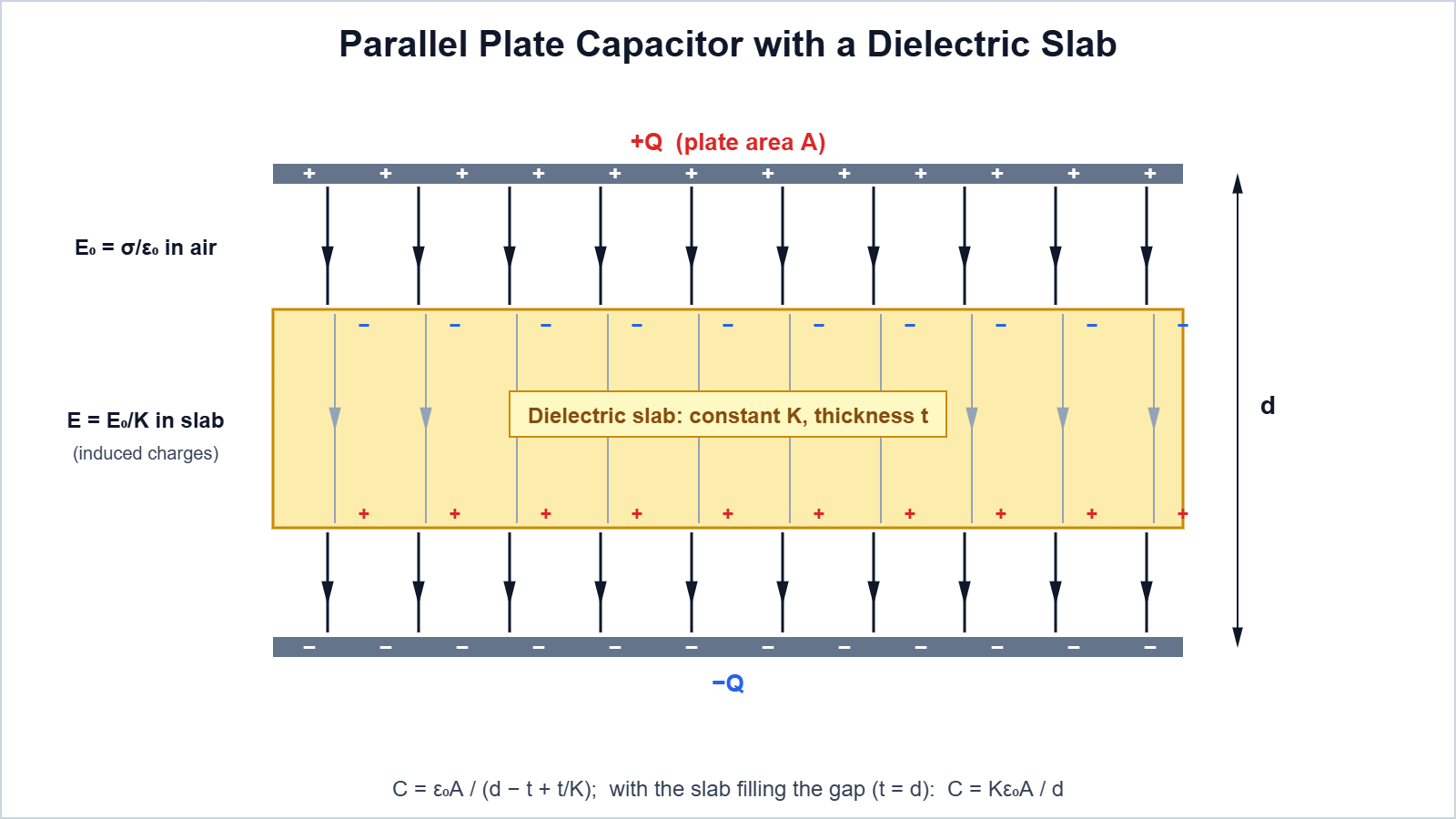
Derivation: Effect of a dielectric slab (thickness t < d)
- Field in air gap = E0 = σ/ε0; field inside the slab = E0/K.
- V = E0(d − t) + (E0/K)t = (σ/ε0)(d − t + t/K).
- C = Q/V = ε0A/(d − t + t/K).
Result: If the dielectric fills the space (t = d): C = Kε0A/d = KC0. A metal slab (K → ∞) gives C = ε0A/(d − t).
Numerical 6: A parallel plate capacitor has plates of area 0.02 m2 separated by 1 mm in air. Find its capacitance. What will it be if the gap is filled with a dielectric of K = 5?
Given: A = 0.02 m2, d = 1 × 10⁻³ m, K = 5
Formula: C = ε0A/d; C’ = KC
Solution: C = 8.854 × 10-12 × 0.02 / 10-3 = 1.77 × 10⁻¹⁰ F
Answer: C = 177 pF; with dielectric C’ = 885 pF
Numerical 7: A capacitor has plates of area 0.01 m2 and separation 4 mm. A slab of thickness 2 mm and K = 4 is inserted. Find the new capacitance.
Given: A = 0.01 m2, d = 4 × 10⁻³ m, t = 2 × 10⁻³ m, K = 4
Formula: C = ε0A/(d − t + t/K)
Solution: d − t + t/K = 0.004 − 0.002 + 0.0005 = 0.0025 m; C = 8.854 × 10⁻¹⁴ / 0.0025
Answer: C = 3.54 × 10⁻¹¹ F = 35.4 pF
6. Combination of Capacitors
Derivation: Capacitors in series
- The same charge Q appears on each capacitor; the total voltage divides: V = V1 + V2 + V3.
- V = Q/C1 + Q/C2 + Q/C3 = Q/C.
Result: 1/C = 1/C1 + 1/C2 + 1/C3 (equivalent capacitance is less than the smallest).
Derivation: Capacitors in parallel
- The same potential difference V is across each; total charge Q = Q1 + Q2 + Q3.
- CV = C1V + C2V + C3V.
Result: C = C1 + C2 + C3
Numerical 8: Capacitors of 2 μF and 3 μF are connected in series across a 10 V battery. Find the equivalent capacitance, the charge, and the voltage across each. What is the equivalent capacitance in parallel?
Given: C1 = 2 μF, C2 = 3 μF, V = 10 V
Formula: 1/C = 1/C1 + 1/C2; Q = CV; Vi = Q/Ci
Solution: 1/C = 1/2 + 1/3 = 5/6, so C = 1.2 μF; Q = 1.2 × 10 = 12 μC; V1 = 12/2 = 6 V; V2 = 12/3 = 4 V
Answer: 1.2 μF; 12 μC; 6 V and 4 V; parallel: 5 μF
7. Energy Stored in a Capacitor
Derivation: Energy stored
- While charging, when the charge is q the potential difference is q/C.
- Work to add charge dq: dW = (q/C) dq.
- Total work W = ∫0Q (q/C) dq = Q2/2C.
Result: U = Q2/2C = ½CV2 = ½QV. Energy density in the field: u = ½ε0E2 (J m-3).
Numerical 9: A 10 μF capacitor is charged to 200 V. Find the energy stored.
Given: C = 10 × 10-6 F, V = 200 V
Formula: U = ½CV2
Solution: U = 0.5 × 10-5 × 4 × 104
Answer: U = 0.2 J
Exam point: Battery connected while a dielectric is inserted: V constant, C, Q and U all become K times. Battery disconnected: Q constant, C becomes K times, V and U become 1/K times.
Easy Memory Trick: “Capacitors are opposite to resistors”: capacitors in series combine like resistors in parallel, and in parallel like resistors in series.
8. Practice Numericals (Answers Only)
- What is the potential at the midpoint between charges +q and −q? Ans: Zero.
- Three 6 μF capacitors are joined (i) in series, (ii) in parallel. Ans: (i) 2 μF; (ii) 18 μF.
- A capacitor stores 20 μC at 5 V. Find its capacitance. Ans: 4 μF.
- Find the energy density in a field of 105 V m-1. Ans: 0.044 J m-3.
- A capacitor connected to a battery is filled with a dielectric of K = 3. How does the charge change? Ans: It becomes 3 times.
9. Board-pattern Practice Questions
(a) Multiple Choice Questions
1. The potential on the equatorial line of a dipole is
(A) kp/r2 (B) 2kp/r3 (C) zero (D) kp/r3
Ans. (C)
2. The work done in moving a charge on an equipotential surface is
(A) positive (B) negative (C) zero (D) infinite
Ans. (C)
3. Two capacitors of 4 μF each in series give
(A) 8 μF (B) 2 μF (C) 4 μF (D) 16 μF
Ans. (B)
4. When a dielectric is inserted in an isolated charged capacitor, the energy stored
(A) increases (B) decreases (C) remains same (D) becomes zero
Ans. (B)
(b) Assertion-Reason
Options: (A) Both A and R are true and R is the correct explanation of A. (B) Both A and R are true but R is not the correct explanation of A. (C) A is true but R is false. (D) A is false but R is true.
1. Assertion (A): The electric field is always perpendicular to equipotential surfaces.
Reason (R): No work is done in moving a charge along an equipotential surface.
Ans. (A)
2. Assertion (A): A metal car protects its passengers during lightning.
Reason (R): The electric field inside a closed conducting shell is zero.
Ans. (A)
(c) Match the Columns
Column I | Column II |
|---|---|
(i) Point charge potential | (p) ½CV2 |
(ii) Dipole potential | (q) kq/r |
(iii) Energy stored | (r) −pE cosθ |
(iv) Dipole potential energy | (s) kp cosθ/r2 |
Ans. (i)-(q), (ii)-(s), (iii)-(p), (iv)-(r)
(d) Case Study
Case: A camera flash unit charges a capacitor slowly from a small battery and then releases the stored energy in a fraction of a millisecond through the flash tube. A typical unit uses a capacitor of a few hundred microfarads charged to about 300 V.
(i) Write the energy stored in terms of C and V.
Ans. U = ½CV2.
(ii) Find the energy for C = 200 μF and V = 300 V.
Ans. U = 0.5 × 2 × 10-4 × 9 × 104 = 9 J.
(iii) Why is the energy released so quickly?
Ans. The discharge circuit has very low resistance, so the time constant is very small.
(iv) If V is doubled, how does the energy change?
Ans. It becomes four times.
(e) Long Answer Questions
Q1. Derive an expression for the capacitance of a parallel plate capacitor. How does it change when a dielectric slab of thickness t (< d) is introduced?
Ans. C0 = ε0A/d (Section 5); with a slab, C = ε0A/(d − t + t/K), which is greater than C0.
Q2. Derive an expression for the energy stored in a capacitor and show that the energy density is ½ε0E2.
Ans. U = Q2/2C. For a parallel plate capacitor, U = ½(ε0A/d)(Ed)2 = ½ε0E2(Ad); dividing by the volume Ad gives u = ½ε0E2.
10. Important Questions
Q1. Define electrostatic potential. Is it a scalar or a vector?
Ans. Work done per unit positive charge in bringing it from infinity to the point; scalar.
Q2. Write the relation between E and V.
Ans. E = −dV/dr.
Q3. Why do two equipotential surfaces never intersect?
Ans. At the point of intersection there would be two values of potential, which is impossible.
Q4. What is the potential inside a charged hollow sphere?
Ans. Constant, equal to the potential on its surface (kq/R).
Q5. Define capacitance and its SI unit.
Ans. C = Q/V; farad.
Q6. What is the effect of a dielectric on capacitance?
Ans. It increases capacitance K times.
Q7. Distinguish between polar and non-polar molecules.
Ans. Polar molecules have a permanent dipole moment (e.g. H2O); non-polar molecules do not (e.g. O2).
Q8. Where is the energy of a capacitor stored?
Ans. In the electric field between the plates.
Q9. What is the potential energy of a dipole in its stable position?
Ans. −pE.
Q10. Why is the electrostatic field zero inside a conductor?
Ans. Free electrons rearrange until the field due to induced charges cancels the external field.
Conclusion: Electrostatic potential describes the energy aspect of electric fields. Capacitors store charge and energy; their capacitance depends on geometry and on the dielectric, and they combine in series and parallel by simple rules.