Magnetism and Matter – Physics Class 12 Notes
Chapter – 5
Magnetism and Matter
1. The Bar Magnet
Every magnet has two poles (north and south) that cannot be isolated: breaking a magnet gives two smaller magnets. A freely suspended magnet points north-south. Like poles repel and unlike poles attract.
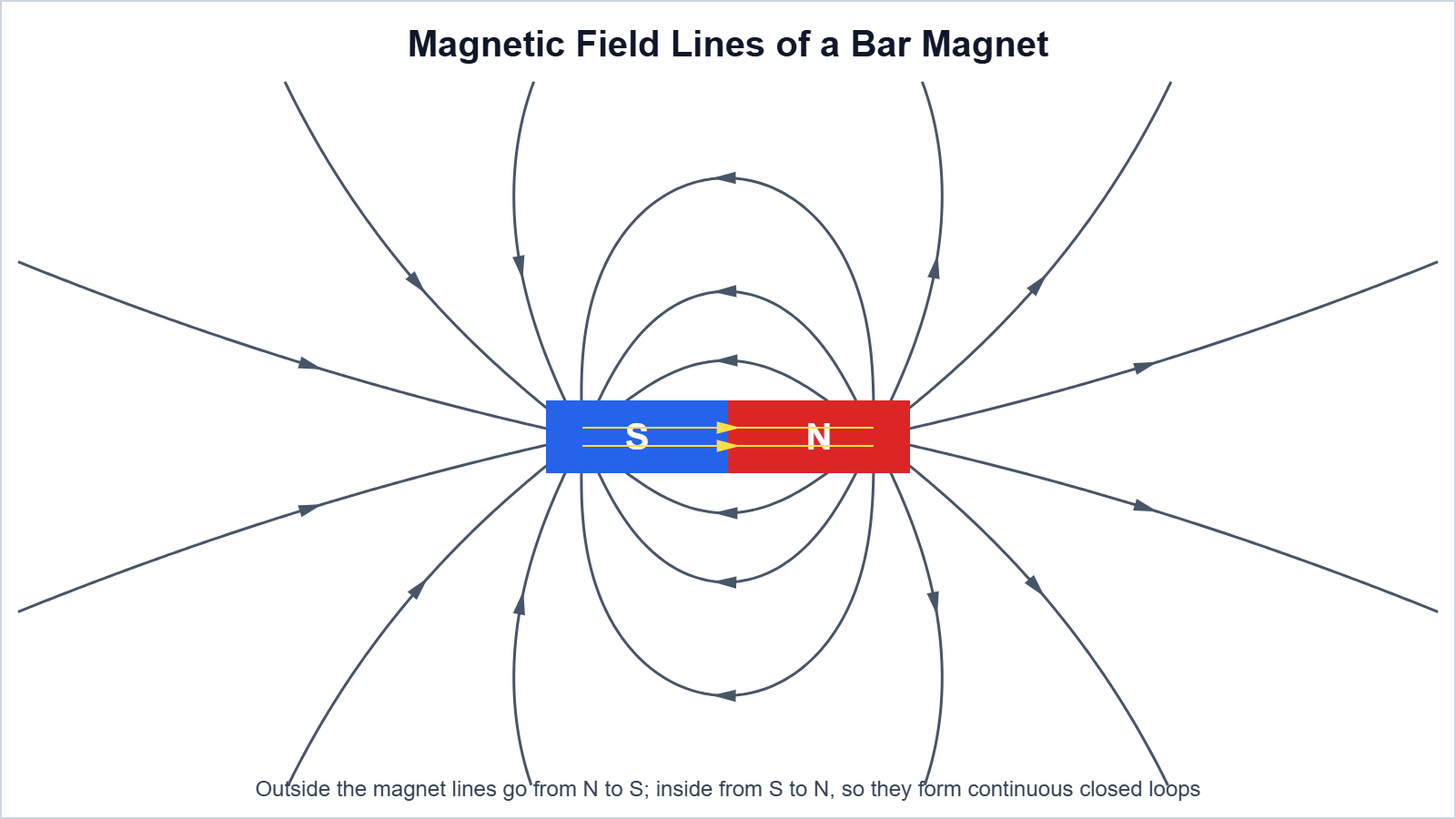
- Magnetic field lines form continuous closed loops: outside the magnet from N to S, inside from S to N (unlike electric field lines, which begin and end on charges).
- The tangent to a field line gives the direction of B; crowding of lines shows a stronger field.
- Field lines never intersect.
Bar magnet as an equivalent solenoid: the field of a bar magnet is very similar to that of a current-carrying solenoid. A bar magnet has a magnetic dipole moment m, directed from its S pole to its N pole (unit A m2).
Quantity | Electric dipole | Magnetic dipole |
|---|---|---|
Dipole moment | p | m |
Axial field (far) | (1/4πε0) 2p/r3 | (μ0/4π) 2m/r3 |
Equatorial field (far) | −(1/4πε0) p/r3 | −(μ0/4π) m/r3 |
Torque in uniform field | p × E | m × B |
Potential energy | −p · E | −m · B |
2. Dipole in a Uniform Magnetic Field
A magnetic dipole in a uniform field B experiences no net force but a torque τ = m × B (magnitude mB sinθ). Its potential energy is U = −mB cosθ: minimum (−mB) at θ = 0° (stable equilibrium), maximum (+mB) at θ = 180° (unstable). If a magnet is slightly displaced from θ = 0°, it oscillates with period T = 2π√(I/mB), where I is its moment of inertia.
Numerical 1: A bar magnet of moment 0.4 A m2 is placed at 30° to a uniform field of 0.2 T. Find the torque on it.
Given: m = 0.4 A m2, B = 0.2 T, θ = 30°
Formula: τ = mB sinθ
Solution: τ = 0.4 × 0.2 × 0.5
Answer: τ = 0.04 N m
Numerical 2: For the magnet in Numerical 1, find (i) its potential energy at 60° to the field, (ii) the work needed to turn it from the stable to the unstable position.
Given: m = 0.4 A m2, B = 0.2 T
Formula: U = −mB cosθ; W = U(180°) − U(0°) = 2mB
Solution: (i) U = −0.4 × 0.2 × cos 60° = −0.08 × 0.5; (ii) W = 2 × 0.4 × 0.2
Answer: (i) −0.04 J; (ii) 0.16 J
Numerical 3: Find the magnetic field at 10 cm from the centre of a short bar magnet of moment 0.5 A m2 on (i) its axis, (ii) its equatorial line.
Given: m = 0.5 A m2, r = 0.10 m, μ0/4π = 10-7 T m A-1
Formula: Baxial = (μ0/4π)(2m/r3); Beq = (μ0/4π)(m/r3)
Solution: Baxial = 10-7 × 2 × 0.5/10-3; Beq = 10-7 × 0.5/10-3
Answer: (i) 1 × 10⁻⁴ T; (ii) 5 × 10⁻⁵ T (opposite to m)
3. Gauss’s Law for Magnetism
The net magnetic flux through any closed surface is zero: ∮B · dS = 0. This means isolated magnetic poles (monopoles) do not exist: as many field lines leave a closed surface as enter it.
4. Magnetisation and Magnetic Intensity
Quantity | Definition | Unit |
|---|---|---|
Magnetisation M | Net magnetic moment per unit volume | A m-1 |
Magnetic intensity H | H = B0/μ0 (field due to free currents); for a solenoid H = nI | A m-1 |
Magnetic susceptibility χ | χ = M/H (how easily a material is magnetised) | no unit |
Relative permeability μr | μr = 1 + χ | no unit |
Permeability μ | μ = μ0μr | T m A-1 |
The total field inside a material is B = μ0(H + M) = μ0(1 + χ)H = μH.
Numerical 4: A solenoid with 1000 turns per metre carries 2 A and has an iron core of relative permeability 1000. Find H, B and M.
Given: n = 1000 m-1, I = 2 A, μr = 1000
Formula: H = nI; B = μ0μrH; M = (μr − 1)H
Solution: H = 1000 × 2 = 2000 A m-1; B = 4π × 10-7 × 1000 × 2000 = 2.51 T; M = 999 × 2000
Answer: H = 2000 A m-1; B ≈ 2.51 T; M ≈ 2.0 × 10⁶ A m-1
5. Magnetic Properties of Materials

Property | Diamagnetic | Paramagnetic | Ferromagnetic |
|---|---|---|---|
Susceptibility χ | Small, negative (about −10-5) | Small, positive (10-5 to 10-3) | Very large, positive (103 or more) |
μr | Slightly less than 1 | Slightly more than 1 | Much greater than 1 |
In a non-uniform field | Moves from stronger to weaker region | Moves from weaker to stronger region | Strongly attracted |
Origin | Induced moments opposing the field (all materials) | Permanent atomic moments partly aligned | Domains of aligned moments |
Effect of temperature | Almost none | χ = C/T (Curie’s law) | Becomes paramagnetic above the Curie temperature |
Examples | Bismuth, copper, water, lead | Aluminium, sodium, oxygen | Iron, nickel, cobalt, gadolinium |
Superconductors are perfect diamagnets (χ = −1): they expel magnetic field completely (Meissner effect).
Numerical 5: A material has relative permeability 1.00002. Find its susceptibility and state its type.
Given: μr = 1.00002
Formula: χ = μr − 1
Solution: χ = 1.00002 − 1
Answer: χ = 2 × 10⁻⁵; small and positive, so the material is paramagnetic
Numerical 6: A paramagnetic salt has susceptibility 1.2 × 10⁻⁵ at 300 K. Find its susceptibility at 200 K.
Given: χ1 = 1.2 × 10⁻⁵ at T1 = 300 K; T2 = 200 K
Formula: Curie’s law: χ = C/T, so χ2 = χ1T1/T2
Solution: χ2 = 1.2 × 10-5 × 300/200
Answer: χ2 = 1.8 × 10⁻⁵
6. Hysteresis; Permanent Magnets and Electromagnets
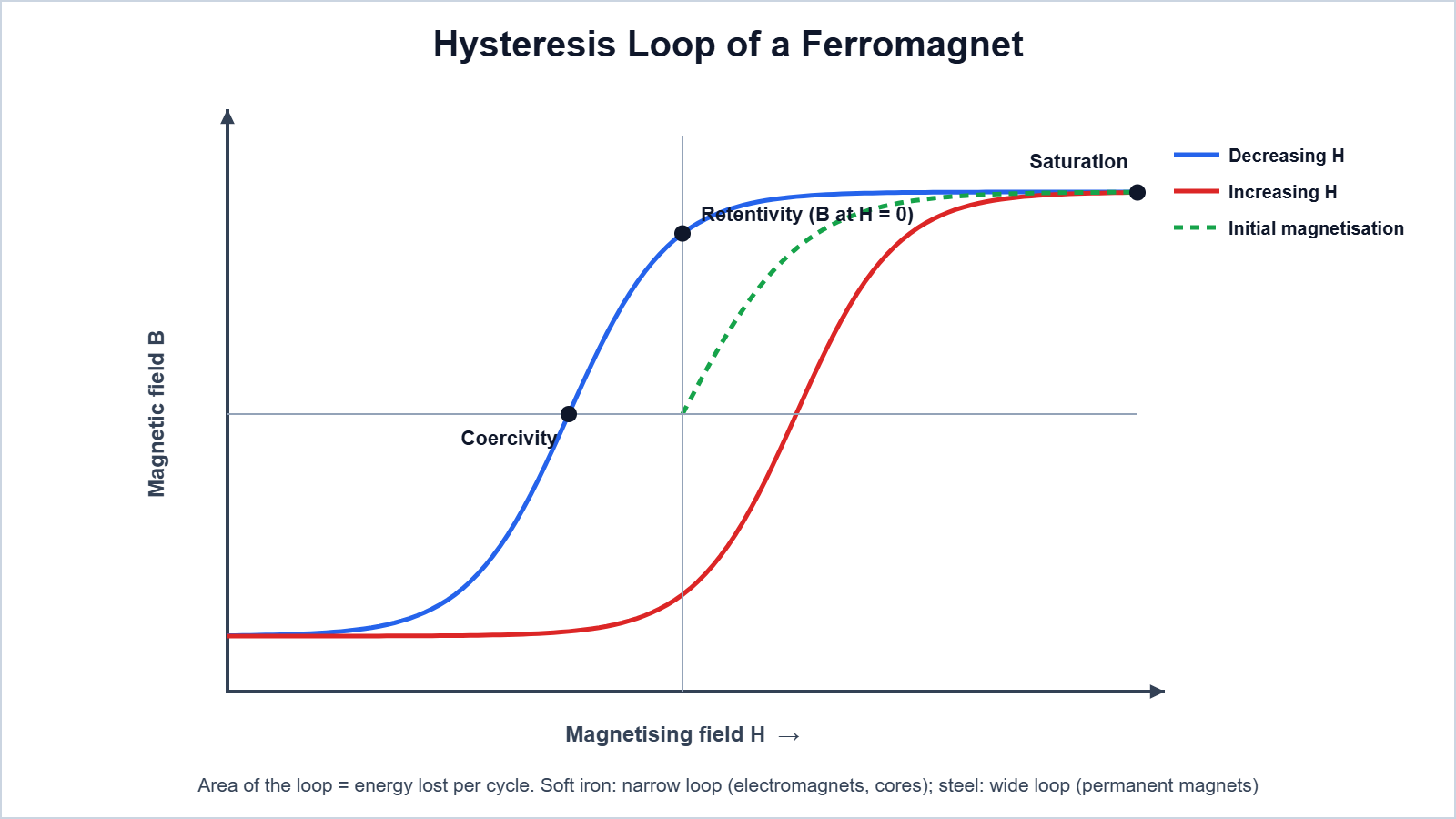
When H is increased, decreased and reversed through a cycle, B in a ferromagnet lags behind H and traces a closed loop called the hysteresis loop.
- Retentivity (remanence): the value of B left when H is reduced to zero.
- Coercivity: the reverse H needed to reduce B to zero.
- Area of the loop = energy lost as heat per unit volume per cycle.
Use | Required properties | Material |
|---|---|---|
Permanent magnets | High retentivity, high coercivity | Steel, alnico, cobalt steel |
Electromagnets, transformer cores | High permeability, low coercivity, low hysteresis loss (narrow loop) | Soft iron |
Exam point: Soft iron is preferred over steel for transformer cores because its narrow hysteresis loop means less energy loss per cycle.
Easy Memory Trick: “Dia Dislikes, Para Prefers, Ferro Fiercely loves” a magnetic field.
7. Practice Numericals (Answers Only)
- Find the maximum torque on a magnet of moment 2 A m2 in a field of 0.1 T. Ans: 0.2 N m.
- A solenoid of 800 turns and area 2.5 × 10⁻⁴ m2 carries 3 A. Find its magnetic moment. Ans: 0.6 A m2.
- A material has μr = 0.99999. Find χ and its type. Ans: −1 × 10⁻⁵; diamagnetic.
- χ of a paramagnet is 2 × 10⁻⁴ at 500 K. Find it at 250 K. Ans: 4 × 10⁻⁴.
- Find the equatorial field at 20 cm from a short magnet of moment 0.8 A m2. Ans: 1 × 10⁻⁵ T.
8. Board-pattern Practice Questions
(a) Multiple Choice Questions
1. Net magnetic flux through a closed surface is
(A) μ0I (B) zero (C) q/ε0 (D) infinite
Ans. (B)
2. Susceptibility of a diamagnetic substance is
(A) large positive (B) small positive (C) small negative (D) zero
Ans. (C)
3. Above the Curie temperature a ferromagnet becomes
(A) diamagnetic (B) paramagnetic (C) superconducting (D) more ferromagnetic
Ans. (B)
4. Material suitable for a permanent magnet must have
(A) low retentivity, low coercivity (B) high retentivity, high coercivity (C) high retentivity, low coercivity (D) low retentivity, high coercivity
Ans. (B)
(b) Assertion-Reason
Options: (A) Both A and R are true and R is the correct explanation of A. (B) Both A and R are true but R is not the correct explanation of A. (C) A is true but R is false. (D) A is false but R is true.
1. Assertion (A): Magnetic monopoles do not exist.
Reason (R): The net magnetic flux through any closed surface is zero.
Ans. (A)
2. Assertion (A): A diamagnetic rod placed in a magnetic field sets itself perpendicular to the field.
Reason (R): Diamagnetic materials are repelled towards weaker parts of the field.
Ans. (A)
(c) Match the Columns
Column I | Column II |
|---|---|
(i) Bismuth | (p) Ferromagnetic |
(ii) Aluminium | (q) Perfect diamagnet |
(iii) Nickel | (r) Diamagnetic |
(iv) Superconductor | (s) Paramagnetic |
Ans. (i)-(r), (ii)-(s), (iii)-(p), (iv)-(q)
(d) Case Study
Case: Hard disks and magnetic stripe cards store data in tiny regions of ferromagnetic material magnetised in one direction or the other. The material must keep its magnetisation for years, but the writing head must be able to reverse it when needed.
(i) Which property ensures that the data stays stored?
Ans. High retentivity.
(ii) Why should the coercivity not be too large?
Ans. So that the writing head can reverse the magnetisation easily.
(iii) What happens if the card is heated above the Curie temperature?
Ans. The material becomes paramagnetic and the stored data is lost.
(iv) Why should cards be kept away from strong magnets?
Ans. A strong external field can change the magnetisation of the regions and erase data.
(e) Long Answer Questions
Q1. Distinguish between dia-, para- and ferromagnetic substances with examples. State Curie’s law.
Ans. See the table in Section 5. Curie’s law: for paramagnets χ = C/T (C is the Curie constant).
Q2. What is a hysteresis loop? Define retentivity and coercivity. Which material is better for (i) electromagnets, (ii) permanent magnets? Why?
Ans. See Section 6: soft iron for electromagnets (low coercivity, small loop area); steel or alnico for permanent magnets (high retentivity and coercivity).
9. Important Questions
Q1. In what way does a bar magnet resemble a solenoid?
Ans. Both produce similar fields and behave as magnetic dipoles.
Q2. What is the direction of field lines inside a bar magnet?
Ans. From the S pole to the N pole.
Q3. Write the potential energy of a magnetic dipole in a field.
Ans. U = −m · B = −mB cosθ.
Q4. Define magnetic susceptibility.
Ans. χ = M/H.
Q5. What is Curie temperature?
Ans. The temperature above which a ferromagnetic substance becomes paramagnetic.
Q6. Why does a paramagnetic sample show greater magnetisation when cooled?
Ans. Thermal agitation, which disturbs alignment of atomic moments, is reduced.
Q7. Write the relation between B, H and M.
Ans. B = μ0(H + M).
Q8. What does the area of a hysteresis loop represent?
Ans. Energy lost per unit volume per cycle.
Q9. Is diamagnetism temperature dependent?
Ans. Almost not.
Q10. What is the susceptibility of a superconductor?
Ans. −1.
Conclusion: Magnets and current loops behave as magnetic dipoles. Materials respond to magnetic fields in three main ways – diamagnetism, paramagnetism and ferromagnetism – and the hysteresis behaviour of ferromagnets decides their use in permanent magnets and electromagnets.