Electric Charges and Fields – Physics Class 12 Notes
Chapter – 1
Electric Charges and Fields
1. Electric Charge
Electric charge is the property of matter due to which it experiences a force in an electric field. There are two kinds: positive and negative. Like charges repel and unlike charges attract. SI unit: coulomb (C).
Property | Meaning |
|---|---|
Additivity | Total charge is the algebraic sum of individual charges: q = q1 + q2 + q3 + … |
Conservation | Charge can neither be created nor destroyed; it is only transferred. Total charge of an isolated system stays constant. |
Quantisation | Charge exists only in whole-number multiples of e: q = ne, where e = 1.6 × 10⁻¹⁹ C and n is an integer. |
Conductors (metals, human body, earth) allow charges to move freely; insulators (glass, plastic, rubber) do not. A body can be charged by friction, conduction (contact) and induction (bringing a charged body near without contact, then earthing).
Remember: Charging by induction gives the induced body a charge opposite to that of the inducing body. Mass of a body increases slightly when it gains electrons.
2. Coulomb’s Law
The force between two point charges is directly proportional to the product of the charges and inversely proportional to the square of the distance between them, acting along the line joining them:
F = (1/4πε0) q1q2 / r2 = k q1q2 / r2, where k = 1/4πε0 = 9 × 10⁹ N m2 C-2 and ε0 = 8.854 × 10⁻¹² C2 N-1 m-2 (permittivity of free space).
Vector form: F21 (force on q2 due to q1) = k q1q2 r̂21 / r2, and F12 = −F21 (Newton’s third law). In a medium of dielectric constant K: Fmedium = Fair / K.
Superposition principle: the net force on a charge due to several charges is the vector sum of the forces due to each charge taken separately.
Numerical 1: Two point charges of +2 μC and +3 μC are placed 30 cm apart in air. Find the force between them.
Given: q1 = 2 × 10⁻⁶ C, q2 = 3 × 10⁻⁶ C, r = 0.30 m
Formula: F = k q1q2 / r2
Solution: F = (9 × 109 × 2 × 10-6 × 3 × 10-6) / (0.30)2 = 0.054 / 0.09
Answer: F = 0.6 N (repulsive)
Numerical 2: How many electrons must be removed from a neutral metal sphere to give it a charge of +8 × 10-16 C?
Given: q = 8 × 10-16 C, e = 1.6 × 10⁻¹⁹ C
Formula: q = ne
Solution: n = q/e = 8 × 10-16 / 1.6 × 10⁻¹⁹
Answer: n = 5000 electrons
3. Electric Field
Electric field at a point is the force experienced by a unit positive test charge placed there: E = F / q0. Unit: N C-1 (= V m-1). It is a vector.
Field of a point charge: E = kq / r2, directed away from a positive charge and towards a negative charge. For several charges, E = E1 + E2 + … (vector sum).
Numerical 3: Find the electric field at a distance of 10 cm from a point charge of 5 nC in air.
Given: q = 5 × 10⁻⁹ C, r = 0.10 m
Formula: E = kq / r2
Solution: E = 9 × 109 × 5 × 10-9 / (0.10)2 = 45 / 0.01
Answer: E = 4500 N C-1, directed away from the charge
4. Electric Field Lines
An electric field line is a curve whose tangent at any point gives the direction of the field there.

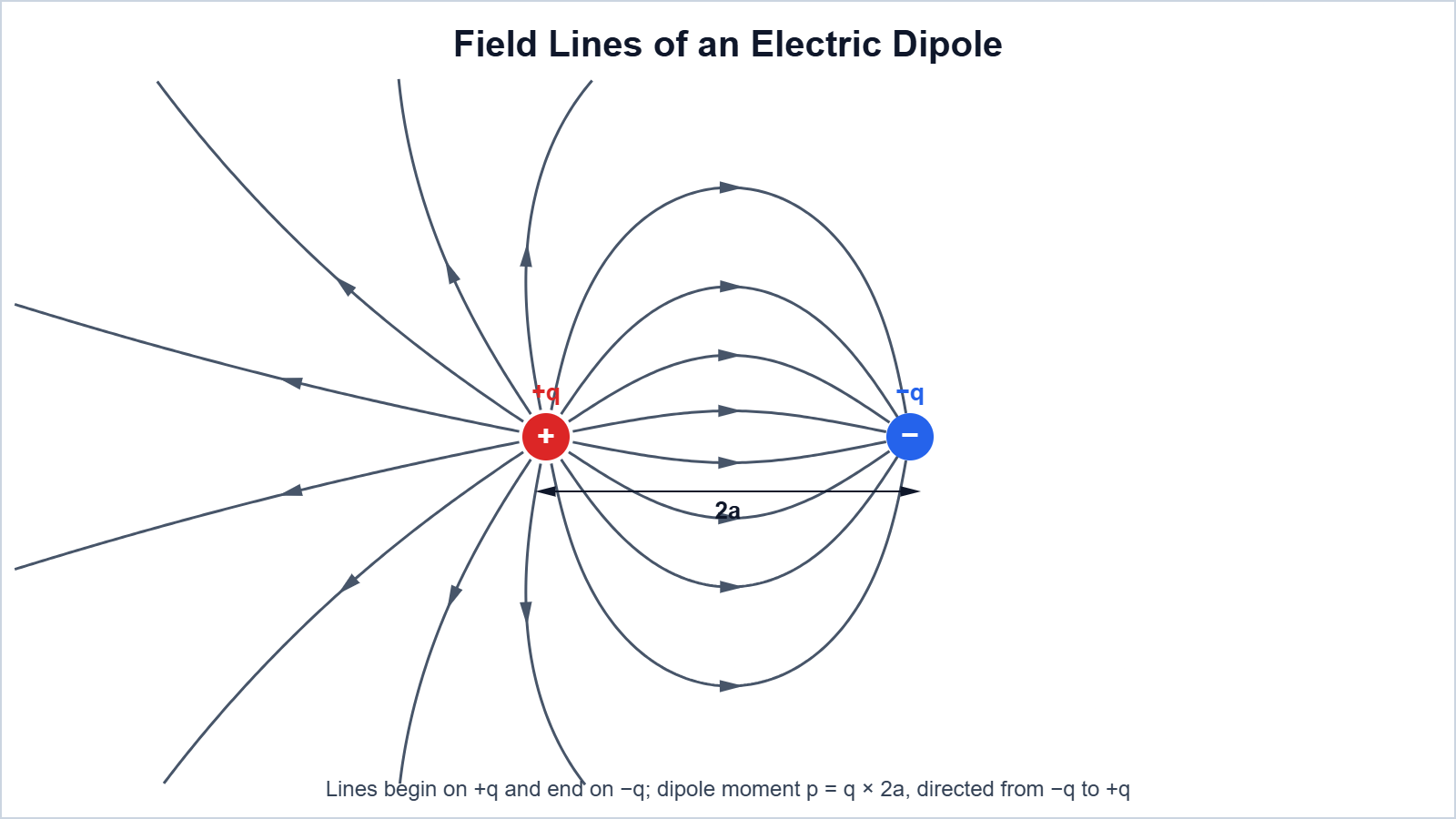
- They start on positive charges and end on negative charges (or at infinity).
- Two field lines never cross (the field has only one direction at a point).
- They are continuous curves in a charge-free region and do not form closed loops.
- Closer lines show a stronger field; parallel equally spaced lines show a uniform field.
- They are perpendicular to the surface of a conductor.
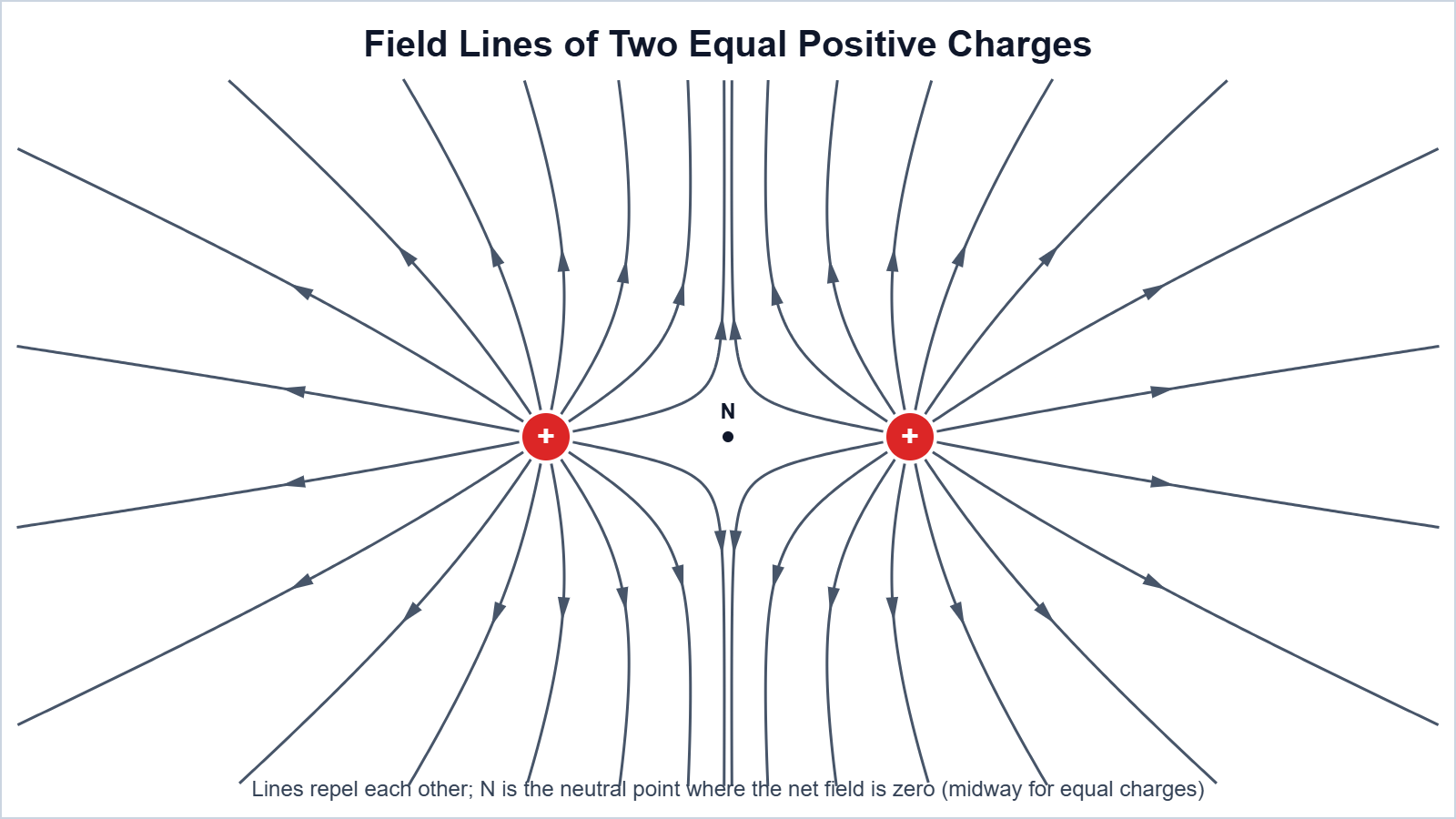
Exam point: The point where the net field is zero (neutral point) between two like charges lies nearer the smaller charge.
5. Electric Dipole
An electric dipole is a pair of equal and opposite charges (+q and −q) separated by a small distance 2a. Dipole moment p = q × 2a, a vector directed from −q to +q. Unit: C m.
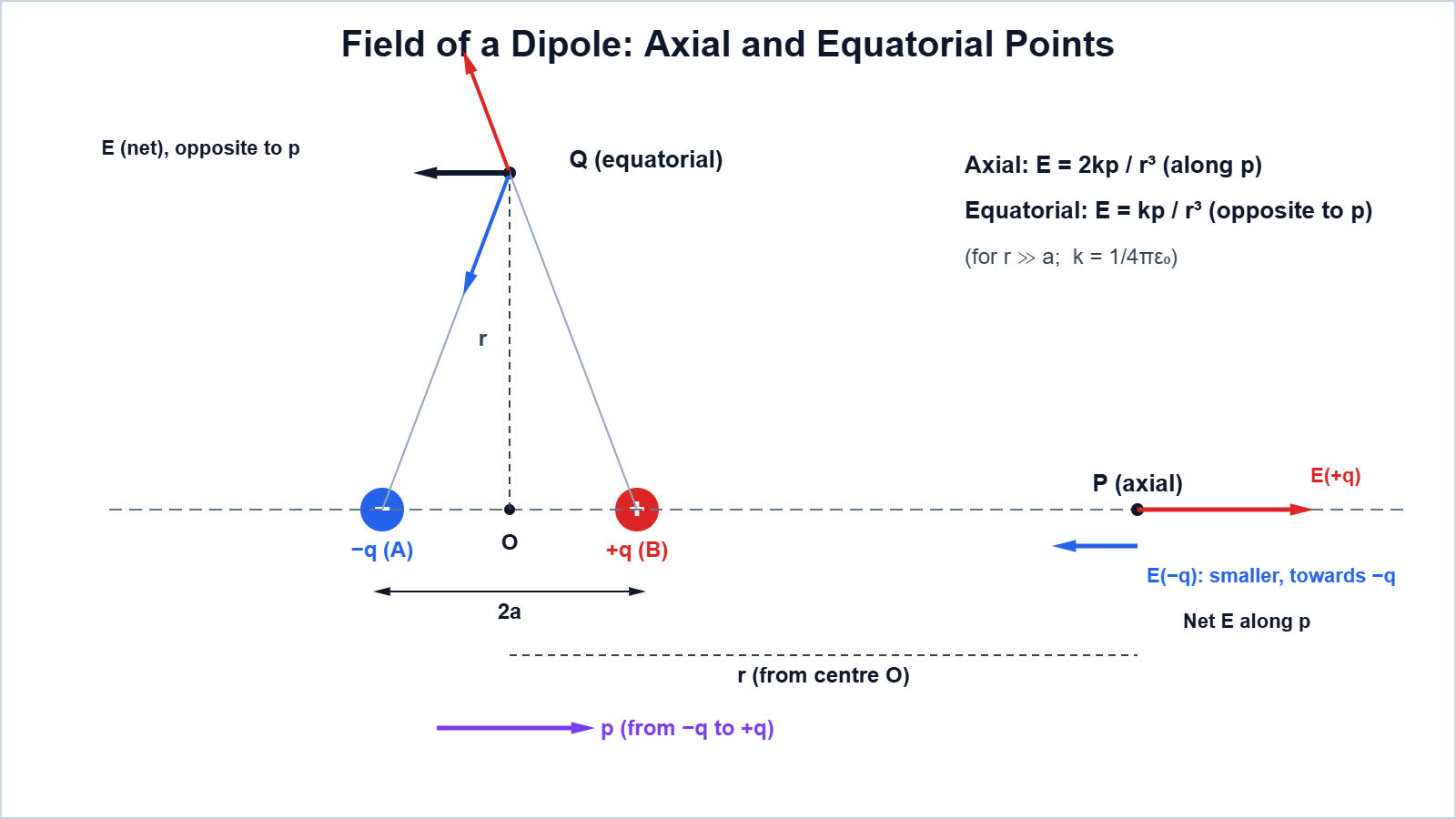
Derivation: Field on the axial line of a dipole
- Let P be on the axis at distance r from the centre O, on the side of +q.
- Field due to +q (distance r − a): E+ = kq/(r − a)2, directed away from +q (along p).
- Field due to −q (distance r + a): E− = kq/(r + a)2, directed towards −q (opposite to p).
- Net field E = kq[1/(r − a)2 − 1/(r + a)2] = kq × 4ar/(r2 − a2)2 = 2kpr/(r2 − a2)2.
- For r ≫ a: Eaxial = 2kp/r3, along p.
Derivation: Field on the equatorial line of a dipole
- Let Q be on the perpendicular bisector at distance r from O. Each charge is at distance √(r2 + a2).
- Magnitudes are equal: E+ = E− = kq/(r2 + a2).
- Components perpendicular to the dipole axis cancel; components parallel to the axis add, both pointing from +q towards −q.
- E = 2 × kq/(r2 + a2) × cosθ, where cosθ = a/√(r2 + a2).
- E = kp/(r2 + a2)3/2; for r ≫ a: Eequatorial = kp/r3, opposite to p.
Result: At the same large distance, Eaxial = 2 Eequatorial. A dipole field falls as 1/r3, faster than a point charge field (1/r2).
Numerical 4: Charges of +4 μC and −4 μC are 2 mm apart. Find the dipole moment and the field at 20 cm from the centre on (i) the axial line, (ii) the equatorial line.
Given: q = 4 × 10⁻⁶ C, 2a = 2 × 10⁻³ m, r = 0.20 m (r ≫ a)
Formula: p = q(2a); Eaxial = 2kp/r3; Eeq = kp/r3
Solution: p = 4 × 10-6 × 2 × 10-3 = 8 × 10⁻⁹ C m. Eaxial = 2 × 9 × 109 × 8 × 10-9 / (0.2)3 = 144/0.008
Answer: p = 8 × 10⁻⁹ C m; (i) 1.8 × 10⁴ N C-1 along p; (ii) 9.0 × 10³ N C-1 opposite to p
6. Dipole in a Uniform External Field
Derivation: Torque on a dipole
- In a uniform field E, force on +q is qE (along E) and on −q is qE (opposite). Net force = 0.
- The two forces form a couple. Perpendicular distance between their lines of action = 2a sinθ, where θ is the angle between p and E.
- Torque τ = qE × 2a sinθ = pE sinθ.
- In vector form: τ = p × E.
Result: τ is maximum (pE) at θ = 90° and zero at θ = 0° (stable equilibrium) and 180° (unstable equilibrium). In a non-uniform field there is also a net force.
Numerical 5: An electric dipole of moment 4 × 10⁻⁹ C m is placed at 30° to a uniform field of 5 × 10⁴ N C-1. Find the torque.
Given: p = 4 × 10⁻⁹ C m, E = 5 × 10⁴ N C-1, θ = 30°
Formula: τ = pE sinθ
Solution: τ = 4 × 10-9 × 5 × 104 × 0.5
Answer: τ = 1 × 10⁻⁴ N m
7. Continuous Charge Distributions
Distribution | Charge density | Unit |
|---|---|---|
Linear (wire) | λ = dq/dl | C m-1 |
Surface (sheet) | σ = dq/dA | C m-2 |
Volume | ρ = dq/dV | C m-3 |
8. Electric Flux and Gauss’s Law
Electric flux through a surface: Φ = E · ΔS = E ΔS cosθ (θ is the angle between E and the area vector). For any surface Φ = ∫E · dS. It is a scalar; unit N m2 C-1 (or V m).
Gauss’s law: the total electric flux through any closed surface equals 1/ε0 times the net charge enclosed: ∮E · dS = qenclosed / ε0. Charges outside the surface contribute zero net flux.
Important: Gauss’s law is true for any closed surface, but it is useful for finding E only when the charge distribution is symmetric, so that E is constant on the chosen Gaussian surface.
Numerical 6: A uniform field of 3 × 10³ N C-1 acts along the x-axis. Find the flux through a square of side 10 cm whose normal makes 60° with the x-axis.
Given: E = 3 × 10³ N C-1, A = (0.10)2 = 0.01 m2, θ = 60°
Formula: Φ = EA cosθ
Solution: Φ = 3 × 103 × 0.01 × 0.5
Answer: Φ = 15 N m2 C-1
Numerical 7: A closed surface encloses a net charge of 8.854 μC. Find the total flux through it.
Given: q = 8.854 × 10⁻⁶ C, ε0 = 8.854 × 10⁻¹² C2 N-1 m-2
Formula: Φ = q/ε0
Solution: Φ = 8.854 × 10⁻⁶ / 8.854 × 10⁻¹²
Answer: Φ = 1 × 10⁶ N m2 C-1
9. Applications of Gauss’s Law
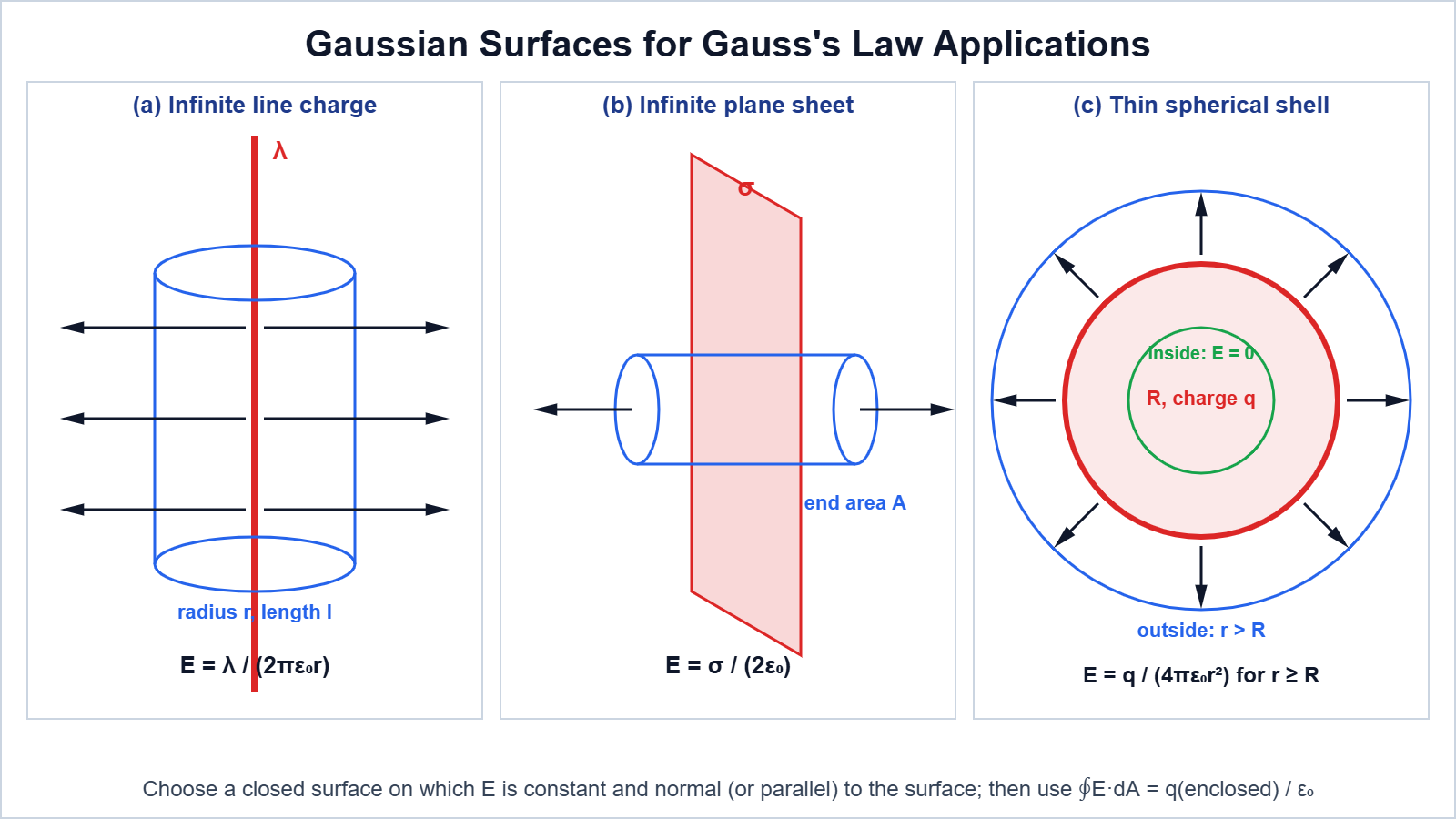
Derivation: Field of an infinitely long straight charged wire
- Take a cylindrical Gaussian surface of radius r and length l, coaxial with the wire (linear charge density λ).
- By symmetry E is radial and has the same magnitude at every point of the curved surface.
- Flux through the flat ends is zero (E is parallel to them). Flux through the curved surface = E × 2πrl.
- Charge enclosed = λl. By Gauss’s law: E × 2πrl = λl/ε0.
- E = λ / 2πε0r = 2kλ / r, directed radially outward for positive λ.
Derivation: Field of an infinite plane sheet of charge
- Take a cylinder (pillbox) of cross-section A crossing the sheet (surface charge density σ), with ends on both sides.
- E is perpendicular to the sheet and of equal magnitude on both sides; no flux through the curved surface.
- Total flux = EA + EA = 2EA. Charge enclosed = σA.
- 2EA = σA/ε0.
- E = σ / 2ε0, independent of distance from the sheet.
Result: Between two oppositely charged parallel sheets the field is σ/ε0 and outside it is zero (used for a parallel plate capacitor).
Derivation: Field of a uniformly charged thin spherical shell
- Shell of radius R carries charge q. Take a concentric spherical Gaussian surface of radius r.
- Outside (r > R): E × 4πr2 = q/ε0, so E = q/4πε0r2 – as if all the charge were at the centre.
- On the surface (r = R): E = q/4πε0R2 = σ/ε0.
- Inside (r < R): enclosed charge = 0, so E = 0.
Numerical 8: An infinitely long wire has a linear charge density of 2 μC m-1. Find the field at 5 cm from it.
Given: λ = 2 × 10⁻⁶ C m-1, r = 0.05 m
Formula: E = 2kλ/r
Solution: E = 2 × 9 × 109 × 2 × 10-6 / 0.05 = 36000/0.05
Answer: E = 7.2 × 10⁵ N C-1
Numerical 9: Find the field near a large plane sheet with surface charge density 8.854 × 10⁻¹⁰ C m-2.
Given: σ = 8.854 × 10⁻¹⁰ C m-2
Formula: E = σ/2ε0
Solution: E = 8.854 × 10⁻¹⁰ / (2 × 8.854 × 10-12)
Answer: E = 50 N C-1
Numerical 10: A thin spherical shell of radius 10 cm carries 2 nC. Find the field (i) at 20 cm from the centre, (ii) at 5 cm from the centre.
Given: q = 2 × 10⁻⁹ C, R = 0.10 m
Formula: Outside: E = kq/r2; inside: E = 0
Solution: (i) E = 9 × 109 × 2 × 10-9 / (0.20)2 = 18/0.04. (ii) r < R, so E = 0
Answer: (i) 450 N C-1; (ii) zero
Easy Memory Trick: “Line – Sheet – Shell = 1/r, constant, 1/r²”: field of a line falls as 1/r, a sheet gives a constant field, and outside a shell the field falls as 1/r².
10. Practice Numericals (Answers Only)
- Charges +1 μC and +4 μC are 30 cm apart. Where is the net field zero? Ans: 10 cm from the 1 μC charge, between them.
- The distance between two charges is halved. By what factor does the force change? Ans: It becomes 4 times.
- Find the electrostatic force between two electrons 1 × 10⁻¹⁰ m apart. Ans: 2.3 × 10⁻⁸ N (repulsive).
- A charge of 6 μC is at the centre of a cube. Find the flux through one face. Ans: q/6ε0 = 1.13 × 10⁵ N m2 C-1.
- Find the field at 30 cm from a 3 μC point charge. Ans: 3 × 10⁵ N C-1.
11. Board-pattern Practice Questions
(a) Multiple Choice Questions
1. The SI unit of electric flux is
(A) N C-1 (B) N m2 C-1 (C) C m-2 (D) N m C-1
Ans. (B)
2. A dipole is placed in a uniform field with p parallel to E. The dipole is in
(A) unstable equilibrium (B) stable equilibrium (C) rotation (D) translation only
Ans. (B)
3. The field inside a charged thin spherical shell is
(A) maximum at the centre (B) σ/ε0 (C) zero (D) kq/R2
Ans. (C)
4. If a charge q is placed at the centre of a cube, the flux through each face is
(A) q/ε0 (B) q/6ε0 (C) 6q/ε0 (D) zero
Ans. (B)
(b) Assertion-Reason
Options: (A) Both A and R are true and R is the correct explanation of A. (B) Both A and R are true but R is not the correct explanation of A. (C) A is true but R is false. (D) A is false but R is true.
1. Assertion (A): Two electric field lines never intersect.
Reason (R): At a point, the electric field has only one direction.
Ans. (A)
2. Assertion (A): The electric field due to a dipole on its equatorial line is opposite to the dipole moment.
Reason (R): Field lines of a dipole start on −q and end on +q.
Ans. (C) (Field lines start on +q and end on −q.)
(c) Match the Columns
Column I | Column II |
|---|---|
(i) Infinite line charge | (p) E = 0 inside |
(ii) Infinite plane sheet | (q) E ∝ 1/r |
(iii) Thin spherical shell | (r) E ∝ 1/r3 |
(iv) Dipole (far point) | (s) E independent of distance |
Ans. (i)-(q), (ii)-(s), (iii)-(p), (iv)-(r)
(d) Case Study
Case: A small water drop in a cloud carries an extra charge of a few electrons. In a laboratory, such tiny charged drops are held stationary between two horizontal plates by a vertical electric field, so that the electric force balances their weight.
(i) Why can the charge on a drop never be 2.4 × 10⁻¹⁹ C?
Ans. Because charge is quantised: q = ne, and 2.4 × 10⁻¹⁹/1.6 × 10-19 = 1.5 is not an integer.
(ii) In which direction must the field point to hold a negatively charged drop stationary?
Ans. Vertically downward, so that the force on the negative charge (opposite to E) is upward.
(iii) Write the balance condition.
Ans. qE = mg.
(iv) If the drop gains one more electron, what must be done to keep it stationary?
Ans. Reduce the field slightly, since the charge has increased.
(e) Long Answer Questions
Q1. Derive an expression for the electric field at a point on the axial line of an electric dipole. How does it compare with the field on the equatorial line at the same distance?
Ans. See the derivation in Section 5: Eaxial = 2kpr/(r2 − a2)2 ≈ 2kp/r3. On the equatorial line E = kp/r3, so the axial field is twice the equatorial field and opposite in direction relative to p.
Q2. State Gauss’s law. Use it to find the field due to a uniformly charged infinite plane sheet.
Ans. ∮E·dS = q/ε0. Using a pillbox Gaussian surface: 2EA = σA/ε0, so E = σ/2ε0, perpendicular to the sheet and independent of distance.
12. Important Questions
Q1. What is meant by quantisation of charge?
Ans. Charge on any body is an integral multiple of e: q = ne.
Q2. State Coulomb’s law in vector form.
Ans. F21 = (1/4πε0) q1q2 r̂21/r2.
Q3. Why do field lines not form closed loops?
Ans. Electrostatic field lines start on positive and end on negative charges; the electrostatic field is conservative.
Q4. Define dipole moment. What is its direction?
Ans. p = q × 2a; from −q to +q.
Q5. What is the net force on a dipole in a uniform field?
Ans. Zero; only a torque acts.
Q6. Define electric flux.
Ans. Φ = ∮E · dS, the number of field lines crossing a surface; unit N m2 C-1.
Q7. A charge q is placed at the corner of a cube. What is the flux through the cube?
Ans. q/8ε0 (only one-eighth of the flux passes through the cube).
Q8. Why is the field inside a charged conductor zero?
Ans. Free charges move until they reside on the outer surface and the internal field becomes zero (electrostatic shielding).
Q9. How does the field of a dipole vary with distance?
Ans. E ∝ 1/r3 for large r.
Q10. Is the force between two charges affected by a third charge?
Ans. No. Each pair interacts independently (superposition principle).
Conclusion: Electric charges are additive, conserved and quantised. Coulomb’s law, the electric field, field lines, dipoles and Gauss’s law together describe electrostatic forces; Gauss’s law gives quick results for symmetric charge distributions.