Electromagnetic Induction – Physics Class 12 Notes
Chapter – 6
Electromagnetic Induction
1. Faraday’s Experiments
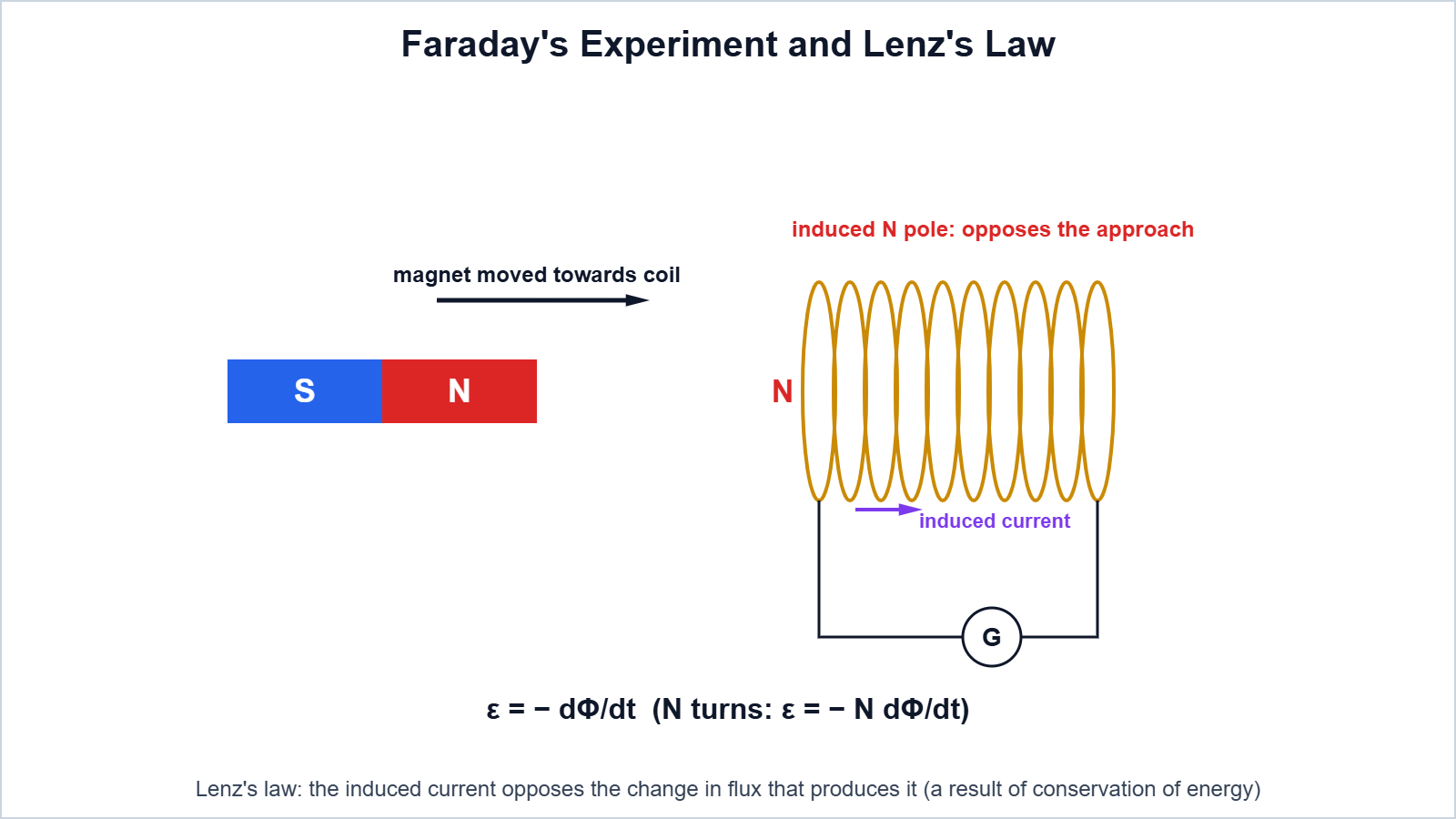
Faraday and Henry showed that an EMF (and a current) is induced in a coil whenever the magnetic flux linked with it changes – for example, when a magnet moves towards or away from a coil, when the current in a nearby coil changes, or when a coil is rotated in a field. The faster the change, the larger the induced EMF. This phenomenon is electromagnetic induction.
2. Magnetic Flux
ΦB = B · A = BA cosθ, where θ is the angle between B and the normal to the area. For a non-uniform field Φ = ∫B · dA. SI unit: weber (Wb) = T m2. Flux is a scalar.
3. Faraday’s Law and Lenz’s Law
Faraday’s law: the induced EMF equals the negative rate of change of magnetic flux: ε = −dΦB/dt; for a coil of N turns ε = −N dΦB/dt. Flux can be changed by changing B, the area A, or the angle θ.
Lenz’s law: the direction of the induced current is such that it opposes the change in flux that produced it (this is the meaning of the minus sign). It follows from conservation of energy: if the induced current aided the change, energy would be created from nothing. When a magnet’s N pole approaches a coil, the near face of the coil becomes an N pole and repels it, so work must be done to push the magnet in; this work appears as electrical energy.
Numerical 1: A coil of 200 turns and area 0.01 m2 is perpendicular to a field that falls from 0.5 T to 0.1 T in 0.2 s. Find the average induced EMF.
Given: N = 200, A = 0.01 m2, ΔB = 0.4 T, Δt = 0.2 s
Formula: |ε| = N A ΔB/Δt
Solution: |ε| = 200 × 0.01 × 0.4/0.2
Answer: ε = 4 V
4. Motional EMF
Derivation: EMF induced in a moving rod
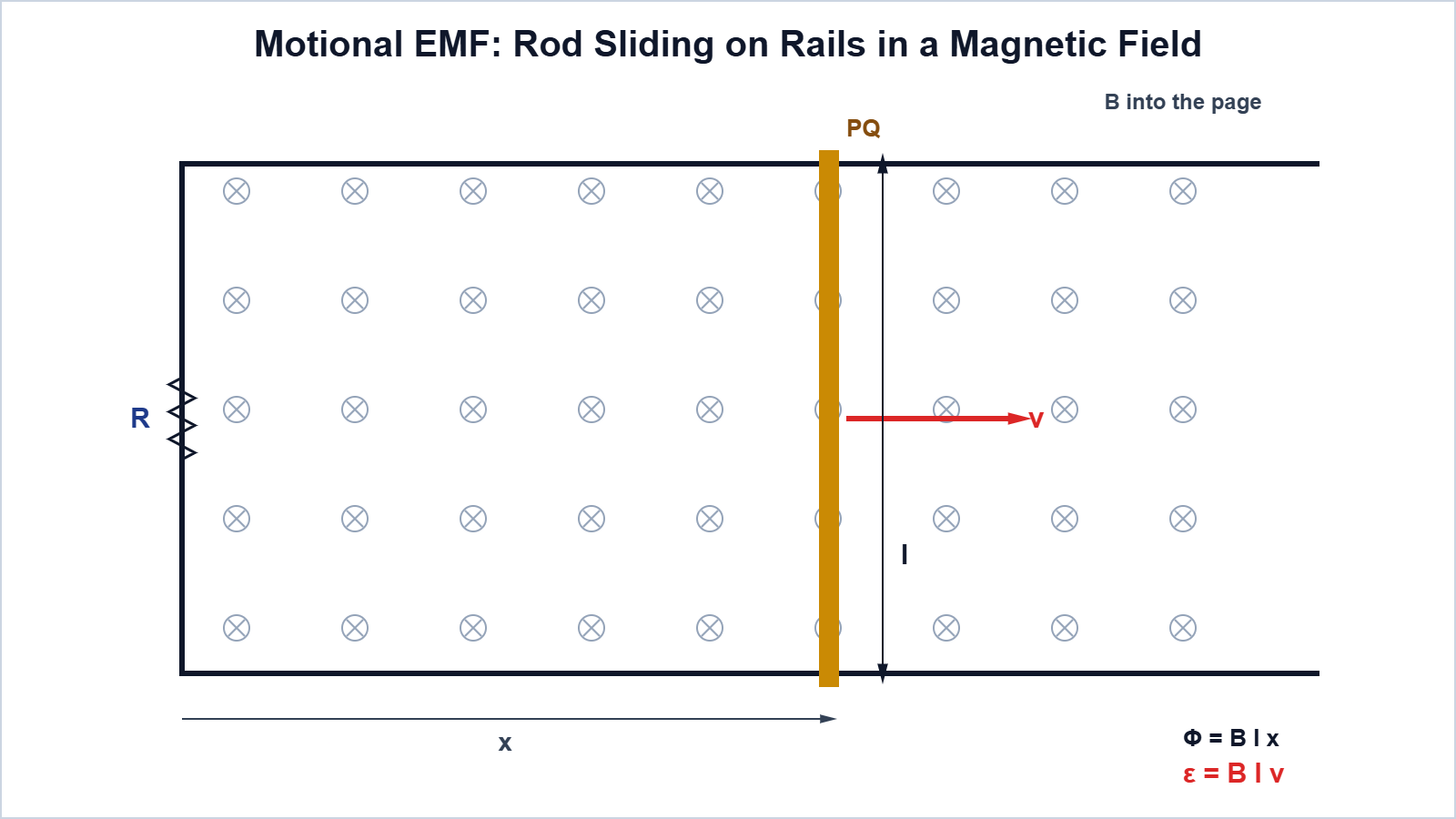
- A rod PQ of length l slides with speed v on parallel rails in a uniform field B perpendicular to the plane; the circuit is completed by a resistance R.
- If x is the distance of the rod from the closed end, the flux through the loop is Φ = Blx.
- ε = −dΦ/dt = −Bl dx/dt = −Blv; magnitude ε = Blv.
- Alternatively: each free charge q in the rod feels the Lorentz force qvB along the rod; the work per unit charge in moving along length l is vBl.
Result: ε = Blv, current I = Blv/R. The current in the rod experiences a force F = IlB = B2l2v/R opposite to v; the mechanical power needed, Fv = B2l2v2/R, equals the Joule heating I2R – energy is conserved.
Numerical 2: A rod of length 0.5 m moves at 4 m s-1 perpendicular to a 0.2 T field on rails connected by a 2 Ω resistor. Find the EMF, the current, the force needed to keep it moving and the power.
Given: l = 0.5 m, v = 4 m s-1, B = 0.2 T, R = 2 Ω
Formula: ε = Blv; I = ε/R; F = BIl; P = Fv
Solution: ε = 0.2 × 0.5 × 4 = 0.4 V; I = 0.4/2 = 0.2 A; F = 0.2 × 0.2 × 0.5 = 0.02 N; P = 0.02 × 4
Answer: ε = 0.4 V; I = 0.2 A; F = 0.02 N; P = 0.08 W (= I2R = 0.04 × 2)
Rotating rod: a metal rod of length l rotating with angular speed ω about one end, perpendicular to B, develops ε = ½Bωl2 between its ends.
Numerical 3: A 1 m long metal rod rotates at 20 rad s-1 about one end in a perpendicular field of 0.5 T. Find the EMF between its ends.
Given: l = 1 m, ω = 20 rad s-1, B = 0.5 T
Formula: ε = ½Bωl2
Solution: ε = 0.5 × 0.5 × 20 × 1
Answer: ε = 5 V
5. Eddy Currents
When a bulk conductor moves in, or experiences, a changing magnetic field, circulating currents called eddy currents are induced in it. They oppose the motion (Lenz’s law) and produce heat. They are reduced by using laminated cores or slots, which increase the resistance of the current paths.
- Electromagnetic damping in galvanometers.
- Magnetic braking in electric trains.
- Electric power meters (rotating disc).
- Induction furnaces for melting metals.
6. Inductance
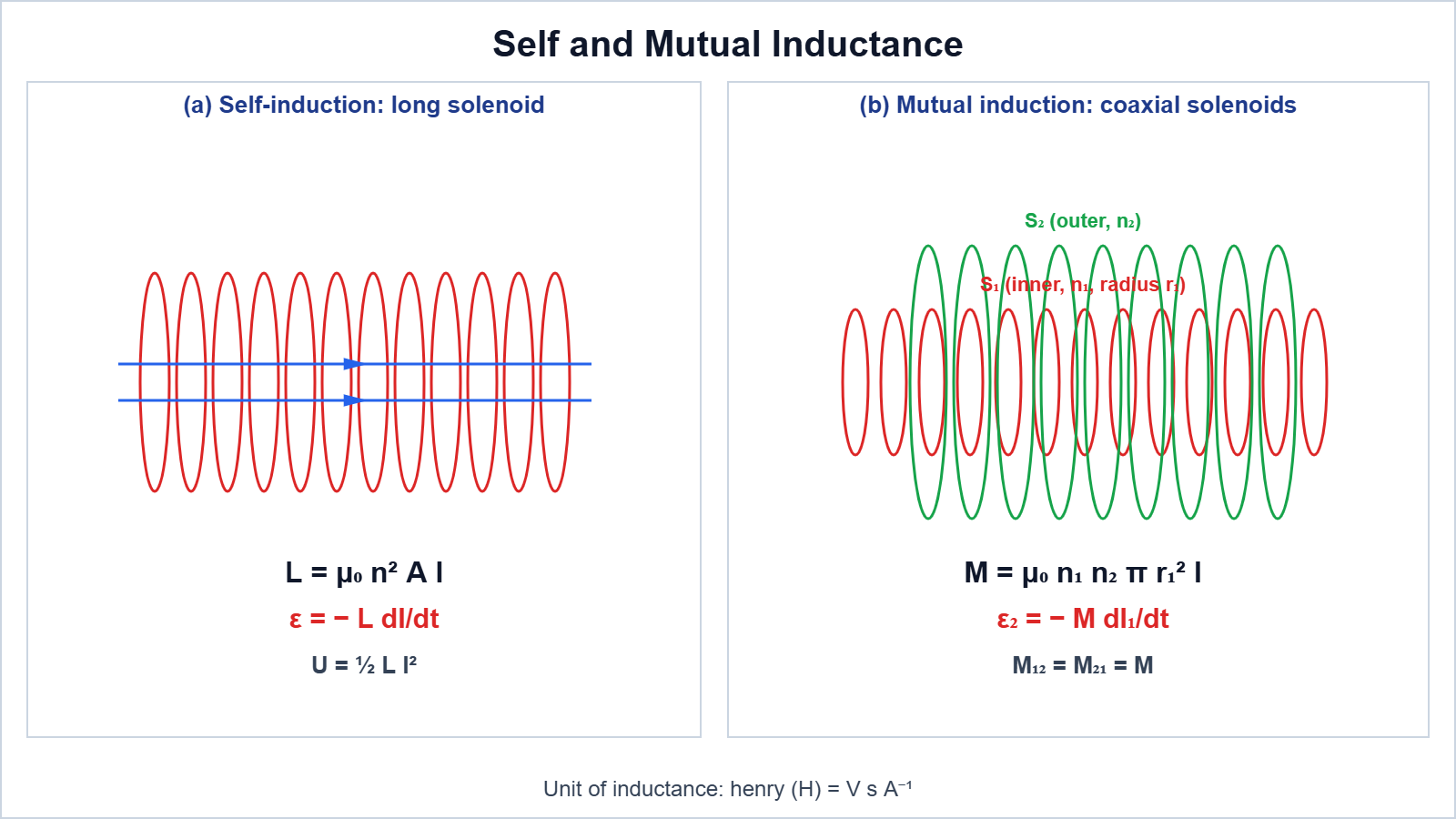
Mutual inductance: a changing current in one coil induces an EMF in a nearby coil: N2Φ2 = MI1 and ε2 = −M dI1/dt. Unit: henry (H).
Derivation: Mutual inductance of two long coaxial solenoids
- Inner solenoid S1: radius r1, n1 turns per unit length; outer S2: n2 turns per unit length; common length l.
- A current I2 in S2 gives B2 = μ0n2I2 inside it.
- Flux linkage with S1: N1Φ1 = (n1l)(πr12)(μ0n2I2) = M12I2.
- Similarly, a current in S1 gives the same value for M21.
Result: M = μ0n1n2πr12l (M12 = M21). With a core of relative permeability μr, M is multiplied by μr.
Self-inductance: a changing current in a coil induces an EMF in the coil itself: NΦ = LI and ε = −L dI/dt (back EMF). Inductance is the electrical analogue of mass (inertia).
Derivation: Self-inductance of a long solenoid
- Solenoid: n turns per unit length, length l, cross-section A; B = μ0nI inside.
- Total flux linkage NΦ = (nl)(μ0nI)A = μ0n2AlI.
- L = NΦ/I.
Result: L = μ0n2Al = μ0N2A/l
Derivation: Energy stored in an inductor
- To increase the current against the back EMF, the source does work at the rate dW/dt = |ε|I = L I dI/dt.
- W = ∫0I L I dI.
Result: U = ½LI2 (stored in the magnetic field).
Numerical 4: A solenoid 0.5 m long has 500 turns and a cross-sectional area of 2 × 10⁻³ m2. Find its self-inductance (air core).
Given: N = 500, l = 0.5 m, A = 2 × 10⁻³ m2
Formula: L = μ0N2A/l
Solution: L = 4π × 10-7 × 250000 × 2 × 10-3/0.5
Answer: L ≈ 1.26 × 10⁻³ H = 1.26 mH
Numerical 5: The current in a coil of inductance 0.2 H falls from 4 A to zero in 0.05 s. Find the average induced EMF.
Given: L = 0.2 H, ΔI = 4 A, Δt = 0.05 s
Formula: |ε| = L ΔI/Δt
Solution: |ε| = 0.2 × 4/0.05
Answer: ε = 16 V
Numerical 6: Find the energy stored in a 0.5 H inductor carrying 4 A.
Given: L = 0.5 H, I = 4 A
Formula: U = ½LI2
Solution: U = 0.5 × 0.5 × 16
Answer: U = 4 J
Numerical 7: A long solenoid of 300 turns and radius 1 cm is placed coaxially inside another of 600 turns; both are 0.4 m long. Find their mutual inductance.
Given: N1 = 300, N2 = 600, l = 0.4 m, r1 = 0.01 m
Formula: M = μ0N1N2πr12/l
Solution: M = 4π × 10-7 × 300 × 600 × π × 10-4/0.4
Answer: M ≈ 1.78 × 10⁻⁴ H
7. AC Generator
An AC generator converts mechanical energy into electrical energy. A coil of N turns and area A rotates with angular speed ω in a uniform field B. The flux at time t is Φ = BA cos ωt, so the EMF is ε = NBAω sin ωt = ε0 sin ωt, with peak value ε0 = NBAω. In India the mains frequency is 50 Hz.
Numerical 8: A coil of 100 turns and area 0.05 m2 rotates at 50 revolutions per second in a field of 0.2 T. Find the peak EMF.
Given: N = 100, A = 0.05 m2, B = 0.2 T, ω = 2π × 50 rad s-1
Formula: ε0 = NBAω
Solution: ε0 = 100 × 0.2 × 0.05 × 314.16
Answer: ε0 ≈ 314 V
Important: Induced EMF depends on the rate of change of flux, not on the flux itself. A coil with large flux but no change in flux has no induced EMF.
Easy Memory Trick: “Lenz says No”: the induced current always says “no” to the change in flux.
8. Practice Numericals (Answers Only)
- A 0.5 T field makes 60° with the normal to an area of 0.2 m2. Find the flux. Ans: 0.05 Wb.
- Flux through a coil changes by 5 × 10⁻³ Wb in 0.1 s. Find the EMF. Ans: 0.05 V.
- Find the energy stored in a 0.1 H inductor carrying 2 A. Ans: 0.2 J.
- A 0.3 m rod moves at 5 m s-1 perpendicular to a 0.4 T field. Find the EMF. Ans: 0.6 V.
- The number of turns of a solenoid is doubled, keeping its length and area unchanged. How does L change? Ans: It becomes 4 times.
9. Board-pattern Practice Questions
(a) Multiple Choice Questions
1. Lenz’s law is a consequence of conservation of
(A) charge (B) momentum (C) energy (D) mass
Ans. (C)
2. The SI unit of inductance is
(A) weber (B) tesla (C) henry (D) farad
Ans. (C)
3. The EMF induced in a rod moving parallel to B is
(A) Blv (B) zero (C) B2lv (D) maximum
Ans. (B)
4. Eddy currents are reduced by
(A) using solid cores (B) using laminated cores (C) increasing B (D) increasing frequency
Ans. (B)
(b) Assertion-Reason
Options: (A) Both A and R are true and R is the correct explanation of A. (B) Both A and R are true but R is not the correct explanation of A. (C) A is true but R is false. (D) A is false but R is true.
1. Assertion (A): A magnet falling through a copper tube falls more slowly than one falling freely.
Reason (R): Eddy currents induced in the tube oppose the motion of the magnet.
Ans. (A)
2. Assertion (A): Self-inductance of a coil is called electrical inertia.
Reason (R): It opposes any change of current in the coil, like mass opposes change of velocity.
Ans. (A)
(c) Match the Columns
Column I | Column II |
|---|---|
(i) Motional EMF | (p) ½LI2 |
(ii) Self-inductance of solenoid | (q) NBAω |
(iii) Energy in inductor | (r) Blv |
(iv) Peak EMF of generator | (s) μ0n2Al |
Ans. (i)-(r), (ii)-(s), (iii)-(p), (iv)-(q)
(d) Case Study
Case: Induction cooktops have a coil under a glass top carrying a high-frequency alternating current. A steel pan placed on top heats up quickly, while the glass top stays relatively cool.
(i) What phenomenon heats the pan?
Ans. Electromagnetic induction: the changing magnetic field induces eddy currents in the pan, which produce heat.
(ii) Why is a high frequency used?
Ans. The induced EMF depends on the rate of change of flux, so a higher frequency gives larger eddy currents.
(iii) Why does the glass not heat up directly?
Ans. Glass is an insulator, so no eddy currents flow in it.
(iv) Name one other device that uses eddy currents.
Ans. Electromagnetic brakes in trains (or induction furnace, damping in galvanometers).
(e) Long Answer Questions
Q1. Derive the expression for the EMF induced in a conducting rod moving on rails in a uniform magnetic field. Show that the mechanical power needed equals the electrical power dissipated.
Ans. See Section 4: ε = Blv; F = B2l2v/R; P = Fv = B2l2v2/R = ε2/R = I2R.
Q2. Define mutual inductance. Derive an expression for the mutual inductance of two long coaxial solenoids.
Ans. See Section 6: M = μ0n1n2πr12l.
10. Important Questions
Q1. State Faraday’s law of electromagnetic induction.
Ans. ε = −N dΦ/dt.
Q2. State Lenz’s law.
Ans. The induced current opposes the change in flux that produces it.
Q3. Define one weber.
Ans. The flux of a uniform field of 1 T through an area of 1 m2 perpendicular to it.
Q4. Define self-inductance.
Ans. L = NΦ/I; the EMF induced per unit rate of change of current in the same coil.
Q5. On what factors does the inductance of a solenoid depend?
Ans. Number of turns, area, length and the permeability of the core.
Q6. What are eddy currents?
Ans. Circulating currents induced in a bulk conductor by changing flux.
Q7. Give two uses of eddy currents.
Ans. Magnetic braking; induction furnace.
Q8. Where is the energy of an inductor stored?
Ans. In its magnetic field.
Q9. A bar magnet is dropped through a closed coil. Is its acceleration equal to g?
Ans. No, less than g, because the induced current opposes its motion.
Q10. Write the expression for EMF of an AC generator.
Ans. ε = NBAω sin ωt.
Conclusion: A changing magnetic flux induces an EMF (Faraday’s law) whose direction opposes the change (Lenz’s law). Motional EMF, eddy currents, self and mutual inductance and the AC generator are all applications of this single principle.