Dual Nature of Radiation and Matter – Physics Class 12 Notes
Chapter – 11
Dual Nature of Radiation and Matter
1. Electron Emission and the Photoelectric Effect
Free electrons in a metal are held by attractive forces of the ions. The minimum energy needed to remove an electron from the metal surface is the work function φ0, usually expressed in electron volts (1 eV = 1.6 × 10⁻¹⁹ J). Electrons can be emitted by heating (thermionic emission), by a strong electric field (field emission), or by light (photoelectric emission).
Photoelectric effect: emission of electrons from a metal surface when light of suitable frequency falls on it. Hertz (1887) noticed that UV light helped sparks jump across a gap; Hallwachs and Lenard studied the effect in detail. Alkali metals (Li, Na, K, Cs) show the effect even with visible light; zinc, cadmium and magnesium need ultraviolet light.
2. Experimental Study
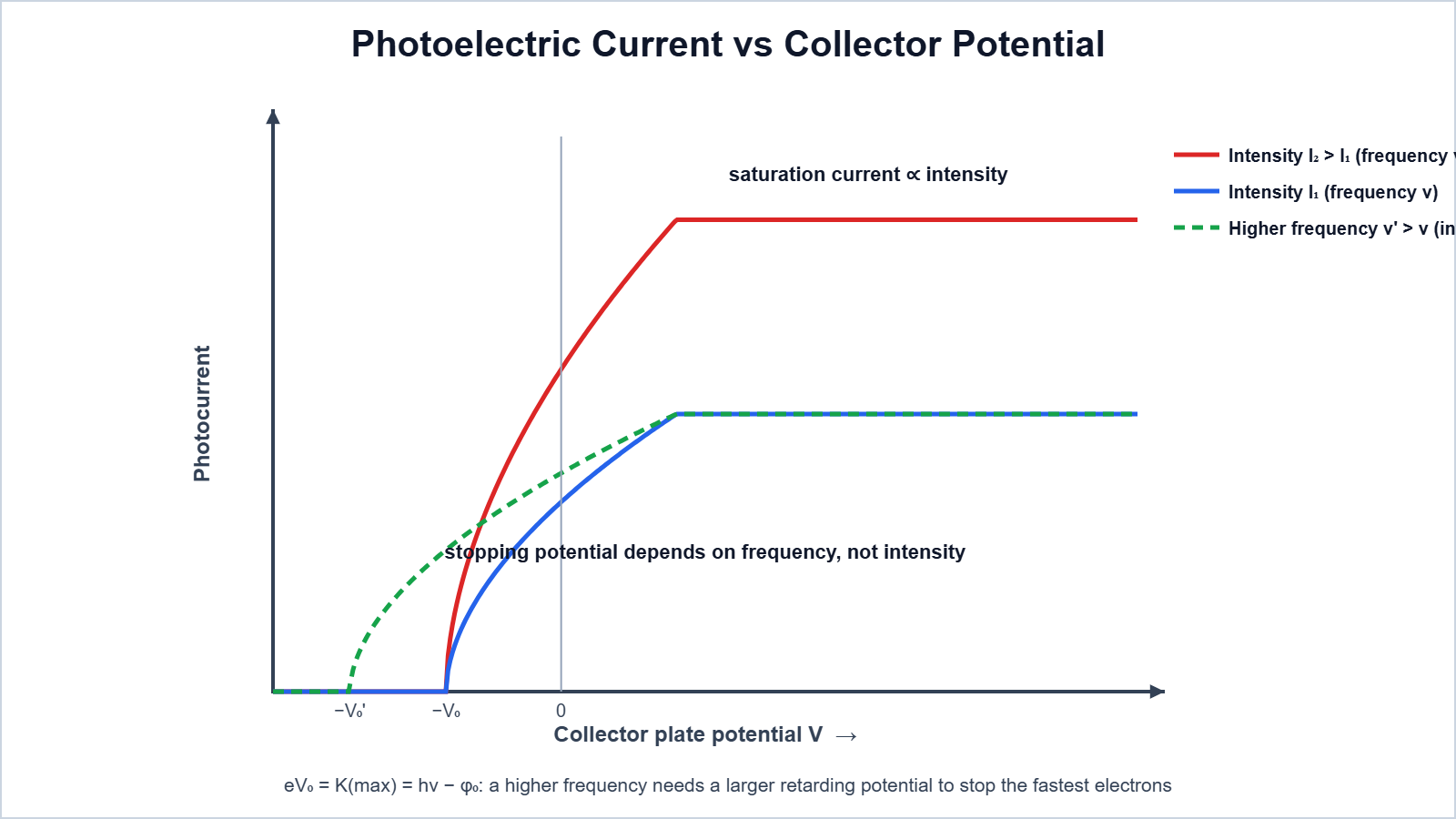
Light falls on an emitter plate C in an evacuated tube; emitted electrons are collected by plate A. The photocurrent is measured while the potential of A is varied.
Variable | Observation |
|---|---|
Intensity of light (fixed ν, accelerating potential) | Photocurrent (and number of photoelectrons per second) is directly proportional to intensity. |
Potential of collector | Current increases with accelerating potential up to a saturation value. With a retarding potential, current decreases and becomes zero at the stopping potential V0: eV0 = Kmax. |
Intensity at fixed ν | Saturation current changes but V0 does not: Kmax is independent of intensity. |
Frequency | V0 (hence Kmax) increases linearly with ν. Below a threshold frequency ν0 no emission occurs, however intense the light. |
Time | Emission is instantaneous (within about 10-9 s), even for very dim light. |
Important: These observations cannot be explained by the wave theory, which predicts that Kmax should increase with intensity, that any frequency should work given enough time, and that there should be a delay for dim light.
3. Einstein’s Photoelectric Equation
Einstein (1905) proposed that light consists of photons, each of energy E = hν. A photon gives all its energy to a single electron. Part of it (φ0) is used to free the electron and the rest appears as kinetic energy:
Kmax = hν − φ0 = h(ν − ν0) = eV0, where φ0 = hν0.
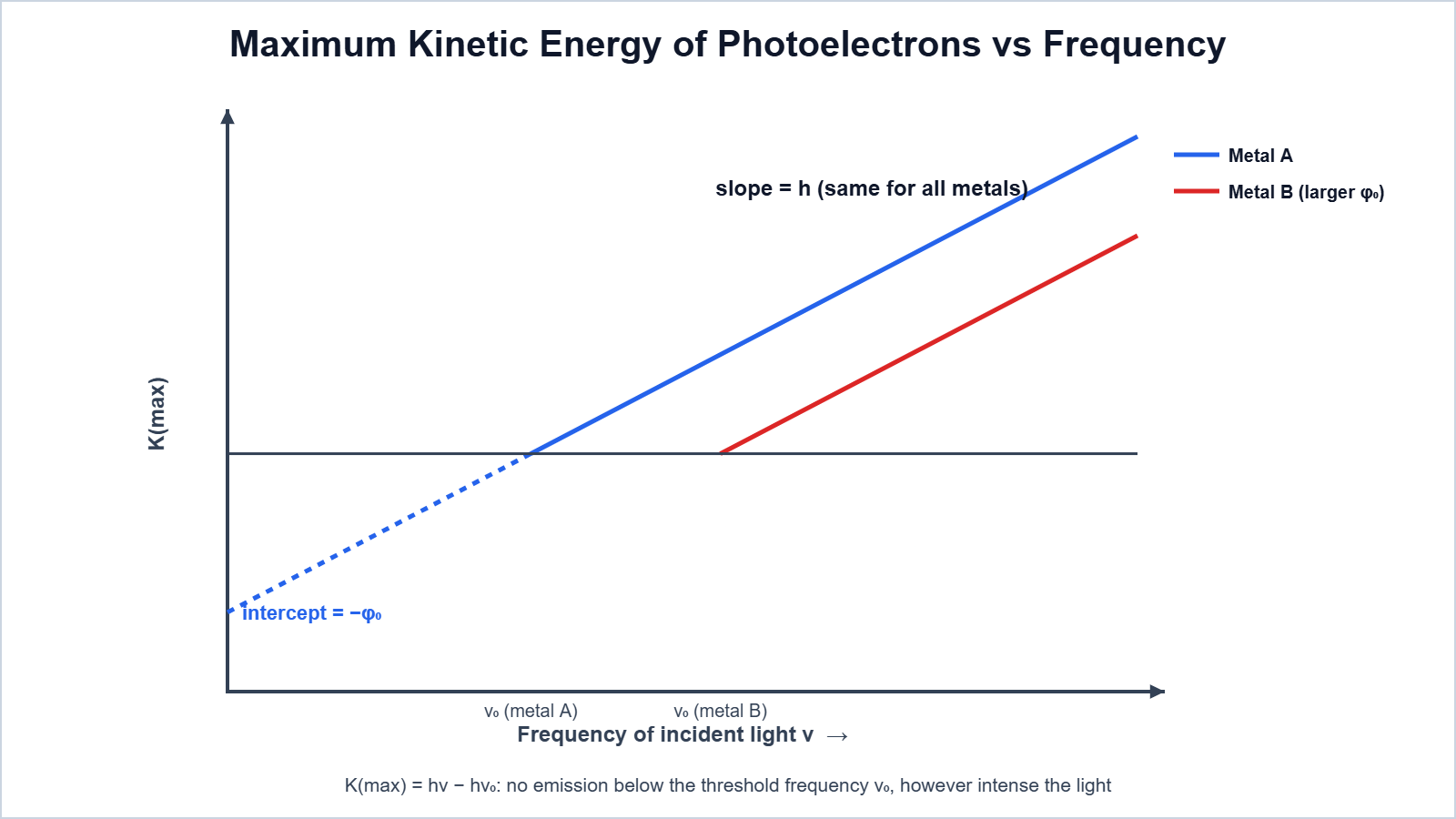
- If ν < ν0, Kmax would be negative, so no emission: the threshold frequency.
- Kmax depends on ν, not on intensity; intensity only changes the number of photons, hence the current.
- A single photon-electron interaction is instantaneous, so there is no time lag.
- The graph of V0 versus ν is a straight line of slope h/e for every metal; its intercept on the ν axis is ν0.
Photon properties: energy E = hν = hc/λ; momentum p = h/λ = hν/c; rest mass zero; speed c in vacuum; photons are electrically neutral and are not deflected by electric or magnetic fields. In a collision with an electron, energy and momentum are conserved, but the number of photons may not be.
Numerical 1: Find the energy of a photon of wavelength 500 nm in joules and in electron volts.
Given: λ = 500 × 10-9 m, h = 6.63 × 10⁻³⁴ J s, c = 3 × 10⁸ m s-1
Formula: E = hc/λ
Solution: E = 6.63 × 10-34 × 3 × 108/(5 × 10-7) = 3.98 × 10⁻¹⁹ J; in eV: 3.98 × 10⁻¹⁹/1.6 × 10-19
Answer: E ≈ 3.98 × 10⁻¹⁹ J ≈ 2.49 eV
Numerical 2: Light of wavelength 400 nm falls on a metal of work function 2.0 eV. Find the maximum kinetic energy of the photoelectrons and the stopping potential.
Given: λ = 400 nm, φ0 = 2.0 eV
Formula: Kmax = hc/λ − φ0; V0 = Kmax/e
Solution: hc/λ = 6.63 × 10-34 × 3 × 108/(4 × 10-7) = 4.97 × 10⁻¹⁹ J = 3.11 eV; Kmax = 3.11 − 2.0
Answer: Kmax ≈ 1.11 eV; V0 ≈ 1.11 V
Numerical 3: The work function of a metal is 2.3 eV. Find its threshold frequency and threshold wavelength.
Given: φ0 = 2.3 eV = 2.3 × 1.6 × 10-19 J
Formula: ν0 = φ0/h; λ0 = c/ν0
Solution: ν0 = 3.68 × 10⁻¹⁹/6.63 × 10-34 = 5.55 × 10¹⁴ Hz; λ0 = 3 × 10⁸/5.55 × 1014
Answer: ν0 ≈ 5.55 × 10¹⁴ Hz; λ0 ≈ 540 nm
Numerical 4: A 10 W source emits light of wavelength 600 nm. How many photons does it emit per second?
Given: P = 10 W, λ = 600 × 10-9 m
Formula: n = P/E = Pλ/hc
Solution: E = 6.63 × 10-34 × 3 × 108/(6 × 10-7) = 3.315 × 10⁻¹⁹ J; n = 10/3.315 × 10-19
Answer: n ≈ 3.02 × 10¹⁹ photons per second
Numerical 5: Find the momentum of a photon of wavelength 500 nm.
Given: λ = 5 × 10⁻⁷ m
Formula: p = h/λ
Solution: p = 6.63 × 10⁻³⁴/(5 × 10-7)
Answer: p ≈ 1.33 × 10⁻²⁷ kg m s-1
4. Wave Nature of Matter
Since radiation has a dual (wave-particle) nature, de Broglie (1924) proposed that moving particles of matter also have wave properties. The de Broglie wavelength of a particle of momentum p is λ = h/p = h/mv.
Derivation: de Broglie wavelength of an electron accelerated through V volts
- Kinetic energy gained: K = ½mv2 = eV.
- Momentum p = mv = √(2mK) = √(2meV).
- λ = h/p = h/√(2meV).
- Substituting h = 6.63 × 10⁻³⁴ J s, m = 9.1 × 10⁻³¹ kg, e = 1.6 × 10⁻¹⁹ C: λ = 1.227 × 10⁻⁹/√V m.
Result: λ = 1.227/√V nm. The wavelength is significant only for very small masses; for everyday objects it is far too small to detect.
Numerical 6: Find the de Broglie wavelength of an electron accelerated through 100 V.
Given: V = 100 V, m = 9.1 × 10⁻³¹ kg
Formula: λ = h/√(2meV)
Solution: √(2 × 9.1 × 10-31 × 1.6 × 10-19 × 100) = 5.40 × 10⁻²⁴ kg m s-1; λ = 6.63 × 10⁻³⁴/5.40 × 10-24
Answer: λ ≈ 1.23 × 10⁻¹⁰ m = 0.123 nm (comparable to X-ray wavelengths, so electrons can be diffracted by crystals)
Numerical 7: Find the de Broglie wavelength of a 0.1 kg ball moving at 10 m s-1.
Given: m = 0.1 kg, v = 10 m s-1
Formula: λ = h/mv
Solution: λ = 6.63 × 10⁻³⁴/(0.1 × 10)
Answer: λ = 6.63 × 10⁻³⁴ m – far too small to observe, so the ball shows no wave behaviour
5. Davisson-Germer Experiment
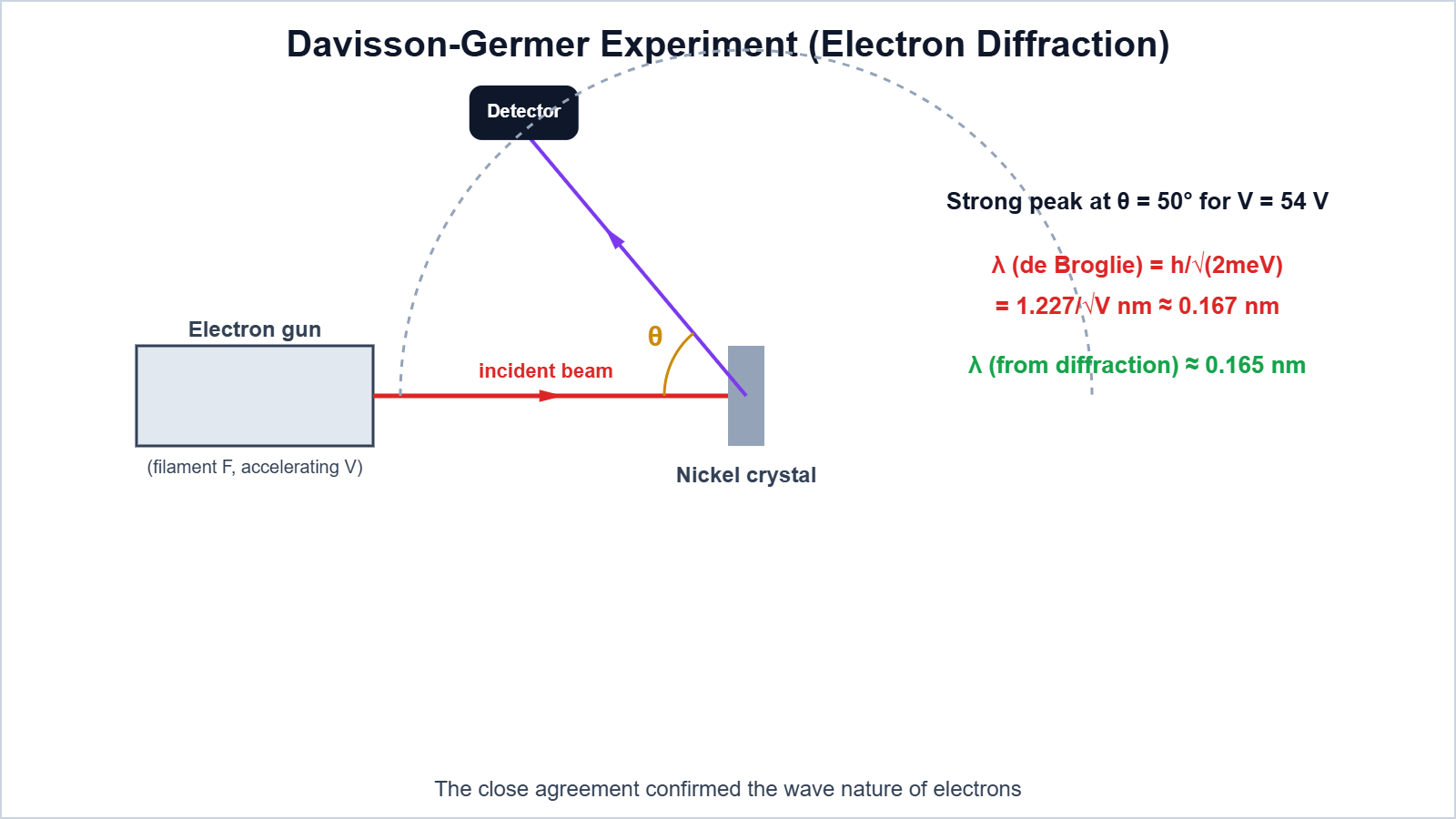
A beam of electrons from an electron gun, accelerated through a voltage V, was directed normally at a nickel crystal and the intensity of scattered electrons was measured at different angles. A strong peak was observed at a scattering angle of 50° for V = 54 V. Treating the crystal as a diffraction grating gave λ ≈ 0.165 nm, while de Broglie’s formula gives λ = 1.227/√54 ≈ 0.167 nm. This close agreement (1927) confirmed the wave nature of electrons. Electron microscopes use this wave nature to achieve much higher resolution than optical microscopes.
Easy Memory Trick: “Frequency Fixes the Fastest; Intensity Increases the number”.
6. Practice Numericals (Answers Only)
- Find the energy in eV of a photon of wavelength 620 nm. Ans: about 2.0 eV.
- Kmax of photoelectrons is 1.5 eV. Find the stopping potential. Ans: 1.5 V.
- Find the de Broglie wavelength of an electron accelerated through 400 V. Ans: 0.0614 nm.
- If the intensity of light is doubled, what happens to Kmax? Ans: No change (photocurrent doubles).
- Express a work function of 4.2 eV in joules. Ans: 6.72 × 10⁻¹⁹ J.
7. Board-pattern Practice Questions
(a) Multiple Choice Questions
1. The stopping potential depends on
(A) intensity of light (B) frequency of light (C) area of the plate (D) time of exposure
Ans. (B)
2. The slope of the V0-ν graph is
(A) h (B) h/e (C) e/h (D) φ0
Ans. (B)
3. The de Broglie wavelength of an electron accelerated through 100 V is about
(A) 1.23 nm (B) 0.123 nm (C) 12.3 nm (D) 0.0123 nm
Ans. (B)
4. Photoelectric emission is
(A) delayed by 1 s (B) instantaneous (C) dependent on intensity for its start (D) possible below ν0
Ans. (B)
(b) Assertion-Reason
Options: (A) Both A and R are true and R is the correct explanation of A. (B) Both A and R are true but R is not the correct explanation of A. (C) A is true but R is false. (D) A is false but R is true.
1. Assertion (A): Photoelectrons are not emitted below the threshold frequency, however intense the light.
Reason (R): The energy of a photon depends on its frequency, not on the intensity of light.
Ans. (A)
2. Assertion (A): A cricket ball shows no observable wave nature.
Reason (R): Its de Broglie wavelength is extremely small because its mass is large.
Ans. (A)
(c) Match the Columns
Column I | Column II |
|---|---|
(i) Photon energy | (p) h/p |
(ii) Einstein’s equation | (q) hν |
(iii) de Broglie wavelength | (r) 1.227/√V nm |
(iv) Electron wavelength | (s) Kmax = hν − φ0 |
Ans. (i)-(q), (ii)-(s), (iii)-(p), (iv)-(r)
(d) Case Study
Case: Solar calculators, automatic street lights and burglar alarms use photocells. When light falls on the cell, electrons are emitted and a current flows; when the light is cut off or blocked, the current stops and a circuit is switched.
(i) Which effect is used in a photocell?
Ans. The photoelectric effect.
(ii) Why might a photocell with a zinc cathode not work with visible light?
Ans. Zinc has a high work function; its threshold frequency lies in the ultraviolet.
(iii) What happens to the current if the light intensity is increased?
Ans. It increases (more photons, more electrons).
(iv) A cathode has φ0 = 2 eV. Will light of 700 nm (1.78 eV per photon) cause emission?
Ans. No, because the photon energy is less than the work function.
(e) Long Answer Questions
Q1. State the laws of photoelectric emission. Explain them using Einstein’s photoelectric equation.
Ans. See Sections 2 and 3.
Q2. What is the de Broglie hypothesis? Derive the de Broglie wavelength of an electron accelerated through a potential V. Describe how the Davisson-Germer experiment confirmed it.
Ans. See Sections 4 and 5: λ = h/√(2meV) = 1.227/√V nm; peak at 50° for 54 V gave λ ≈ 0.165 nm.
8. Important Questions
Q1. Define work function.
Ans. The minimum energy needed to remove an electron from the surface of a metal.
Q2. Define threshold frequency.
Ans. The minimum frequency of light that can cause photoelectric emission from a given metal.
Q3. What is stopping potential?
Ans. The minimum retarding potential that stops the most energetic photoelectrons.
Q4. Write Einstein’s photoelectric equation.
Ans. Kmax = hν − φ0.
Q5. Why does wave theory fail to explain the photoelectric effect?
Ans. It cannot explain the threshold frequency, the independence of Kmax from intensity, or instantaneous emission.
Q6. Write two properties of photons.
Ans. Energy hν; momentum h/λ; zero rest mass; speed c.
Q7. Write the de Broglie relation.
Ans. λ = h/p.
Q8. An electron and a proton have the same kinetic energy. Which has the longer de Broglie wavelength?
Ans. The electron, since λ = h/√(2mK) and its mass is smaller.
Q9. What did the Davisson-Germer experiment prove?
Ans. The wave nature of electrons.
Q10. What is the effect of frequency on photocurrent at fixed intensity?
Ans. Saturation current remains the same (above threshold); only V0 increases.
Conclusion: The photoelectric effect shows that light behaves as particles (photons), while electron diffraction shows that matter behaves as waves. Radiation and matter both have a dual nature.