Network Classification- LAN, MAN, WAN, PAN.
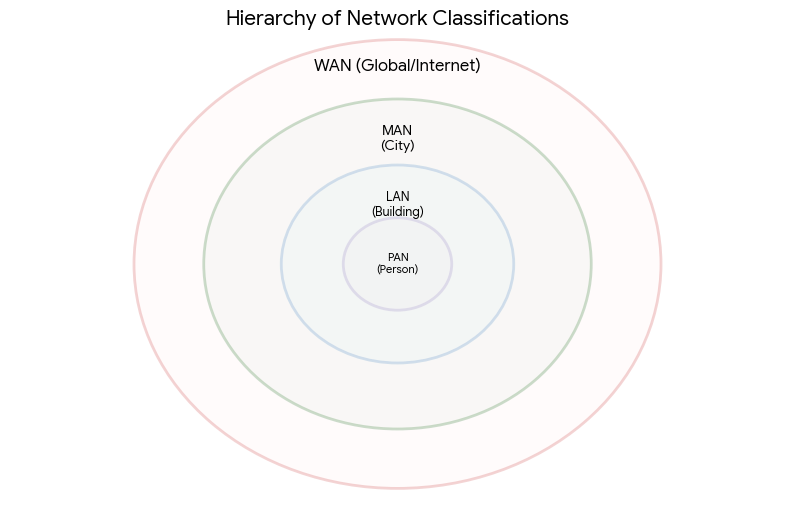
Computer networks are classified based on the geographical area they cover. They range from a few meters around a person to thousands of kilometers across the globe.
1. PAN (Personal Area Network)
A PAN is a small network used for communication among personal devices within a short range (usually up to 10 meters).
Examples: Mobile phone, laptop, Bluetooth devices, smartwatch.
Advantages:
- Easy to set up and use
- Low cost
- No need for complex infrastructure
- Portable and flexible
Disadvantages:
- Very limited range
- Low data transfer speed
- Less secure compared to larger networks
2. LAN (Local Area Network)
A LAN connects computers within a small geographical area like a home, school, or office.
Examples: School computer lab, office network, home Wi-Fi.
Advantages:
- High data transfer speed
- Easy resource sharing (printers, files)
- Better security than larger networks
- Low maintenance cost
Disadvantages:
- Limited coverage area
- Requires technical setup and management
- Network failure can affect all connected devices
3. MAN (Metropolitan Area Network)
A MAN covers a city or large campus and connects multiple LANs.
Examples: City-wide internet network, cable TV network.
Advantages:
- Covers a larger area than LAN
- High-speed connectivity
- Efficient for communication within a city
Disadvantages:
- Expensive to set up
- Complex management
- Security issues due to larger size
4. WAN (Wide Area Network)
A WAN covers a very large geographical area (countries or continents) and connects multiple LANs and MANs.
Examples: The Internet, banking networks.
Advantages:
- Global connectivity
- Allows communication over long distances
- Useful for large organizations
Disadvantages:
- High setup and maintenance cost
- Slower speed compared to LAN
- More security risks
- Complex to manage