Transmission Media and its types
Transmission Media (also known as communication channels) are the physical paths through which data is transferred from one computer or device to another. They act as the “highway” for electrical or electromagnetic signals.
These are broadly classified into two categories: Guided (Wired) and Unguided (Wireless).
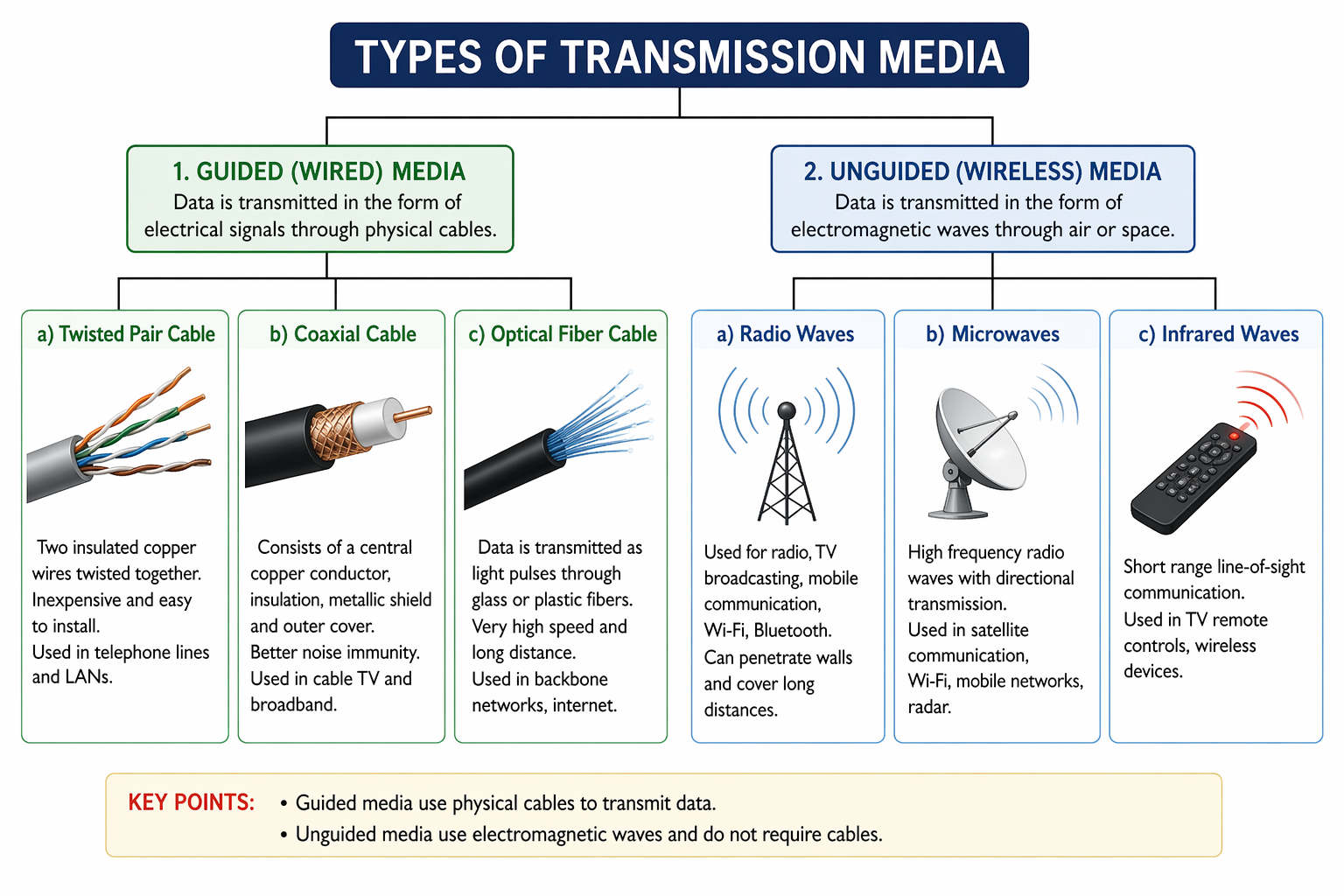
Guided Media
Guided media (also known as Wired or Bounded media) uses physical cables to transmit data. The signal is “guided” or contained within the physical boundaries of the medium.
Here are the three primary types with their advantages and disadvantages:
1. Twisted Pair Cable
This consists of pairs of copper wires twisted around each other to reduce electrical interference. It is the most common cable used in Local Area Networks (LANs).
- Advantages:
- It is the cheapest transmission medium available.
- It is thin, flexible, and very easy to install or move.
- Most networking professionals are highly trained in handling this cable.
- Disadvantages:
- It has lower data rates compared to other cables.
- The signal weakens quickly (attenuation), usually requiring a repeater every 100 meters.
- It is susceptible to electromagnetic interference (EMI).
2. Coaxial Cable
This cable has a central copper conductor, a surrounding layer of flexible insulation, and a metallic shield (braid) to block outside noise.
- Advantages:
- It can carry more data than twisted pair.
- The metal braid provides excellent protection against external interference.
- It is physically stronger and lasts longer than twisted pair.
- Disadvantages:
- The cable is thick and stiff, making it harder to pull through narrow pipes.
- It is more expensive than twisted pair.
- If the main cable (bus) is damaged, the entire network branch can go down.
3. Fiber Optic Cable
This high-tech cable uses pulses of light to transmit data through thin strands of glass or plastic.
- Advantages:
- It offers the highest bandwidth and fastest data rates.
- Light signals can travel for miles without losing much strength.
- Since it uses light, it is completely unaffected by electricity or lightning.
- It is extremely difficult to “tap” into a light signal without being detected.
- Disadvantages:
- Both the cable and the equipment (lasers/detectors) are high-cost.
- The glass core is brittle and can break if bent too sharply.
- It requires specialized tools and expert technicians to join (splice) the cables.
Unguided media
Unguided media, or Wireless communication, transmits electromagnetic waves through the air, vacuum, or water without using a physical cable. The signals are broadcasted and can be received by anyone with the right equipment within range.
Here are the three primary types of unguided media:
1. Radio Waves
Radio waves are omnidirectional (they travel in all directions) and use frequencies between 3 kHz and 1 GHz. They are commonly used for Wi-Fi, Bluetooth, and FM radio.
- Advantages:
- They can penetrate walls and obstacles, so the sender and receiver don’t need to see each other.
- Ideal for broadcasting information to many people simultaneously over a large area.
- Disadvantages:
- Signals can be easily disrupted by weather or other electronic devices.
- Since the signal goes everywhere, it is easier for unauthorized users to intercept it.
2. Microwaves
Microwaves are unidirectional (they travel in a straight line) and use higher frequencies (1 GHz to 300 GHz). They are used for satellite links and mobile networks (4G/5G).
- Advantages:
- They can carry much more data than radio waves.
- No need to lay expensive physical cables over difficult terrains like mountains or oceans.
- Disadvantages:
- The transmitter and receiver must be perfectly aligned with no obstacles between them.
- Heavy rain or “rain fade” can significantly weaken the signal.
3. Infrared
Infrared uses very high frequencies (300 GHz to 400 THz) for short-range communication. You use this every time you change the channel on your TV.
- Advantages:
- Because they cannot pass through walls, your neighbor cannot control your TV from their house.
- The technology is very cheap to manufacture.
- Disadvantages:
- Only works over a few meters.
- Even a person walking in front of the remote will block the signal.