Data communication fundamentals Analog and Digital signal transmission
Data communication involves transforming information into electromagnetic signals for transmission over physical media. These signals can be broadly classified into two categories based on their representation of values: Analog and Digital.
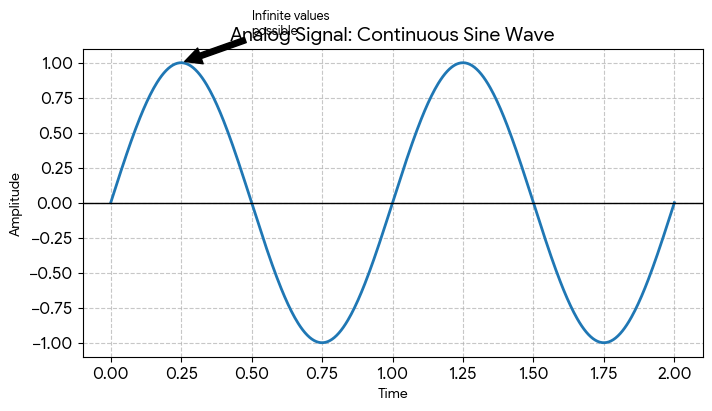
Characteristics: Represented by sine waves; defined by amplitude, frequency, and phase.
Examples: Human voice, AM/FM radio, traditional telephone lines.
Pros/Cons: High density and natural representation, but highly sensitive to noise and distortion.
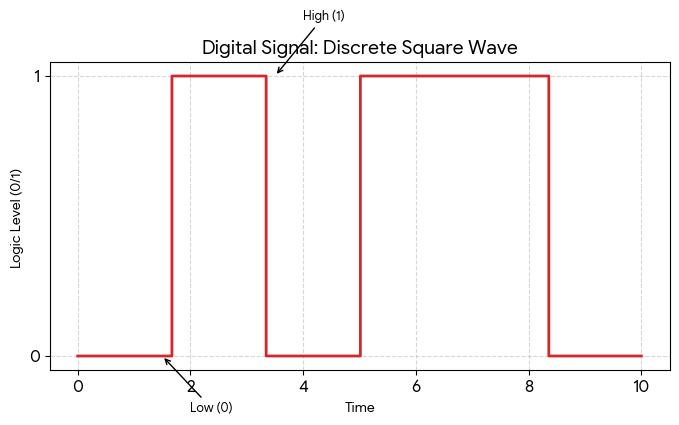
Characteristics: Represented by square waves; characterized by bit rate and bit interval.
Examples: Computer networks (Ethernet), digital TV, mobile phones.
Pros/Cons: Highly resistant to noise and easy to compress/encrypt, but generally requires more bandwidth.