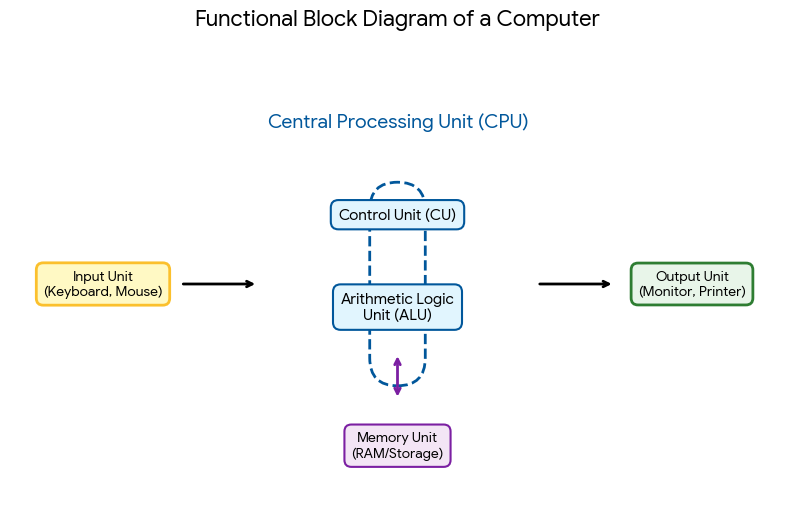
A block diagram of a computer shows how data flows between the three main components: Input, the Central Processing Unit (CPU), and Output.
Block Diagram of a Computer
This diagram represents the functional organization of a computer system:
Core Components
- Input Unit: Accepts raw data from the user and converts it into a binary form that the computer can understand.
- Central Processing Unit (CPU): The “brain” of the computer. It has two main parts:
- Control Unit (CU): It doesn’t process data itself but acts as a supervisor, directing the flow of data between the ALU, memory, and I/O devices.
- Arithmetic Logic Unit (ALU): Performs all calculations (addition, subtraction) and logical comparisons (equal to, greater than).
- Memory Unit: Stores data and instructions. The CPU pulls data from here for processing and sends the results back to be stored.
- Output Unit: Converts the processed binary data back into a human-readable format (text, image, sound).