Transport and Communication (India) – Geography Class 12 Notes
Part B: India – People and Economy
Chapter – 7
Transport and Communication (India)
1. Land Transport: Roads
India has one of the largest road networks in the world. Roads carry most passengers and goods because they are flexible and reach remote areas. Pradhan Mantri Gram Sadak Yojana (PMGSY) aims to connect villages with all-weather roads.
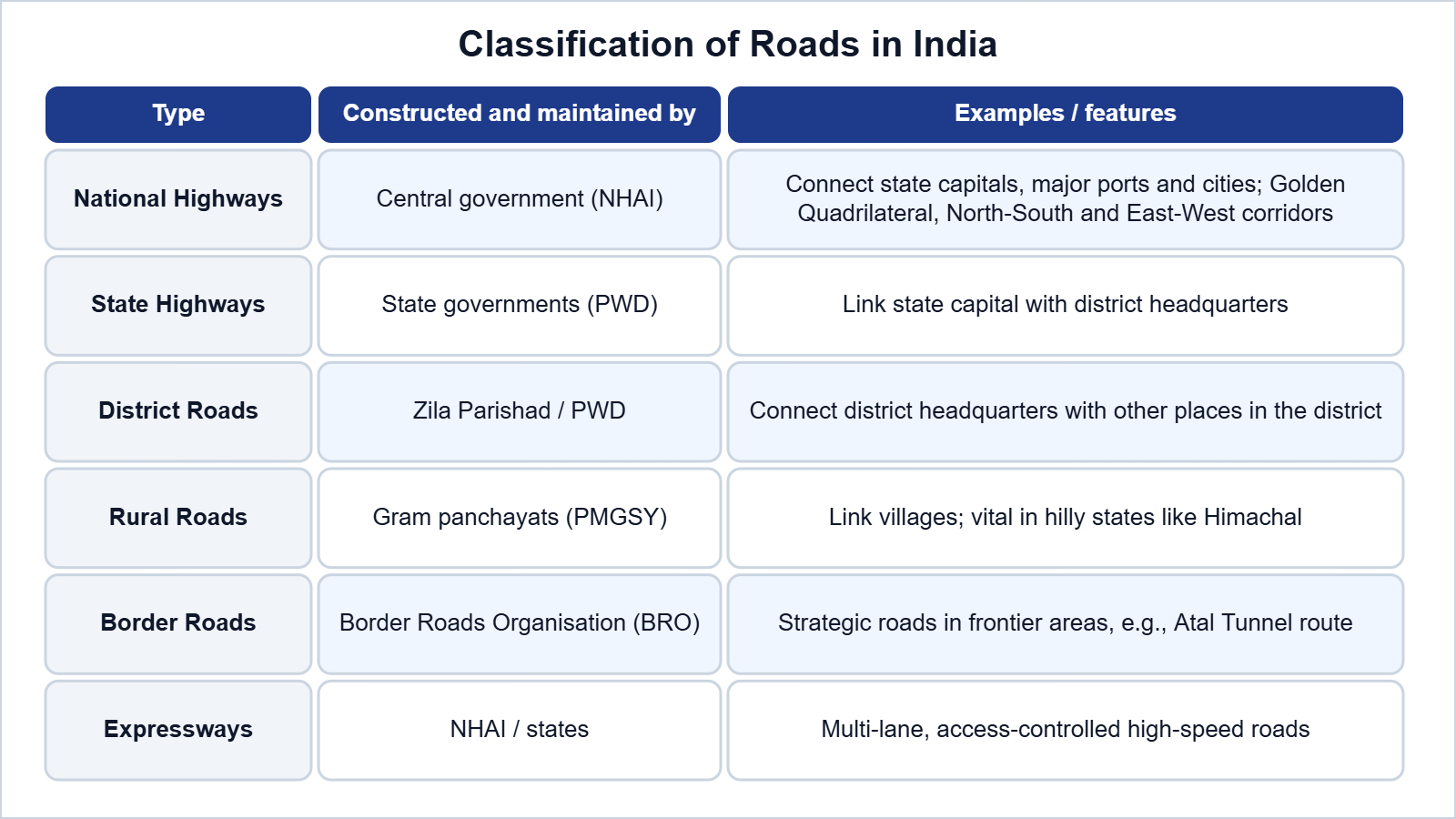
Golden Quadrilateral links Delhi, Mumbai, Chennai and Kolkata. The North-South corridor links Srinagar with Kanyakumari, and the East-West corridor links Silchar (Assam) with Porbandar (Gujarat).
Example: In Himachal Pradesh, roads are the main means of transport; the Atal Tunnel under the Rohtang Pass gives all-weather access to the Lahaul valley.
2. Rail Transport
Indian Railways is one of the largest railway systems in the world and the largest public undertaking in India. It is divided into zones for management. Railways carry bulky goods and passengers cheaply over long distances.

Konkan Railway (completed in 1998) runs along the west coast through Maharashtra, Goa and Karnataka; it crosses many rivers and tunnels and is an engineering marvel. Metro railways in big cities have reduced congestion.
3. Water Transport
Water transport is cheap and fuel-efficient for bulky goods. Inland waterways: rivers, canals, backwaters and creeks. Important National Waterways:
National Waterway | Stretch | Length (km) |
|---|---|---|
NW-1 | Ganga: Allahabad (Prayagraj) to Haldia | 1,620 |
NW-2 | Brahmaputra: Sadiya to Dhubri | 891 |
NW-3 | West Coast Canal: Kottapuram to Kollam (Kerala) | 205 |
Oceanic routes: India has a long coastline with major and minor ports. Most of India’s foreign trade by volume moves by sea.
4. Air Transport and Pipelines
Air transport is the fastest means and is very important for a large country with difficult terrain like the Himalaya and the north-east. The Airports Authority of India manages airports; international, domestic and regional connectivity schemes have expanded flights. Himachal Pradesh has airports at Shimla (Jubbarhatti), Kullu (Bhuntar) and Kangra (Gaggal).
Pipelines carry oil, gas and water. Example: the HBJ gas pipeline (Hazira-Bijaipur-Jagdishpur) carries natural gas from Gujarat to fertiliser and power plants in northern India.
5. Communication Networks
Type | Examples |
|---|---|
Personal communication | Post, telephone, mobile phones, e-mail, internet |
Mass communication | Radio, television, newspapers, films, social media |
Satellite communication | INSAT for telecommunication, TV and weather; IRS satellites for remote sensing of resources |
Remember: satellites have revolutionised communication, weather forecasting, disaster warning and resource mapping.
Exam point: Prasar Bharati manages All India Radio (Akashvani) and Doordarshan.
6. Important Questions
Q1. Name the agencies that build National Highways and State Highways.
Ans. NHAI (central government) and state public works departments.
Q2. What is the Golden Quadrilateral?
Ans. A highway network linking Delhi, Mumbai, Chennai and Kolkata.
Q3. Name the cities linked by the North-South and East-West corridors.
Ans. Srinagar-Kanyakumari; Silchar-Porbandar.
Q4. What are the three railway gauges of India?
Ans. Broad (1.676 m), metre (1.000 m) and narrow (0.762 m / 0.610 m).
Q5. Name two narrow-gauge railways of Himachal Pradesh.
Ans. Kalka-Shimla and Pathankot-Jogindernagar.
Q6. Why is the Konkan Railway important?
Ans. It links the west coast through difficult terrain with many bridges and tunnels, saving time and distance.
Q7. Name National Waterway 1.
Ans. The Ganga from Allahabad (Prayagraj) to Haldia.
Q8. What is the HBJ pipeline?
Ans. A gas pipeline from Hazira (Gujarat) to Bijaipur and Jagdishpur.
Q9. Distinguish between personal and mass communication.
Ans. Personal communication is between individuals (phone, mail); mass communication reaches many people (TV, radio).
Q10. What is the role of INSAT?
Ans. Telecommunication, television broadcasting and weather forecasting.
Easy Memory Trick: Waterways “1-2-3” = Ganga, Brahmaputra, West Coast Canal.
Conclusion: A well-developed network of roads, railways, waterways, airways, pipelines and communication links integrates India’s economy and society, and is especially vital for hilly states like Himachal Pradesh.