Planning and Sustainable Development in Indian Context – Geography Class 12 Notes
Part B: India – People and Economy
Chapter – 6
Planning and Sustainable Development in Indian Context
1. Planning
Planning means thinking out a course of action, formulating a scheme or programme and implementing it to achieve goals. India adopted planned development after Independence. The Planning Commission (1950) prepared Five Year Plans; the last (12th) plan ended in 2017. In January 2015 the Planning Commission was replaced by NITI Aayog, a policy think-tank of the Government of India.
Approach | Meaning |
|---|---|
Sectoral planning | Programmes for sectors such as agriculture, irrigation, industry, power, transport, health |
Regional planning | Development of backward regions to reduce regional imbalance |
2. Target Area and Target Group Planning
Target area programmes focus on specific regions, e.g., the Command Area Development Programme, the Drought Prone Area Programme (DPAP) and the Hill Area Development Programme. Target group programmes focus on specific groups, such as the Small Farmers Development Agency (SFDA) and the Marginal Farmers Development Agency.
Hill Area Development Programme was started in the Fifth Five Year Plan for hilly areas. It aimed to develop horticulture, plantation agriculture, animal husbandry, poultry, forestry, small and village industries, using local resources and the people’s participation.
Drought Prone Area Programme was started in the Fourth Five Year Plan to provide employment and create productive assets in drought-prone areas through irrigation, land development, afforestation and pasture development.
3. Case Study: Bharmaur Tribal Region (Himachal Pradesh)
The Bharmaur tribal region lies in the Chamba district of Himachal Pradesh, in the Ravi valley. It has a harsh climate, steep slopes and limited cultivable land. It is the home of the Gaddis, a tribal community that traditionally practised transhumance with sheep and goats.
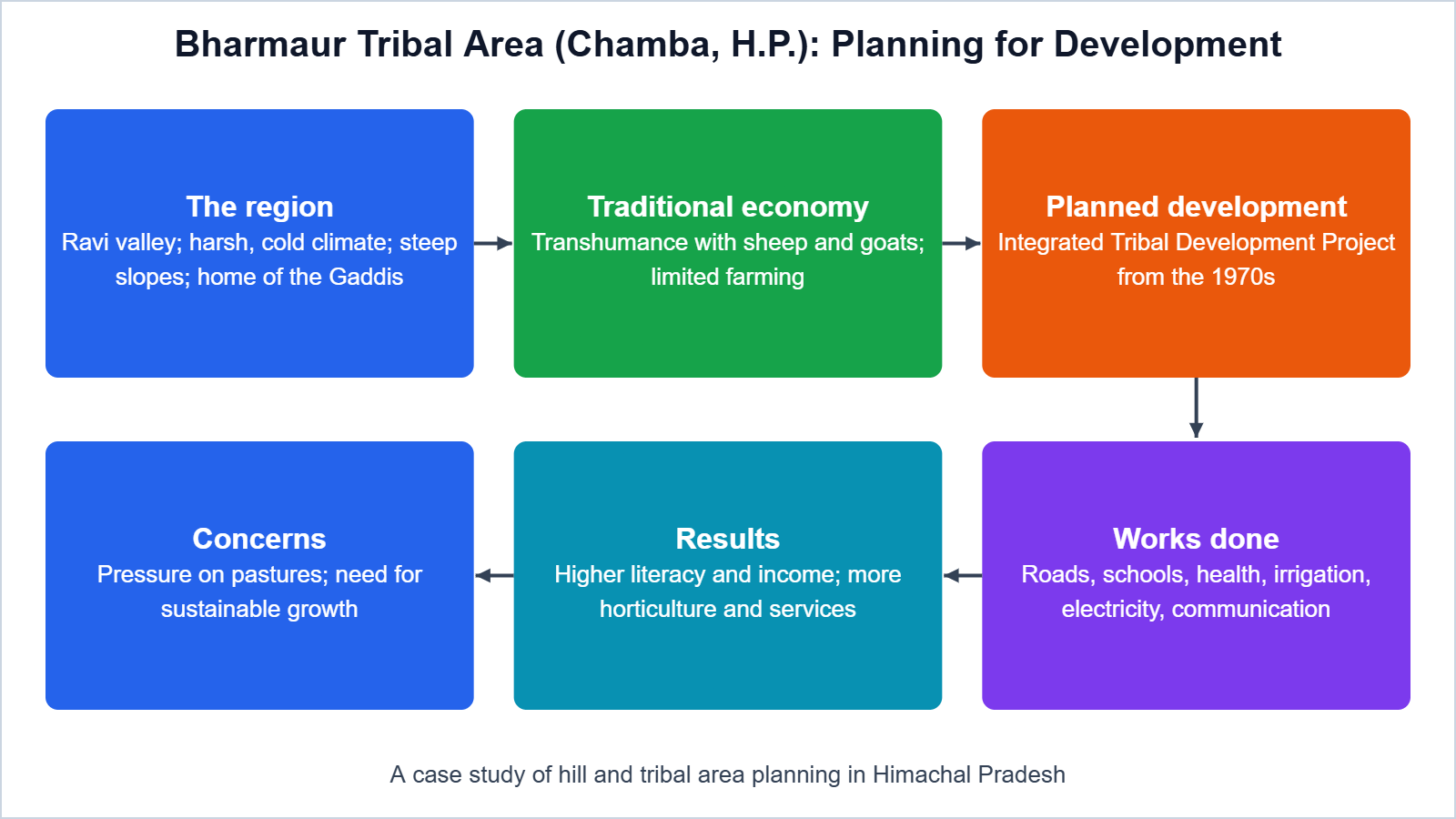
Bharmaur was notified as a tribal area, and an Integrated Tribal Development Project was launched in the 1970s (Fifth Five Year Plan). Development focused on transport and communication, agriculture and allied activities, and social and community services (schools, health centres, drinking water, electricity). Literacy, incomes and access to services improved, and horticulture and service jobs grew, while traditional pastoralism declined in importance.
4. Sustainable Development
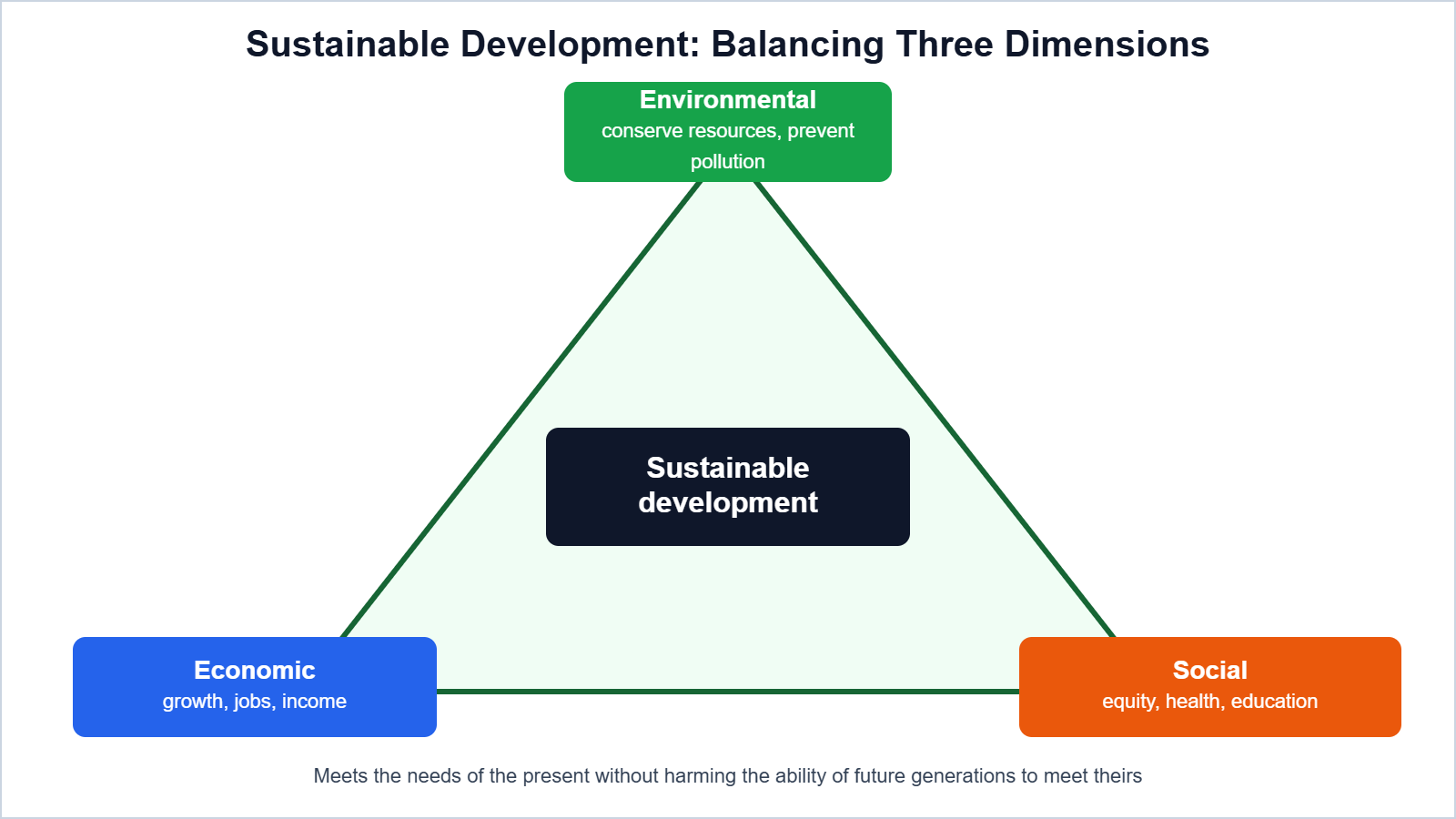
Sustainable development means development that meets the needs of the present without compromising the ability of future generations to meet their own needs. The idea was popularised by the Brundtland Commission (World Commission on Environment and Development) in its report Our Common Future (1987).
5. Case Study: Indira Gandhi Canal Command Area
The Indira Gandhi Canal (earlier called the Rajasthan Canal) is one of the largest canal systems in India. It starts from the Harike barrage in Punjab and runs into the Thar desert of Rajasthan. Its construction began in 1958 and it was built in two stages.
Positive effects: availability of water for irrigation and drinking, spread of agriculture (wheat, cotton, groundnut, rice), afforestation and pasture development, reduced soil erosion.
Negative effects: waterlogging and soil salinity due to intensive irrigation, change in traditional cropping patterns, and pressure on the fragile desert ecology.
Measures for sustainability: strict implementation of the water management policy, water-efficient crops (avoiding water-intensive crops), afforestation and shelter belts, land reclamation in waterlogged areas, and development of irrigation with drainage.
Exam point: Sustainable development requires both economic progress and protection of the environment, with equal concern for present and future generations.
6. Important Questions
Q1. What is planning?
Ans. Formulating and implementing a scheme or programme to achieve development goals.
Q2. Which body replaced the Planning Commission and when?
Ans. NITI Aayog, in January 2015.
Q3. Distinguish between sectoral and regional planning.
Ans. Sectoral planning develops sectors (agriculture, industry); regional planning develops backward regions.
Q4. What is target area planning? Give an example.
Ans. Planning focused on specific regions, e.g., the Drought Prone Area Programme.
Q5. When was the Hill Area Development Programme started and what was its aim?
Ans. In the Fifth Five Year Plan; to develop hill areas using local resources.
Q6. Where is the Bharmaur tribal region located?
Ans. In the Chamba district of Himachal Pradesh, in the Ravi valley.
Q7. Who are the Gaddis?
Ans. A tribal community of Bharmaur who traditionally practise transhumance.
Q8. Define sustainable development.
Ans. Development that meets present needs without compromising the ability of future generations to meet their needs.
Q9. Which report popularised the concept of sustainable development?
Ans. Our Common Future (1987) by the Brundtland Commission.
Q10. State two negative effects of the Indira Gandhi Canal.
Ans. Waterlogging and soil salinity.
Easy Memory Trick: Sustainable development = “E-E-S” (Economy, Environment, Society in balance).
Conclusion: Planning has helped India develop its regions and sectors. Case studies like Bharmaur and the Indira Gandhi Canal show that development must be sustainable, with people’s participation and care for the environment.