Human Geography: Nature and Scope – Geography Class 12 Notes
Part A: Fundamentals of Human Geography
Chapter – 1
Human Geography: Nature and Scope
1. Meaning of Human Geography
Geography has two main branches: physical geography, which studies the natural environment, and human geography, which studies human beings, their activities and their relationship with the environment. Human geography studies how people use and change the earth, and how the earth affects their lives.
Different geographers have defined it in their own ways. Friedrich Ratzel described it as the combined study of human societies and the earth’s surface; Ellen Churchill Semple stressed the changing relationship between active human beings and an ever-changing earth; Paul Vidal de la Blache saw it as a study of the relations between the earth’s physical laws and the living beings that inhabit it.
Remember: physical and human environments are closely linked; human geography studies the mutual interaction between them.
2. Nature of Human Geography
Human geography studies the interrelationship between the physical environment and the socio-cultural environment created by human beings. Houses, villages, cities, roads, railways, industries, farms, ports and markets are examples of cultural landscape created by people within the frame of the natural environment.
Example: In Himachal Pradesh, people have built terraced fields on hill slopes, apple orchards and hydropower dams. These show how people adapt to and modify their mountain environment.
3. Naturalisation of Humans and Humanisation of Nature
In early times, people depended directly on nature and had very simple technology. They lived close to nature and worshipped its forces; this is the naturalisation of humans, which relates to environmental determinism.
As technology developed, people began to use resources more efficiently and to change the environment to suit their needs. The imprints of human activity – farms, orchards, cities, roads – appear everywhere. This is the humanisation of nature, which relates to possibilism.

Neo-determinism (also called “stop and go determinism”), proposed by Griffith Taylor, says that people can conquer nature only by obeying it. Like traffic lights, nature allows development in some directions and stops it in others. It encourages sustainable development.
4. Human Geography through the Corridors of Time
Period | Approach | Broad features |
|---|---|---|
Early colonial period | Exploration and description | Imperial and trade interests led to the discovery of new areas; encyclopaedic descriptions of regions |
Later colonial period | Regional analysis | Detailed description of regions; the region seen as a part of the whole |
1930s (inter-war period) | Areal differentiation | Identifying how and why each region differs from others |
Late 1950s to late 1960s | Spatial organisation | Quantitative revolution: use of computers and statistics to find patterns |
1970s | Humanistic, radical and behavioural schools | Concern for human welfare, poverty, inequality and people’s perception |
1990s | Post-modernism | Rejection of grand generalisations; importance of local context |
5. Fields and Sub-fields of Human Geography
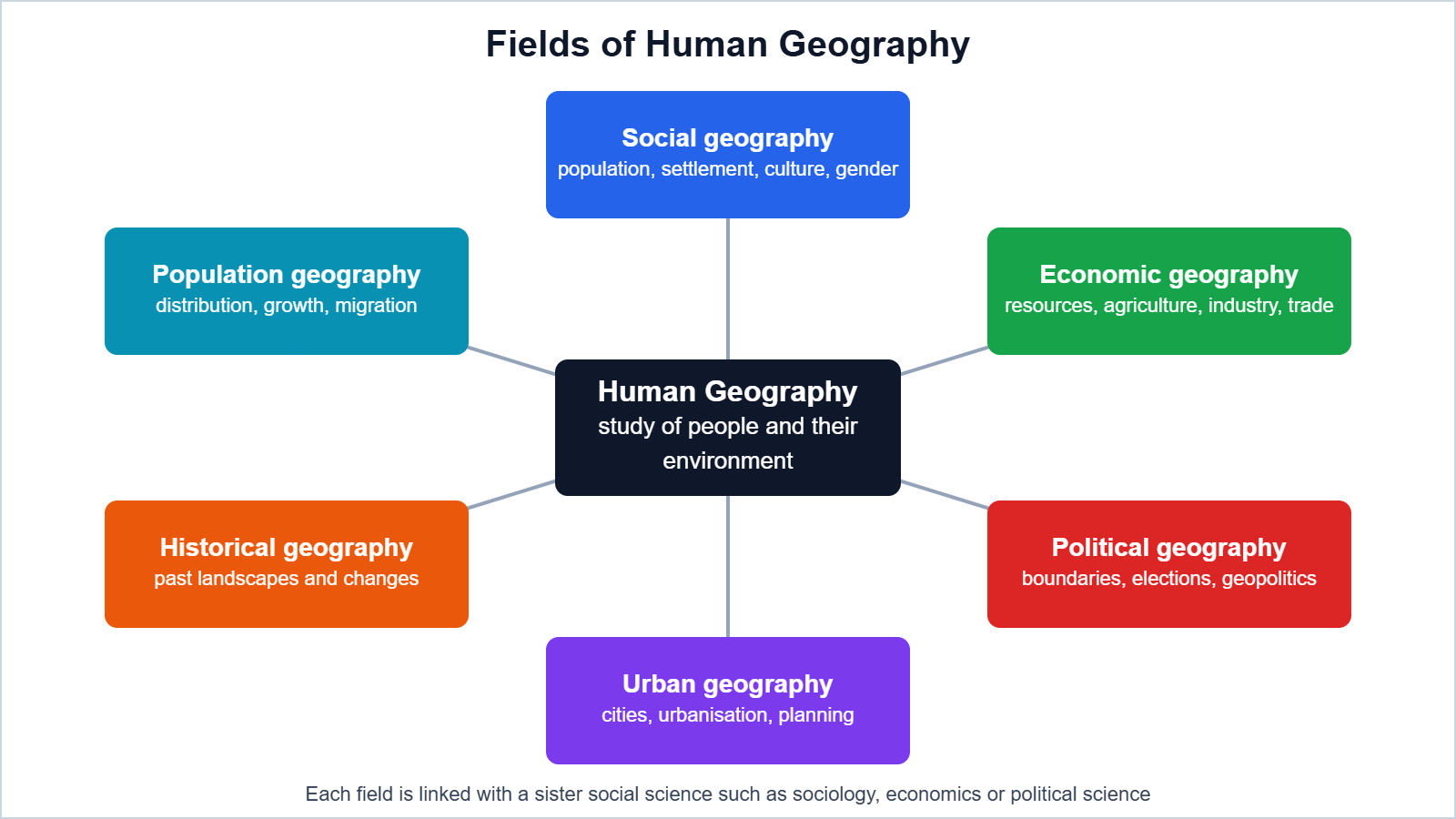
Field | Sub-fields | Sister discipline |
|---|---|---|
Social geography | Behavioural, population, settlement, cultural, gender, historical, medical, geography of social well-being | Sociology, demography, anthropology, history |
Urban geography | – | Urban studies and planning |
Political geography | Electoral, military geography | Political science, military science |
Economic geography | Resource, agricultural, industrial, marketing, tourism, geography of international trade | Economics, agricultural science, tourism and travel management |
6. Scope of Human Geography
Human geography is interdisciplinary. It is closely linked with other social sciences such as economics, sociology, history and political science. It helps in understanding and solving problems such as population growth, poverty, urbanisation, pollution and regional imbalance, and it guides planning and sustainable development.
Exam point: Human geography studies “who lives where, why, and how they use their environment”.
7. Important Questions
Q1. What is human geography?
Ans. The study of human beings, their activities and their interrelationship with the physical environment.
Q2. What is meant by environmental determinism?
Ans. The view that the natural environment controls human activities and development.
Q3. What is possibilism?
Ans. The view that humans, through technology, can create many possibilities and change the environment to suit their needs.
Q4. Who propounded neo-determinism and what does it say?
Ans. Griffith Taylor; humans can progress by following nature’s limits, like a “stop and go” system.
Q5. What is meant by humanisation of nature?
Ans. The imprint of human activities on the environment, such as farms, cities and roads.
Q6. Name any four fields of human geography.
Ans. Social, economic, political and urban geography.
Q7. Which approach was used during the 1930s?
Ans. Areal differentiation.
Q8. What was the quantitative revolution?
Ans. The use of computers and statistical techniques in geography during the late 1950s and 1960s (spatial organisation).
Q9. Give an example of humanisation of nature from Himachal Pradesh.
Ans. Terraced fields, apple orchards and hydropower dams such as Bhakra.
Q10. Why is human geography called interdisciplinary?
Ans. Because it is closely linked with economics, sociology, history, political science and other social sciences.
Easy Memory Trick: “D-P-N” = Determinism (nature controls), Possibilism (humans control), Neo-determinism (stop and go).
Conclusion: Human geography studies the changing relationship between people and their environment. From determinism to possibilism and neo-determinism, it shows how people adapt to and transform the earth, and it guides sustainable development.