Human Development – Geography Class 12 Notes
Part A: Fundamentals of Human Geography
Chapter – 3
Human Development
1. Growth and Development
Growth is quantitative and value-neutral: it means an increase (or decrease) in size, such as GDP. Development is qualitative and always positive: it means an improvement in the quality of life. Development occurs only when there is a positive change; growth may or may not lead to development.
Example: a country’s GDP may rise because of a few industries, while most people remain poor and unhealthy – this is growth without development.
2. The Concept of Human Development
The concept was introduced by the Pakistani economist Dr. Mahbub ul Haq, who described human development as development that enlarges people’s choices and improves their lives. The Indian economist Prof. Amartya Sen saw development as an increase in freedom (or decrease in unfreedom). Since 1990 the United Nations Development Programme (UNDP) has published the Human Development Report every year.
The three basic areas of human development are: a long and healthy life, access to knowledge, and a decent standard of living (access to resources).
3. The Four Pillars of Human Development

Pillar | Meaning |
|---|---|
Equity | Equal access to opportunities for everyone, irrespective of gender, caste, income or race |
Sustainability | Continuity in the availability of opportunities; resources must be used so that future generations also have them |
Productivity | Productivity of human labour, increased by investing in health, education and skills |
Empowerment | Having the power and freedom to make choices; good governance and people-oriented policies help |
4. Approaches to Human Development
Approach | Main idea |
|---|---|
Income approach | Human development is linked with income; higher income means more development |
Welfare approach | People are beneficiaries; the government spends on education, health and social security |
Basic needs approach (proposed by the ILO) | Provide six basic needs: health, education, food, water supply, sanitation and housing |
Capability approach (associated with Amartya Sen) | Build human capabilities in health, education and access to resources to widen choices |
5. Measuring Human Development: the HDI
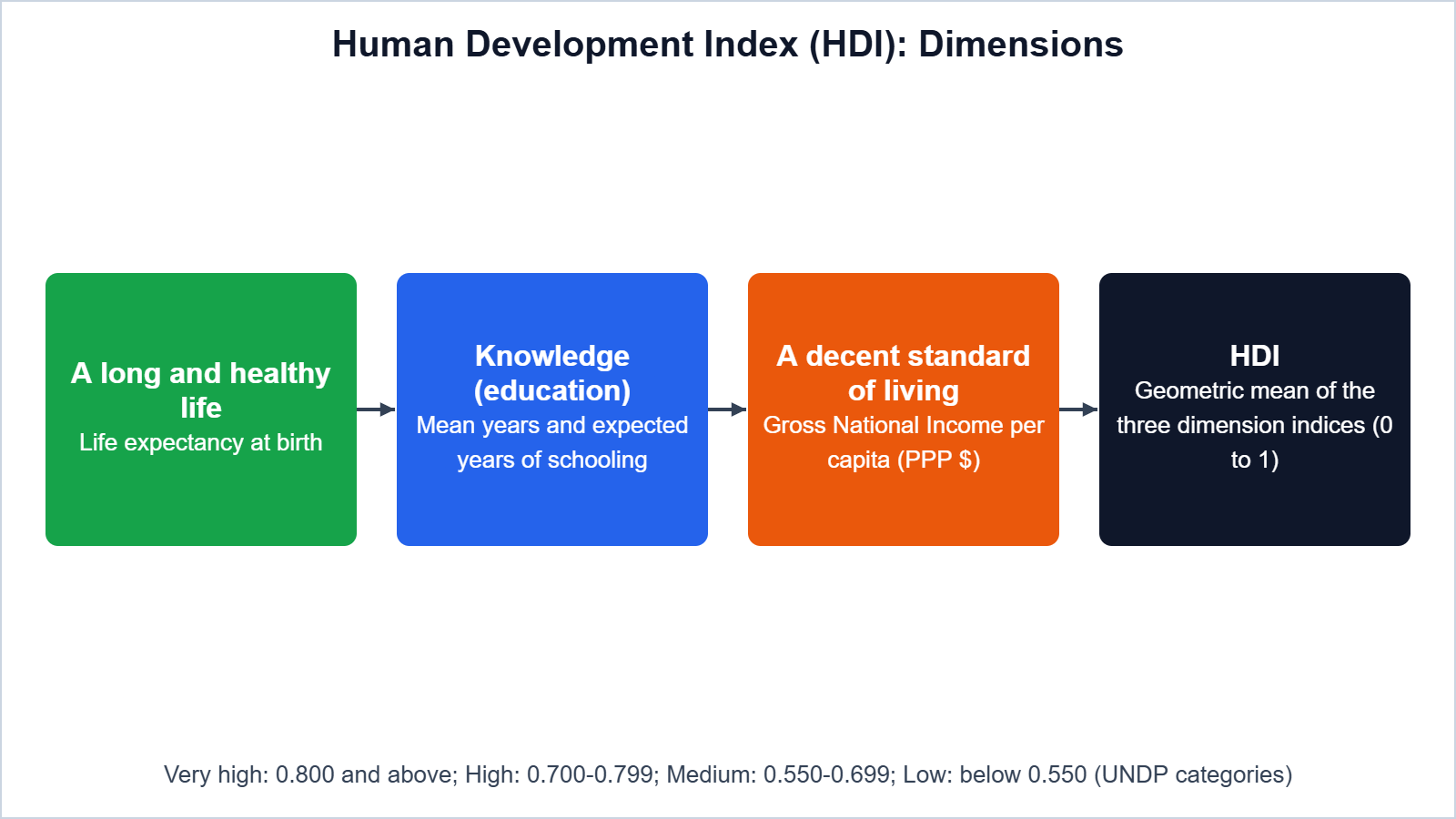
The Human Development Index (HDI) ranks countries on a scale of 0 to 1. Each dimension is converted into an index, and the HDI is the geometric mean of the three indices. Countries are grouped as very high, high, medium and low human development.
Numerical 1: A country has a life expectancy of 72 years. Using UNDP goalposts of 20 years (minimum) and 85 years (maximum), find its life expectancy index.
Given: LE = 72; min = 20; max = 85
Formula: Index = (actual – minimum) / (maximum – minimum)
Solution: (72 – 20) / (85 – 20) = 52 / 65
Answer: Life expectancy index = 0.80
Numerical 2: A country’s health index is 0.8, education index 0.6 and income index 0.7. Find its HDI and category.
Given: Indices: 0.8, 0.6, 0.7
Formula: HDI = cube root of (health x education x income)
Solution: Cube root of (0.8 x 0.6 x 0.7) = cube root of 0.336
Answer: HDI ≈ 0.695: medium human development (0.550-0.699)
Human Poverty Index and, more recently, the Multidimensional Poverty Index measure deprivation (shortfall) in health, education and standard of living. Some countries have also developed alternative measures, such as Bhutan’s Gross National Happiness.
6. International Comparisons
Countries with very high human development usually invest heavily in health and education and have good governance. A small country may have a higher HDI than a big, rich country; size and total income do not decide human development. India falls in the medium human development category in recent UNDP reports, with large differences between states.
Exam point: Kerala has consistently been among the top Indian states in human development indicators such as literacy and life expectancy.
7. Important Questions
Q1. Distinguish between growth and development.
Ans. Growth is a quantitative, value-neutral change; development is a qualitative, positive change in the quality of life.
Q2. Who introduced the concept of human development?
Ans. Dr. Mahbub ul Haq.
Q3. What are the three key areas of human development?
Ans. A long and healthy life, access to knowledge, and a decent standard of living.
Q4. Name the four pillars of human development.
Ans. Equity, sustainability, productivity and empowerment.
Q5. What is the basic needs approach?
Ans. An approach proposed by the ILO to provide six basic needs: health, education, food, water, sanitation and housing.
Q6. What is the capability approach?
Ans. An approach associated with Amartya Sen that stresses building human capabilities in health, education and resources.
Q7. How is HDI calculated?
Ans. As the geometric mean of the health, education and income indices, on a scale of 0 to 1.
Q8. Which organisation publishes the Human Development Report?
Ans. The United Nations Development Programme (UNDP), since 1990.
Q9. What does the Human Poverty Index measure?
Ans. Shortfall or deprivation in human development, such as lack of health, education and standard of living.
Q10. Why is equity important for human development?
Ans. Because opportunities must be equally available to all people regardless of gender, caste or income.
Easy Memory Trick: “E-S-P-E” = Equity, Sustainability, Productivity, Empowerment.
Conclusion: Human development is about widening people’s choices through health, education and access to resources. The HDI measures it, and the four pillars – equity, sustainability, productivity and empowerment – show how it can be achieved.