Transport and Communication – Geography Class 12 Notes
Part A: Fundamentals of Human Geography
Chapter – 7
Transport and Communication
1. Transport
Transport is the service of carrying people and goods from one place to another. A transport system has nodes (meeting points of routes) and links (routes joining nodes); together they form a network. The choice of mode depends on the type of goods, distance, cost and time.

2. Land Transport
Roads are the most economical for short distances and provide door-to-door service. Road quality varies; developed countries have good highways (e.g., trans-continental highways like the Pan-American Highway and Trans-Canadian Highway). Problems include congestion and the need for maintenance. Border roads link remote frontier areas.
Example: roads are the lifeline of Himachal Pradesh, where most areas are hilly; the Atal Tunnel at Rohtang provides all-weather access to Lahaul valley.
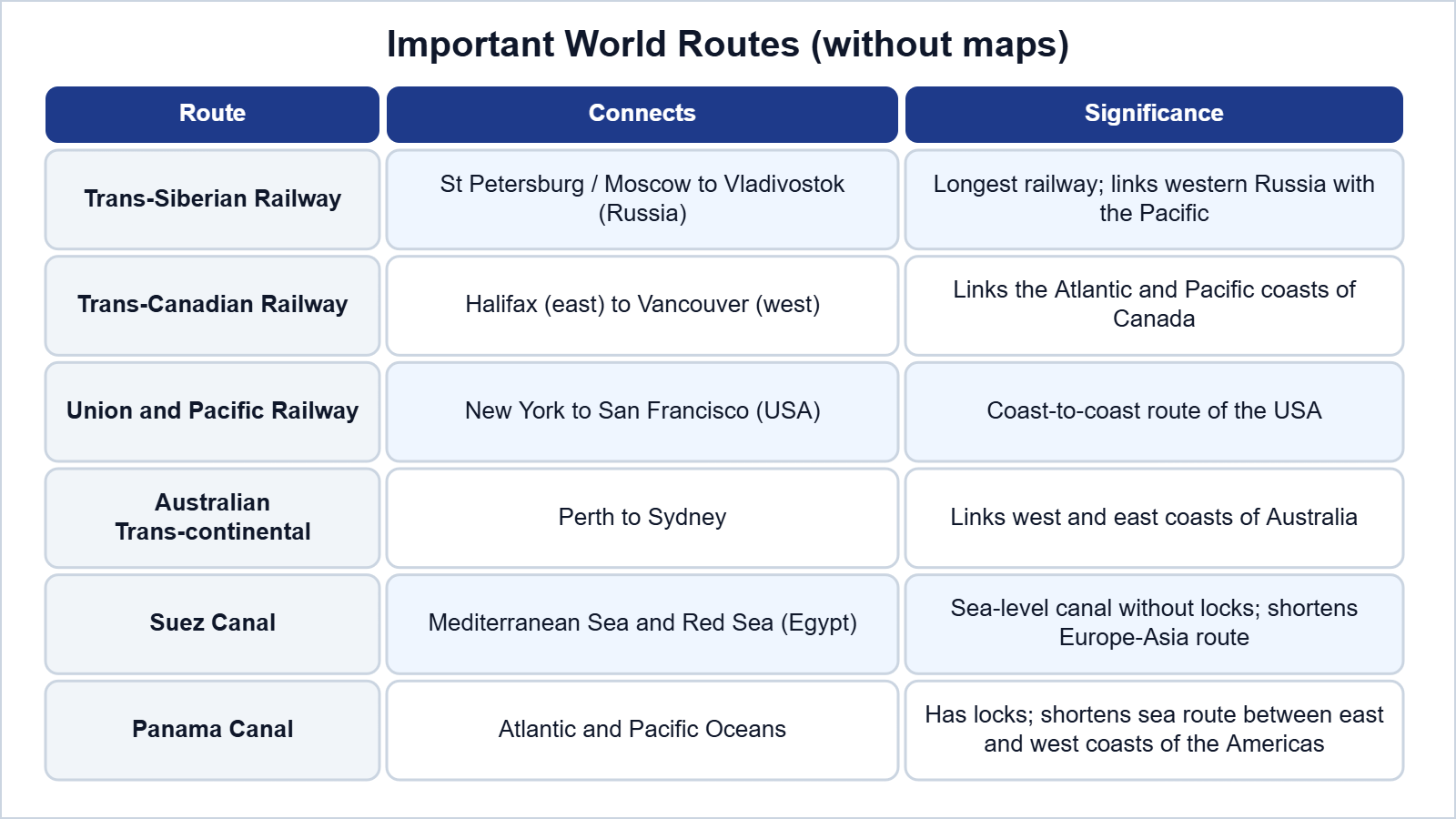
Railways carry bulky goods and passengers cheaply over long distances. Trans-continental railways run across continents and link their ends.
3. Water Transport
Water transport is the cheapest for heavy, bulky goods, as no route has to be built and friction is low. Sea routes: the Northern Atlantic sea route (busiest, linking north-eastern USA and north-western Europe), the Mediterranean-Indian Ocean route (via Suez), the Cape of Good Hope route, and the North Pacific route.
Shipping canals: the Suez Canal (opened in 1869) links the Mediterranean and the Red Sea and is a sea-level canal without locks; the Panama Canal (opened in 1914) links the Atlantic and the Pacific and has locks. Both greatly shorten sea routes.
Inland waterways: rivers, canals and lakes. Examples: the Rhine (Europe), the Danube, the Volga, the Great Lakes-St Lawrence Seaway and the Mississippi (North America).
4. Air Transport and Pipelines
Air transport is the fastest but most costly means. It is valuable for passengers, perishable and valuable goods, and for reaching remote areas such as mountains, deserts and islands. Pipelines carry water, petroleum, natural gas and slurry continuously and safely, but routes are fixed and initial cost is high.
5. Communication
Communication is the transmission of messages, ideas and information. Modern communication uses telecommunication: telephones, radio, television, satellites, mobile phones and the internet. Satellite communication has made the world a “global village”, and cyberspace (the internet) links people across the world instantly.
Exam point: India launched its first satellite, Aryabhata, in 1975.
6. Important Questions
Q1. What is a transport network?
Ans. A system of nodes (points) and links (routes) along which transport takes place.
Q2. Why is road transport important in hilly states like Himachal Pradesh?
Ans. Railways and airways are limited by terrain, so roads provide access to almost all places.
Q3. Name two trans-continental railways.
Ans. The Trans-Siberian Railway and the Trans-Canadian Railway.
Q4. Which is the busiest sea route in the world?
Ans. The Northern Atlantic sea route.
Q5. Distinguish between the Suez and Panama Canals.
Ans. Suez links the Mediterranean and Red Sea without locks (1869); Panama links the Atlantic and Pacific with locks (1914).
Q6. Why is water transport the cheapest?
Ans. No route needs to be built and friction is low, so bulky goods can be carried cheaply.
Q7. Name two important inland waterways of the world.
Ans. The Rhine and the Great Lakes-St Lawrence Seaway (also Danube, Volga, Mississippi).
Q8. State two advantages and one disadvantage of air transport.
Ans. Fastest and reaches remote areas; but it is very costly.
Q9. What are the advantages of pipelines?
Ans. Continuous and safe transport of liquids and gases with low running cost.
Q10. What is cyberspace?
Ans. The electronic world of computers and the internet through which information is exchanged.
Easy Memory Trick: “R-R-W-A-P” = Roads, Railways, Water, Air, Pipelines.
Conclusion: Transport and communication link places and people, support trade and integrate the world. Each mode has its own advantages, and modern communication has made the world a global village.