International Trade – Geography Class 12 Notes
Part A: Fundamentals of Human Geography
Chapter – 8
International Trade
1. Meaning and History
International trade is the exchange of goods and services between countries. It arises because no country is self-sufficient; it is based on specialisation and comparative advantage. In early times trade was by barter; later money made exchange easier. Historic routes like the Silk Route linked China with the Mediterranean. The slave trade (from the 15th century) was a shameful part of the history of trade. After the Industrial Revolution, trade in raw materials and manufactured goods grew rapidly.
2. Basis of International Trade
- Difference in national resources: geological structure, mineral resources and climate differ.
- Population factors: size, density and cultural factors affect demand and production.
- Stage of economic development: agricultural countries export farm goods and import manufactured goods; industrial countries do the opposite.
- Extent of foreign investment: investment in mining, plantations and industries of developing countries.
- Transport: better transport and refrigeration expanded trade.
3. Important Aspects of International Trade
Aspect | Meaning |
|---|---|
Volume of trade | Total value of goods traded (exports + imports) |
Composition of trade | The types of goods and services traded |
Direction of trade | The countries or regions with which trade takes place |
Balance of trade | Difference between the value of exports and imports |

Numerical 1: Country A exports goods worth ₹500 crore and imports goods worth ₹400 crore. Country B exports ₹450 crore and imports ₹600 crore. Find the balance of trade for each and the volume of trade of A.
Given: A: X = 500, M = 400; B: X = 450, M = 600
Formula: Balance of trade = exports – imports; volume = exports + imports
Solution: A: 500 – 400 = +100; B: 450 – 600 = -150; volume of A = 500 + 400
Answer: A: favourable balance (+₹100 crore), volume ₹900 crore; B: unfavourable balance (-₹150 crore)
Remember: a favourable balance means exports exceed imports; an unfavourable (negative) balance means imports exceed exports and must be paid for from reserves or borrowing.
4. Types of International Trade
Bilateral trade is between two countries under an agreement. Multilateral trade is with many countries. Free trade (trade liberalisation) means lowering trade barriers such as tariffs. It can help growth, but cheap imports (“dumping” of goods at prices below cost) can harm domestic producers, so countries need safeguards.
5. World Trade Organisation and Regional Blocs
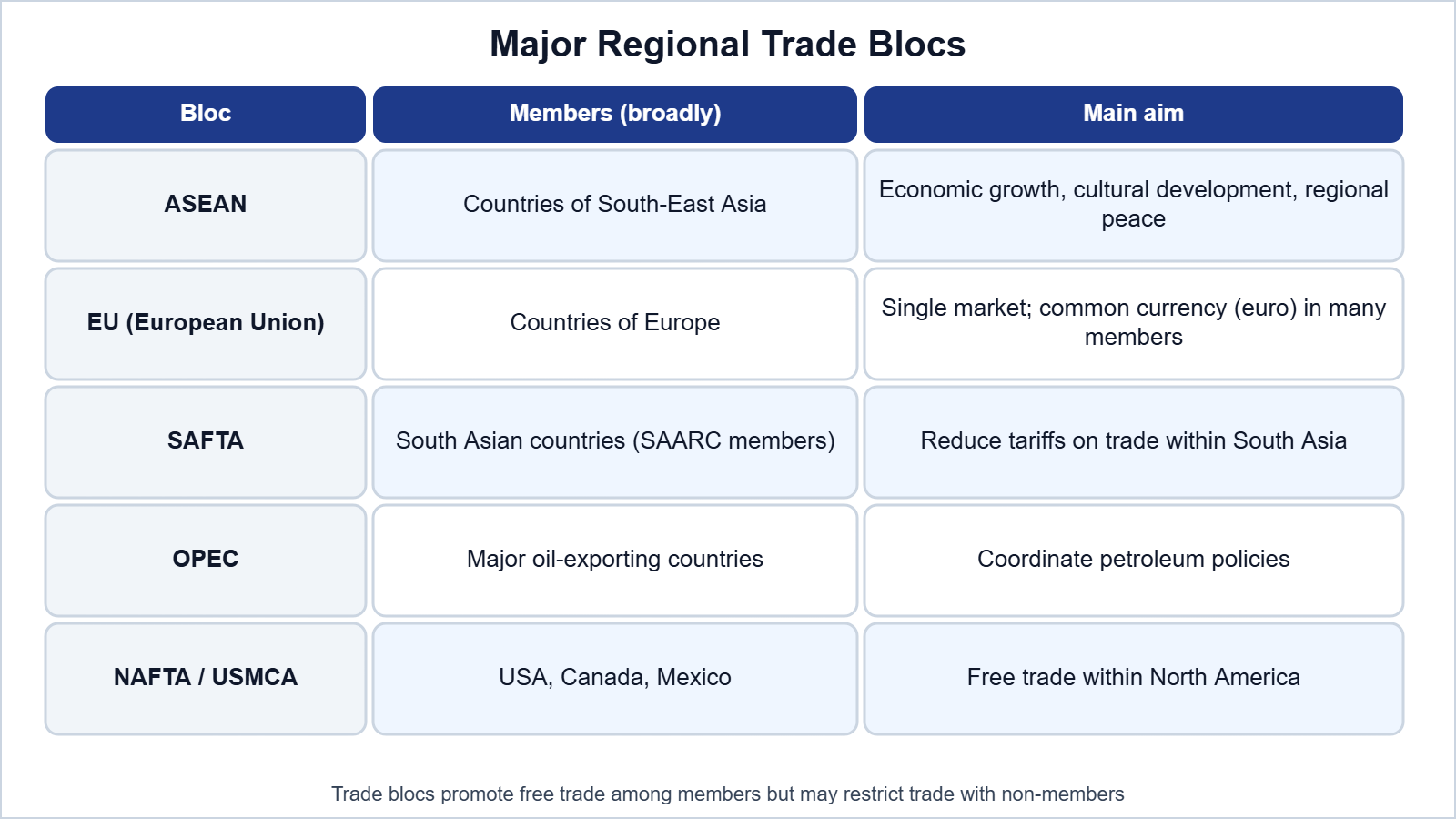
The General Agreement on Tariffs and Trade (GATT) was formed in 1948 to reduce tariffs. It was replaced in 1995 by the World Trade Organisation (WTO), with headquarters in Geneva. The WTO sets rules for world trade and settles disputes among members. It is criticised for favouring rich countries and for neglecting issues like workers’ rights and the environment.
6. Ports
Ports are gateways of international trade. By cargo they are industrial ports (bulk cargo), commercial ports (general cargo) and comprehensive ports (both). By location they are inland ports, out ports (deep-water ports away from the main port), naval ports, oil ports, ports of call, packet stations (ferry ports) and entrepot ports (collection centres for re-export, e.g., Singapore, Rotterdam).
Exam point: International trade can harm when countries depend on exporting only primary products; diversification and value addition are important.
7. Important Questions
Q1. What is international trade?
Ans. The exchange of goods and services between countries.
Q2. What is barter?
Ans. Direct exchange of goods without the use of money.
Q3. State three bases of international trade.
Ans. Differences in national resources, population factors and stages of economic development.
Q4. Define balance of trade.
Ans. The difference between the value of exports and imports of a country.
Q5. When is the balance of trade unfavourable?
Ans. When the value of imports exceeds the value of exports.
Q6. Distinguish between bilateral and multilateral trade.
Ans. Bilateral trade is between two countries; multilateral trade is with many countries.
Q7. When was the WTO set up and where is its headquarters?
Ans. In 1995; Geneva.
Q8. What is dumping?
Ans. Selling goods in another country at a price lower than the cost of production or the domestic price.
Q9. What is an entrepot port? Give an example.
Ans. A port where goods are collected for re-export, e.g., Singapore.
Q10. Name two regional trade blocs.
Ans. ASEAN and the European Union (also SAFTA, OPEC).
Easy Memory Trick: “V-C-D-B” = Volume, Composition, Direction, Balance of trade.
Conclusion: International trade allows countries to specialise and benefit from one another’s resources. A favourable balance of trade, fair rules through the WTO and regional co-operation help nations gain from trade.