Human Settlements – Geography Class 12 Notes
Part B: India – People and Economy
Chapter – 2
Human Settlements
1. Meaning
A human settlement is a cluster of dwellings of any type or size where people live. It may be a small hamlet or a large city. Settlements are broadly classified as rural (people mainly engaged in primary activities such as agriculture) and urban (people mainly engaged in secondary and tertiary activities). Rural settlements depend on land; urban settlements depend on processing raw materials and on services.
2. Types of Rural Settlements
The type of rural settlement depends on the extent of the built-up area and the distance between houses. It is influenced by physical features (relief, water), cultural and ethnic factors (caste, religion) and security factors.
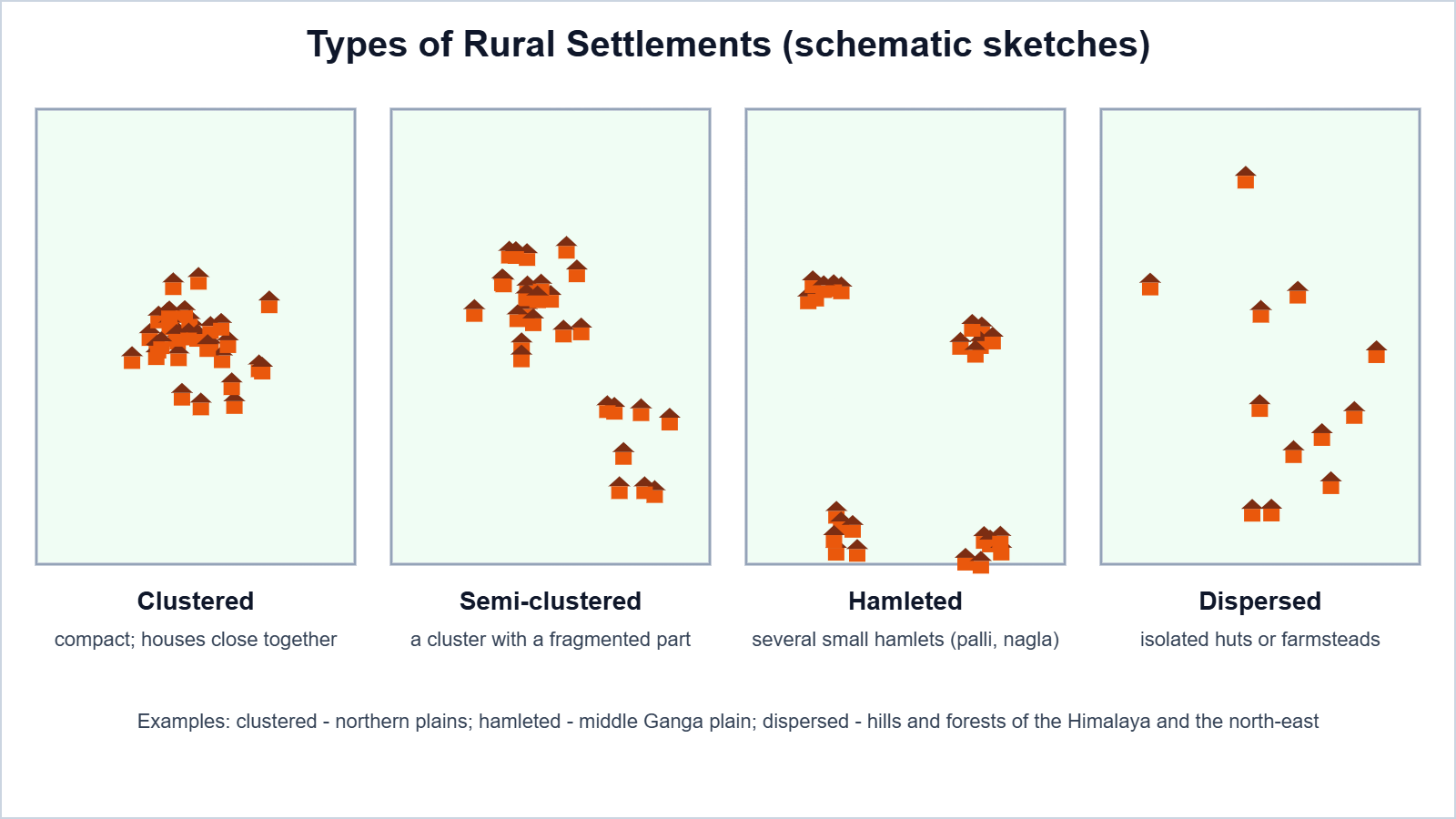
Type | Features | Where found |
|---|---|---|
Clustered (compact) | Houses built close together; a compact built-up area separated from fields | Northern plains, north-eastern states, parts of central India; in Bundelkhand and Nagaland clusters also give security |
Semi-clustered (fragmented) | A cluster with a segregated part, often for certain communities or workers | Gujarat plains and parts of Rajasthan |
Hamleted | Settlement split into several small units (hamlets) with a common name; called panna, para, palli, nagla, dhani | Middle and lower Ganga plain, Chhattisgarh, lower Himalayan valleys |
Dispersed (isolated) | Isolated huts or small groups of houses far apart, often on hill slopes or in forests | Meghalaya, Uttarakhand, Himachal Pradesh, Kerala |
Example: In Himachal Pradesh, houses are often scattered on hill slopes and terraces near cultivable land and water sources, giving a dispersed or hamleted pattern.
3. Patterns (Shapes) of Rural Settlements

Rural settlements also take different shapes: linear (along a road, river or canal), rectangular (in plains, with lanes crossing at right angles), circular (around a lake or tank), star-like (where several roads meet), T-shaped, Y-shaped or cross-shaped (at road junctions) and double villages (on both banks of a river with a bridge).
4. Urban Settlements
According to the Census of India, an urban place is either a statutory town (with a municipality, corporation, cantonment board or notified area committee) or a census town that satisfies all three conditions: (i) a minimum population of 5,000; (ii) at least 75% of male main workers engaged in non-agricultural work; and (iii) a population density of at least 400 persons per sq km.
Evolution of towns in India: ancient towns (e.g., Varanasi, Patliputra, Madurai) developed as religious and cultural centres; medieval towns (e.g., Delhi, Agra, Hyderabad, Jaipur) as capitals of kingdoms; modern towns (e.g., Mumbai, Chennai, Kolkata) were developed by the British as ports, administrative centres and hill stations (e.g., Shimla, Darjeeling).
5. Classification of Towns on the Basis of Population
Census 2011 classified urban areas by size. Towns with a population of 1 lakh or more are cities (Class I towns); cities with 10 lakh or more are million-plus cities; those with more than 1 crore are often called megacities (e.g., Greater Mumbai, Delhi, Kolkata). An urban agglomeration is a continuous urban spread consisting of a town and its adjoining urban outgrowths.
6. Functional Classification of Towns
Function | Examples |
|---|---|
Administrative | New Delhi, Shimla, state capitals |
Industrial | Jamshedpur, Bhilai, Baddi (H.P.) |
Transport (ports, rail junctions) | Kandla, Kochi, Mughal Sarai (Pt. Deen Dayal Upadhyaya Junction) |
Commercial | Kolkata, Saharanpur |
Mining | Raniganj, Jharia, Digboi |
Garrison (cantonment) | Ambala, Jalandhar, Mhow |
Educational | Roorkee, Varanasi, Aligarh |
Religious and cultural | Varanasi, Haridwar, Ajmer, Amritsar |
Tourist | Shimla, Manali, Nainital, Ooty |
Remember: most towns perform several functions; they are classified by their dominant function.
Exam point: Shimla was the summer capital of British India and is now an administrative and tourist town.
7. Important Questions
Q1. What is a human settlement?
Ans. A cluster of dwellings where people live, ranging from a hamlet to a city.
Q2. Distinguish between rural and urban settlements.
Ans. Rural settlements depend mainly on primary activities; urban settlements on secondary and tertiary activities.
Q3. Name the four types of rural settlements in India.
Ans. Clustered, semi-clustered, hamleted and dispersed.
Q4. Why are settlements dispersed in hilly areas?
Ans. Because of rugged terrain and limited flat land near water, houses are built near scattered fields.
Q5. What are the census criteria for an urban place?
Ans. Statutory town, or a census town with at least 5,000 people, 75% male main workers in non-agricultural work and density of at least 400 per sq km.
Q6. What is an urban agglomeration?
Ans. A continuous urban spread of a town and its adjoining urban outgrowths.
Q7. What are million-plus cities?
Ans. Cities with a population of 10 lakh or more.
Q8. Give one example each of an administrative and a tourist town.
Ans. New Delhi (administrative); Manali (tourist).
Q9. Name the shape of a settlement that develops along a road.
Ans. Linear.
Q10. Why do hamleted settlements develop?
Ans. Because of social and ethnic factors that lead to segregation into small units.
Easy Memory Trick: “C-S-H-D” = Clustered, Semi-clustered, Hamleted, Dispersed.
Conclusion: Human settlements in India range from scattered hill hamlets to huge megacities. Their type, shape and function reflect the physical environment, social factors and economic activities of the people.