Open Economy Macroeconomics – Class 12 Economics Notes
Part B: Introductory Macroeconomics
Chapter – 6
Open Economy Macroeconomics
An open economy interacts with other economies of the world. The links work through three markets: the output market (trade in goods and services), the financial market (buying and selling of financial assets across countries) and the labour market (movement of workers, though restricted by immigration laws). Openness widens choice for consumers and producers but also exposes the economy to outside shocks.
6.1 The Balance of Payments
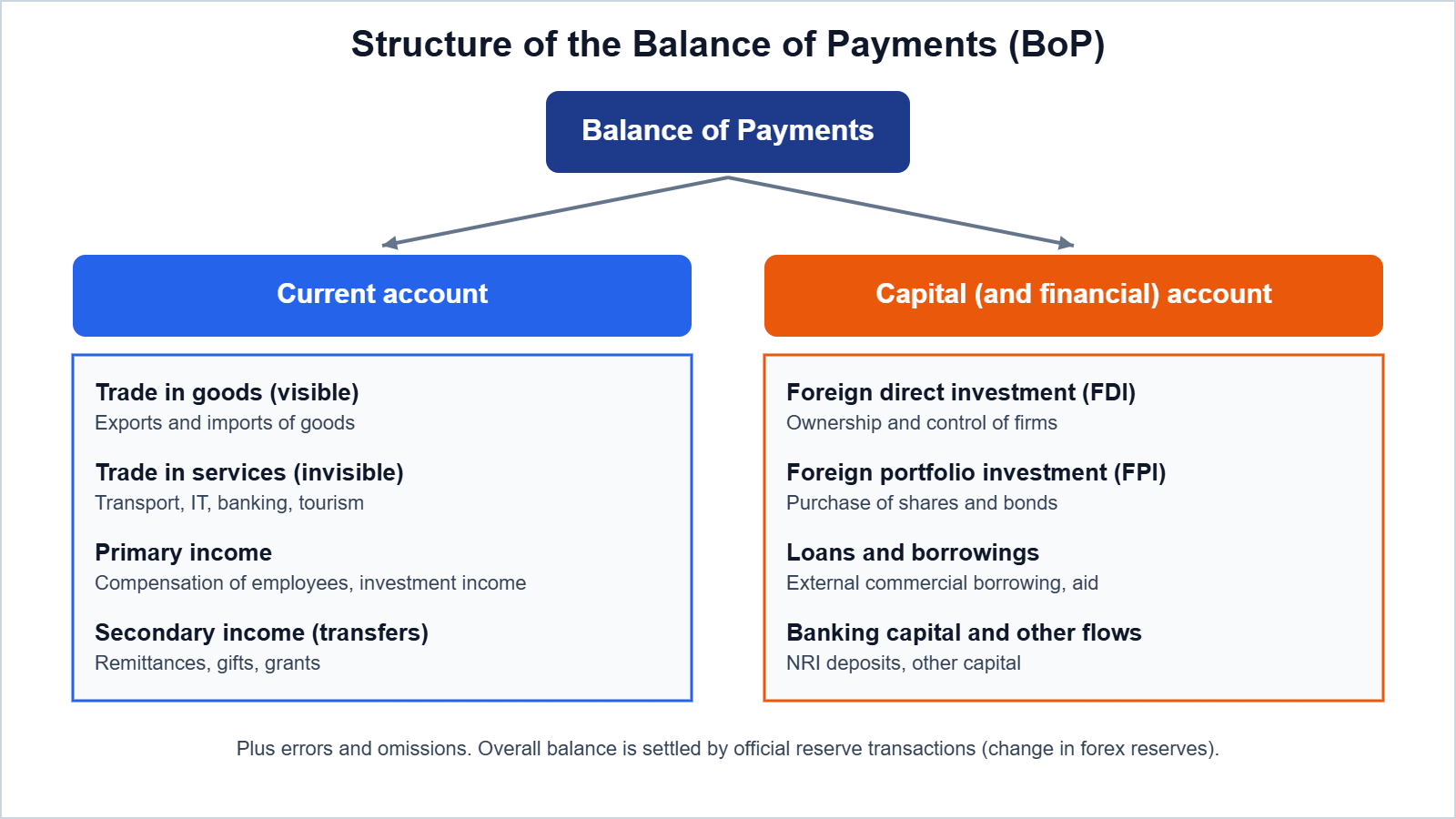
The balance of payments (BoP) is a systematic record of all economic transactions between the residents of a country and the rest of the world during a given period (usually a year). It has two main accounts – the current account and the capital account.
6.1.1 Current Account
Records exports and imports of goods and services, income and transfer payments. These do not create claims or liabilities.
- Trade in goods (visible items): merchandise exports and imports. Balance of trade (BoT) = exports of goods – imports of goods.
- Trade in services (invisible items): transport, insurance, banking, software, tourism.
- Primary income (factor income): compensation of employees, interest, profit and dividends on investments.
- Secondary income (transfers): remittances, gifts and grants, which do not involve any return flow.
Current account balance = (exports – imports of goods and services) + net income + net transfers. A current account surplus means receipts exceed payments; a deficit means payments exceed receipts.
Numerical 1: Hypothetical data for a year (₹ crore): exports of goods 500, imports of goods 700, exports of services 300, imports of services 150, net primary income -30, net transfers +60. Find the balance of trade and current account balance.
Given: As given
Formula: BoT = exports – imports of goods; CAB = BoT + net services + net income + net transfers
Solution: BoT = 500 – 700 = -200; net services = 300 – 150 = +150; CAB = -200 + 150 – 30 + 60
Answer: BoT = -₹200 crore (trade deficit); current account deficit = ₹20 crore
6.1.2 Capital Account
Records all international transactions of assets (money, shares, bonds, land, buildings, factories). They create claims or liabilities. Main items: foreign direct investment (FDI) (buying a controlling stake or setting up a firm), foreign portfolio investment (FPI) (buying shares and bonds without control), external borrowing and lending, banking capital (including NRI deposits) and other flows. Inflows (foreigners buying domestic assets, borrowing from abroad) are credits; outflows are debits.
A current account deficit must be financed by a net capital inflow (capital account surplus) or by running down reserves.
6.1.3 Balance of Payments Surplus and Deficit
Transactions undertaken for their own sake (profit, consumption) are autonomous transactions; those made to cover the gap in autonomous transactions are accommodating (e.g., sale or purchase of foreign exchange reserves by the RBI). If autonomous receipts exceed autonomous payments, there is a BoP surplus and official reserves rise; if they fall short, there is a BoP deficit and reserves fall. In accounting terms, the BoP always balances: current account + capital account + errors and omissions + change in reserves = 0. Errors and omissions reflect the inability to record all transactions accurately.
Numerical 2: In Numerical 1, net FDI inflow is ₹100 crore, net FPI inflow ₹50 crore and net repayment of loans ₹40 crore. Errors and omissions are zero. Find the capital account balance, the overall balance and the change in reserves.
Given: CAB = -20; FDI = +100; FPI = +50; loans = -40
Formula: Capital account balance = sum of net capital flows; overall balance = CAB + KAB
Solution: KAB = 100 + 50 – 40 = 110; overall = -20 + 110
Answer: Capital account surplus = ₹110 crore; BoP surplus = ₹90 crore; official reserves rise by ₹90 crore
Transaction | Account | Credit / Debit |
|---|---|---|
Export of software services | Current (services) | Credit |
Remittance from an Indian worker abroad | Current (secondary income) | Credit |
Import of crude oil | Current (goods) | Debit |
Foreign company sets up a factory in India | Capital (FDI) | Credit |
Indian resident buys shares of a foreign company | Capital (portfolio) | Debit |
Interest paid on external loans | Current (primary income) | Debit |
6.2 The Foreign Exchange Market
The foreign exchange (forex) market is the market in which national currencies are traded for one another. Major participants are commercial banks, foreign exchange brokers, other authorised dealers and monetary authorities.
6.2.1 Foreign Exchange Rate
The foreign exchange rate (nominal exchange rate) is the price of one currency in terms of another, e.g., ₹ per US dollar. If more rupees are needed to buy one dollar, the rupee has depreciated (dollar appreciated); if fewer rupees are needed, the rupee has appreciated.
Real exchange rate (RER) = e x Pf / P, where e is the nominal rate (₹ per $), Pf the foreign price level and P the domestic price level. It measures international competitiveness. When RER = 1, the two currencies have equal purchasing power (purchasing power parity). The nominal and real effective exchange rates (NEER and REER) are weighted averages against a basket of trading partners’ currencies.
Numerical 3: (Hypothetical) The nominal exchange rate is ₹40 per $, the US price index is 120 and the Indian price index is 100. Find the real exchange rate.
Given: e = 40; Pf = 120; P = 100
Formula: RER = e x Pf / P
Solution: RER = 40 x 120 / 100
Answer: RER = 48
6.2.2 Determination of the Exchange Rate
Demand for foreign exchange arises from imports, travel and study abroad, investment abroad, gifts sent abroad and speculation. It is inversely related to the exchange rate: a higher rate (costlier dollar) makes imports and foreign travel costlier, so less forex is demanded.
Supply of foreign exchange arises from exports, foreign tourists in India, foreign investment, remittances from abroad and speculation. It is directly related to the exchange rate: a higher rate makes Indian goods cheaper for foreigners, raising exports and forex supply.
Under a flexible exchange rate system, the equilibrium rate is where demand for forex = supply of forex.
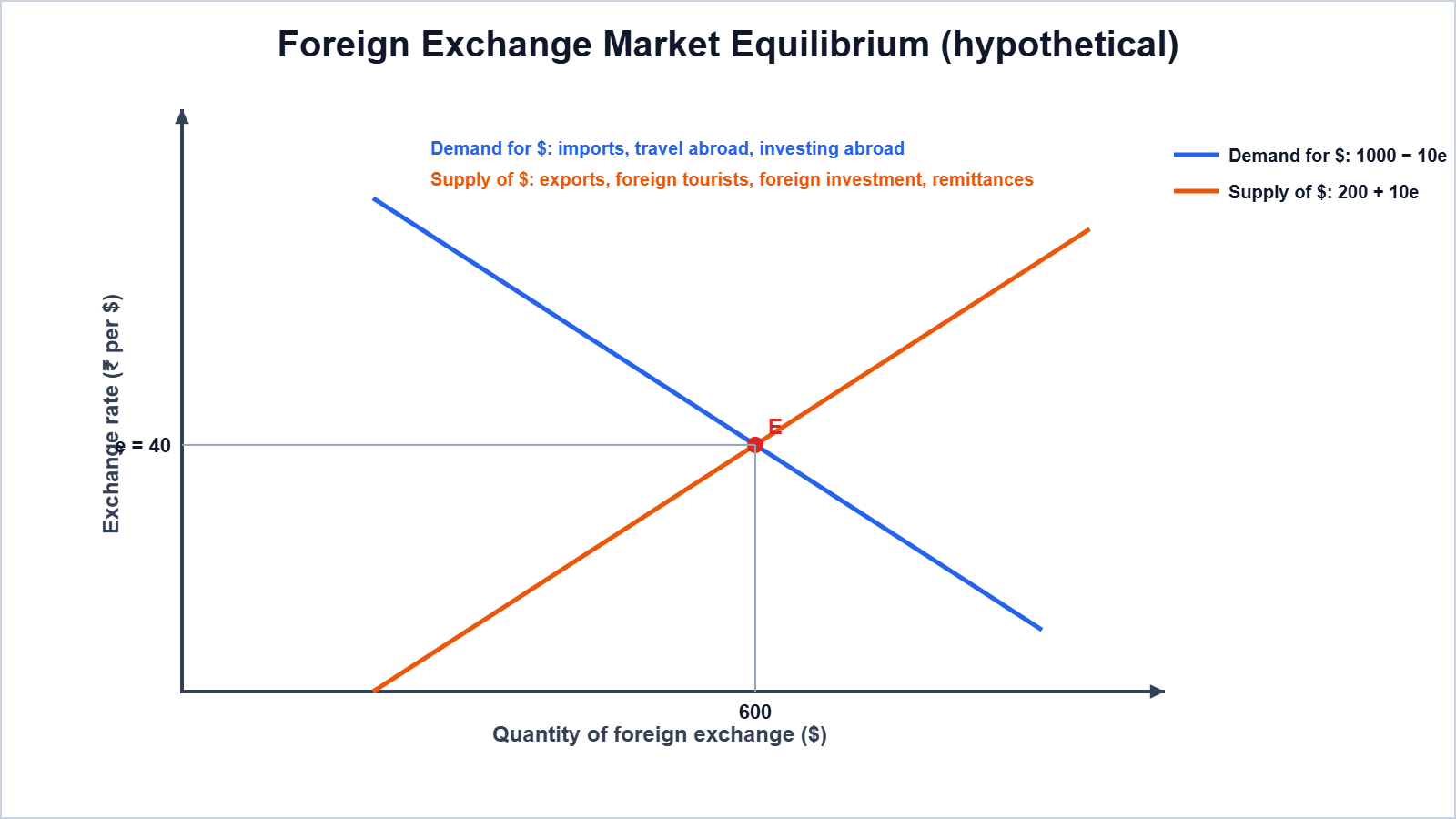
Numerical 4: (Hypothetical) Demand for dollars: D = 1000 – 10e; supply: S = 200 + 10e, where e is ₹ per $. Find the equilibrium exchange rate and quantity.
Given: D = 1000 – 10e; S = 200 + 10e
Formula: D = S
Solution: 1000 – 10e = 200 + 10e, so 800 = 20e and e = 40; Q = 1000 – 400
Answer: e = ₹40 per $; quantity = $600
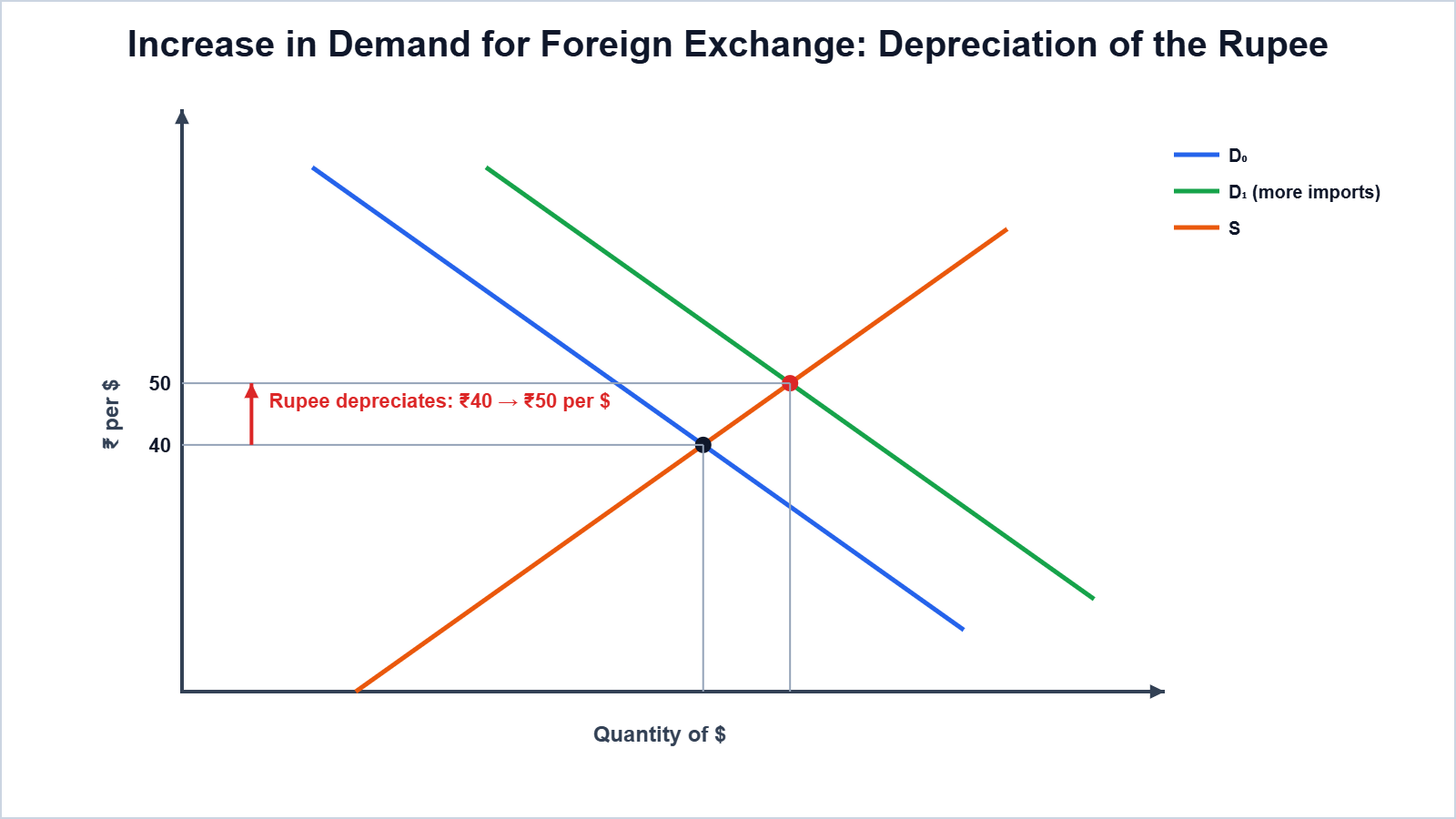
Numerical 5: In Numerical 4, imports rise so demand becomes D = 1200 – 10e. Find the new rate and the percentage depreciation of the rupee.
Given: D = 1200 – 10e; S = 200 + 10e
Formula: D = S; % depreciation = (new e – old e)/old e x 100
Solution: 1200 – 10e = 200 + 10e, so e = 50; (50 – 40)/40 x 100
Answer: e rises to ₹50 per $; the rupee depreciates by 25%
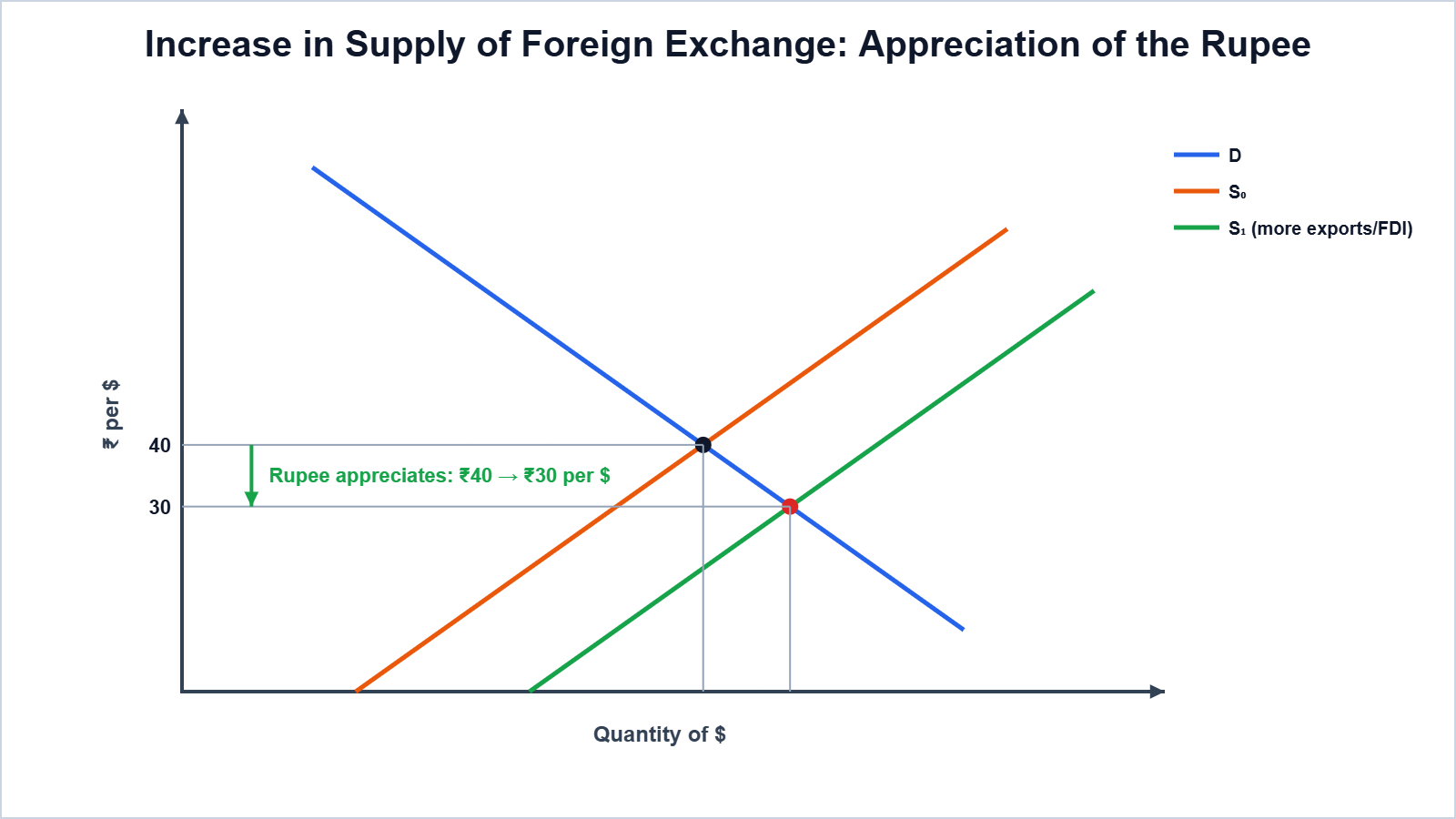
Numerical 6: In Numerical 4, exports and FDI rise so supply becomes S = 400 + 10e. Find the new rate.
Given: D = 1000 – 10e; S = 400 + 10e
Formula: D = S
Solution: 1000 – 10e = 400 + 10e, so 600 = 20e
Answer: e falls to ₹30 per $: the rupee appreciates (the dollar value of one rupee rises from 1/40 to 1/30, about 33.3%)
Numerical 7: (Hypothetical) The exchange rate changes from ₹40 to ₹50 per $. What happens to the dollar price of an Indian good costing ₹2,000 and to the rupee price of an American good costing $10?
Given: Old e = 40; new e = 50
Formula: $ price = ₹ price / e; ₹ price = $ price x e
Solution: Indian good: 2000/40 = $50 before, 2000/50 = $40 after. American good: 10 x 40 = ₹400 before, 10 x 50 = ₹500 after
Answer: Depreciation makes Indian exports cheaper ($50 → $40) and imports costlier (₹400 → ₹500), which tends to raise exports and reduce imports.
6.2.3 Merits and Demerits of Flexible and Fixed Exchange Rate Systems
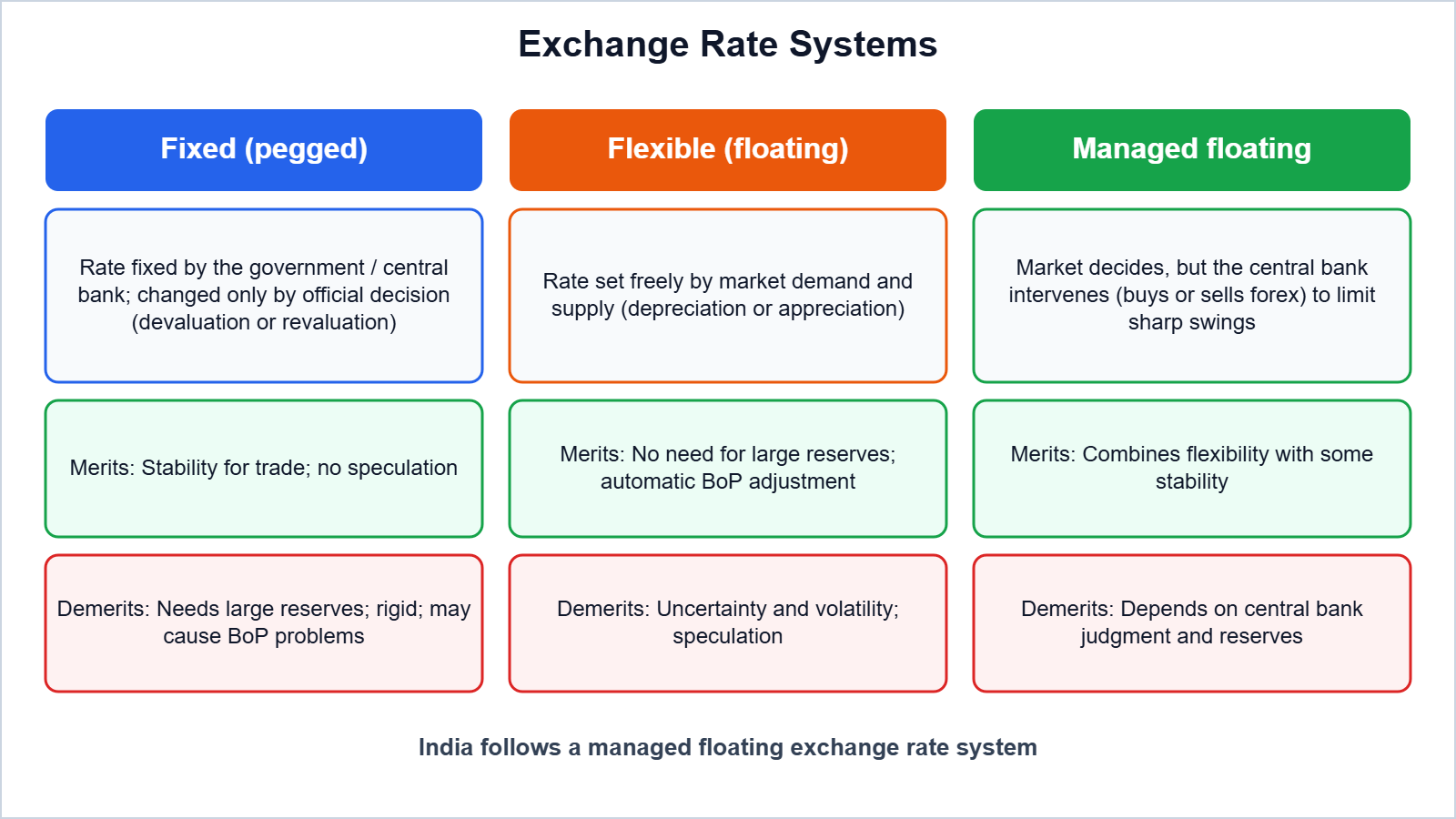
Basis | Fixed exchange rate | Flexible exchange rate |
|---|---|---|
Determined by | Government / central bank | Market forces of demand and supply |
Change in value | Devaluation / revaluation (official) | Depreciation / appreciation (market) |
Merits | Stability and certainty for trade and investment; prevents speculation | No need to hold large reserves; BoP adjusts automatically; monetary policy is freer |
Demerits | Needs large forex reserves; rate may be unrealistic; can cause black markets | Uncertainty and fluctuations; may encourage speculation; can hurt trade planning |
Remember: devaluation and revaluation are terms for a fixed system (official decisions); depreciation and appreciation are for a flexible system (market changes).
6.2.4 Managed Floating
Managed floating (dirty floating) is a mix of fixed and flexible systems. The exchange rate is basically determined by the market, but the central bank intervenes by buying or selling foreign currency to reduce excessive fluctuations. If the rupee is depreciating too fast, the RBI sells dollars from its reserves; if it is appreciating too fast, the RBI buys dollars. India follows a managed floating exchange rate system.
Easy Memory Trick: “Fixed = Government; Flexible = Market; Managed = Market + RBI”.
Practice Problems (Answers Only)
- Exports of goods ₹400 crore, imports of goods ₹550 crore, net invisibles +₹100 crore. Find the current account balance. Ans: Deficit of ₹50 crore
- Current account deficit ₹50 crore and capital account surplus ₹80 crore. Find the overall BoP and the change in reserves. Ans: Surplus of ₹30 crore; reserves rise by ₹30 crore
- D = 1500 – 20e and S = 300 + 10e. Find the equilibrium e. Ans: ₹40 per $
- The rate changes from ₹70 to ₹75 per $. Has the rupee appreciated or depreciated, and by what percentage (in ₹ per $ terms)? Ans: Depreciated by about 7.1%
- Classify: purchase of a building in India by a foreign company. Ans: Capital account (credit)
Important Questions
Q1. What is the balance of payments?
Ans. A systematic record of all economic transactions between residents of a country and the rest of the world in a period.
Q2. Distinguish between balance of trade and current account balance.
Ans. BoT covers only goods; the current account also includes services, income and transfers.
Q3. Name the components of the current account.
Ans. Trade in goods, trade in services, primary income and secondary income (transfers).
Q4. What are autonomous and accommodating transactions?
Ans. Autonomous are for their own sake; accommodating are made to cover the gap in autonomous transactions.
Q5. When is there a BoP deficit?
Ans. When autonomous payments exceed autonomous receipts, so reserves fall.
Q6. What is the foreign exchange rate?
Ans. The price of one currency in terms of another.
Q7. Why does the demand curve for foreign exchange slope downward?
Ans. A higher exchange rate makes imports and foreign travel costlier, so less forex is demanded.
Q8. Distinguish between depreciation and devaluation.
Ans. Depreciation is a market-driven fall in value under a flexible system; devaluation is an official reduction under a fixed system.
Q9. State two merits of a flexible exchange rate.
Ans. No need for large reserves; automatic adjustment of the BoP.
Q10. What is managed floating?
Ans. A system where the market sets the rate but the central bank intervenes to limit fluctuations.
Conclusion: The balance of payments records a country’s transactions with the world through current and capital accounts. The exchange rate is determined by demand and supply of foreign exchange, and countries choose fixed, flexible or managed floating systems, each with its own merits and demerits.