Market Equilibrium – Class 12 Economics Notes
Part A: Introductory Microeconomics
Chapter – 5
Market Equilibrium
5.1 Equilibrium, Excess Demand, Excess Supply
Equilibrium is a situation in which the plans of all consumers and firms match, so there is no tendency to change. In a perfectly competitive market, equilibrium occurs where market demand = market supply, i.e., qD(p*) = qS(p*). p* is the equilibrium price and q* the equilibrium quantity.
- Excess demand: at a price below p*, quantity demanded exceeds quantity supplied. Buyers compete for the limited supply and the price rises towards p*.
- Excess supply: at a price above p*, quantity supplied exceeds quantity demanded. Sellers cut prices to sell, and the price falls towards p*.
- This automatic adjustment is the work of the “invisible hand” (price mechanism).
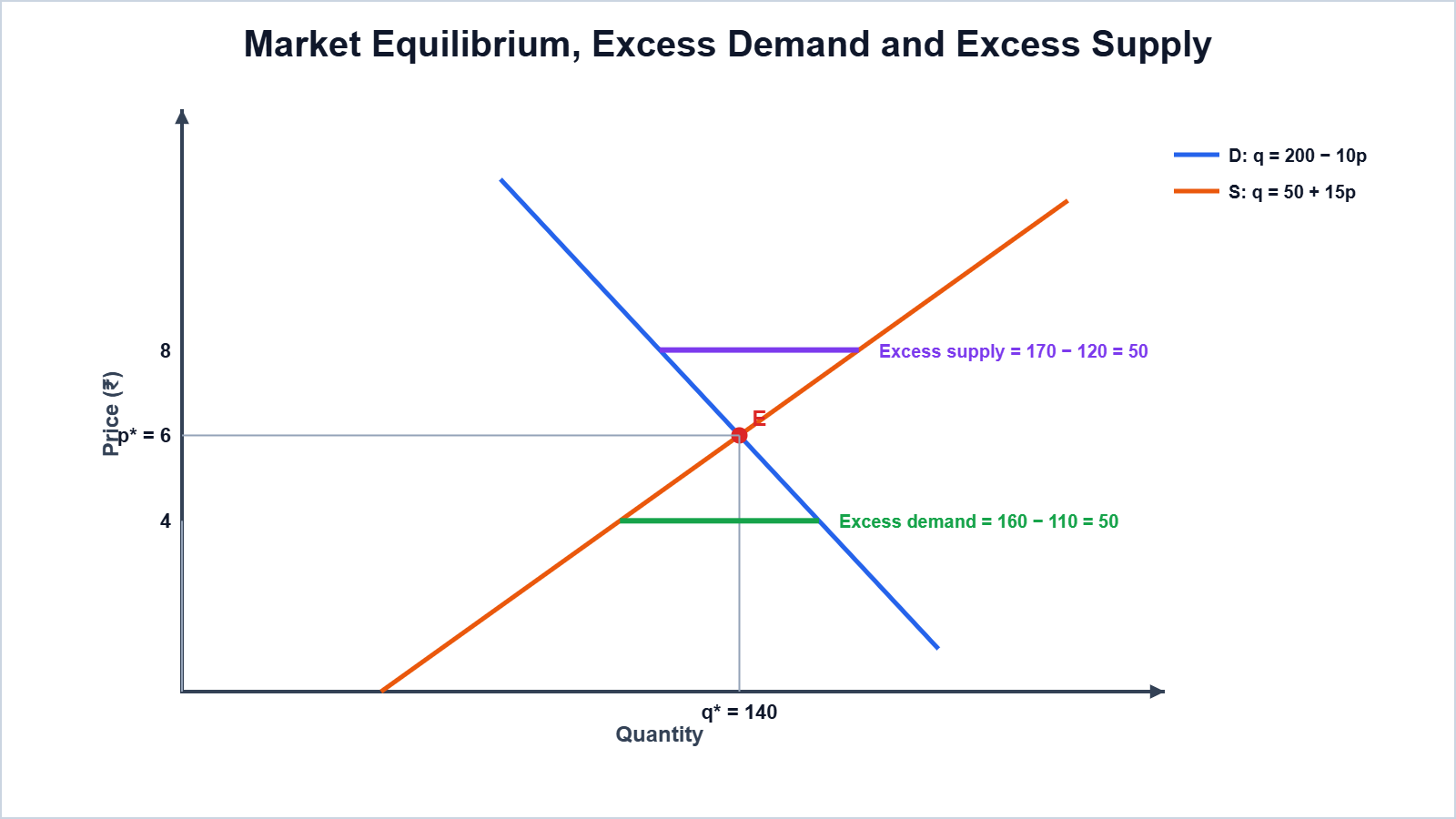
Numerical 1: The demand and supply functions are qD = 200 – 10p and qS = 50 + 15p. Find the equilibrium price and quantity.
Given: qD = 200 – 10p; qS = 50 + 15p
Formula: At equilibrium qD = qS
Solution: 200 – 10p = 50 + 15p, so 150 = 25p and p = 6; q = 200 – 10 x 6
Answer: p* = ₹6; q* = 140 units
Numerical 2: In Numerical 1, find the excess demand or excess supply at p = ₹4 and at p = ₹8.
Given: p = 4 and p = 8
Formula: Excess demand = qD – qS; excess supply = qS – qD
Solution: At p = 4: qD = 160, qS = 110. At p = 8: qD = 120, qS = 170
Answer: Excess demand of 50 units at ₹4; excess supply of 50 units at ₹8
5.1.1 Market Equilibrium: Fixed Number of Firms
When the number of firms is fixed, the market supply curve is upward sloping and equilibrium is where it cuts the market demand curve. A wage rate in a labour market is determined in the same way, by the demand for labour (MRPL = w) and the supply of labour.
Numerical 3: There are 20 identical firms, each with supply qs = 2p – 4 (for p ≥ 2). Market demand is qD = 400 – 20p. Find equilibrium price and quantity.
Given: Market supply = 20(2p – 4) = 40p – 80
Formula: qD = qS
Solution: 400 – 20p = 40p – 80, so 480 = 60p and p = 8; q = 400 – 20 x 8
Answer: p* = ₹8; q* = 240 units (each firm supplies 2 x 8 – 4 = 12 units)
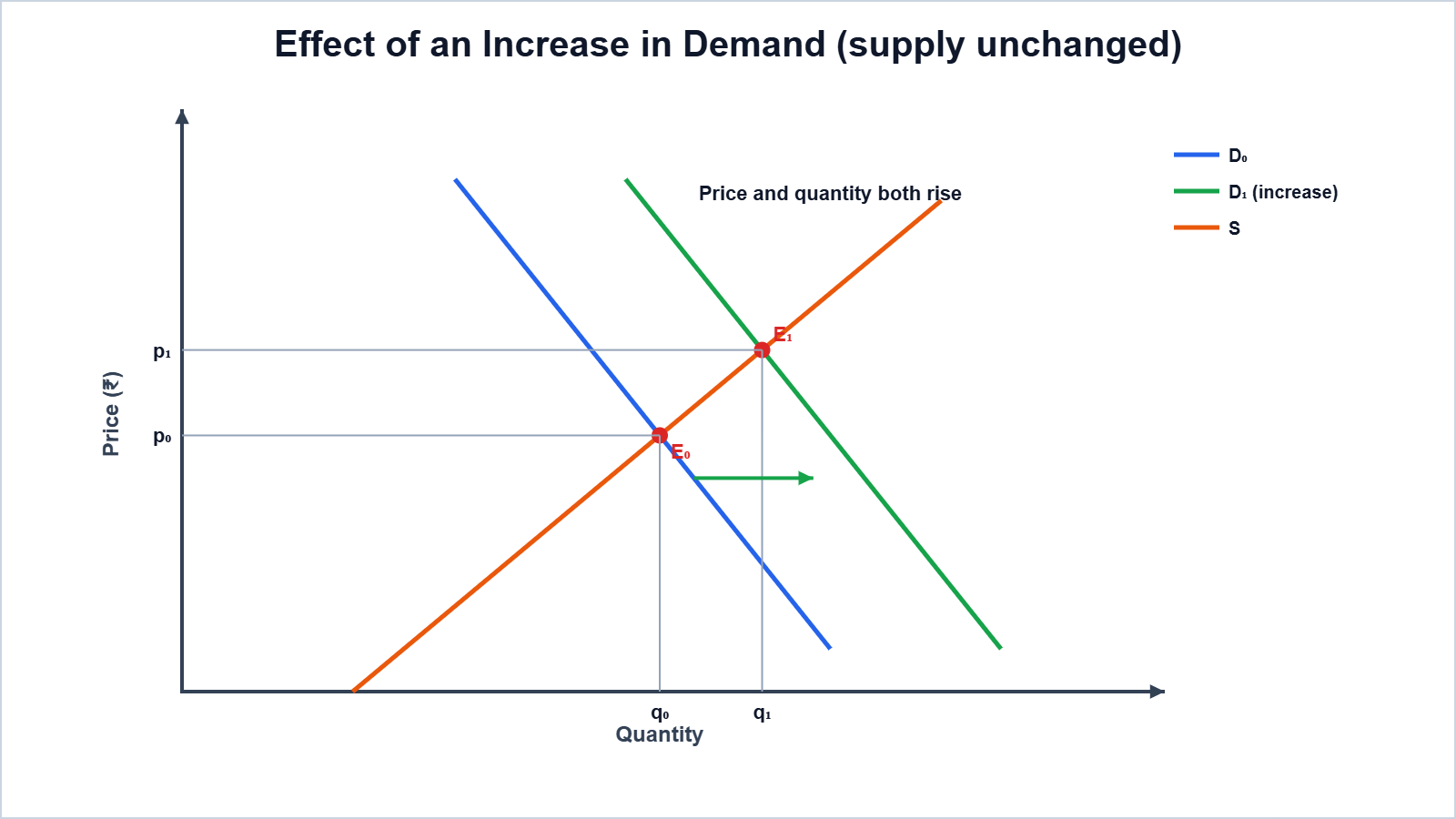
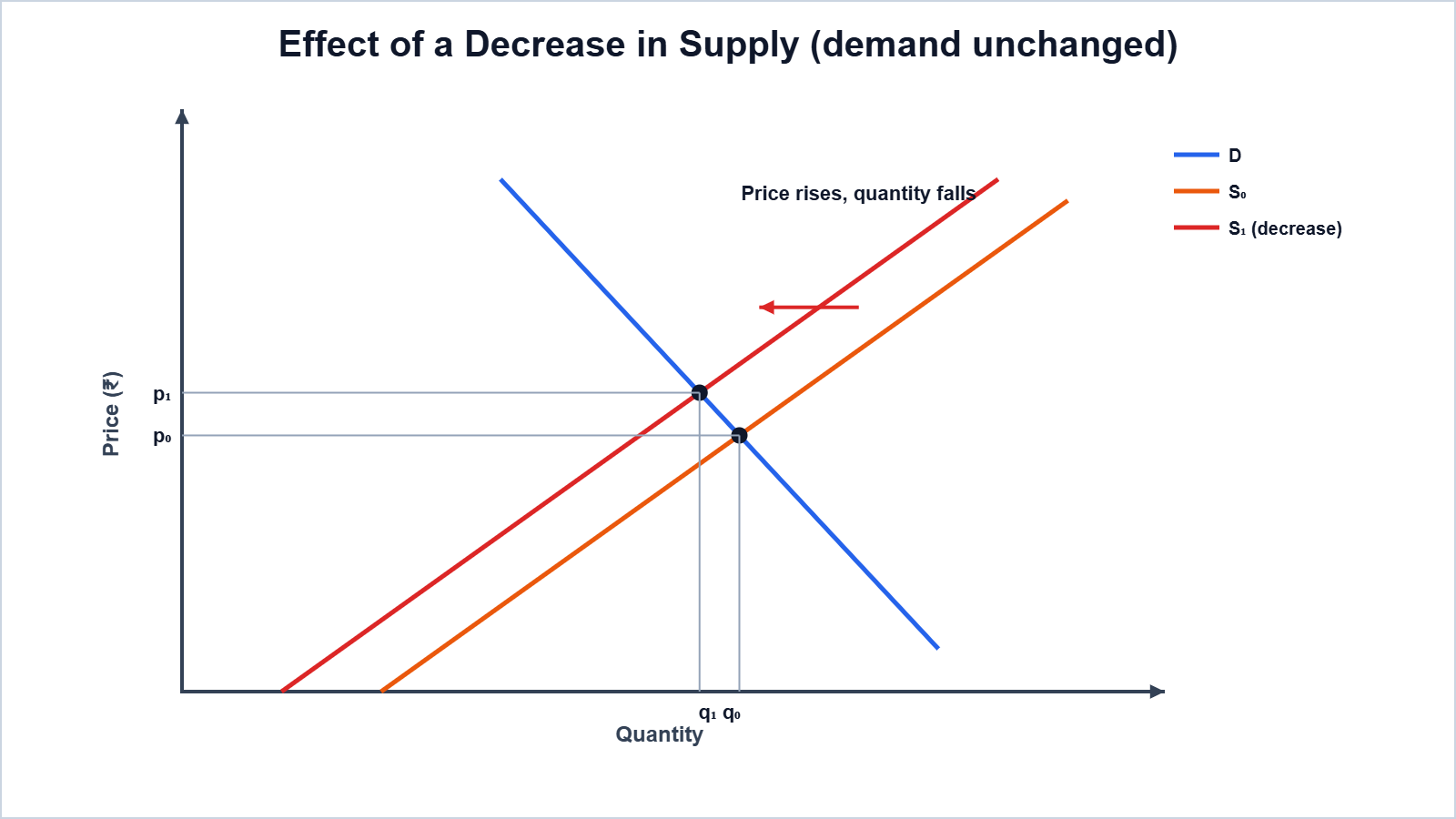
Shifts in demand and supply (fixed number of firms):
Change | Effect on equilibrium price | Effect on equilibrium quantity |
|---|---|---|
Increase in demand | Rises | Rises |
Decrease in demand | Falls | Falls |
Increase in supply | Falls | Rises |
Decrease in supply | Rises | Falls |
Demand and supply both increase | Indeterminate (depends on size of shifts) | Rises |
Demand rises, supply falls | Rises | Indeterminate |
Numerical 4: In Numerical 1, demand rises to qD = 250 – 10p. Find the new equilibrium.
Given: qD = 250 – 10p; qS = 50 + 15p
Formula: qD = qS
Solution: 250 – 10p = 50 + 15p, so p = 200/25 = 8; q = 250 – 80
Answer: p = ₹8, q = 170: both price and quantity rise (from ₹6 and 140).
Numerical 5: In Numerical 1, supply falls to qS = 25 + 15p. Find the new equilibrium.
Given: qD = 200 – 10p; qS = 25 + 15p
Formula: qD = qS
Solution: 200 – 10p = 25 + 15p, so p = 175/25 = 7; q = 200 – 70
Answer: p = ₹7, q = 130: price rises and quantity falls.
5.1.2 Market Equilibrium: Free Entry and Exit
If firms can enter and exit freely, super-normal profits attract new firms (supply rises, price falls) and losses make firms leave (supply falls, price rises). In the long run, each firm earns only normal profit, so price = minimum AC. The market supply curve is horizontal at that price, and the equilibrium quantity is decided by demand at that price.
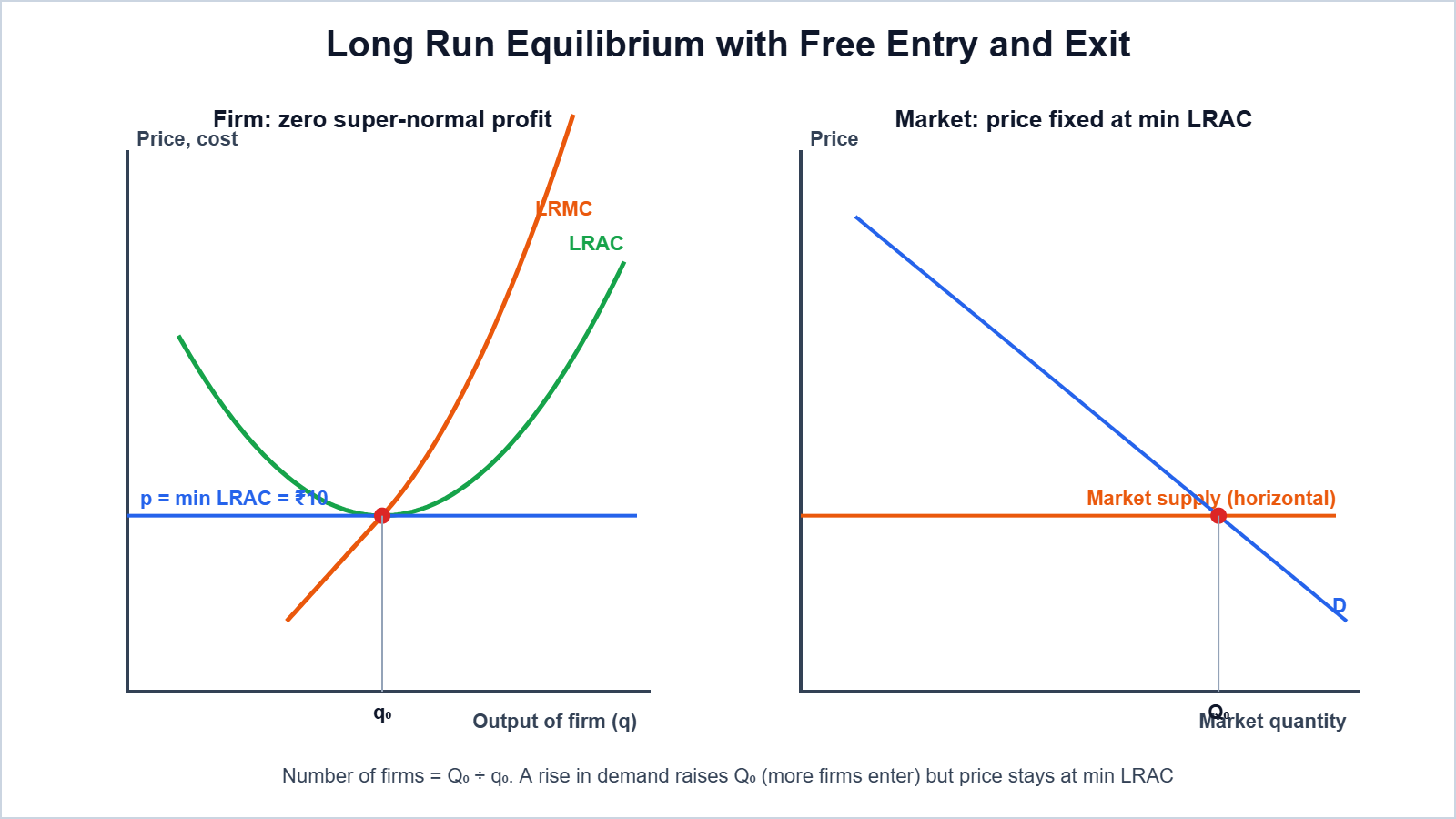
Numerical 6: With free entry and exit, minimum AC of each identical firm is ₹10 at output 40 units. Market demand is qD = 1000 – 20p. Find the equilibrium price, quantity and number of firms.
Given: Min AC = ₹10 at q = 40; qD = 1000 – 20p
Formula: p = min AC; Q = qD(p); number of firms = Q / output per firm
Solution: p = 10; Q = 1000 – 20 x 10 = 800; firms = 800/40
Answer: p = ₹10; Q = 800 units; 20 firms
Exam point: with free entry and exit, a shift in demand changes the equilibrium quantity and the number of firms, but not the price (which stays at minimum AC).
5.2 Applications
Sometimes the government fixes prices instead of leaving them to the market.
5.2.1 Price Ceiling: a legal maximum price set below the equilibrium price, to make essential goods (wheat, rice, kerosene, sugar) affordable for the poor. It causes excess demand (shortage). The government then uses rationing (ration cards, fair price shops). Possible problems: long queues, poor quality, and black markets where the good is sold illegally at a higher price.
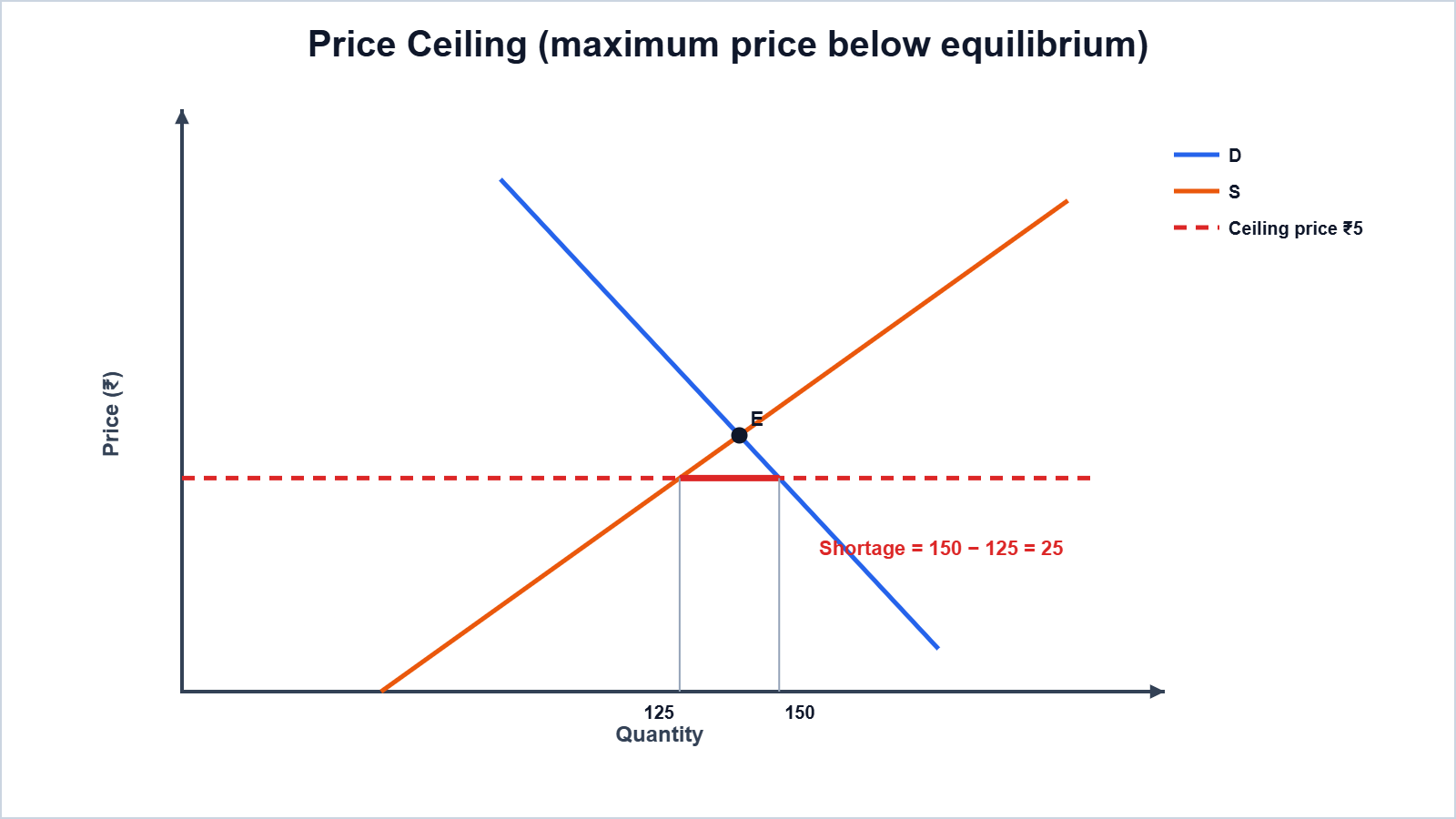
Numerical 7: In Numerical 1, the government fixes a price ceiling of ₹5. Find the shortage.
Given: pc = 5
Formula: Shortage = qD – qS at pc
Solution: qD = 200 – 50 = 150; qS = 50 + 75 = 125
Answer: Shortage (excess demand) = 25 units
5.2.2 Price Floor: a legal minimum price set above the equilibrium price, e.g., minimum support price for farm products and minimum wages. It causes excess supply (surplus). The government may buy the surplus (buffer stocks), and storage costs rise; in the labour market a minimum wage above equilibrium may cause some unemployment.

Numerical 8: In Numerical 1, the government fixes a price floor of ₹8. Find the surplus.
Given: pf = 8
Formula: Surplus = qS – qD at pf
Solution: qS = 50 + 120 = 170; qD = 200 – 80 = 120
Answer: Surplus (excess supply) = 50 units
Easy Memory Trick: “Ceiling is low, Floor is high” – a ceiling sits below equilibrium (shortage); a floor sits above equilibrium (surplus).
Practice Problems (Answers Only)
- qD = 100 – 10p and qS = 40 + 5p. Find equilibrium. Ans: p = ₹4, q = 60
- In the above, find excess demand at p = ₹2. Ans: 80 – 50 = 30 units
- Demand increases while supply remains the same. What happens to price and quantity? Ans: Both rise
- Minimum AC = ₹25 at 50 units per firm; market demand at ₹25 is 2,000 units. How many firms with free entry? Ans: 40
- Is a minimum support price a ceiling or a floor? Ans: A price floor
Important Questions
Q1. What is market equilibrium?
Ans. A situation where market demand equals market supply at a price, so there is no tendency to change.
Q2. Explain how excess demand is removed.
Ans. Buyers bid up the price; quantity demanded falls and supply rises until equilibrium is restored.
Q3. Explain how excess supply is removed.
Ans. Sellers lower the price; quantity demanded rises and supply falls until equilibrium.
Q4. What is the effect of an increase in demand on equilibrium price and quantity?
Ans. Both rise (with supply unchanged and upward sloping).
Q5. Under free entry and exit, why is price equal to minimum AC?
Ans. Super-normal profits attract entry and losses cause exit, until only normal profit remains.
Q6. Under free entry and exit, what is the effect of an increase in demand?
Ans. Quantity and number of firms rise; price stays at minimum AC.
Q7. What is a price ceiling? Give its consequences.
Ans. A maximum price below equilibrium; it causes shortage, rationing, queues and black markets.
Q8. What is a price floor? Give two examples.
Ans. A minimum price above equilibrium; minimum support price and minimum wage.
Q9. What happens if both demand and supply increase equally?
Ans. Quantity rises; price remains unchanged.
Q10. Why does a black market arise under a price ceiling?
Ans. Because some buyers are willing to pay more than the ceiling price for the scarce good.
Conclusion: Market equilibrium is reached where demand equals supply, and the price mechanism removes any excess demand or supply. Shifts in demand and supply change the equilibrium, free entry and exit keep price at minimum AC, and government price ceilings and floors create shortages and surpluses.