Government Budget and the Economy – Class 12 Economics Notes
Part B: Introductory Macroeconomics
Chapter – 5
Government Budget and the Economy
5.1 Government Budget – Meaning and its Components
A government budget is an annual statement of the estimated receipts and expenditure of the government for a financial year (1 April to 31 March in India). Under Article 112 of the Indian Constitution, it is laid before Parliament as the “Annual Financial Statement”.
Components: the revenue budget (revenue receipts and revenue expenditure) and the capital budget (capital receipts and capital expenditure).
5.1.1 Objectives of Government Budget
- Allocation of resources: providing public goods (defence, roads, street lights, parks) which the market does not supply well because they are non-rival (one person’s use does not reduce another’s) and non-excludable (people cannot easily be stopped from using them, leading to the “free rider” problem). The government may also tax harmful goods and subsidise useful ones.
- Redistribution of income and wealth: through progressive taxes and transfer payments (subsidies, pensions, free services) to reduce inequality.
- Economic stabilisation: controlling inflation and unemployment by changing government spending and taxes (fiscal policy).
- Management of public enterprises and promoting economic growth through investment in infrastructure.
Remember: public provision means the government finances a good through the budget; it need not produce it itself (production may be by private firms).
5.1.2 Classification of Receipts
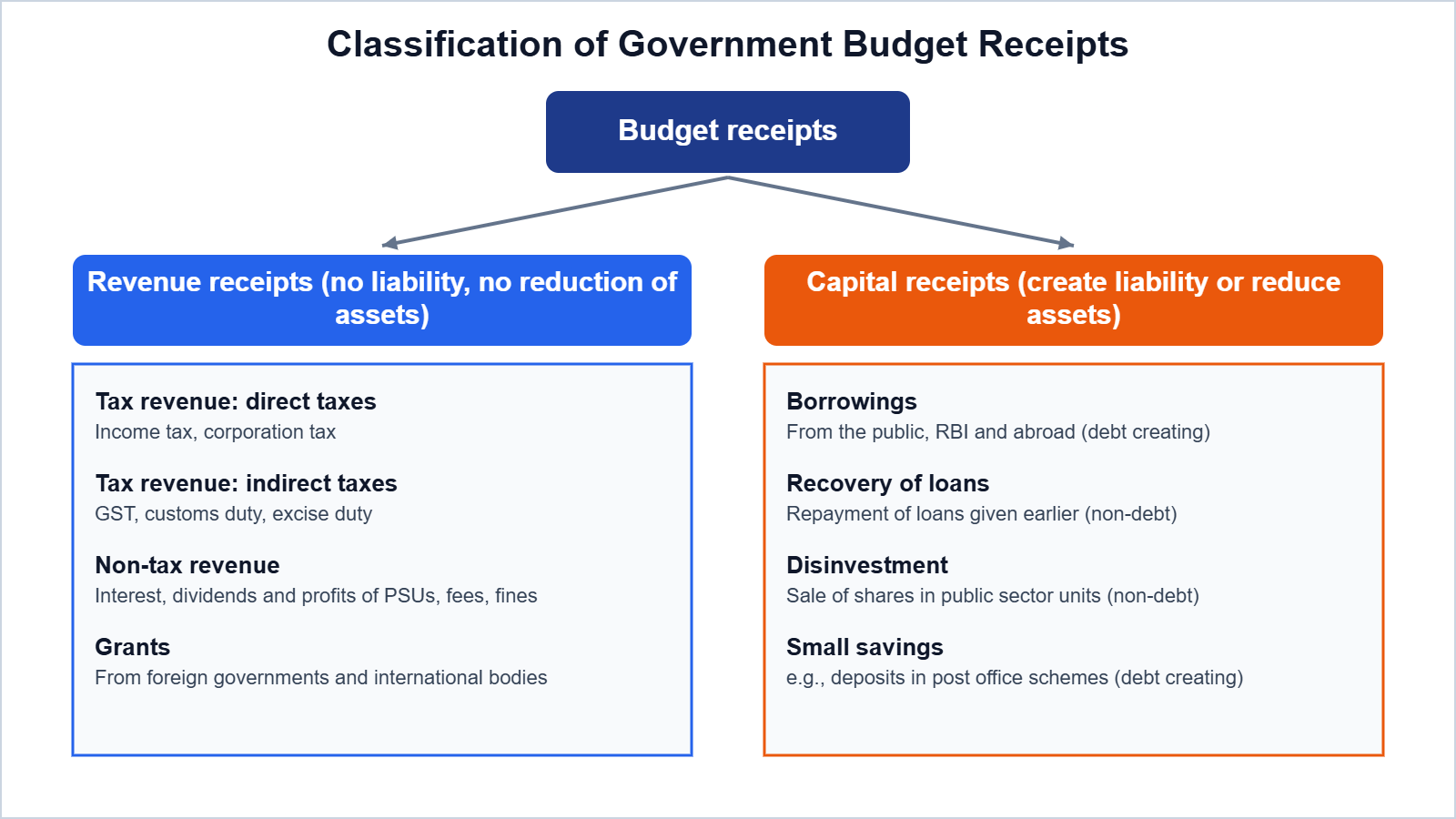
Revenue receipts neither create a liability nor reduce assets of the government. They include tax revenue – direct taxes (burden cannot be shifted: personal income tax, corporation tax) and indirect taxes (burden can be shifted: GST, customs duties, excise duties) – and non-tax revenue (interest on loans given, dividends and profits from public enterprises, fees, fines, grants received).
Capital receipts either create a liability or reduce assets: borrowings (market loans, small savings, borrowing from the RBI and from abroad), recovery of loans given earlier and disinvestment (sale of government shares in public sector units). Recovery of loans and disinvestment are non-debt creating capital receipts; borrowings are debt creating.
Exam point: Is a receipt revenue or capital? Ask: does it create a liability or reduce an asset? If yes, it is a capital receipt; if no, it is a revenue receipt. Example: borrowings (capital: liability), disinvestment (capital: asset falls), dividends from PSUs (revenue).
5.1.3 Classification of Expenditure

Revenue expenditure does not create assets or reduce liabilities: salaries, pensions, interest payments, subsidies and grants to state governments. Capital expenditure creates assets or reduces liabilities: buying land, buildings and machinery, building roads, investment in shares, loans to states and public enterprises, and repayment of loans.
Expenditure is also classified (in older budget documents) as plan and non-plan, and as developmental and non-developmental. India discontinued the plan/non-plan distinction from the 2017-18 budget.
5.2 Balanced, Surplus and Deficit Budget
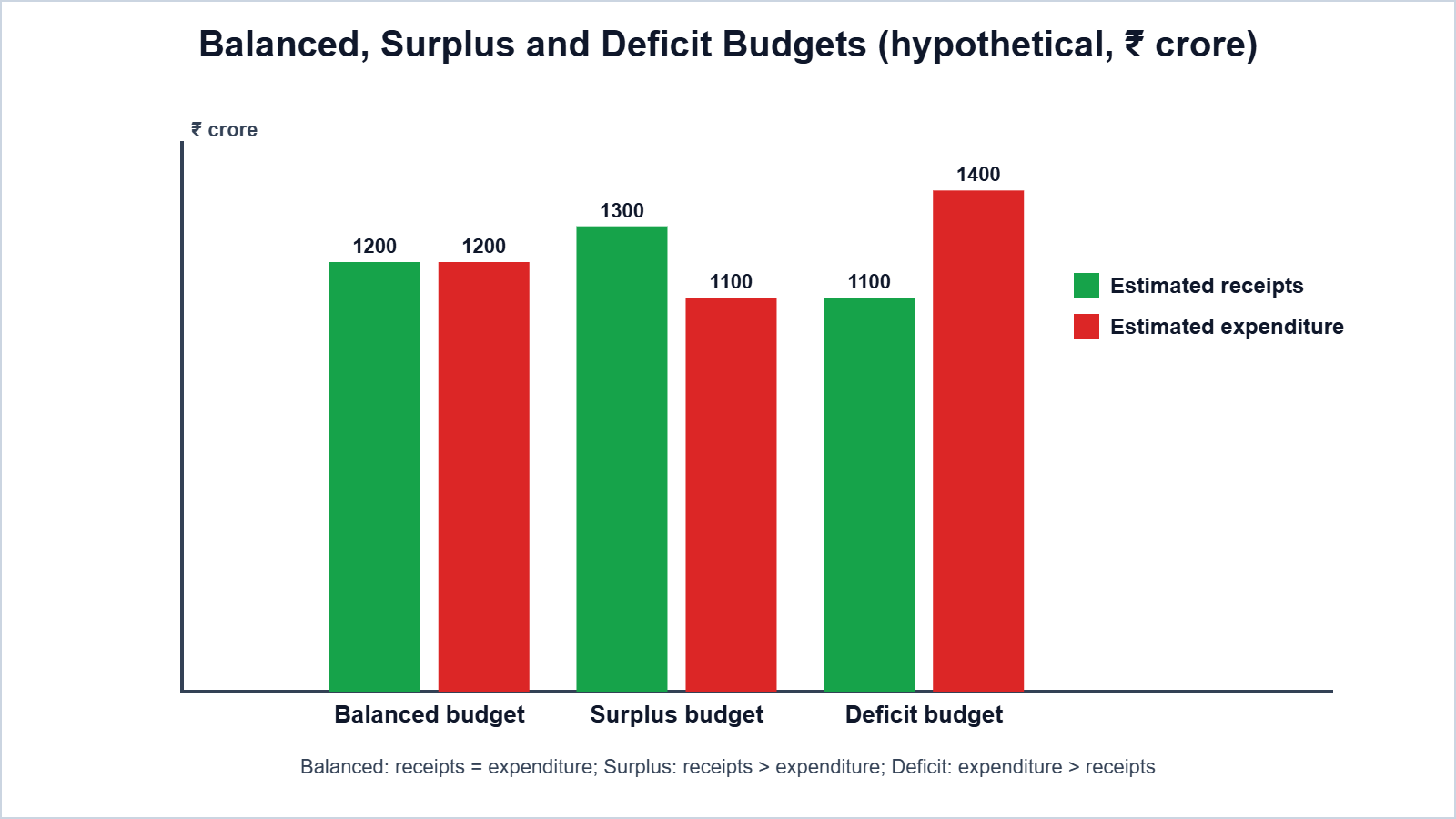
Type | Condition | Use |
|---|---|---|
Balanced budget | Estimated receipts = estimated expenditure | Neutral; does not add to or cut aggregate demand directly |
Surplus budget | Estimated receipts > estimated expenditure | Reduces aggregate demand; useful to control inflation |
Deficit budget | Estimated expenditure > estimated receipts | Increases aggregate demand; useful in a recession (deflationary gap) |
5.2.1 Measures of Government Deficit
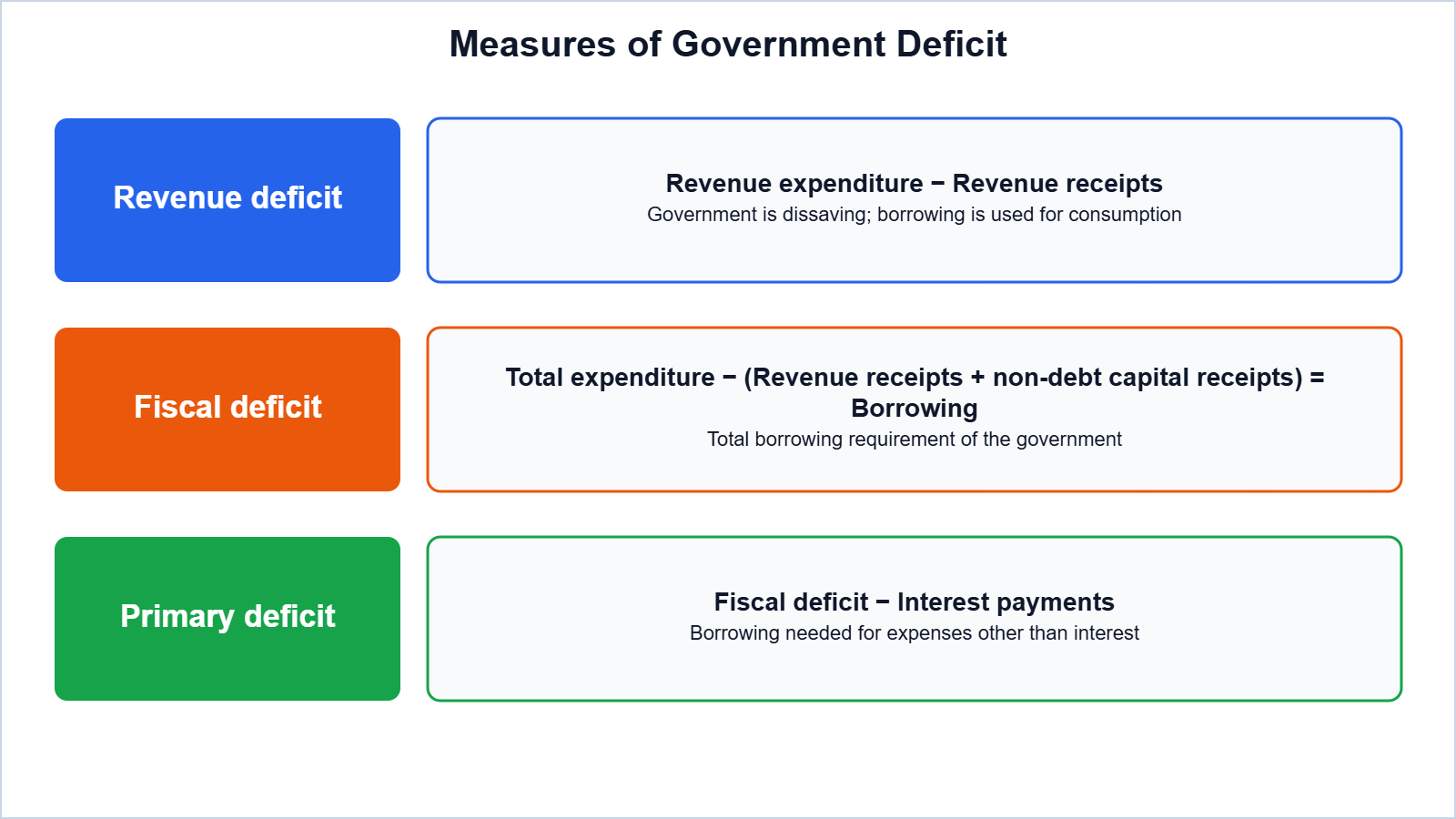
- Revenue deficit (RD) = Revenue expenditure – Revenue receipts. It shows the government is dissaving: it borrows to meet consumption-type expenses, which may increase the future debt burden without creating assets.
- Fiscal deficit (FD) = Total expenditure – (Revenue receipts + non-debt creating capital receipts) = total borrowing requirement of the government. It indicates the debt the government adds in the year.
- Primary deficit (PD) = Fiscal deficit – Interest payments. It shows the borrowing needed for current year’s needs other than interest on past debt.
- Effective revenue deficit = Revenue deficit – grants given for creation of capital assets.
Item (hypothetical, ₹ crore) | Amount |
|---|---|
Tax revenue | 600 |
Non-tax revenue | 200 |
Revenue expenditure | 1,000 (of which interest payments 150; grants for creating capital assets 60) |
Capital expenditure | 400 |
Recovery of loans | 50 |
Disinvestment | 50 |
Numerical 1: From the table above, find the revenue deficit and effective revenue deficit.
Given: Revenue receipts = 600 + 200 = 800; revenue expenditure = 1,000; grants for capital assets = 60
Formula: RD = RE – RR; ERD = RD – grants for creation of capital assets
Solution: RD = 1000 – 800 = 200; ERD = 200 – 60
Answer: Revenue deficit = ₹200 crore; effective revenue deficit = ₹140 crore
Numerical 2: From the same table, find the fiscal deficit and the amount of borrowing.
Given: Total expenditure = 1000 + 400 = 1400; RR = 800; non-debt capital receipts = 50 + 50 = 100
Formula: FD = Total expenditure – (RR + non-debt capital receipts)
Solution: FD = 1400 – (800 + 100) = 1400 – 900
Answer: Fiscal deficit = ₹500 crore = borrowing required
Numerical 3: Find the primary deficit in Numerical 2.
Given: FD = 500; interest payments = 150
Formula: PD = FD – interest payments
Solution: PD = 500 – 150
Answer: Primary deficit = ₹350 crore
Numerical 4: If GDP is ₹10,000 crore, express the fiscal deficit in Numerical 2 as a percentage of GDP.
Given: FD = 500; GDP = 10,000
Formula: FD as % of GDP = FD/GDP x 100
Solution: 500/10000 x 100
Answer: 5% of GDP
Numerical 5: Revenue receipts ₹1,200, revenue expenditure ₹1,300, capital expenditure ₹700, non-debt capital receipts ₹100 and interest payments ₹300 (₹ crore). Find RD, FD and PD.
Given: As given
Formula: RD = RE – RR; FD = (RE + CE) – (RR + non-debt CR); PD = FD – interest
Solution: RD = 1300 – 1200 = 100; FD = 2000 – 1300 = 700; PD = 700 – 300
Answer: RD = 100; FD = 700; PD = ₹400 crore
Implications of deficits: a large fiscal deficit means heavy borrowing, rising interest burden in future, possible inflation (if financed by borrowing from the RBI, i.e., deficit financing) and less funds available for private investment (crowding out). Deficits used for productive capital expenditure are less harmful than those used for consumption. Laws such as the Fiscal Responsibility and Budget Management (FRBM) Act, 2003 aim to keep deficits under control (targets are revised from time to time).
Fiscal policy and the multiplier (with government): a rise in government expenditure raises AD and income by a multiple (government expenditure multiplier = 1/(1 – MPC)); a rise in lump-sum taxes lowers consumption and income (tax multiplier = -MPC/(1 – MPC)).
Easy Memory Trick: “Fiscal = Full borrowing; Primary = Present borrowing (minus interest); Revenue = Running expenses gap”.
Practice Problems (Answers Only)
- Revenue expenditure ₹900 crore, revenue receipts ₹700 crore. Find revenue deficit. Ans: ₹200 crore
- Fiscal deficit ₹450 crore, interest payments ₹200 crore. Find primary deficit. Ans: ₹250 crore
- Fiscal deficit ₹300 crore and GDP ₹6,000 crore. Find FD as % of GDP. Ans: 5%
- If primary deficit is zero, what does it show? Ans: Borrowing is only for paying interest on past loans (fiscal deficit = interest payments)
- Classify: (a) dividends from PSUs, (b) disinvestment, (c) borrowing from the RBI. Ans: (a) revenue receipt, (b) capital (non-debt), (c) capital (debt creating)
Important Questions
Q1. What is a government budget?
Ans. An annual statement of estimated receipts and expenditure of the government for a financial year.
Q2. State three objectives of a government budget.
Ans. Allocation of resources, redistribution of income and economic stabilisation.
Q3. Distinguish between revenue and capital receipts.
Ans. Revenue receipts create no liability and do not reduce assets; capital receipts create a liability or reduce assets.
Q4. Distinguish between direct and indirect taxes.
Ans. The burden of a direct tax cannot be shifted (income tax); that of an indirect tax can be shifted (GST).
Q5. Distinguish between revenue and capital expenditure.
Ans. Revenue expenditure creates no asset and reduces no liability; capital expenditure does.
Q6. Why are public goods provided by the government?
Ans. They are non-rival and non-excludable, so the market under-supplies them (free rider problem).
Q7. Define fiscal deficit. What does it indicate?
Ans. Total expenditure minus revenue receipts and non-debt capital receipts; it shows the total borrowing requirement.
Q8. What is primary deficit?
Ans. Fiscal deficit minus interest payments.
Q9. What are the implications of a revenue deficit?
Ans. Government borrows for consumption, dissaving and increasing future debt and interest burden.
Q10. When is a surplus budget useful?
Ans. During inflation, as it reduces aggregate demand.
Conclusion: The government budget allocates resources, redistributes income and stabilises the economy. Receipts and expenditure are classified into revenue and capital items, and the revenue, fiscal and primary deficits measure the gap the government must fill by borrowing.