National Income Accounting – Class 12 Economics Notes
Part B: Introductory Macroeconomics
Chapter – 2
National Income Accounting
2.1 Some Basic Concepts of Macroeconomics
- Final goods: goods bought for final use (consumption or investment) and not for resale or further processing in the same year, e.g., bread bought by a household, a machine bought by a firm.
- Intermediate goods: goods used up as inputs in producing other goods or resold in the same year, e.g., flour bought by a baker. Only final goods are counted in national income, to avoid double counting.
- Consumption goods: final goods that satisfy wants directly (food, clothes, services). Capital goods: durable final goods used to produce other goods (machines, buildings, tools); they are not used up in one production cycle.
- Stocks and flows: a stock is measured at a point of time (wealth, capital, money supply); a flow is measured over a period of time (income, output, investment, consumption).
- Investment (capital formation): addition to the stock of capital during a period. Gross investment = net investment + depreciation.
- Depreciation (consumption of fixed capital): fall in the value of fixed capital due to normal wear and tear and expected obsolescence.
2.2 Circular Flow of Income and Methods of Calculating National Income
In a simple two-sector economy (households and firms, no saving, no government, no foreign trade), households supply factor services to firms and receive factor payments (wages, rent, interest, profit). They spend all of this income on goods and services produced by firms. So income flows in a circle: value of output = factor incomes = expenditure. This is why national income can be measured in three ways.
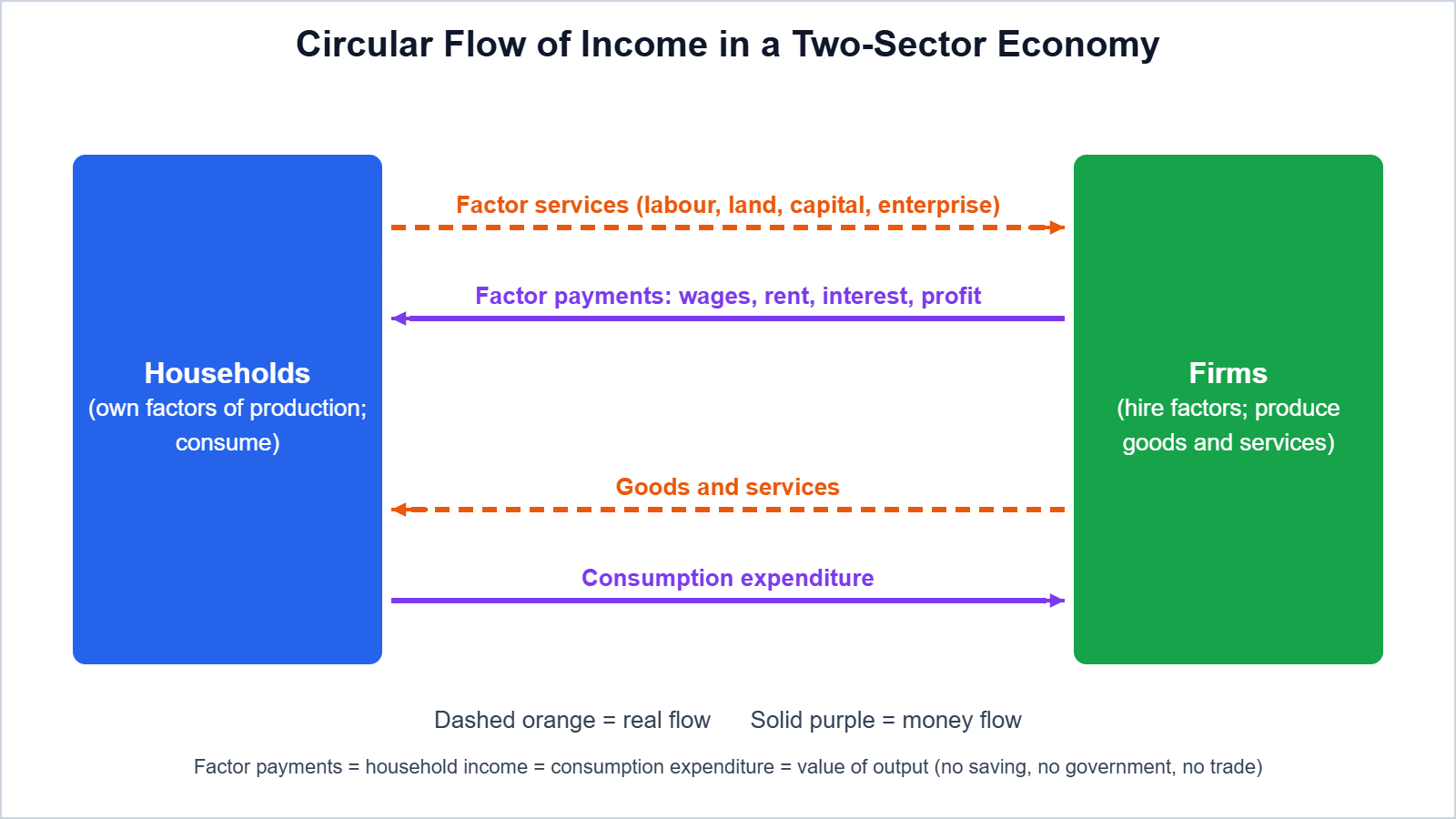
Numerical 1: In a two-sector economy firms pay wages ₹600 crore, rent ₹150 crore, interest ₹100 crore and profits ₹150 crore. Households spend all their income. Find household income, consumption expenditure and value of output.
Given: Factor payments: 600, 150, 100, 150
Formula: Household income = sum of factor payments = consumption = value of output
Solution: 600 + 150 + 100 + 150
Answer: ₹1,000 crore each: the circular flow is complete. (If households save ₹200 crore and firms invest ₹200 crore, the flow still balances because saving returns as investment.)
2.2.1 The Product or Value Added Method
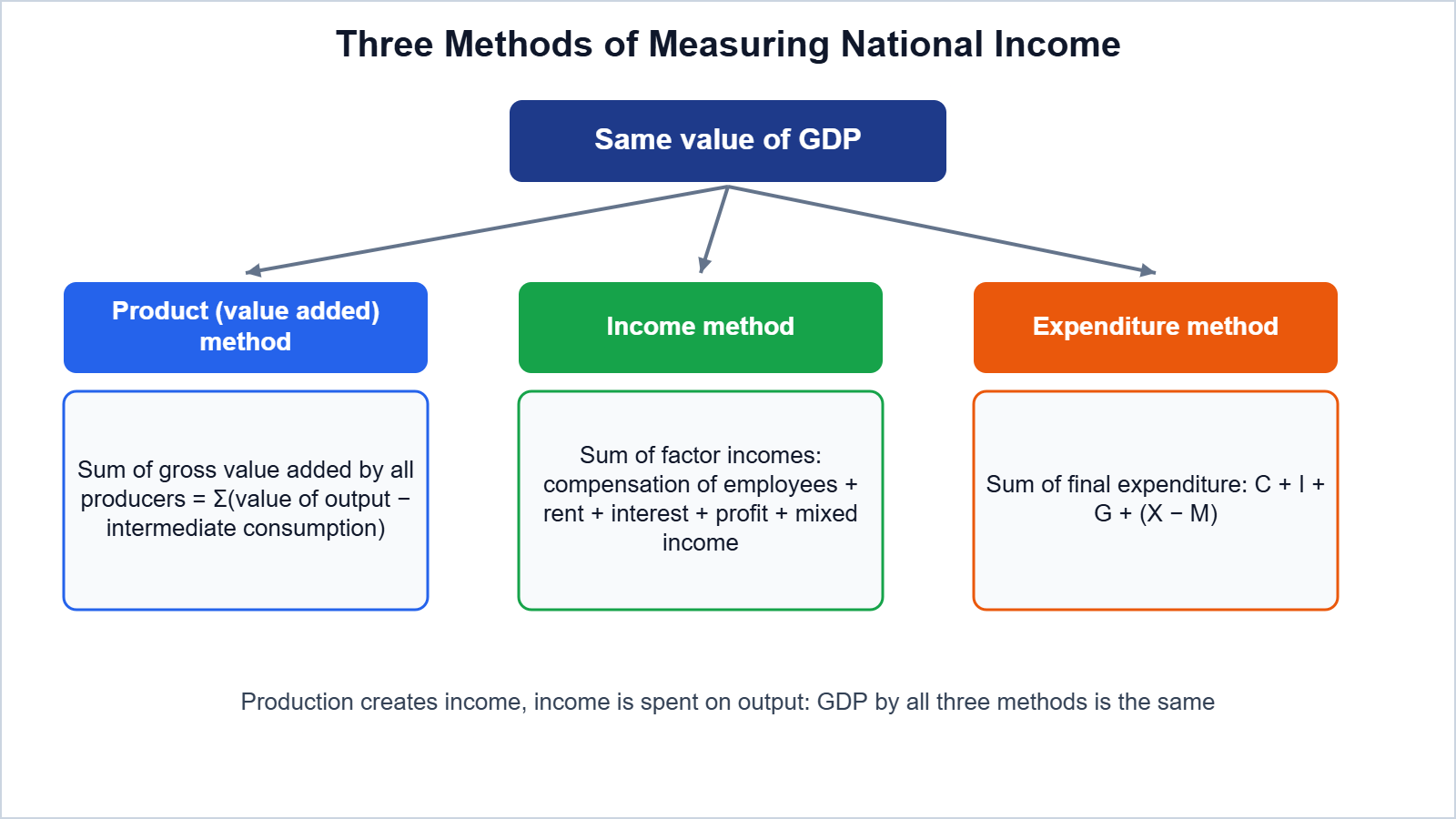
Value added = value of output – intermediate consumption. Value of output = sales + change in stock. GDP = sum of gross value added (GVA) by all producing enterprises in the domestic territory.
Numerical 2: A farmer grows wheat worth ₹100 (no inputs bought), sells it to a miller who makes flour worth ₹150, and the miller sells it to a baker who makes bread worth ₹200 sold to consumers. Find value added at each stage and GDP.
Given: Outputs: 100, 150, 200; intermediate inputs: 0, 100, 150
Formula: Value added = output – intermediate consumption
Solution: Farmer: 100 – 0 = 100; miller: 150 – 100 = 50; baker: 200 – 150 = 50
Answer: Total value added = ₹200 = value of the final good (bread). Adding all outputs (₹450) would double count.
Numerical 3: A firm’s sales are ₹500, change in stock ₹20, intermediate consumption ₹300, depreciation ₹20 and net indirect taxes ₹30. Find GVA at MP and NVA at FC.
Given: Sales 500; change in stock 20; IC 300; depreciation 20; NIT 30
Formula: Value of output = sales + change in stock; GVAMP = value of output – IC; NVAFC = GVAMP – depreciation – NIT
Solution: Value of output = 520; GVAMP = 520 – 300 = 220; NVAMP = 200; NVAFC = 200 – 30
Answer: GVA at MP = ₹220; NVA at FC = ₹170
2.2.2 Expenditure Method
GDP is measured as the sum of final expenditures on domestically produced goods and services: GDPMP = C + I + G + (X – M), where C = private final consumption expenditure, I = gross investment (gross domestic capital formation), G = government final consumption expenditure, X – M = net exports.
Numerical 4: Private consumption ₹600, gross investment ₹200, government consumption ₹150, exports ₹80, imports ₹100, depreciation ₹50, NFIA -₹10, net indirect taxes ₹70 (₹ crore). Find GDPMP, NDPMP, NNPMP and national income.
Given: C = 600; I = 200; G = 150; X = 80; M = 100
Formula: GDPMP = C + I + G + (X – M); NDP = GDP – dep.; NNPMP = NDPMP + NFIA; NI = NNPMP – NIT
Solution: GDPMP = 600 + 200 + 150 – 20 = 930; NDPMP = 880; NNPMP = 870; NNPFC = 870 – 70
Answer: GDPMP = 930; NDPMP = 880; NNPMP = 870; National income = ₹800 crore
2.2.3 Income Method
GDP is the sum of factor incomes generated in production: compensation of employees (wages, salaries, employer’s contribution to social security) + operating surplus (rent, interest, profit) + mixed income of the self-employed. This gives NDP at FC; add depreciation to get GDP at FC.
Numerical 5: Compensation of employees ₹400, rent ₹100, interest ₹80, profit ₹220, mixed income ₹200, NFIA ₹20, depreciation ₹60 (₹ crore). Find NDPFC, national income and GNPFC.
Given: Factor incomes: 400, 100, 80, 220, 200
Formula: NDPFC = sum of factor incomes; NI = NDPFC + NFIA; GNPFC = NI + depreciation
Solution: NDPFC = 400 + 100 + 80 + 220 + 200 = 1000; NI = 1000 + 20 = 1020; GNPFC = 1020 + 60
Answer: NDPFC = 1,000; National income = 1,020; GNPFC = ₹1,080 crore
Remember: transfer payments (old-age pensions, scholarships, gifts), sale of second-hand goods and purchase of shares or bonds are not included in national income, as they do not represent current production. Commission on the sale of second-hand goods and brokerage on shares are included, as they are payments for current services.
2.2.4 Factor Cost, Basic Prices and Market Prices
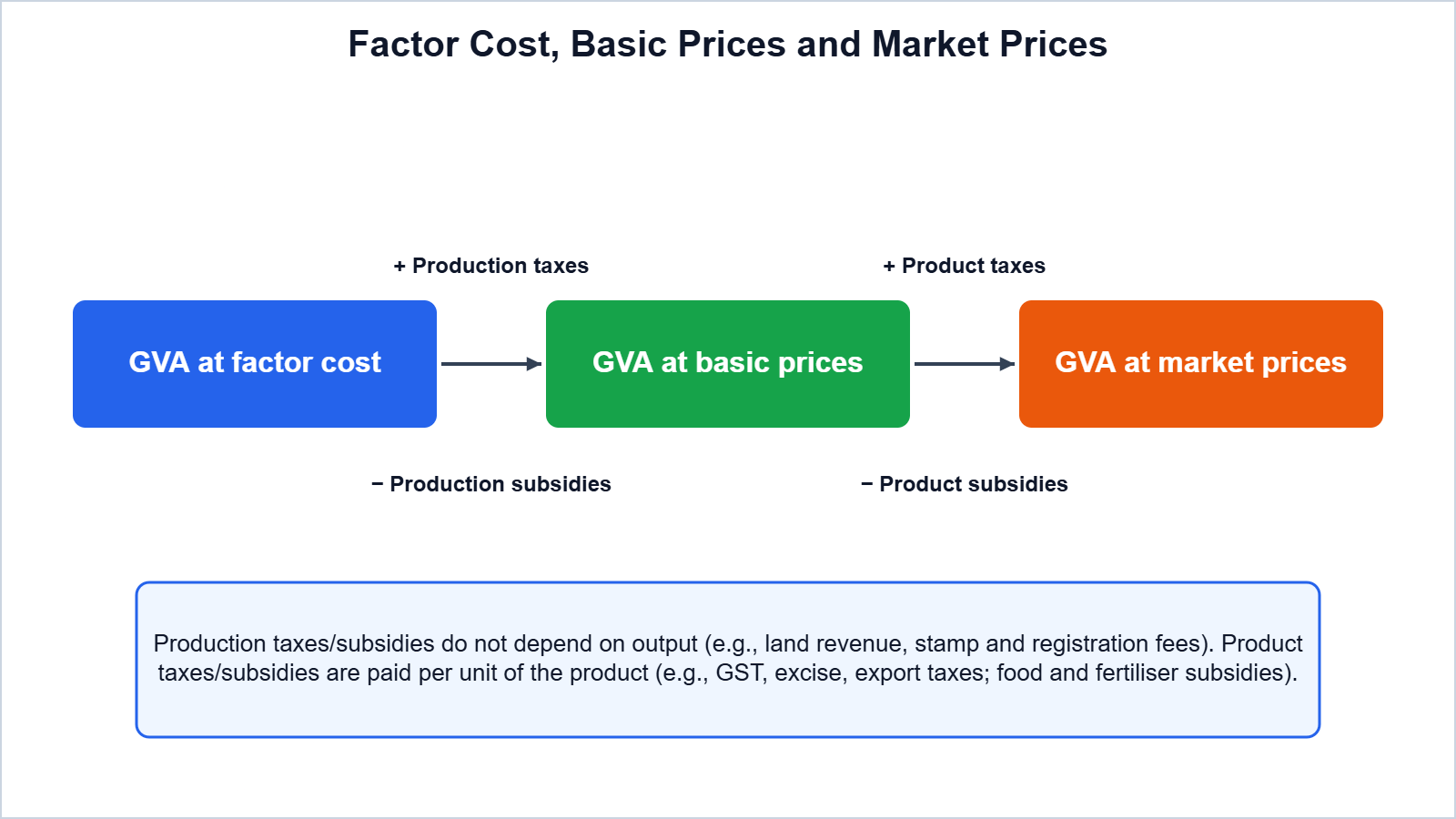
Market price includes taxes and excludes subsidies; factor cost is the payment to factors only. Net indirect taxes = indirect taxes – subsidies. In Indian national accounts, GVA is now reported at basic prices, which lie between factor cost and market prices.
Step | Relationship |
|---|---|
GVA at basic prices | GVA at factor cost + production taxes – production subsidies |
GVA at market prices | GVA at basic prices + product taxes – product subsidies |
Numerical 6: GVA at factor cost is ₹900, production taxes ₹50, production subsidies ₹10, product taxes ₹80 and product subsidies ₹20 (₹ crore). Find GVA at basic prices and at market prices.
Given: As given
Formula: GVABP = GVAFC + production taxes – production subsidies; GVAMP = GVABP + product taxes – product subsidies
Solution: GVABP = 900 + 50 – 10 = 940; GVAMP = 940 + 80 – 20
Answer: GVA at basic prices = ₹940 crore; GVA at market prices = ₹1,000 crore
2.3 Some Macroeconomic Identities
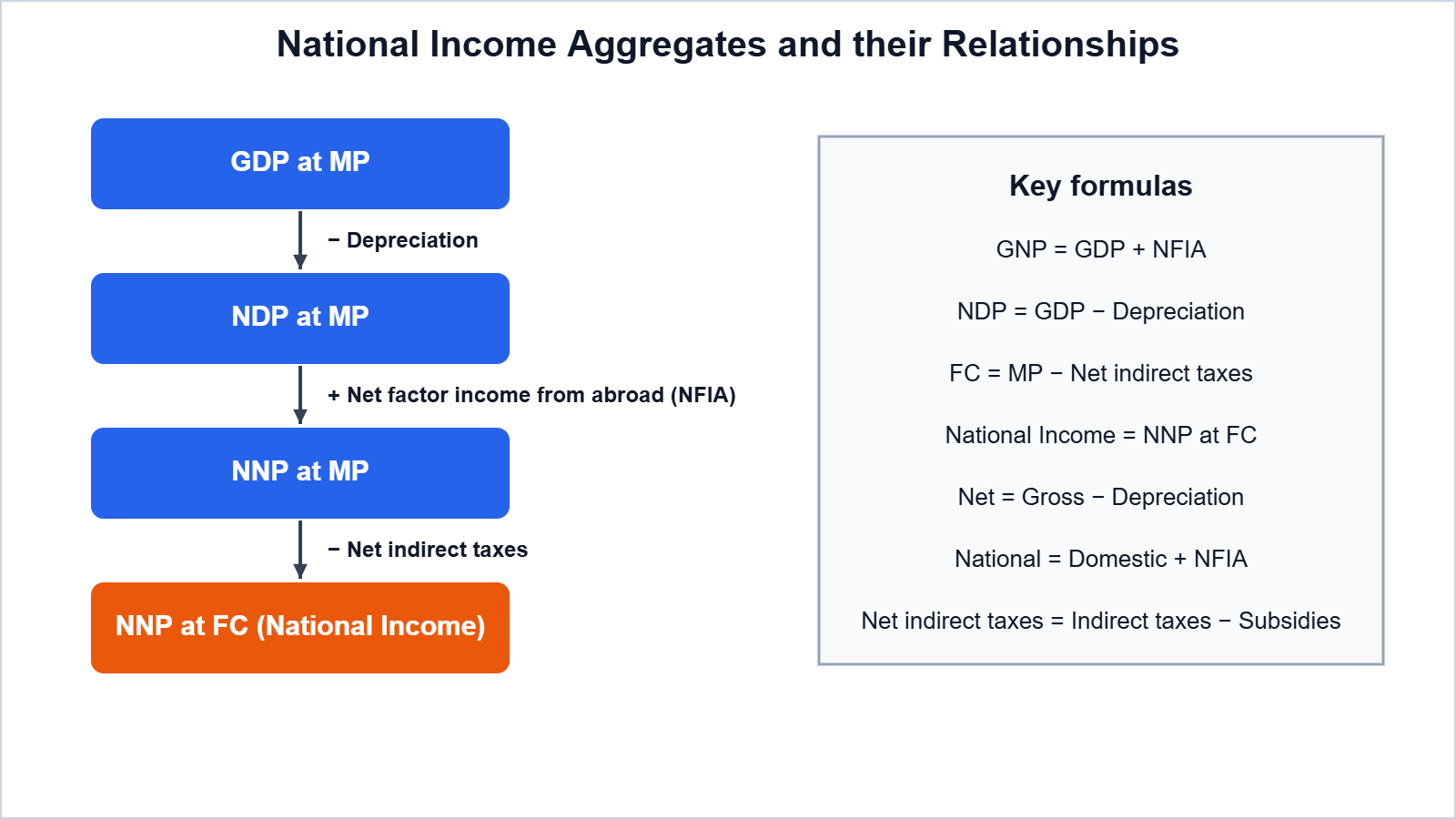
- GNP = GDP + NFIA, where NFIA = factor income earned by residents from abroad – factor income paid to non-residents.
- NNP = GNP – depreciation.
- National income (NI) = NNP at FC = NNP at MP – net indirect taxes.
- Personal income (PI) = NI – undistributed profits – net interest payments made by households – corporate tax + transfer payments to households (from government and firms).
- Personal disposable income (PDI) = PI – personal tax payments – non-tax payments (fees, fines).
- National disposable income = NNP at MP + other current transfers from the rest of the world.
- Private income = factor income from NDP accruing to the private sector + national debt interest + NFIA + current transfers from government + other net transfers from the rest of the world.
Numerical 7: GDPMP = ₹1,000 crore, NFIA = -₹20 crore, depreciation ₹50 crore, net indirect taxes ₹80 crore. Find GNPMP, NNPMP and national income.
Given: GDPMP = 1000; NFIA = -20; dep. = 50; NIT = 80
Formula: GNP = GDP + NFIA; NNP = GNP – dep.; NI = NNPMP – NIT
Solution: GNPMP = 1000 – 20 = 980; NNPMP = 980 – 50 = 930; NI = 930 – 80
Answer: GNPMP = 980; NNPMP = 930; National income = ₹850 crore
Numerical 8: National income ₹1,000 crore; undistributed profits ₹60; net interest paid by households ₹20; corporate tax ₹40; transfer payments ₹50; personal taxes ₹100; non-tax payments ₹10 (₹ crore). Find PI and PDI.
Given: As given
Formula: PI = NI – undistributed profits – net interest by households – corporate tax + transfers; PDI = PI – personal taxes – non-tax payments
Solution: PI = 1000 – 60 – 20 – 40 + 50 = 930; PDI = 930 – 100 – 10
Answer: PI = ₹930 crore; PDI = ₹820 crore
2.4 Nominal and Real GDP
Nominal GDP values output at current year prices; real GDP values it at base year (constant) prices. Nominal GDP can rise just because prices rise, so real GDP is the better measure of growth in output.
GDP deflator = (Nominal GDP / Real GDP) x 100. Other price indices: the Consumer Price Index (CPI) measures prices of a fixed basket of goods bought by consumers; the Wholesale Price Index (WPI) measures wholesale prices. The deflator covers all goods and services produced, while CPI includes imported consumer goods and uses fixed weights.
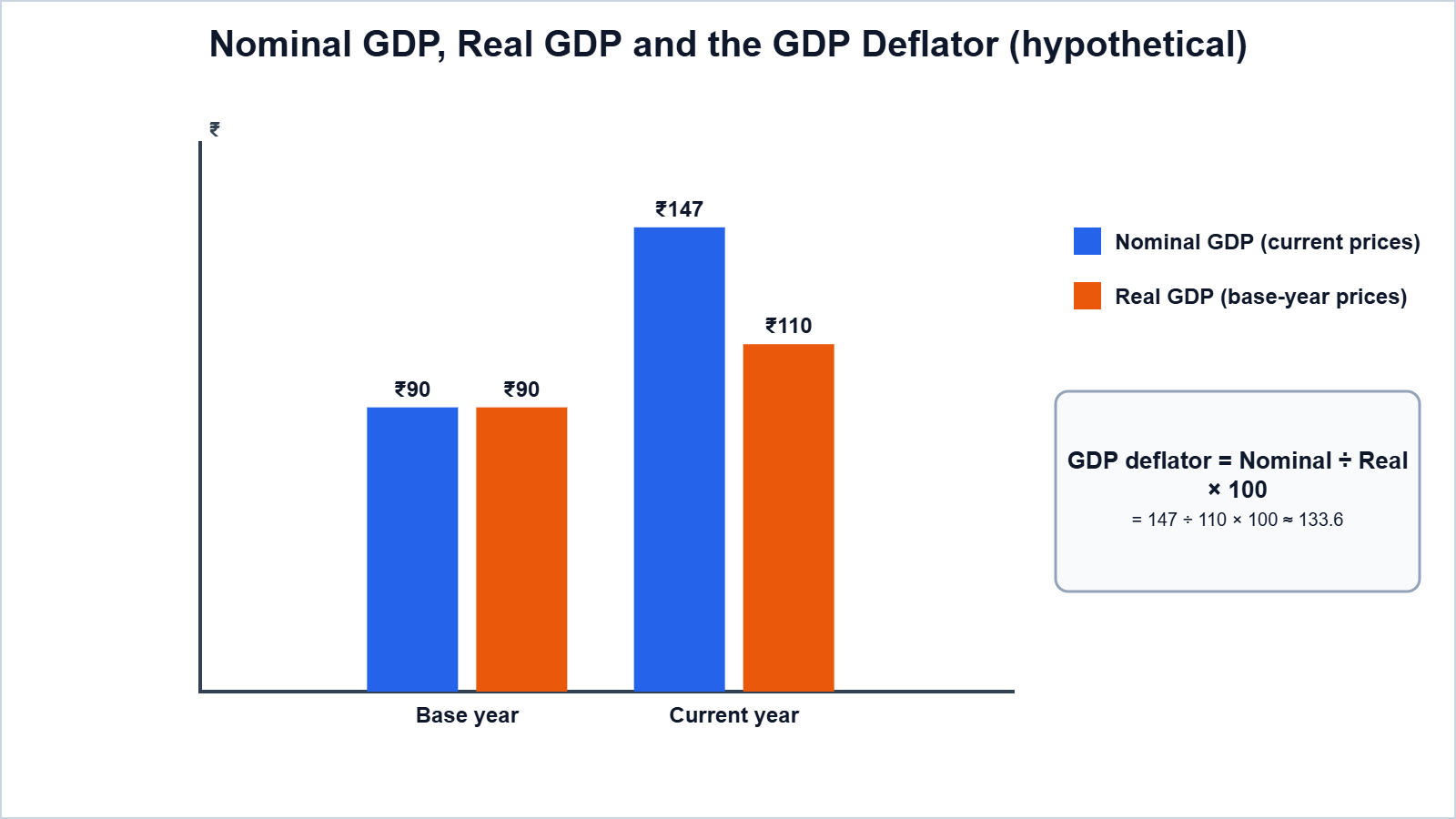
Numerical 9: An economy produces apples and oranges. Base year: 10 apples at ₹5 and 20 oranges at ₹2. Current year: 12 apples at ₹6 and 25 oranges at ₹3. Find nominal and real GDP of the current year and the GDP deflator.
Given: Quantities and prices as given; base year prices ₹5 and ₹2
Formula: Nominal = Σ(current q x current p); Real = Σ(current q x base p); Deflator = Nominal/Real x 100
Solution: Nominal = 12 x 6 + 25 x 3 = 72 + 75 = 147; Real = 12 x 5 + 25 x 2 = 60 + 50 = 110; Deflator = 147/110 x 100
Answer: Nominal GDP = ₹147; real GDP = ₹110; GDP deflator ≈ 133.6 (prices rose by about 33.6%)
Numerical 10: Nominal GDP is ₹3,000 crore and the GDP deflator is 125. Find real GDP. Also find the deflator if nominal GDP is ₹2,400 crore and real GDP ₹2,000 crore.
Given: (a) Nominal = 3000, deflator = 125; (b) Nominal = 2400, Real = 2000
Formula: Real GDP = Nominal/Deflator x 100; Deflator = Nominal/Real x 100
Solution: (a) 3000/125 x 100; (b) 2400/2000 x 100
Answer: (a) Real GDP = ₹2,400 crore; (b) deflator = 120
2.5 GDP and Welfare
A higher real GDP per head is often taken as a sign of higher welfare, but GDP is not a perfect index of welfare because:
- Distribution of GDP: GDP may rise while most of the gain goes to a few, leaving the majority no better off.
- Non-monetary exchanges: many activities (household work, barter in villages, own-farm produce) are not counted, so GDP underestimates welfare.
- Externalities: benefits or harms to others that are not paid for. Negative externalities (pollution by a factory) reduce welfare but are not deducted from GDP; positive externalities (a public park) are not added.
- Composition of output: GDP may rise through production of goods like weapons that do not raise people’s welfare.
Easy Memory Trick: “D-N-E” – Distribution, Non-monetary exchanges, Externalities.
Practice Problems (Answers Only)
- C = 800, I = 200, depreciation = 50 (G and net exports zero). Find NDPMP. Ans: 950
- GDPMP = 1,500, depreciation = 100, NFIA = -20. Find NNPMP. Ans: 1,380
- Nominal GDP 2,200; real GDP 2,000. Find the deflator. Ans: 110
- Value of output ₹300; intermediate consumption ₹120. Find GVA. Ans: ₹180
- Is a pension paid to a retired person included in national income? Ans: No, it is a transfer payment
Important Questions
Q1. Distinguish between final and intermediate goods.
Ans. Final goods are for final use; intermediate goods are used up or resold within the year in production.
Q2. What is double counting? How is it avoided?
Ans. Counting the value of a good more than once; avoided by counting only final goods or by the value added method.
Q3. Distinguish between stock and flow with examples.
Ans. Stock at a point of time (wealth); flow over a period (income).
Q4. Explain the circular flow of income in a two-sector economy.
Ans. Households supply factors and receive income; they spend it on firms’ output; value of output = income = expenditure.
Q5. Name the three methods of measuring national income.
Ans. Value added (product), income and expenditure methods.
Q6. What is NFIA?
Ans. Factor income earned by residents from abroad minus factor income paid to non-residents.
Q7. Distinguish between GDP at market price and GDP at factor cost.
Ans. GDPMP includes net indirect taxes; GDPFC = GDPMP – net indirect taxes.
Q8. What is the GDP deflator?
Ans. Nominal GDP / real GDP x 100; a measure of the price level.
Q9. Why is real GDP a better measure of growth than nominal GDP?
Ans. Real GDP removes the effect of price changes and shows changes in actual output.
Q10. Why is GDP not a good index of welfare?
Ans. Because of unequal distribution, non-monetary exchanges and externalities.
Conclusion: National income can be measured by the value added, income and expenditure methods, which give the same result because of the circular flow. The aggregates GDP, GNP, NDP and NNP at market prices or factor cost are linked by depreciation, NFIA and net indirect taxes, and real GDP tracks actual growth better than nominal GDP.