Introduction to Macroeconomics – Class 12 Economics Notes
Part B: Introductory Macroeconomics
Chapter – 1
Introduction to Macroeconomics
Macroeconomics studies the economy as a whole. It deals with aggregates such as national income (GDP), total output, total employment, the general price level, total consumption, total investment, money supply and the balance of payments. It tries to explain questions like: Why does output grow faster in some years? Why is there unemployment? Why do prices rise (inflation)? How can the government and the central bank influence these?
Microeconomics | Macroeconomics |
|---|---|
Studies individual units (a consumer, a firm, an industry) | Studies the economy as a whole |
Price of a good, output of a firm | National income, general price level, total employment |
Tools: demand and supply of a good | Tools: aggregate demand and aggregate supply |
Assumes other things (aggregates) constant | Assumes the distribution of output among units given |
1.1 Emergence of Macroeconomics
Macroeconomics emerged as a separate branch after the publication of “The General Theory of Employment, Interest and Money” (1936) by the British economist John Maynard Keynes.
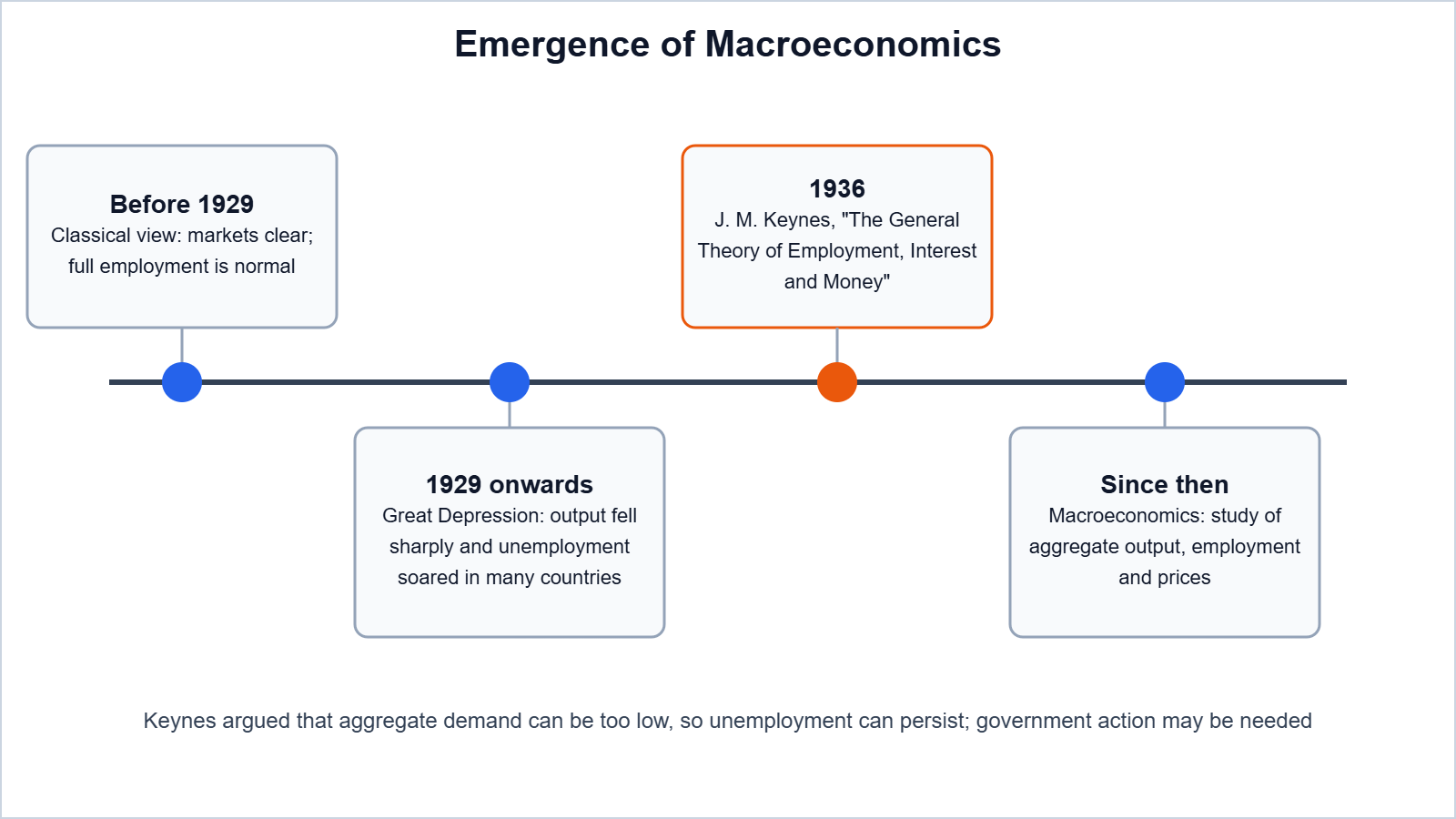
- Classical view: before Keynes, most economists believed that markets clear automatically, so all labour willing to work at the market wage would find work; long periods of unemployment were thought unlikely.
- The Great Depression (from 1929): output and employment fell sharply in Europe and North America. In the USA, unemployment rose to about a quarter of the labour force in the early 1930s. Factories stood idle and many people were jobless for years. The classical view could not explain this.
- Keynes’s contribution: he studied the economy as a whole and showed that output and employment depend on aggregate (effective) demand. If demand is too low, the economy can stay at a level with large unemployment, and government spending and policy can help raise demand and employment.
Remember: the classical economists focused on the long run and believed in automatic full employment; Keynes focused on the short run and showed that involuntary unemployment can persist.
1.2 Context of the Present Book of Macroeconomics
The book studies macroeconomics mainly in the framework of a capitalist economy, adapting it to India’s mixed economy.
Features of a capitalist economy:
- Private ownership of the means of production.
- Production is for sale in the market (not mainly for own consumption).
- Labour is bought and sold at a price called the wage rate.
- Entrepreneurs organise production; they hire labour, rent land and borrow capital, and earn profit as the residual after paying wages, rent and interest. Profit is reinvested to expand production.
Four major sectors (decision makers) of a macroeconomy:
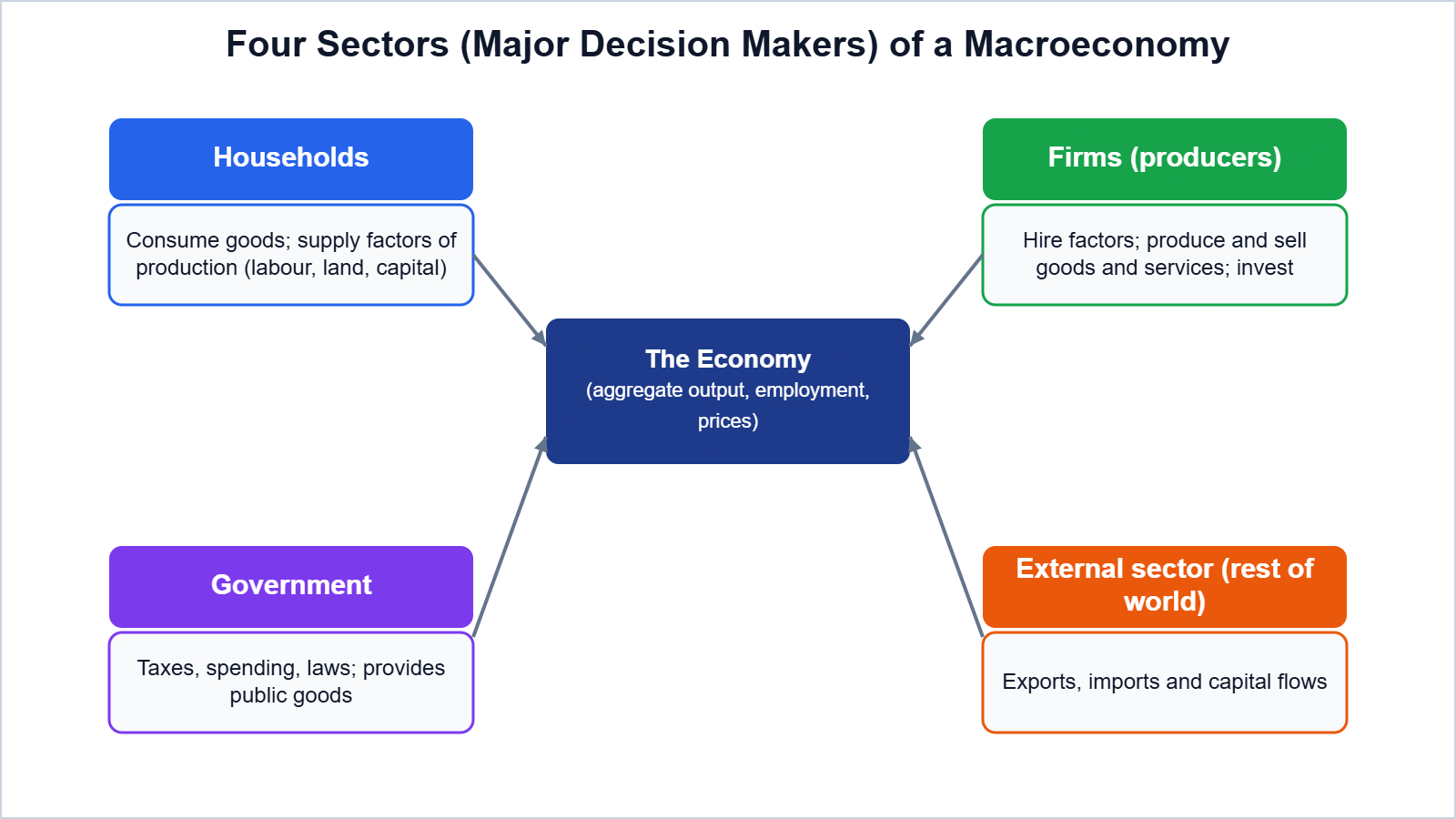
Sector | Main role |
|---|---|
Households | Consume goods and services; own and supply factors of production; save |
Firms (producers) | Hire factors, produce goods and services, invest in capital goods |
Government | Collects taxes, spends on public goods and welfare, makes laws, regulates the economy |
External sector (rest of the world) | Trade in goods and services (exports and imports) and flows of capital with other countries |
Exam point: an economy with only households and firms is a two-sector economy; adding government gives a three-sector (closed) economy; adding the external sector gives a four-sector (open) economy.
Major macroeconomic issues: economic growth, full employment, price stability (control of inflation and deflation), balance of payments stability and fair distribution of income. Governments use fiscal policy (taxes and spending) and central banks use monetary policy (money supply and interest rates) to address them.
Easy Memory Trick: “H-F-G-E” – Households, Firms, Government, External sector.
Important Questions
Q1. What is macroeconomics?
Ans. The branch of economics that studies the economy as a whole and its aggregates.
Q2. Give two examples of macroeconomic variables.
Ans. National income and general price level (also total employment, money supply).
Q3. Who is regarded as the father of modern macroeconomics?
Ans. John Maynard Keynes.
Q4. Name Keynes’s famous book and its year.
Ans. The General Theory of Employment, Interest and Money, 1936.
Q5. What was the Great Depression?
Ans. The severe worldwide fall in output and employment that began in 1929.
Q6. What was the classical view about employment?
Ans. That markets clear automatically so the economy tends to full employment.
Q7. How did Keynes explain unemployment?
Ans. By deficiency of aggregate (effective) demand.
Q8. State three features of a capitalist economy.
Ans. Private ownership, production for the market, and labour hired for wages; profit-driven entrepreneurs.
Q9. Name the four sectors of a macroeconomy.
Ans. Households, firms, government and the external sector.
Q10. Distinguish between micro and macroeconomics with one example each.
Ans. Micro: price of rice; macro: general price level of the economy.
Conclusion: Macroeconomics grew out of the Great Depression and the work of Keynes. It studies aggregates of the economy and the behaviour of households, firms, government and the external sector, to understand growth, employment, prices and policy.