Part B: Introductory Macroeconomics
Chapter – 3
Money and Banking
Money is anything that is generally accepted as a means of payment for goods and services and for the settlement of debts. In a barter system (direct exchange of goods for goods), trade needs a double coincidence of wants – each party must want what the other has – which is rare. Barter also lacks a common measure of value, has problems of indivisibility, and makes it hard to store value.
3.1 Functions of Money
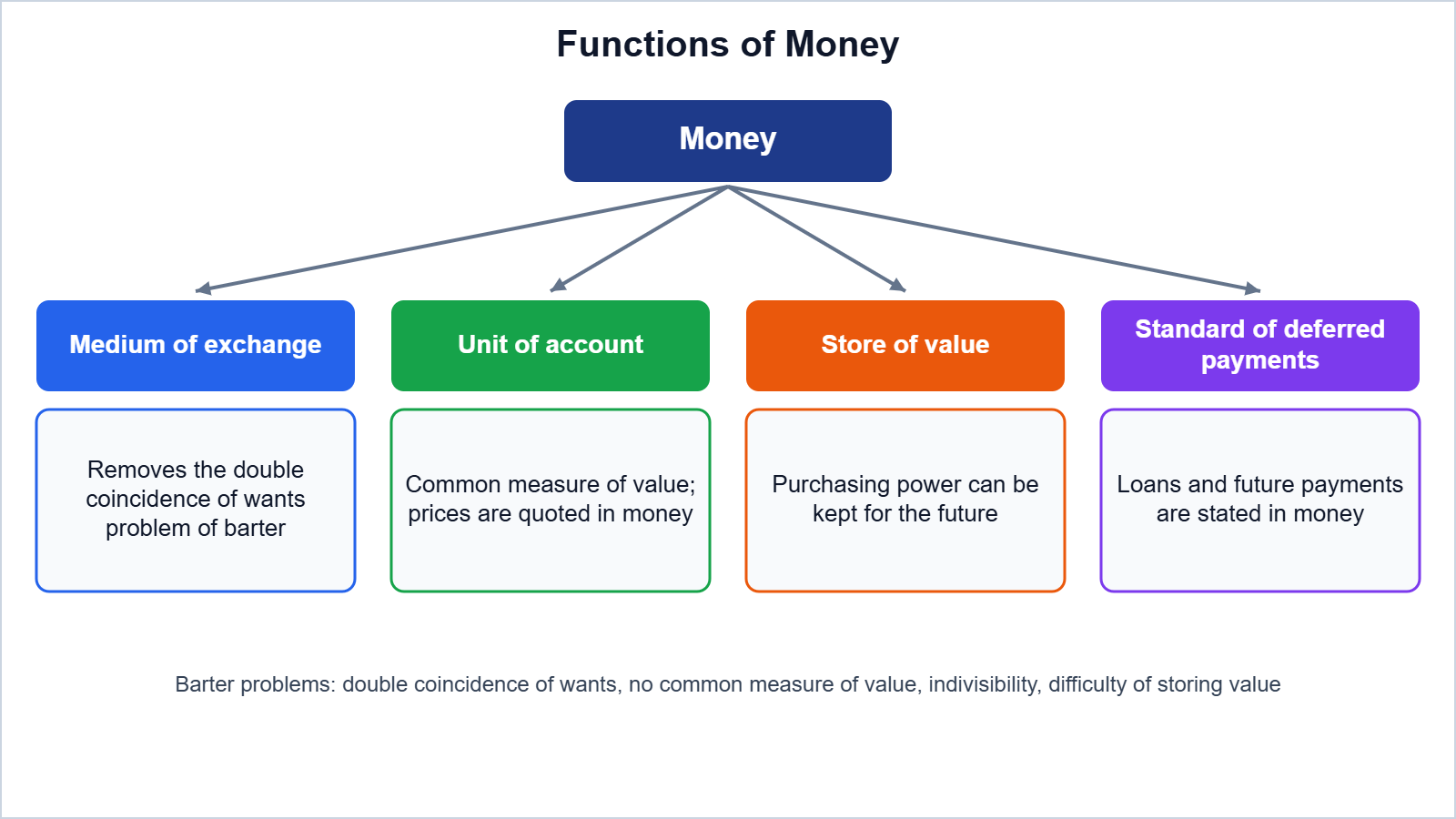
- Medium of exchange: money is accepted in exchange for all goods and services, removing the need for double coincidence of wants.
- Unit of account (measure of value): values of all goods and services are expressed in money (prices), making comparison easy.
- Store of value: money can be held to buy goods in the future, as it does not perish. Its value may fall with inflation.
- Standard of deferred payments: future payments such as loans and their interest are expressed in money.
3.2 Demand for Money and Supply of Money
3.2.1 Demand for Money
People hold (demand) money for two main motives:
(a) Transaction motive: to carry out day-to-day transactions, since receipts and payments do not happen at the same time. The transaction demand depends on the value of transactions: MTd = k.T, where T is the total value of transactions in a period and k is a positive fraction. 1/k is the velocity of circulation (number of times a unit of money changes hands in a period). Since total transactions rise with nominal income, transaction demand rises with income.
Numerical 1: The total value of transactions in an economy in a year is ₹1,200 crore and each rupee changes hands 4 times in the year. Find the transaction demand for money.
Given: T = ₹1,200 crore; velocity = 4, so k = 1/4
Formula: MTd = k.T
Solution: MTd = (1/4) x 1200
Answer: ₹300 crore
(b) Speculative motive: people hold money (instead of interest-earning bonds) to avoid capital losses on bonds and to take advantage of future changes in bond prices. Bond prices move inversely with the interest rate. When the interest rate is high, people expect it to fall (bond prices to rise), so they buy bonds and hold little money; when the rate is low, they expect it to rise, so they hold more money. Thus speculative demand is inversely related to the rate of interest. At a very low rate everyone expects the rate to rise and holds money: the demand curve becomes almost flat – the liquidity trap.
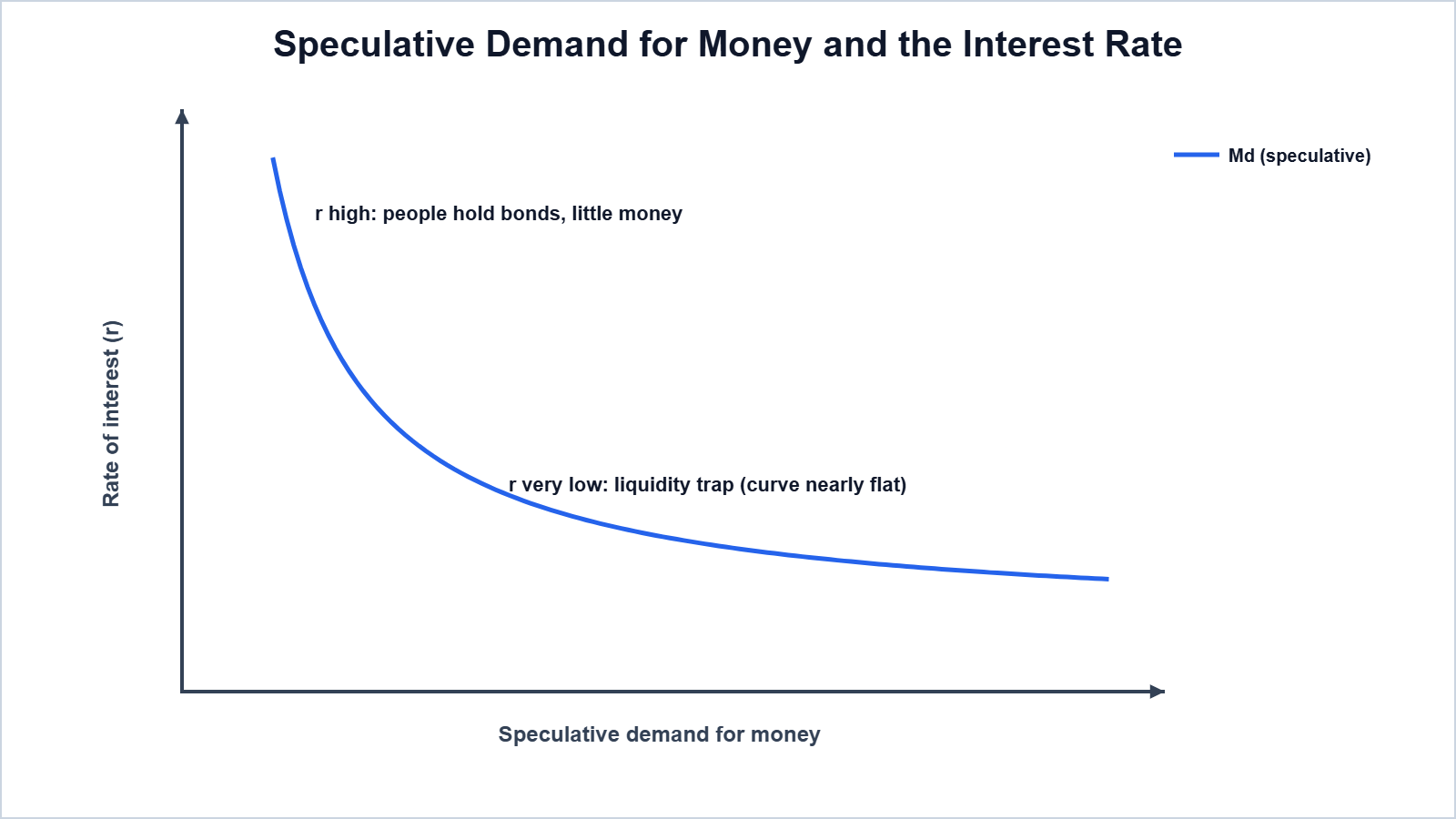
Total demand for money = transaction demand (depends on income) + speculative demand (depends inversely on the interest rate).
3.2.2 Supply of Money
Money supply is the total stock of money held by the public at a point of time (it is a stock). It excludes money held by the government, the RBI and commercial banks, as these are suppliers of money.
Legal tender: currency notes and coins issued by the monetary authority (RBI) or government that cannot be refused for settlement of payments. Their value is not based on the metal or paper but on the government’s order: it is fiat money. Cheques drawn on demand deposits are not legal tender but are widely accepted.

Measure | Composition |
|---|---|
M1 | CU (currency held by the public) + DD (net demand deposits of commercial banks) + OD (other deposits with the RBI) |
M2 | M1 + savings deposits with post office savings banks |
M3 | M1 + net time deposits of commercial banks |
M4 | M3 + total deposits with post office savings organisations (excluding National Savings Certificates) |
Remember: M1 is the most liquid; liquidity falls from M1 to M4. M3 is commonly called broad money. The Reserve Bank of India (RBI) is the monetary authority; it issues currency (except one-rupee notes and coins, issued by the Government of India) and regulates the money supply.
High powered money (reserve money, H) = currency held by the public + reserves of commercial banks with the RBI (and vault cash). It is the liability of the RBI and the base on which banks create money.
3.3 Money Creation by Banking System
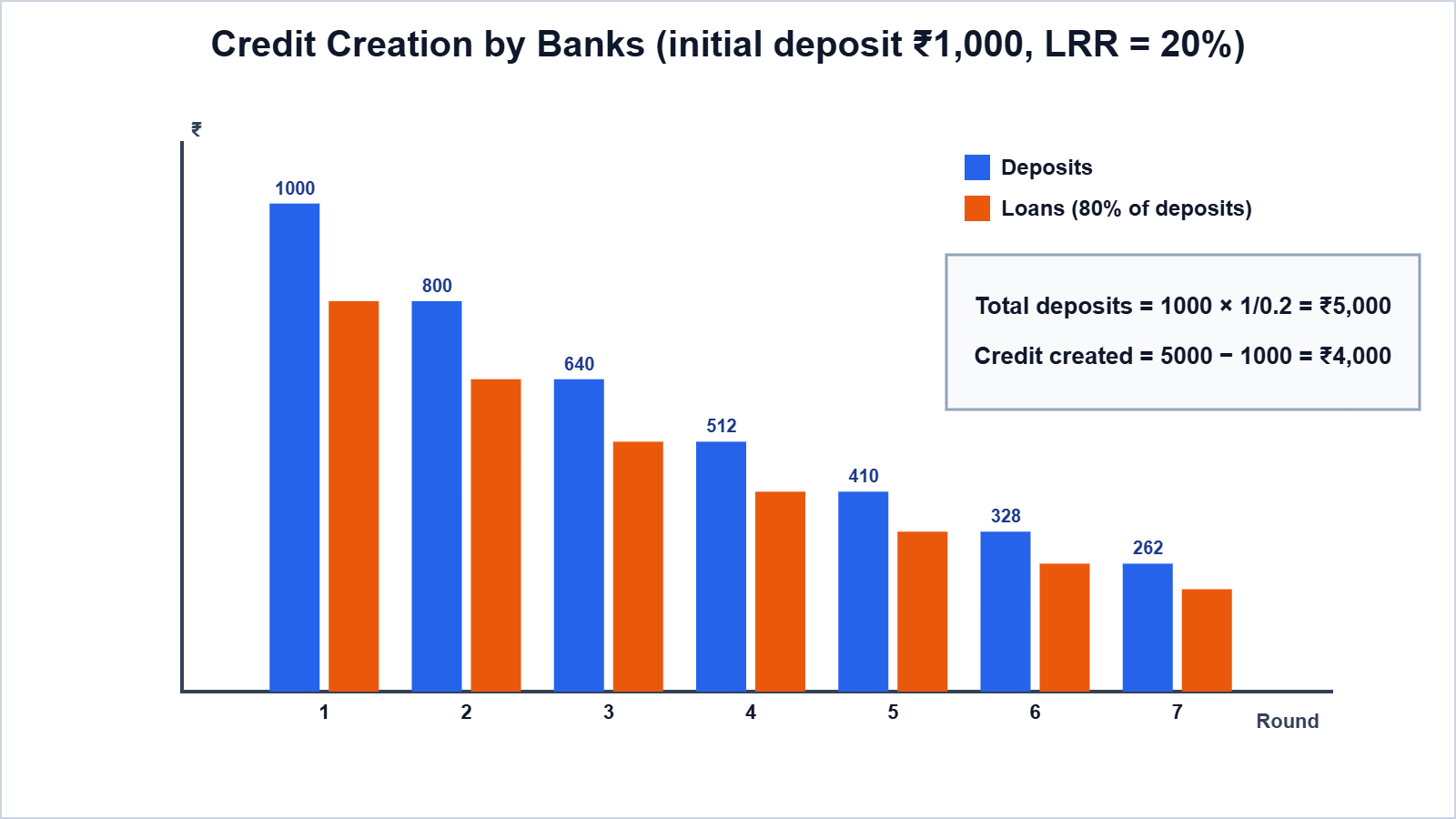
Commercial banks accept deposits from the public and lend to borrowers. They keep only a fraction of deposits as reserves and lend the rest. Each loan is spent and re-deposited in some bank, which lends again. In this way banks create deposits (credit) many times the initial deposit.
Reserve ratio: the fraction of deposits banks must keep as reserves. It consists of the cash reserve ratio (CRR), kept with the RBI, and the statutory liquidity ratio (SLR), kept by the banks themselves in specified liquid assets. Together these form the legal reserve ratio (LRR) in textbook examples. (Current values of CRR, SLR and policy rates change often and are announced by the RBI; the numbers used below are hypothetical.)
3.3.1 Balance Sheet of a Fictional Bank
A balance sheet records the assets (what the bank owns or is owed: reserves, loans) and liabilities (what it owes: deposits of the public). Assets = Liabilities + Net worth.

Numerical 2: A bank receives deposits of ₹500 and the reserve ratio is 20%. How much must it keep as reserves and how much can it lend?
Given: Deposits = ₹500; reserve ratio = 20%
Formula: Required reserves = reserve ratio x deposits; loans = deposits – reserves
Solution: Reserves = 0.2 x 500 = 100; loans = 500 – 100
Answer: Reserves = ₹100; loans = ₹400 (as in the balance sheet above)
Process of credit creation:
Round | Deposits (₹) | Reserves @ 20% (₹) | Loans (₹) |
|---|---|---|---|
I (initial) | 1,000 | 200 | 800 |
II | 800 | 160 | 640 |
III | 640 | 128 | 512 |
IV | 512 | 102.4 | 409.6 |
… | … | … | … |
Total | 5,000 | 1,000 | 4,000 |
3.3.2 Limits to Credit Creation and Money Multiplier
Money (credit) multiplier = 1 / LRR. Total deposits created = initial deposit x 1/LRR. Credit created = total deposits – initial deposit. The higher the reserve ratio, the smaller the multiplier.
Numerical 3: An initial deposit of ₹1,000 is made and LRR is 20%. Find the money multiplier, total deposits and credit created.
Given: Initial deposit = ₹1,000; LRR = 0.2
Formula: Multiplier = 1/LRR; total deposits = initial deposit x multiplier; credit = total deposits – initial deposit
Solution: Multiplier = 1/0.2 = 5; total deposits = 1000 x 5 = 5000; credit = 5000 – 1000
Answer: Multiplier = 5; total deposits = ₹5,000; credit created = ₹4,000
Numerical 4: Initial deposits are ₹2,000 and LRR is 10%. Find total deposits and credit created.
Given: Initial deposit = 2000; LRR = 0.1
Formula: Total deposits = initial deposit / LRR
Solution: 2000/0.1 = 20,000; credit = 20,000 – 2,000
Answer: Total deposits = ₹20,000; credit created = ₹18,000
Numerical 5: Banks create total deposits of ₹8,000 with LRR of 25%. Find the initial deposit.
Given: Total deposits = 8000; LRR = 0.25
Formula: Initial deposit = total deposits x LRR
Solution: 8000 x 0.25
Answer: Initial deposit = ₹2,000
Numerical 6: In Numerical 3, if the LRR is cut from 20% to 10%, what happens to total deposits?
Given: Initial deposit = 1000; new LRR = 0.1
Formula: Total deposits = initial deposit / LRR
Solution: 1000/0.1 = 10,000
Answer: Total deposits double from ₹5,000 to ₹10,000: a lower reserve ratio increases credit creation.
Money multiplier with currency holding: if the public holds a fraction of money as currency (currency-deposit ratio, cdr) and banks keep a reserve-deposit ratio (rdr), then M = [(1 + cdr)/(cdr + rdr)] x H. The multiplier is greater than 1.
Numerical 7: cdr = 0.2, rdr = 0.1 and high powered money H = ₹1,000 crore. Find the money multiplier and money supply.
Given: cdr = 0.2; rdr = 0.1; H = 1000
Formula: Money multiplier = (1 + cdr)/(cdr + rdr); M = multiplier x H
Solution: (1 + 0.2)/(0.2 + 0.1) = 1.2/0.3 = 4; M = 4 x 1000
Answer: Money multiplier = 4; money supply = ₹4,000 crore
Limits to credit creation: the reserve ratio, the amount of initial deposits, the public’s preference to hold cash (leakages), availability of credit-worthy borrowers, and RBI’s policies.
3.4 Policy Tools to Control Money Supply
The RBI controls money supply and credit through monetary policy. As the banker’s bank and lender of last resort, it also supports banks in a crisis.
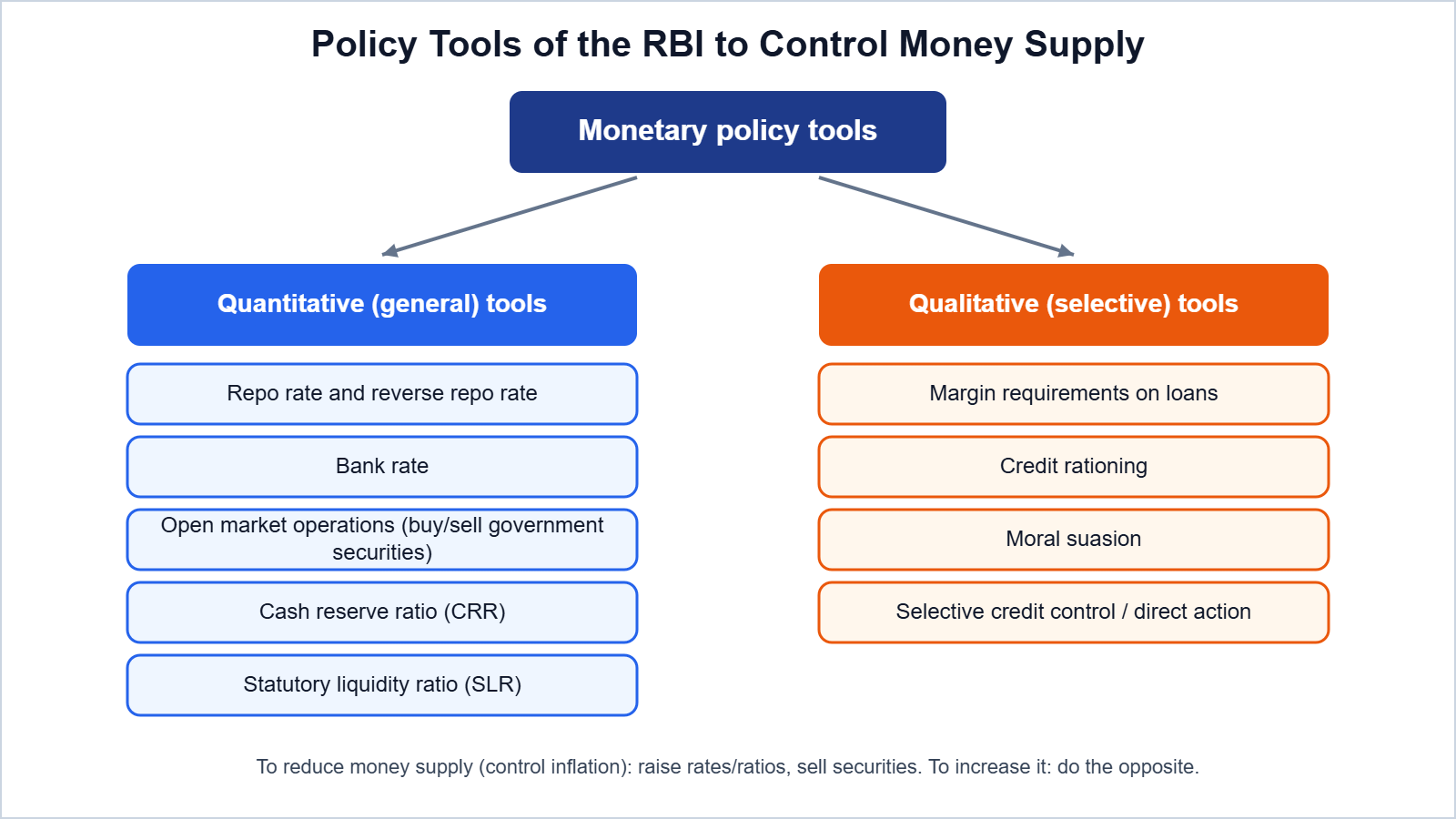
- Open market operations (OMO): purchase or sale of government securities by the RBI in the open market. Buying securities pays out money and increases reserves of banks (money supply rises); selling securities absorbs money (money supply falls). Outright OMO are permanent; repo operations are temporary, with an agreement to reverse the transaction.
- Repo rate: the rate at which the RBI lends short-term funds to banks against securities. A higher repo rate makes borrowing costlier for banks, reducing credit. Reverse repo rate: the rate at which the RBI borrows from banks (absorbs liquidity).
- Bank rate: the rate at which the RBI lends to commercial banks (usually longer term, without a repurchase agreement). A rise discourages borrowing and reduces money supply.
- Cash reserve ratio (CRR): fraction of deposits banks must keep with the RBI. Raising CRR reduces the funds banks can lend.
- Statutory liquidity ratio (SLR): fraction of deposits banks must keep in specified liquid assets (cash, gold, approved securities). Raising SLR reduces lending.
- Qualitative tools: margin requirements (the part of a loan not financed by the bank; raising it reduces credit for that purpose), credit rationing, moral suasion and selective credit controls.
To control inflation (reduce money supply) | To fight deflation (increase money supply) |
|---|---|
Raise repo rate / bank rate | Lower repo rate / bank rate |
Raise CRR and SLR | Lower CRR and SLR |
Sell government securities (OMO) | Buy government securities (OMO) |
Raise margin requirements | Lower margin requirements |
Easy Memory Trick: “Sell to Shrink, Buy to Boost” – OMO sales shrink money supply; purchases boost it.
Practice Problems (Answers Only)
- Find the money multiplier when LRR is 12.5%. Ans: 8
- Initial deposit ₹5,000, LRR 20%. Find total deposits and credit created. Ans: ₹25,000 and ₹20,000
- cdr = 0.25 and rdr = 0.25. Find the money multiplier. Ans: 2.5
- Value of transactions ₹800 crore, velocity 4. Find transaction demand for money. Ans: ₹200 crore
- If the RBI raises the CRR, what happens to the money multiplier? Ans: It falls
Important Questions
Q1. What is barter? State its problems.
Ans. Direct exchange of goods; problems include lack of double coincidence of wants, no common measure of value, indivisibility and difficulty of storing value.
Q2. Explain the functions of money.
Ans. Medium of exchange, unit of account, store of value and standard of deferred payments.
Q3. What is the transaction demand for money?
Ans. Money held for day-to-day transactions; MTd = k.T.
Q4. Why is speculative demand inversely related to the interest rate?
Ans. Because at high rates people expect rates to fall and bond prices to rise, so they hold bonds rather than money.
Q5. What is the liquidity trap?
Ans. A very low interest rate at which people hold all extra money and the demand curve becomes flat.
Q6. What is legal tender? What is fiat money?
Ans. Money that cannot be refused in payment; money whose value comes from government order.
Q7. State the components of M1 and M3.
Ans. M1 = CU + DD + OD; M3 = M1 + net time deposits of banks.
Q8. How do commercial banks create credit?
Ans. By keeping a fraction of deposits as reserves and lending the rest, which returns as new deposits repeatedly.
Q9. Explain how repo rate and CRR control money supply.
Ans. A rise in repo rate raises borrowing costs for banks; a rise in CRR reduces lendable funds; both reduce credit.
Q10. What are open market operations?
Ans. Purchase or sale of government securities by the RBI to change money supply.
Conclusion: Money removes the problems of barter. People demand money for transactions and speculation, while the money supply consists of currency and deposits. Banks create credit through the money multiplier, and the RBI controls money supply with repo rate, bank rate, CRR, SLR, open market operations and qualitative tools.