Practicals – Class 12 Chemistry Notes
Chapter – 11
Practical’s
1. Evaluation Scheme (20 Marks)
Component | Marks |
|---|---|
Volumetric Analysis | 5 |
Salt Analysis | 4 |
Content Based Experiment | 3 |
Class Record and Viva | 3 |
Investigatory Project | 5 |
Total | 20 |
2. Laboratory Safety Notes
- Always wear a lab coat and safety goggles; tie back long hair.
- Never taste chemicals or pipette by mouth; use a pipette filler or bulb.
- Add acid to water slowly, never water to acid.
- Heat test tubes with the mouth pointing away from yourself and others.
- Handle concentrated acids, alkalis, bromine, aniline, chloroform and H2S in a fume cupboard; avoid inhaling vapours.
- Keep flammable liquids (ethanol, acetone, ether) away from flames.
- Wash spills on skin at once with plenty of water and inform the teacher.
- Dispose of waste in the proper containers; wash hands after the practical.
A. Chemical Kinetics
(a) Effect of concentration and temperature on the rate of reaction between sodium thiosulphate and hydrochloric acid
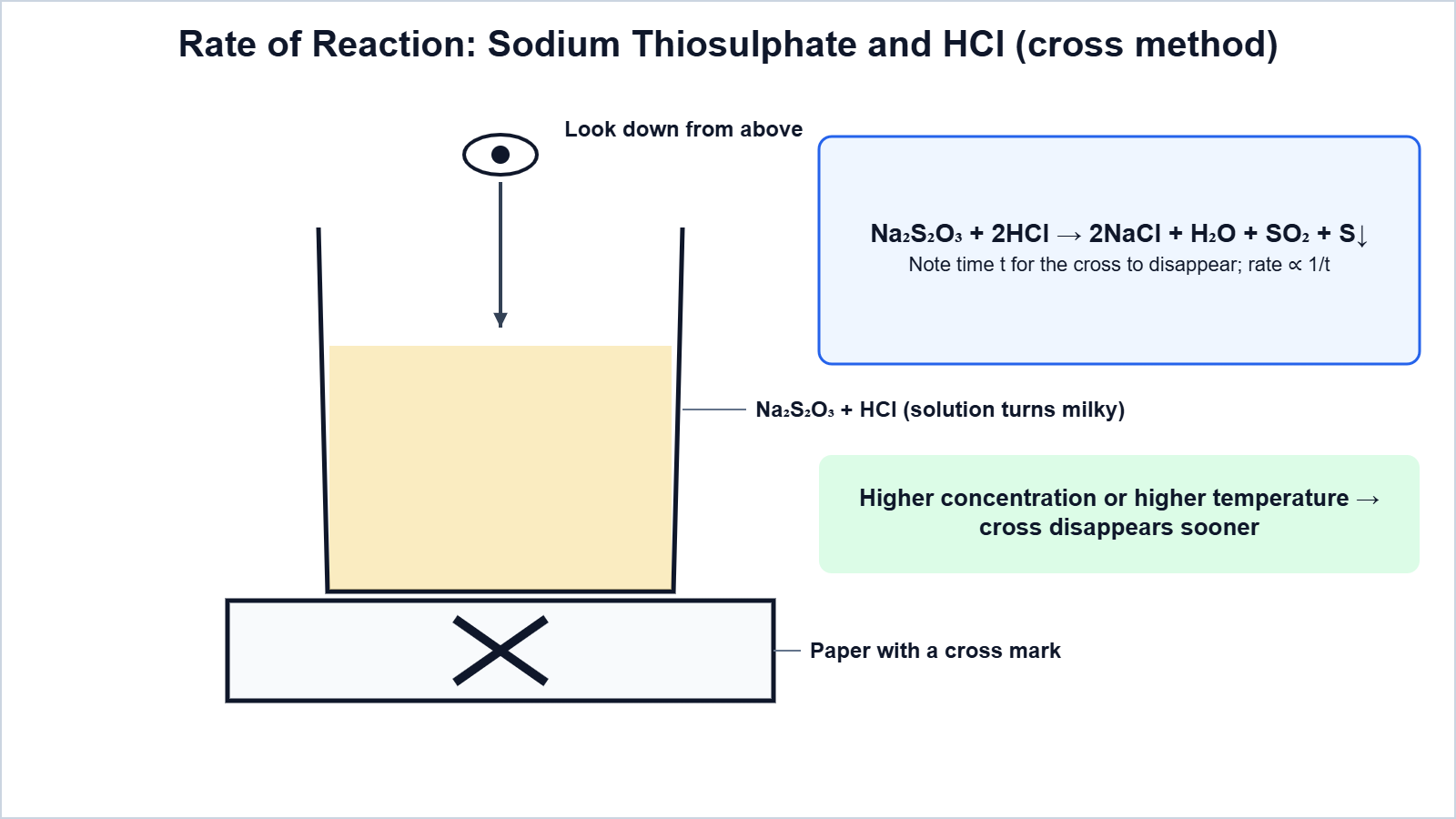
Aim: To study the effect of concentration and temperature on the rate of the reaction Na2S2O3 + 2HCl → 2NaCl + H2O + SO2 + S.
Apparatus and chemicals: Conical flasks or beakers, measuring cylinders, stopwatch, thermometer, water bath, paper with a cross mark; sodium thiosulphate solution (about 0.1 M), 1 M HCl.
Procedure:
- Place a flask containing a known volume of thiosulphate solution over a paper marked with a cross.
- Add a fixed volume of HCl, start the stopwatch and swirl.
- Look down through the solution and note the time when the cross just disappears due to the precipitated sulphur.
- Repeat with diluted thiosulphate solutions (keeping total volume constant) to study concentration.
- Repeat with the same concentration at different temperatures (e.g., room temperature, +10 °C, +20 °C) using a water bath.
Observation table:
S.No. | Volume of Na2S2O3 (mL) | Volume of water (mL) | Volume of HCl (mL) | Time t (s) | 1/t (s-1) |
|---|---|---|---|---|---|
1 | 50 | 0 | 10 |
|
|
2 | 40 | 10 | 10 |
|
|
3 | 30 | 20 | 10 |
|
|
4 | 20 | 30 | 10 |
|
|
Result: The time taken for the cross to disappear decreases (rate, ∝ 1/t, increases) as the concentration of thiosulphate increases and as the temperature increases.
(b) Reaction of iodide ions with hydrogen peroxide (alternative): H2O2 + 2I– + 2H+ → I2 + 2H2O. A fixed small amount of sodium thiosulphate and starch is added; the blue colour appears when all thiosulphate is used. Repeat with different KI concentrations and note the time. Result: rate increases with iodide concentration.
Or: clock reaction of KIO3 and Na2SO3 with starch: iodate is reduced by sulphite; once sulphite is used up, iodine forms and a sudden blue colour appears. The time to the blue colour decreases with increase in concentration of KIO3.
B. Thermochemistry
Enthalpy of neutralisation of strong acid (HCl) and strong base (NaOH)
Aim: To determine the enthalpy of neutralisation of HCl with NaOH.
Apparatus and chemicals: Calorimeter (or polythene/thermos bottle) with stirrer, thermometer (0.1 °C), measuring cylinders; 1 M HCl and 1 M NaOH.
Procedure:
- Take 100 mL of 1 M HCl in the calorimeter and 100 mL of 1 M NaOH in a beaker; note the initial temperatures (they should be the same, t1).
- Add NaOH to the acid quickly, stir and note the highest temperature reached (t2).
- Calculate heat evolved: q = (mass of solution) x (specific heat) x (t2 – t1), taking density 1 g/mL and specific heat 4.18 J g-1 K-1 (for accurate work, add the water equivalent of the calorimeter).
Result: Sample calculation: if ΔT = 6.8 °C, q = 200 x 4.18 x 6.8 = 5685 J for 0.1 mol of water formed, so ΔHneut = -5685/0.1 J mol-1 ≈ -56.8 kJ mol-1. The accepted value for strong acid and strong base is about -57 kJ mol-1.
Alternatives: (i) enthalpy of dissolution of CuSO4 or KNO3: dissolve a weighed amount in a known volume of water in the calorimeter and note the temperature change (KNO3 dissolution is endothermic, temperature falls); (ii) enthalpy change on mixing acetone and chloroform: mixing is exothermic due to hydrogen bond formation between them.
C. Electrochemistry
Aim: To study the variation of cell potential of Zn/Zn2+ || Cu2+/Cu with change in concentration of CuSO4 at room temperature.
Apparatus and chemicals: Zinc and copper strips, two beakers, salt bridge (KNO3 or KCl in agar), high resistance voltmeter or potentiometer, sandpaper; 1 M ZnSO4 and CuSO4 solutions of 1 M, 0.1 M and 0.01 M.
Procedure:
- Clean the metal strips with sandpaper.
- Dip Zn in 1 M ZnSO4 and Cu in 1 M CuSO4; connect the beakers with a salt bridge.
- Connect Zn to the negative and Cu to the positive terminal; record the EMF.
- Repeat with 0.1 M and 0.01 M CuSO4.
Observation table:
[Zn2+] (M) | [Cu2+] (M) | E (theoretical, V) | E (observed, V) |
|---|---|---|---|
1 | 1 | 1.10 |
|
1 | 0.1 | 1.07 |
|
1 | 0.01 | 1.04 |
|
Result: Ecell = 1.10 – (0.0591/2) log ([Zn2+]/[Cu2+]); the cell potential decreases as [Cu2+] decreases.
D. Chromatography
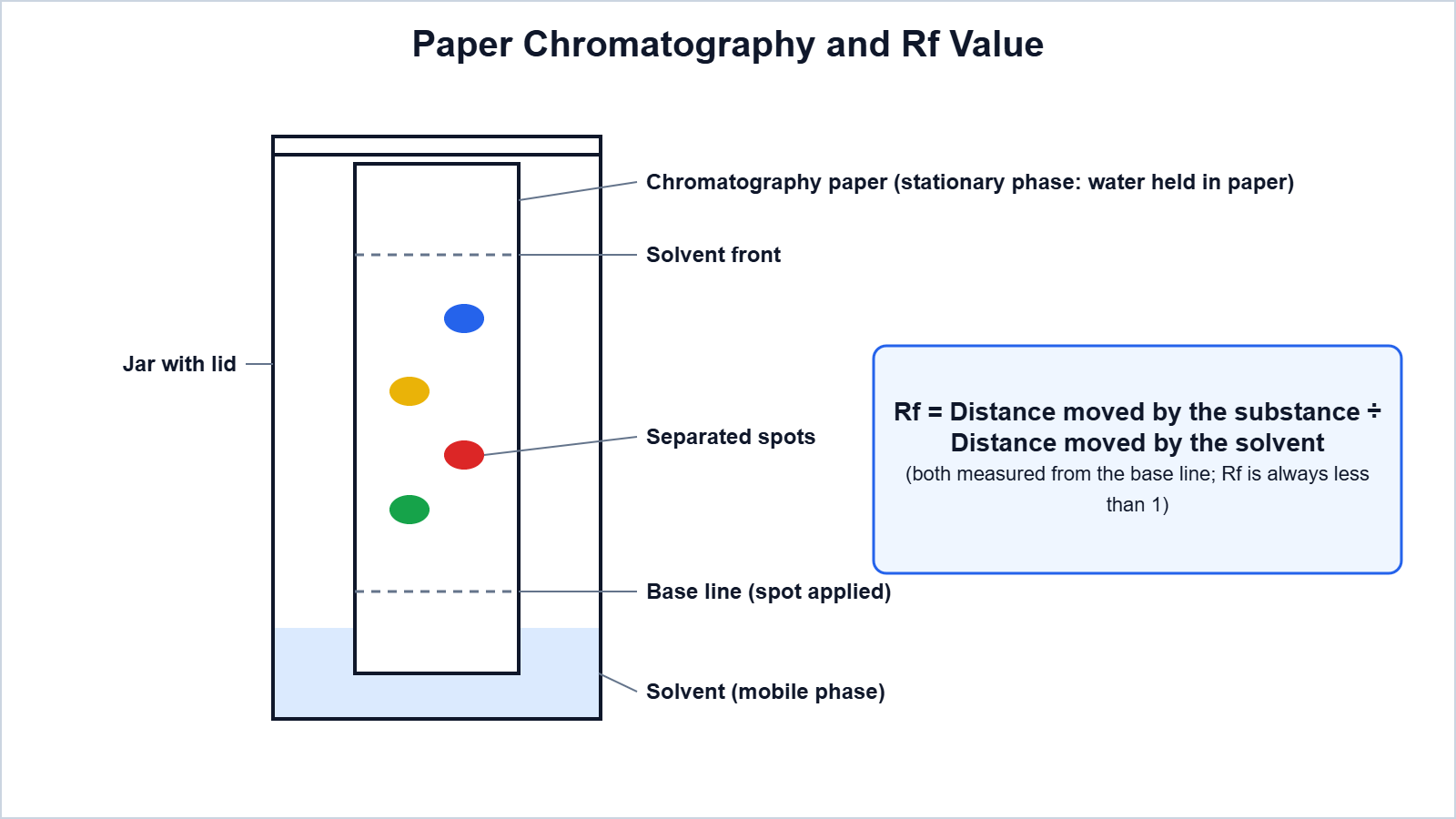
Aim: (i) To separate pigments from extracts of leaves and flowers by paper chromatography and determine their Rf values; (ii) to separate the constituents of an inorganic mixture of cations (e.g., Fe3+ and Cu2+ or Co2+ and Ni2+).
Apparatus and chemicals: Whatman filter paper strip, gas jar with lid, capillary tube, pencil, scale; leaf extract in acetone (or ethanol); solvent: petroleum ether-acetone mixture for pigments; acetone-HCl-water for cations; spraying reagent for cations (e.g., ammonia vapour, potassium hexacyanidoferrate(II) or dimethylglyoxime).
Procedure:
- Draw a pencil base line about 2 cm from the bottom of the strip.
- Put a small concentrated spot of the extract on the line with a capillary; dry and repeat.
- Suspend the strip in the jar so that the solvent is below the line; cover the jar.
- When the solvent has risen about 3/4 of the paper, remove it and mark the solvent front.
- Dry the paper (spray with the reagent for cations), mark the spots and measure distances.
Observation table:
Spot | Distance moved by spot (cm) | Distance moved by solvent (cm) | Rf |
|---|---|---|---|
Sample | 3.6 | 6.0 | 0.60 |
Your spot 1 |
|
|
|
Your spot 2 |
|
|
|
Result: The mixture separates into spots with different Rf values (Rf = distance moved by substance / distance moved by solvent). The sample value shown is only an example of the calculation.
E. Preparation of Inorganic Compounds
Aim: (i) To prepare a double salt: ferrous ammonium sulphate (Mohr’s salt) or potash alum.
Apparatus and chemicals: Beakers, china dish, glass rod, funnel, filter paper, water bath; ferrous sulphate (FeSO4.7H2O) and ammonium sulphate in equimolar amounts, dilute H2SO4; or potassium sulphate and aluminium sulphate.
Procedure:
- Dissolve the two salts in the minimum amount of warm water containing a few drops of dilute H2SO4 (to prevent hydrolysis of Fe2+).
- Filter, concentrate the solution by heating to the crystallisation point and cool slowly.
- Filter the crystals, wash with a little cold water and dry between filter papers.
Result: Mohr’s salt FeSO4.(NH4)2SO4.6H2O forms pale green crystals; potash alum K2SO4.Al2(SO4)3.24H2O forms colourless octahedral crystals. Record the yield.
Aim: (ii) To prepare potassium ferric oxalate (potassium trioxalatoferrate(III)), K3[Fe(C2O4)3].3H2O.
Apparatus and chemicals: Beakers, funnel, filter paper, china dish; ferric chloride, KOH, oxalic acid, potassium oxalate.
Procedure:
- Precipitate ferric hydroxide by adding KOH solution to ferric chloride solution; filter and wash.
- Dissolve the fresh ferric hydroxide in a hot solution of oxalic acid and potassium oxalate.
- Filter, concentrate and allow to crystallise in the dark.
Result: Bright green crystals are obtained; they are light sensitive and are kept in the dark. Record the yield.
F. Preparation of Organic Compounds (any two)
Compound | Brief method | Appearance and m.p. |
|---|---|---|
Acetanilide | Aniline + acetic anhydride with a little glacial acetic acid; pour into ice-cold water; recrystallise from hot water | White crystals; m.p. about 114 °C |
Dibenzalacetone | Benzaldehyde + acetone in ethanol with aqueous NaOH (Claisen-Schmidt condensation); filter and recrystallise from ethanol | Pale yellow crystals; m.p. about 110 °C |
p-Nitroacetanilide | Acetanilide in glacial acetic acid and conc. H2SO4; add nitrating mixture keeping temperature below 10 °C; pour on crushed ice | Pale yellow crystals; m.p. about 214 °C |
Aniline yellow / 2-naphthol aniline dye | Diazotise aniline (NaNO2 + HCl, 0-5 °C); couple with aniline (aniline yellow) or with alkaline 2-naphthol (orange-red dye) | Yellow / orange-red coloured solid |
Iodoform | Warm ethanol or acetone with iodine and sodium carbonate (or NaOH) solution; cool | Yellow crystals with characteristic smell; m.p. about 119 °C |
Remember: report yield, colour and melting point; record the reaction involved.
G. Tests for Functional Groups
Group | Test | Observation |
|---|---|---|
Unsaturation (C=C) | Bromine water / alkaline KMnO4 (Baeyer’s reagent) | Orange colour of bromine / pink colour of KMnO4 discharged |
Alcoholic -OH | Ceric ammonium nitrate; sodium metal | Red colour; effervescence of H2 |
Phenolic -OH | Neutral FeCl3 solution | Violet (or blue/green) colour |
Aldehyde -CHO | Schiff’s reagent; Tollens’ reagent; Fehling’s solution | Pink colour; silver mirror; red ppt |
Ketone >C=O | 2,4-DNP; sodium nitroprusside + NaOH | Yellow-orange ppt; red colour; Tollens’ negative |
Carboxylic -COOH | NaHCO3 solution; blue litmus | Brisk effervescence of CO2; litmus turns red |
Primary amino -NH2 | Carbylamine test; azo dye test (aromatic amines) | Foul smell of isocyanide; orange-red dye with 2-naphthol |
H. Carbohydrates, Fats and Proteins in Foodstuffs
Substance | Test | Positive result |
|---|---|---|
Carbohydrates | Molisch’s test (α-naphthol + conc. H2SO4) | Violet ring at the junction |
Reducing sugars (glucose) | Fehling’s / Tollens’ / Benedict’s test | Red ppt / silver mirror |
Starch | Iodine solution | Blue-black colour |
Fats and oils | Translucent spot on filter paper; acrolein test (heat with KHSO4) | Greasy spot; pungent smell |
Proteins | Biuret test (NaOH + dilute CuSO4) | Violet colour |
Proteins | Xanthoproteic test (conc. HNO3, then NH3) | Yellow, turning orange |
Proteins | Ninhydrin test | Blue-violet colour |
Proteins | Millon’s test | White ppt turning brick red on heating |
Test samples such as potato, bread, milk, groundnut, egg albumin and pulses; record which components are present.
I. Volumetric Analysis: Molarity of KMnO4
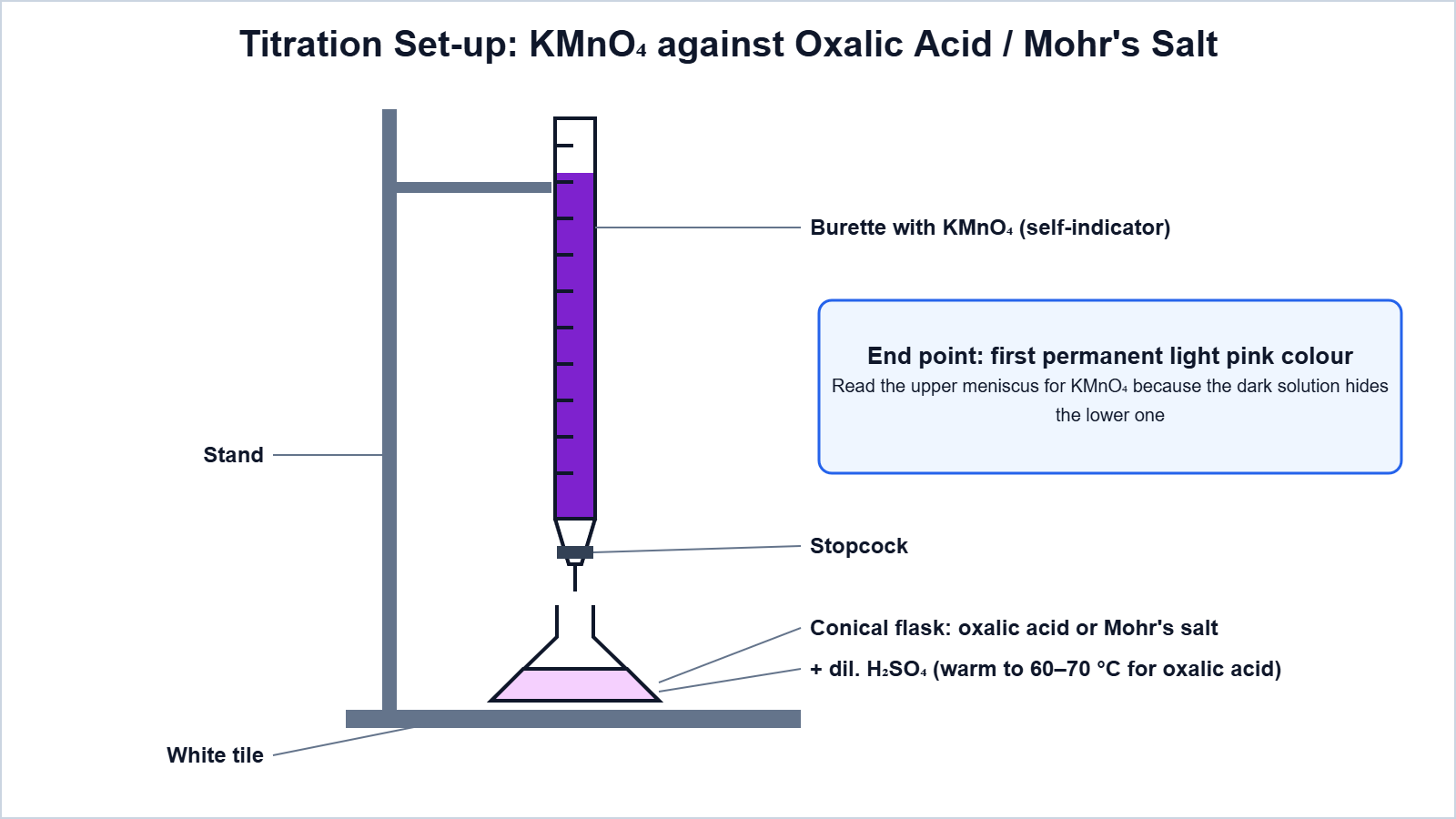
Principle: KMnO4 is a strong oxidising agent in acidic medium (dilute H2SO4) and acts as a self-indicator.
Titration | Ionic equation | Molarity relation |
|---|---|---|
Against oxalic acid (warm 60-70 °C) | 2MnO4– + 5C2O42- + 16H+ → 2Mn2+ + 10CO2 + 8H2O | M1V1/2 = M2V2/5 |
Against Mohr’s salt (cold) | MnO4– + 5Fe2+ + 8H+ → Mn2+ + 5Fe3+ + 4H2O | M1V1/1 = M2V2/5 |
(Subscript 1 = KMnO4, 2 = oxalic acid or Mohr’s salt.)
Preparing standard solutions by weighing: 250 mL of 0.05 M oxalic acid needs 0.05 x 126 x 0.25 = 1.575 g of H2C2O4.2H2O (molar mass 126 g mol-1); 250 mL of 0.05 M Mohr’s salt needs 0.05 x 392 x 0.25 = 4.9 g of FeSO4.(NH4)2SO4.6H2O (molar mass 392 g mol-1), dissolved with a little dilute H2SO4.
Procedure: rinse and fill the burette with KMnO4; pipette 10 mL of the standard solution into a conical flask, add about 10 mL of dilute H2SO4 (warm for oxalic acid) and titrate until a permanent light pink colour appears. Repeat to get concordant readings.
S.No. | Volume of oxalic acid (mL) | Initial burette reading (mL) | Final burette reading (mL) | Volume of KMnO4 used (mL) |
|---|---|---|---|---|
1 | 10.0 | 0.0 | 20.1 | 20.1 |
2 | 10.0 | 20.1 | 40.1 | 20.0 |
3 | 10.0 | 0.0 | 20.0 | 20.0 (concordant) |
Numerical 1: 10.0 mL of 0.05 M oxalic acid required 20.0 mL of KMnO4 solution. Calculate the molarity and strength of the KMnO4 solution.
Given: M2 = 0.05 M; V2 = 10.0 mL; V1 = 20.0 mL; molar mass of KMnO4 = 158 g mol-1
Formula: M1V1/2 = M2V2/5, so M1 = (2/5) x M2V2/V1; strength = molarity x molar mass
Solution: M1 = (2/5) x (0.05 x 10.0)/20.0 = 0.4 x 0.025; strength = 0.01 x 158
Answer: Molarity = 0.01 M; strength = 1.58 g L-1
Numerical 2: 20.0 mL of 0.05 M Mohr’s salt solution required 20.0 mL of KMnO4. Find the molarity of KMnO4.
Given: M2 = 0.05 M; V2 = 20.0 mL; V1 = 20.0 mL
Formula: M1V1/1 = M2V2/5
Solution: M1 = (1/5) x (0.05 x 20.0)/20.0
Answer: Molarity = 0.01 M
Exam point: oxalic acid titration needs warming because the reaction is slow at room temperature (the Mn2+ formed then catalyses it – autocatalysis); Mohr’s salt titration is done cold because heating would oxidise Fe2+ by air.
J. Qualitative Analysis (one cation and one anion)
Preliminary tests: note colour (blue/green: Cu2+, Ni2+, Fe2+; pink: Co2+, Mn2+ light pink; yellow-brown: Fe3+), smell, solubility, dry heating test, flame test and borax bead test.
Anion analysis:
Group / reagent | Anion | Observation | Confirmatory test |
|---|---|---|---|
Dil. H2SO4 | CO32- | Brisk effervescence of colourless, odourless gas | Gas turns lime water milky |
Dil. H2SO4 | S2- | Gas with rotten egg smell | Lead acetate paper turns black; sodium nitroprusside gives violet colour |
Dil. H2SO4 | SO32- | Gas with burning sulphur smell | Acidified K2Cr2O7 paper turns green |
Dil. H2SO4 | NO2– | Light brown fumes | KI + starch solution turns blue |
Conc. H2SO4 | Cl– | Colourless pungent gas; white fumes with NH3 rod | AgNO3 gives white ppt soluble in NH4OH; chromyl chloride test |
Conc. H2SO4 | Br– | Reddish-brown vapours | AgNO3 gives pale yellow ppt partly soluble in NH4OH; layer test (orange-brown in CHCl3) |
Conc. H2SO4 | I– | Violet vapours | AgNO3 gives yellow ppt insoluble in NH4OH; layer test (violet) |
Conc. H2SO4 | NO3– | Brown fumes, more with copper turnings | Brown ring test (FeSO4 + conc. H2SO4) |
Conc. H2SO4 | CH3COO– | Vinegar-like smell | Neutral FeCl3 gives deep red colour; ester (fruity) smell with ethanol |
Conc. H2SO4 | C2O42- | CO and CO2 evolved (CO burns with blue flame) | CaCl2 gives white ppt that decolourises warm acidified KMnO4 |
Independent | SO42- | No gas with acids | BaCl2 gives white ppt insoluble in conc. HCl |
Independent | PO43- | No gas with acids | Ammonium molybdate + conc. HNO3 gives canary yellow ppt |
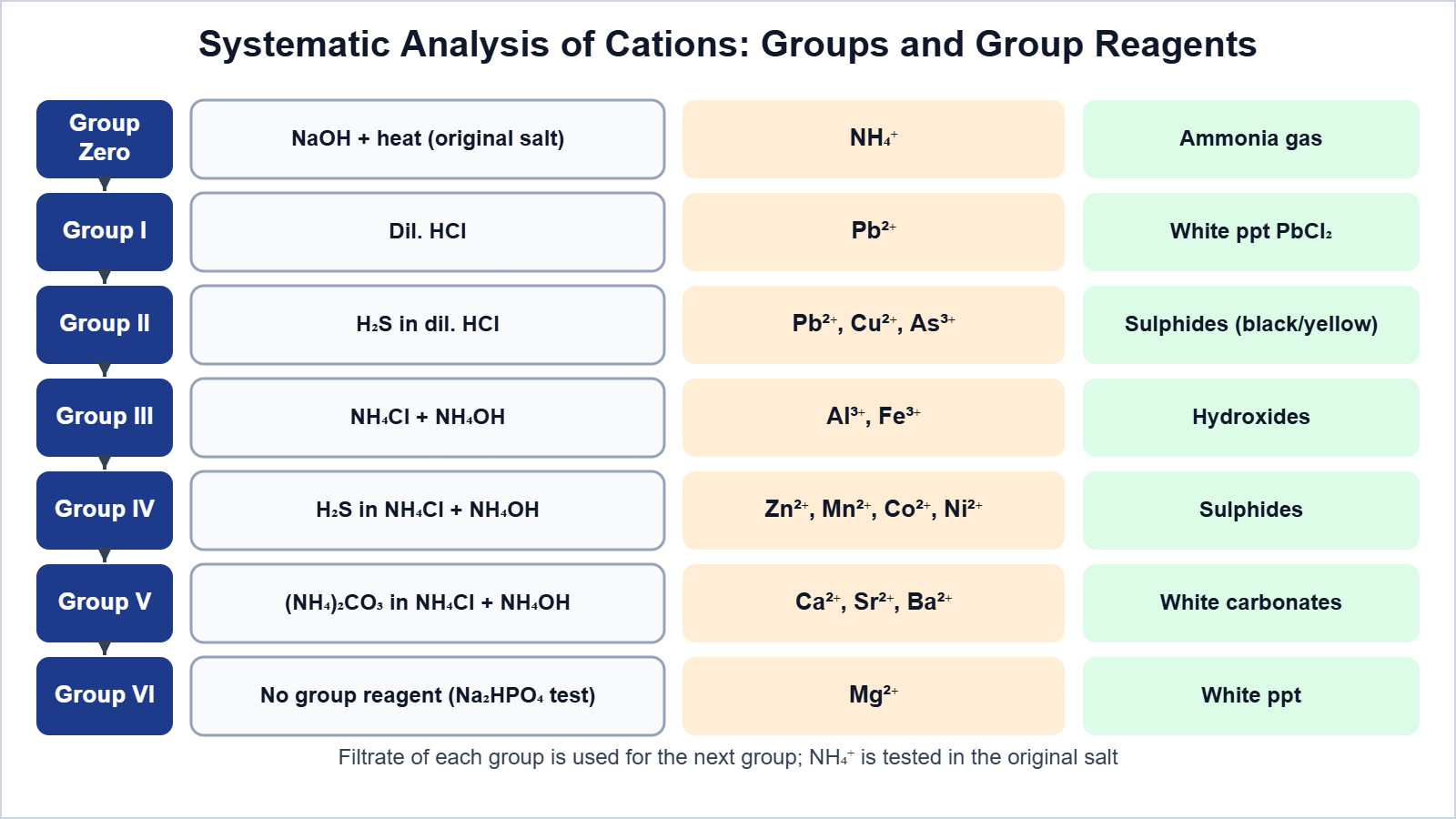
Cation analysis: prepare the original solution and add group reagents in order.
Cation | Confirmatory test | Observation |
|---|---|---|
NH4+ | Heat with NaOH; Nessler’s reagent | Smell of ammonia; brown ppt |
Pb2+ | KI solution; K2CrO4 solution | Yellow ppt; yellow ppt |
Cu2+ | Excess NH4OH; K4[Fe(CN)6] | Deep blue solution; chocolate-brown ppt |
As3+ | Yellow sulphide dissolved in conc. HNO3, then ammonium molybdate | Canary yellow ppt |
Al3+ | White gelatinous Al(OH)3; blue litmus + NH4OH (lake test) | Blue lake floating in colourless solution |
Fe3+ | K4[Fe(CN)6]; KSCN | Prussian blue; blood red colour |
Zn2+ | White ZnS dissolved in HCl; NaOH (dropwise then excess); K4[Fe(CN)6] | White ppt soluble in excess NaOH; bluish-white ppt |
Mn2+ | Buff (flesh) coloured MnS; NaOH; PbO2 + conc. HNO3 | White ppt turning brown; pink-purple colour |
Co2+ | Black sulphide; borax bead; KNO2 + acetic acid | Blue bead; yellow ppt |
Ni2+ | Black sulphide; dimethylglyoxime + NH4OH | Bright red (rosy) ppt |
Ca2+ | Ammonium oxalate; flame test | White ppt; brick red flame |
Sr2+ | Ammonium sulphate; flame test | White ppt; crimson red flame |
Ba2+ | K2CrO4; flame test | Yellow ppt; apple (grassy) green flame |
Mg2+ | Na2HPO4 + NH4OH (scratch the sides) | White crystalline ppt |
Remember: insoluble salts are excluded from the syllabus. Always record: experiment, observation and inference in three columns.
Investigatory Project (5 Marks)
A project involves about 10 periods of scientific investigation with laboratory testing and information from other sources. The report should contain: certificate, acknowledgement, aim, introduction/theory, materials, procedure, observations (tables/graphs), result, conclusion, precautions and bibliography.
Suggested project | Key idea |
|---|---|
Oxalate ions in guava at different stages of ripening | Extract oxalate and titrate with standard KMnO4; compare ripe and unripe fruit |
Casein in different milk samples | Precipitate casein with dilute acetic acid at its isoelectric point; dry and weigh |
Soybean milk vs natural milk | Compare curd formation, effect of temperature and taste |
Potassium bisulphite as food preservative | Compare spoilage of samples with different concentrations, temperature and time |
Digestion of starch by salivary amylase | Follow disappearance of the blue iodine colour; study effect of pH and temperature |
Rate of fermentation of wheat flour, gram flour, potato juice, carrot juice | Measure time for fermentation with yeast (e.g., Fehling’s test for remaining sugar) |
Essential oils from saunf, ajwain, illaichi | Steam distillation and separation of the oil |
Common food adulterants | Simple tests for adulterants in fat, oil, butter, sugar, turmeric, chilli powder and pepper |
Viva Questions
Q1. Why is KMnO4 called a self-indicator?
Ans. Its purple colour disappears during titration; the first excess drop gives a permanent pink colour at the end point.
Q2. Why is dilute H2SO4 used and not HCl in KMnO4 titrations?
Ans. HCl is oxidised by KMnO4 to chlorine; HNO3 is itself an oxidising agent.
Q3. Why is the oxalic acid solution warmed?
Ans. To speed up the slow reaction at room temperature.
Q4. Why are a few drops of dilute H2SO4 added while preparing Mohr’s salt?
Ans. To prevent hydrolysis of ferrous sulphate.
Q5. What is the Rf value?
Ans. Ratio of distance travelled by the substance to that travelled by the solvent front.
Q6. Why is the base line drawn with a pencil?
Ans. Ink would dissolve in the solvent and spread.
Q7. What is a salt bridge? Why is it used?
Ans. A tube of inert electrolyte in agar; it completes the circuit and maintains electrical neutrality.
Q8. What is the group reagent for Group III cations?
Ans. NH4OH in presence of NH4Cl.
Q9. Why is NH4Cl added before NH4OH in Group III?
Ans. It suppresses ionisation of NH4OH (common ion effect) so that only Group III hydroxides precipitate.
Q10. What is the brown ring?
Ans. The complex [Fe(H2O)5NO]2+ formed in the nitrate test.
Q11. Why does sulphur appear in the thiosulphate-HCl reaction?
Ans. Thiosulphate decomposes in acid, giving colloidal sulphur that makes the solution milky.
Q12. Which reagent detects aldehydes but not ketones?
Ans. Tollens’ reagent (silver mirror) and Fehling’s solution.
Conclusion: Practical work builds skill in titration, qualitative analysis, preparation and testing of compounds. Careful observation, correct recording, accurate calculation and safe handling of chemicals are the keys to good results in the practical examination.