Chapter – 2
Electrochemistry
1. Redox Reactions and Electrochemical Cells
Electrochemistry studies the production of electricity from chemical reactions and the use of electricity to bring about non-spontaneous chemical changes. Oxidation is loss of electrons; reduction is gain of electrons. A galvanic (voltaic) cell converts chemical energy of a spontaneous redox reaction into electrical energy; an electrolytic cell uses electrical energy to carry out a non-spontaneous reaction.
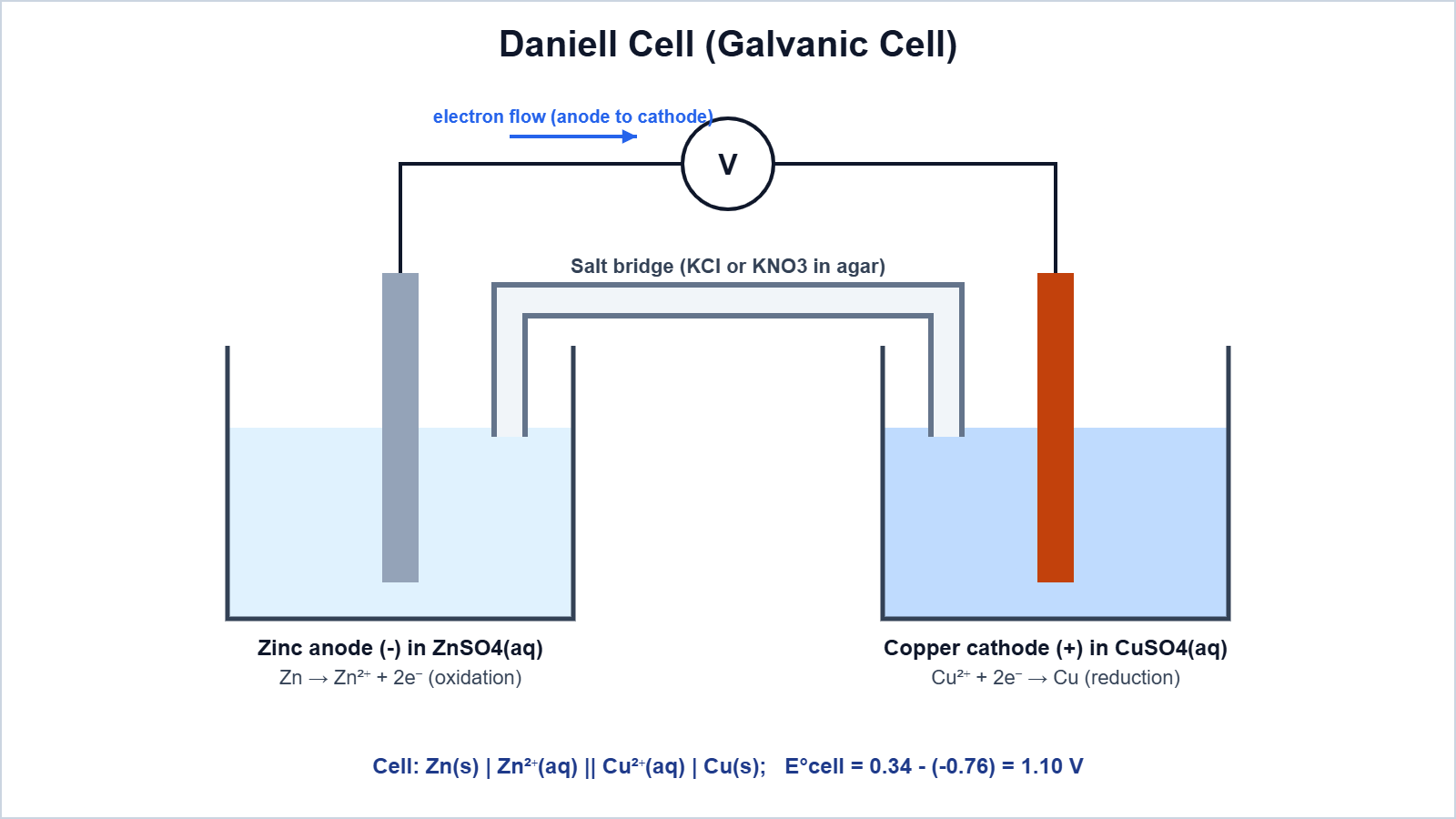
Remember: In a galvanic cell, oxidation occurs at the anode (negative) and reduction at the cathode (positive). The salt bridge completes the circuit and maintains electrical neutrality.
2. EMF of a Cell and Standard Electrode Potential
The electrode potential is the potential difference between an electrode and its electrolyte. When all concentrations are 1 M and gases are at 1 bar at 298 K, it is the standard electrode potential (E°). Standard reduction potentials are measured against the Standard Hydrogen Electrode (SHE), whose E° is taken as 0.00 V.
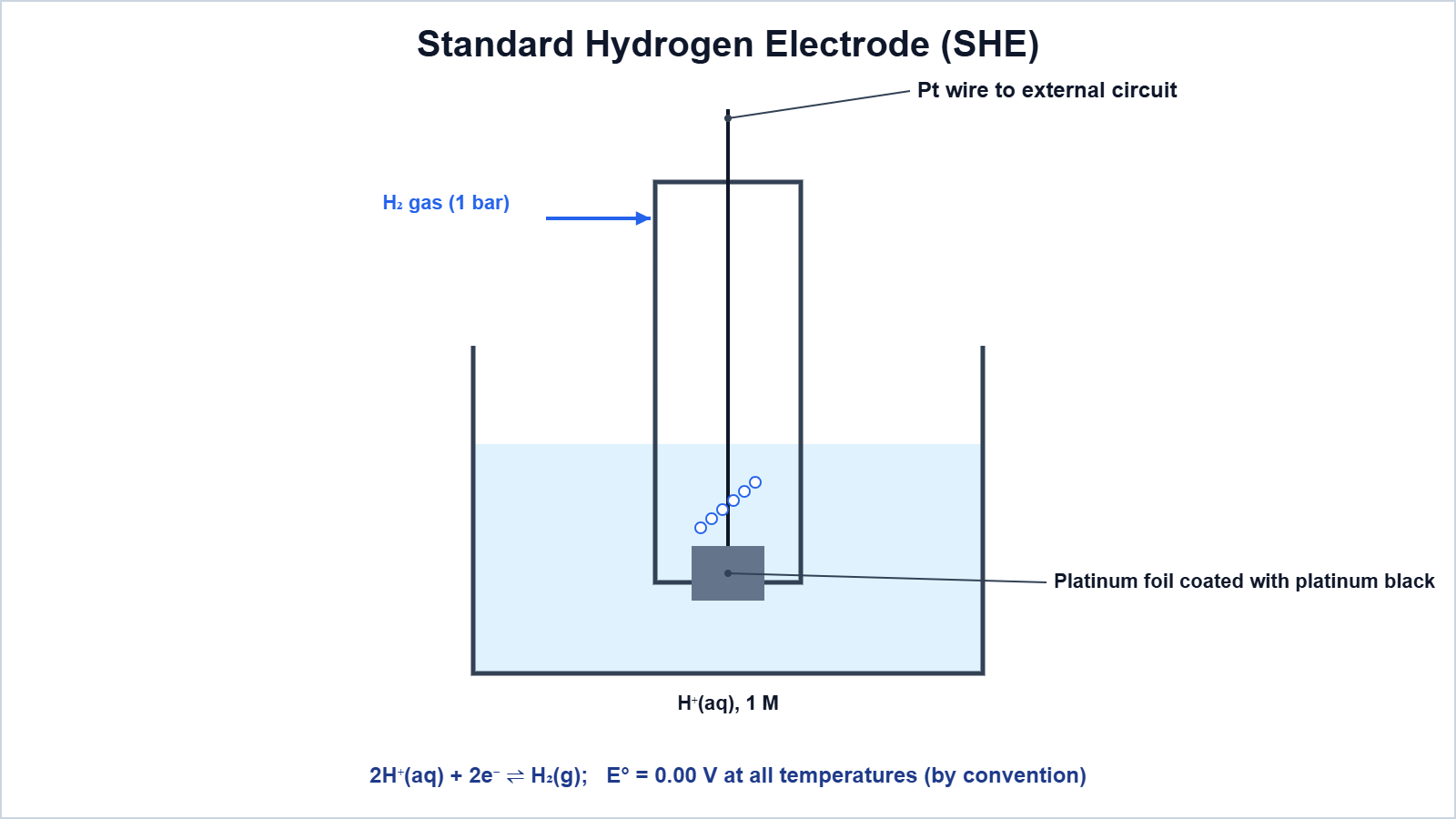
E°cell = E°cathode – E°anode = E°right – E°left (both as reduction potentials). A more negative E° means a stronger reducing agent (e.g., Li, E° = -3.05 V); a more positive E° means a stronger oxidising agent (e.g., F2, E° = +2.87 V).
Numerical 1: Calculate E°cell for Zn | Zn2+ || Cu2+ | Cu. (E°Cu2+/Cu = +0.34 V; E°Zn2+/Zn = -0.76 V)
Given: E°cathode = +0.34 V; E°anode = -0.76 V
Formula: E°cell = E°cathode – E°anode
Solution: E°cell = 0.34 – (-0.76)
Answer: 1.10 V
3. Nernst Equation and its Application
For Mn+ + ne– → M: E = E° – (0.059/n) log (1/[Mn+]) at 298 K. For a cell aA + bB → cC + dD: Ecell = E°cell – (0.059/n) log Q, where Q = [C]c[D]d/[A]a[B]b (solids are omitted).
Numerical 2: Calculate the emf of the cell Zn | Zn2+(0.1 M) || Cu2+(1 M) | Cu at 298 K. (E°cell = 1.10 V)
Given: E°cell = 1.10 V; n = 2; [Zn2+] = 0.1 M; [Cu2+] = 1 M
Formula: Ecell = E°cell – (0.059/n) log ([Zn2+]/[Cu2+])
Solution: Ecell = 1.10 – (0.059/2) log (0.1/1) = 1.10 – 0.0295 x (-1) = 1.10 + 0.0295
Answer: 1.13 V (1.1295 V)
Numerical 3: Find the electrode potential of Cu2+/Cu when [Cu2+] = 0.01 M at 298 K. (E° = +0.34 V)
Given: E° = 0.34 V; n = 2; [Cu2+] = 0.01 M
Formula: E = E° – (0.059/n) log (1/[Cu2+])
Solution: E = 0.34 – (0.059/2) log 100 = 0.34 – 0.0295 x 2 = 0.34 – 0.059
Answer: 0.281 V
4. Relation between Gibbs Energy Change and EMF
ΔG° = -nFE°cell, where F = 96,500 C mol-1. A positive E°cell gives a negative ΔG°, so the reaction is spontaneous. Also, ΔG° = -2.303RT log K, so log K = nE°cell / 0.059 at 298 K.
Numerical 4: Calculate ΔG° for the Daniell cell (E°cell = 1.10 V).
Given: n = 2; F = 96,500 C mol-1; E°cell = 1.10 V
Formula: ΔG° = -nFE°cell
Solution: ΔG° = -2 x 96,500 x 1.10 = -2,12,300 J mol-1
Answer: -212.3 kJ mol-1
Numerical 5: Calculate the equilibrium constant of the Daniell cell reaction at 298 K.
Given: n = 2; E°cell = 1.10 V
Formula: log K = nE°cell / 0.059
Solution: log K = (2 x 1.10)/0.059 = 37.29; K = 1037.29
Answer: K ≈ 1.9 x 1037
5. Conductance in Electrolytic Solutions
Quantity | Formula | Unit |
|---|---|---|
Resistance R | R = ρ (l/A) | ohm (Ω) |
Conductance G | G = 1/R | S (siemens) |
Conductivity κ | κ = 1/ρ = G* / R, where G* = l/A is the cell constant | S cm-1 (or S m-1) |
Molar conductivity Λm | Λm = κ x 1000 / M (κ in S cm-1, M in mol L-1) | S cm2 mol-1 |
Numerical 6: A conductivity cell with cell constant 1.5 cm-1 filled with 0.01 M KCl solution has a resistance of 1500 Ω. Find its conductivity and molar conductivity.
Given: G* = 1.5 cm-1; R = 1500 Ω; M = 0.01 mol L-1
Formula: κ = G*/R; Λm = κ x 1000/M
Solution: κ = 1.5/1500 = 0.001 S cm-1; Λm = 0.001 x 1000/0.01
Answer: κ = 1.0 x 10⁻³ S cm-1; Λm = 100 S cm2 mol-1
6. Variation of Conductivity with Concentration and Kohlrausch’s Law
Conductivity decreases with dilution (fewer ions per unit volume), but molar conductivity increases with dilution. The limiting value at zero concentration is Λ°m.
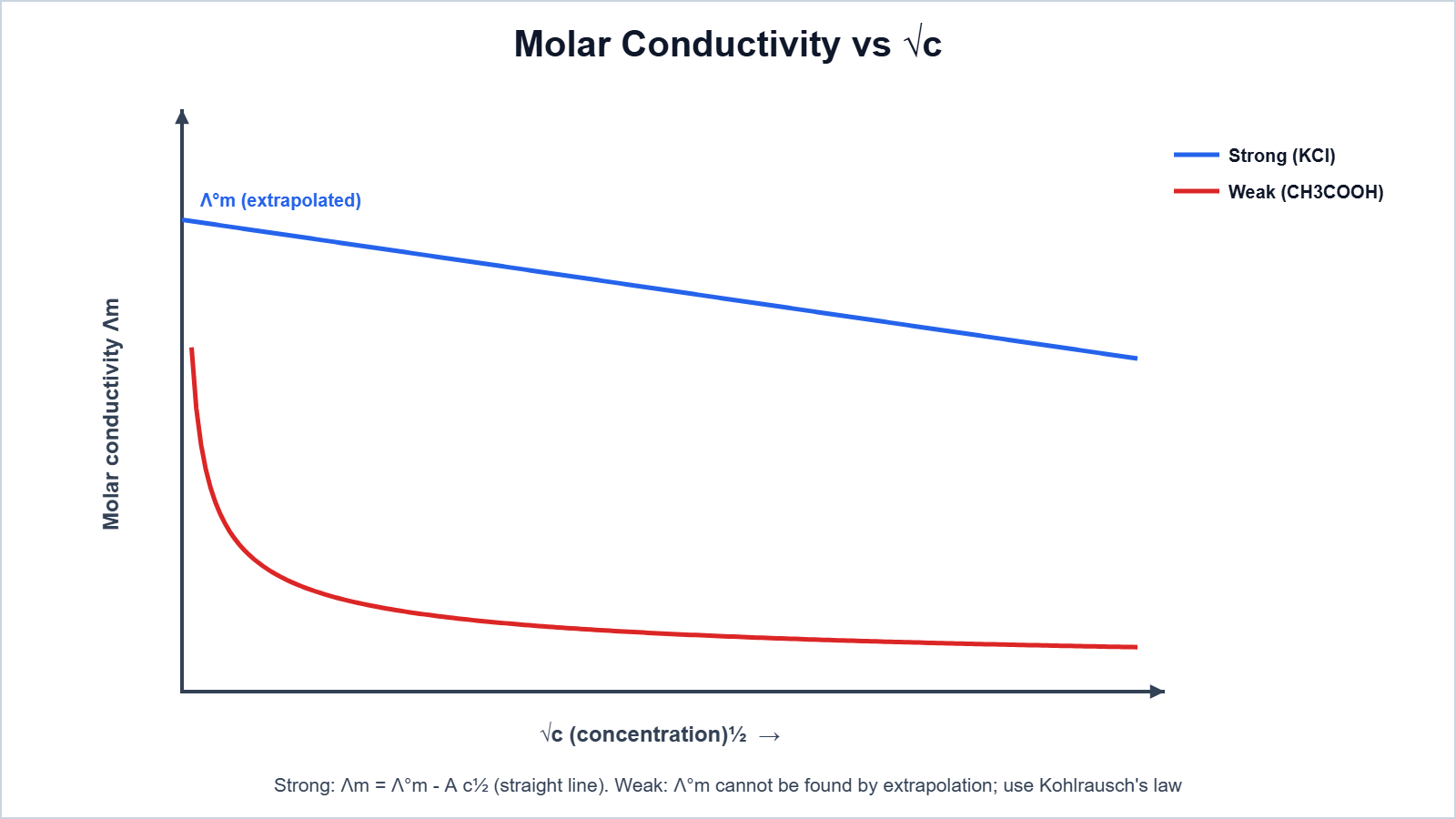
Kohlrausch’s law of independent migration of ions: The limiting molar conductivity of an electrolyte is the sum of the limiting molar conductivities of its cation and anion: Λ°m = ν+λ°+ + ν–λ°–. It is used to find Λ°m of weak electrolytes and their degree of dissociation (α = Λm / Λ°m).
Numerical 7: Calculate Λ°m of ethanoic acid. If its Λm at a certain concentration is 39.05 S cm2 mol-1, find its degree of dissociation. (λ°H+ = 349.6, λ°CH3COO– = 40.9 S cm2 mol-1)
Given: λ° values given; Λm = 39.05 S cm2 mol-1
Formula: Λ°m = λ°H+ + λ°CH3COO–; α = Λm/Λ°m
Solution: Λ°m = 349.6 + 40.9 = 390.5; α = 39.05/390.5
Answer: Λ°m = 390.5 S cm2 mol-1; α = 0.1
7. Electrolysis and Faraday’s Laws (Elementary Idea)
First law: The mass of substance deposited at an electrode is directly proportional to the quantity of electricity passed (m = ZIt). Second law: When the same quantity of electricity is passed through different electrolytes, the masses deposited are proportional to their chemical equivalent weights. One mole of electrons carries 1 Faraday = 96,500 C.
Products of electrolysis depend on the electrolyte and the electrodes. Example: electrolysis of aqueous NaCl gives H2 at the cathode and Cl2 at the anode, leaving NaOH in solution.
Numerical 8: A current of 2 A is passed for 965 s through CuSO4 solution. Find the mass of copper deposited. (Cu = 63.5 g mol-1)
Given: I = 2 A; t = 965 s; Cu2+ + 2e– → Cu
Formula: Q = It; moles of e– = Q/F
Solution: Q = 2 x 965 = 1930 C; moles of e– = 1930/96,500 = 0.02 mol; moles of Cu = 0.02/2 = 0.01 mol; mass = 0.01 x 63.5
Answer: 0.635 g
8. Batteries: Dry Cell, Lead Accumulator and Fuel Cells
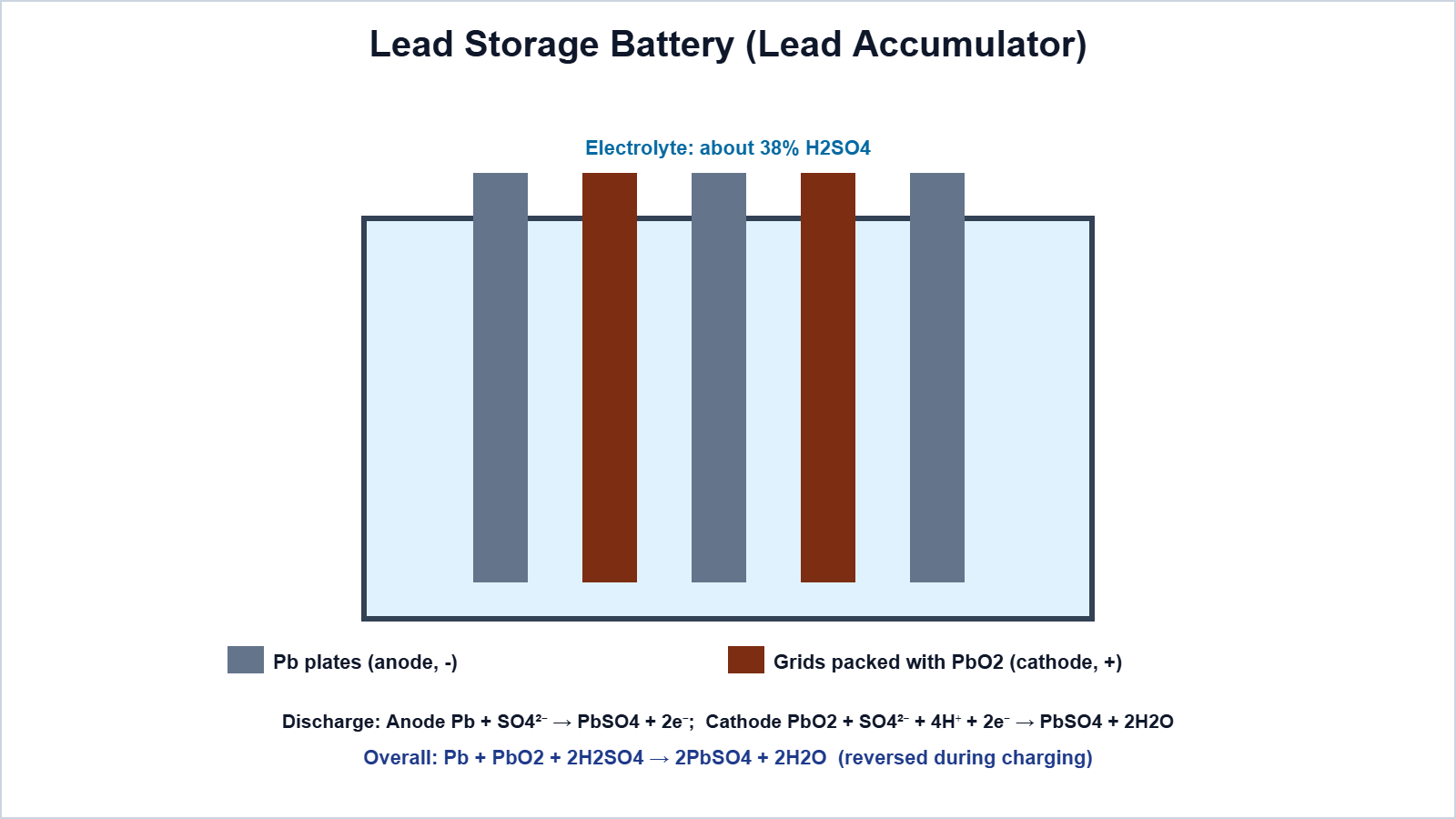
Primary batteries cannot be recharged (dry cell, mercury cell). Secondary batteries can be recharged (lead storage battery, nickel-cadmium cell).
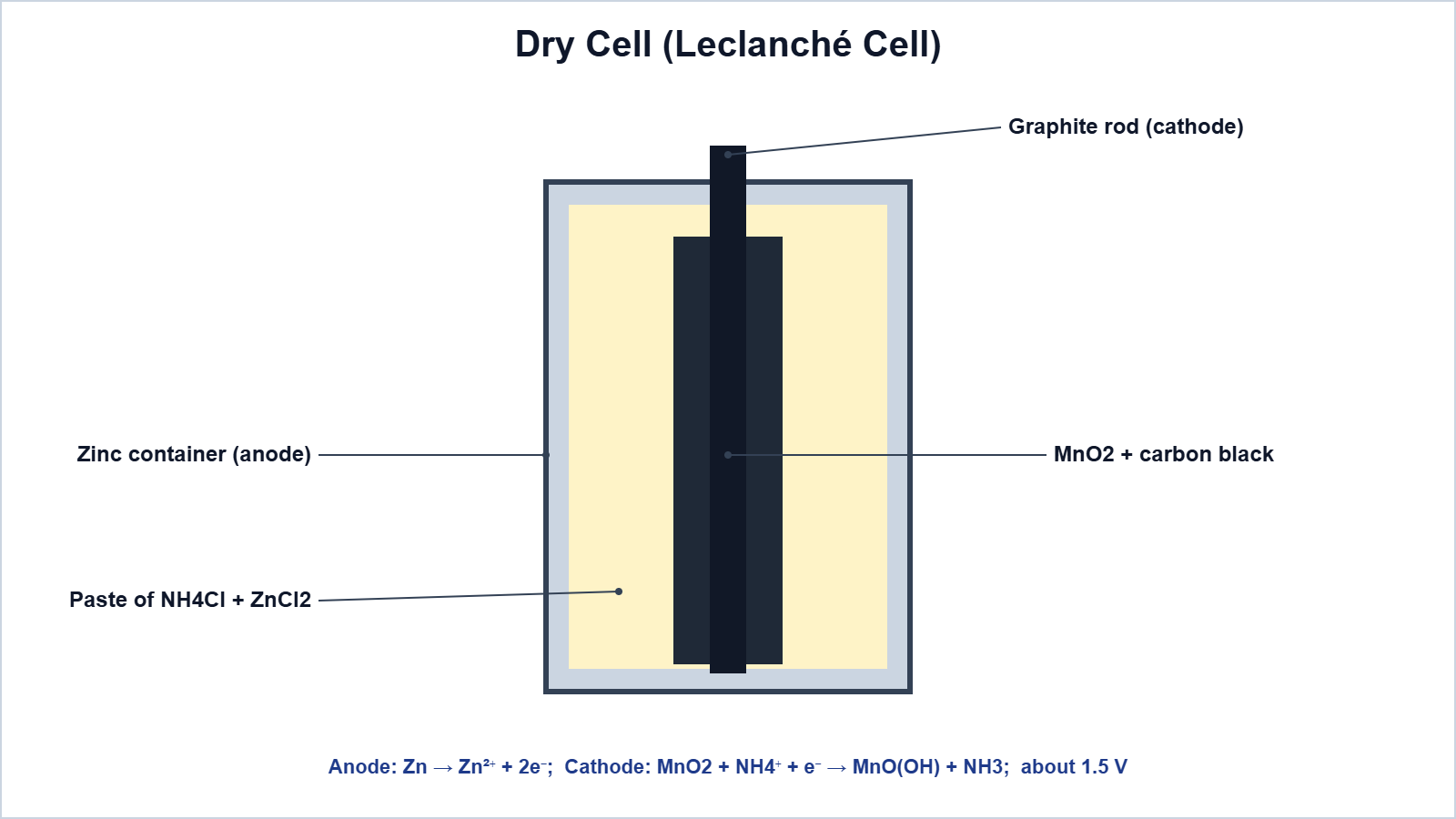
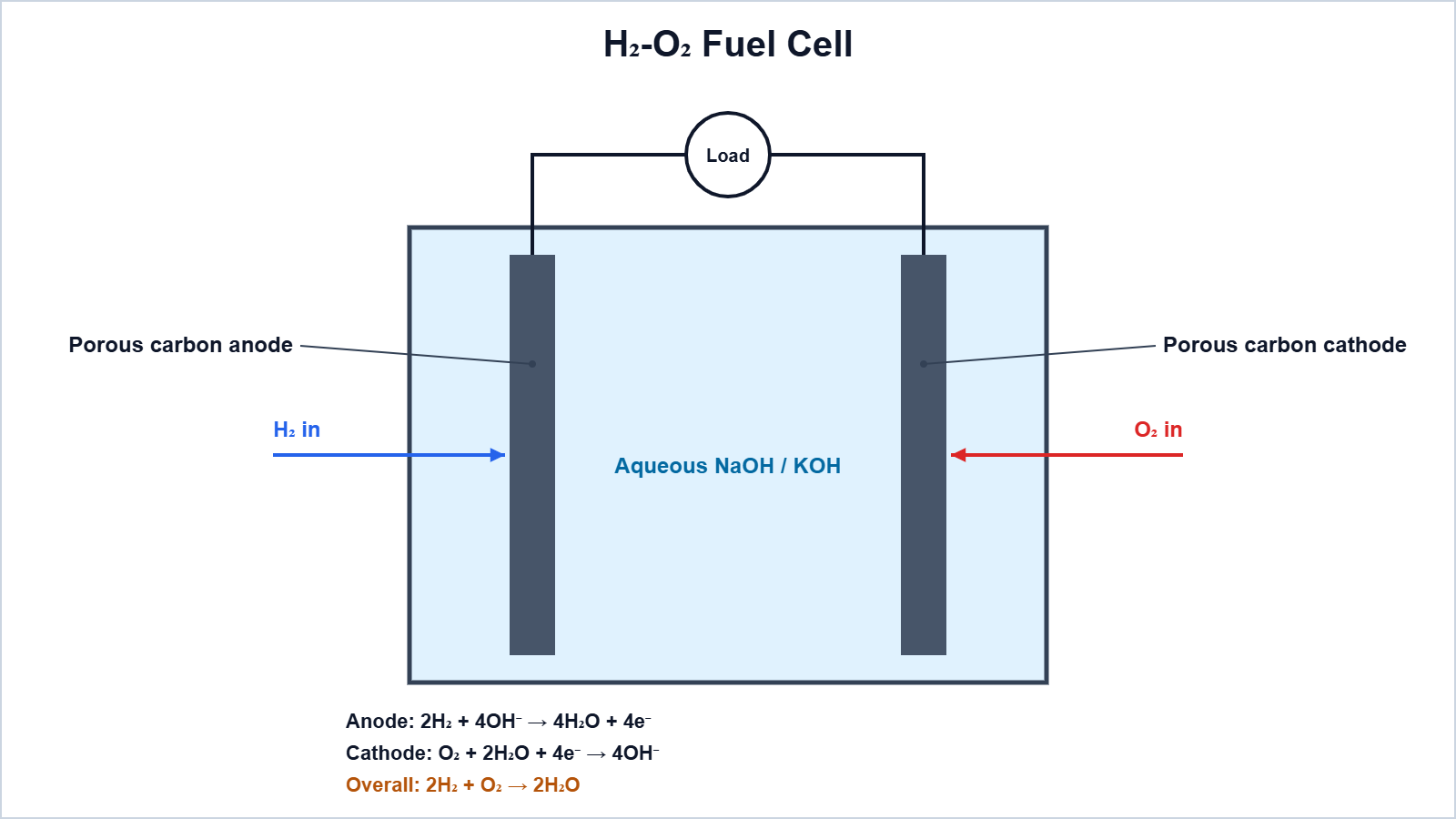
Fuel cells convert the energy of combustion of fuels like hydrogen directly into electricity. The H2-O2 fuel cell was used in the Apollo space programme; the water produced was used by astronauts. Fuel cells are efficient (about 70%) and pollution-free.
9. Corrosion
Corrosion is the slow destruction of a metal by its environment, as in rusting of iron, tarnishing of silver and green coating on copper. It is an electrochemical process.
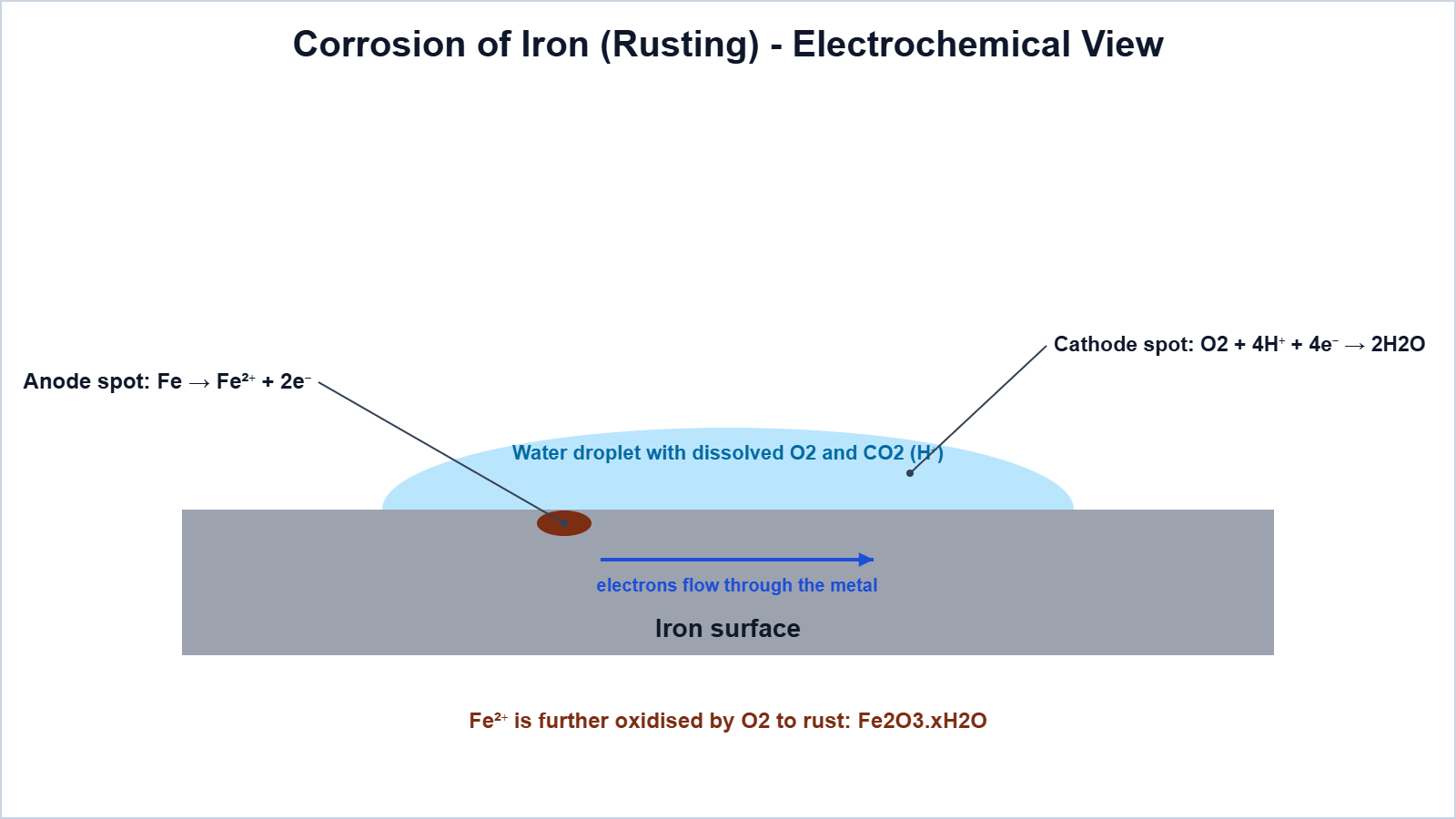
Prevention: painting, oiling or greasing; galvanising (coating iron with zinc); covering with a more reactive metal (sacrificial protection); using anti-rust solutions.
Exam point: Galvanised iron is protected even when the zinc coating is scratched, because zinc is more reactive and gets oxidised first (sacrificial protection).
Easy Memory Trick: “An Ox, Red Cat”: ANode = OXidation, REDuction = CAThode.
10. Practice Problems (Answers Only)
- E°cell for Zn | Zn2+ || Ag+ | Ag (E°Ag+/Ag = +0.80 V, E°Zn = -0.76 V). Ans: 1.56 V
- ΔG° for a cell with n = 2 and E°cell = 1.56 V. Ans: -301.08 kJ mol-1
- Charge needed to deposit 1 mol of Al from Al3+. Ans: 3F = 2,89,500 C
- κ = 0.0025 S cm-1 for a 0.05 M solution. Find Λm. Ans: 50 S cm2 mol-1
- Time to deposit 1.08 g Ag with a current of 1 A (Ag = 108). Ans: 965 s
11. Important Questions
Q1. What is the function of a salt bridge?
Ans. It completes the electrical circuit and maintains electrical neutrality of the two half-cells.
Q2. What is the standard electrode potential of SHE?
Ans. 0.00 V at all temperatures (by convention).
Q3. Write the Nernst equation for a metal electrode.
Ans. E = E° – (0.059/n) log (1/[Mn+]) at 298 K.
Q4. How are ΔG° and E°cell related?
Ans. ΔG° = -nFE°cell.
Q5. Why does molar conductivity increase on dilution?
Ans. Because the total number of ions from one mole of electrolyte increases (weak) or ions move more freely (strong) as the solution becomes dilute.
Q6. State Kohlrausch’s law.
Ans. The limiting molar conductivity of an electrolyte is the sum of the limiting molar conductivities of its cation and anion.
Q7. Why can’t Λ°m of a weak electrolyte be found by extrapolation?
Ans. Because its Λm rises very steeply at low concentrations and does not give a straight line.
Q8. Write the overall reaction of the lead storage battery during discharge.
Ans. Pb + PbO2 + 2H2SO4 → 2PbSO4 + 2H2O.
Q9. Give two advantages of fuel cells.
Ans. High efficiency and pollution-free operation.
Q10. How does galvanisation prevent rusting?
Ans. Zinc, being more reactive than iron, is oxidised in preference to iron (sacrificial protection).
Conclusion: Electrochemistry links chemical reactions and electricity. Electrode potentials, the Nernst equation, conductance and Faraday’s laws explain how cells and batteries work and how corrosion can be prevented.