Alcohols, Phenols and Ethers – Class 12 Chemistry Notes
Chapter – 7
Alcohols, Phenols and Ethers
1. Introduction and Classification
Alcohols contain an -OH group attached to an sp3 carbon of an alkyl group (R-OH). Phenols have -OH attached directly to an aromatic ring (Ar-OH). Ethers have an oxygen atom bonded to two alkyl or aryl groups (R-O-R’).
- Alcohols: monohydric (one -OH), dihydric (ethane-1,2-diol), trihydric (propane-1,2,3-triol, glycerol).
- Monohydric alcohols: primary (1°, -CH2OH), secondary (2°, >CHOH) and tertiary (3°, ≡C-OH); also allylic and benzylic alcohols.
- Ethers: simple or symmetrical (both groups same, C2H5OC2H5) and mixed or unsymmetrical (CH3OC2H5).
2. Nomenclature
Compound | Common name | IUPAC name |
|---|---|---|
CH3OH | Methyl alcohol | Methanol |
CH3CH(OH)CH3 | Isopropyl alcohol | Propan-2-ol |
(CH3)3C-OH | tert-Butyl alcohol | 2-Methylpropan-2-ol |
HOCH2CH2OH | Ethylene glycol | Ethane-1,2-diol |
C6H5OH | Phenol | Phenol |
CH3C6H4OH (ortho) | o-Cresol | 2-Methylphenol |
C6H4(OH)2 (1,2) | Catechol | Benzene-1,2-diol |
CH3OCH3 | Dimethyl ether | Methoxymethane |
C2H5OC2H5 | Diethyl ether | Ethoxyethane |
C6H5OCH3 | Anisole | Methoxybenzene |
Remember: In alcohols the C-O-H bond angle (about 108.9° in methanol) is slightly less than tetrahedral because of lone pair repulsion; in ethers the C-O-C angle (about 111.7° in methoxymethane) is slightly more due to repulsion between bulky groups.
3. Alcohols: Methods of Preparation
- From alkenes: (i) acid-catalysed hydration (Markovnikov addition): CH3CH=CH2 + H2O (H+) → CH3CH(OH)CH3; (ii) hydroboration-oxidation with B2H6 then H2O2/OH– gives the anti-Markovnikov alcohol: propene → propan-1-ol.
- From carbonyl compounds: reduction of aldehydes gives 1° alcohols and ketones give 2° alcohols with H2/Pd, NaBH4 or LiAlH4. Carboxylic acids are reduced to 1° alcohols by LiAlH4; esters by H2 with a catalyst.
- From Grignard reagents: RMgX adds to carbonyl compounds and the adduct is hydrolysed. HCHO gives a 1° alcohol, other aldehydes give 2° alcohols, ketones give 3° alcohols.
- From haloalkanes: R-X + aqueous KOH → R-OH + KX.
Example: CH3MgBr + HCHO, then H2O → CH3CH2OH (ethanol, 1°); CH3MgBr + CH3COCH3, then H2O → (CH3)3COH (2-methylpropan-2-ol, 3°).
4. Physical Properties of Alcohols
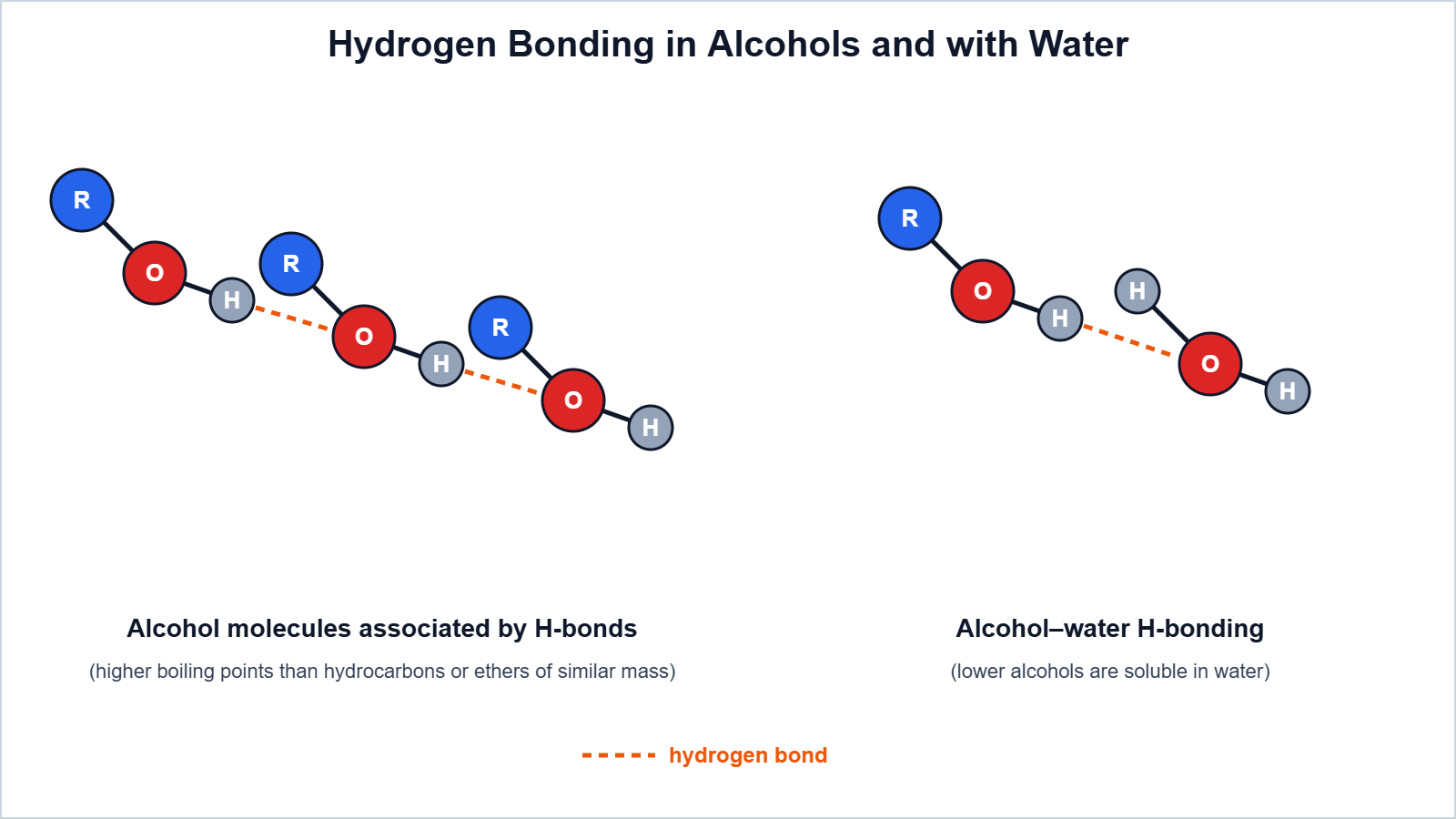
- Boiling points are higher than those of hydrocarbons, ethers and haloalkanes of comparable molecular mass because of intermolecular hydrogen bonding. They increase with the number of carbon atoms and decrease with branching.
- Solubility: lower alcohols are miscible with water because they form hydrogen bonds with water molecules; solubility decreases as the hydrocarbon part increases.
5. Chemical Properties of Primary Alcohols
(A) Reactions involving cleavage of the O-H bond (acidic nature):
- With active metals: 2R-OH + 2Na → 2R-ONa + H2. Alcohols are weaker acids than water; acidity order: 1° > 2° > 3° (alkyl groups release electrons and destabilise the alkoxide ion).
- Esterification: R-OH + R’COOH ⇌ R’COOR + H2O (conc. H2SO4); with acid chlorides: R-OH + R’COCl → R’COOR + HCl (pyridine removes HCl). Acetylation of salicylic acid gives aspirin.
(B) Reactions involving cleavage of the C-O bond:
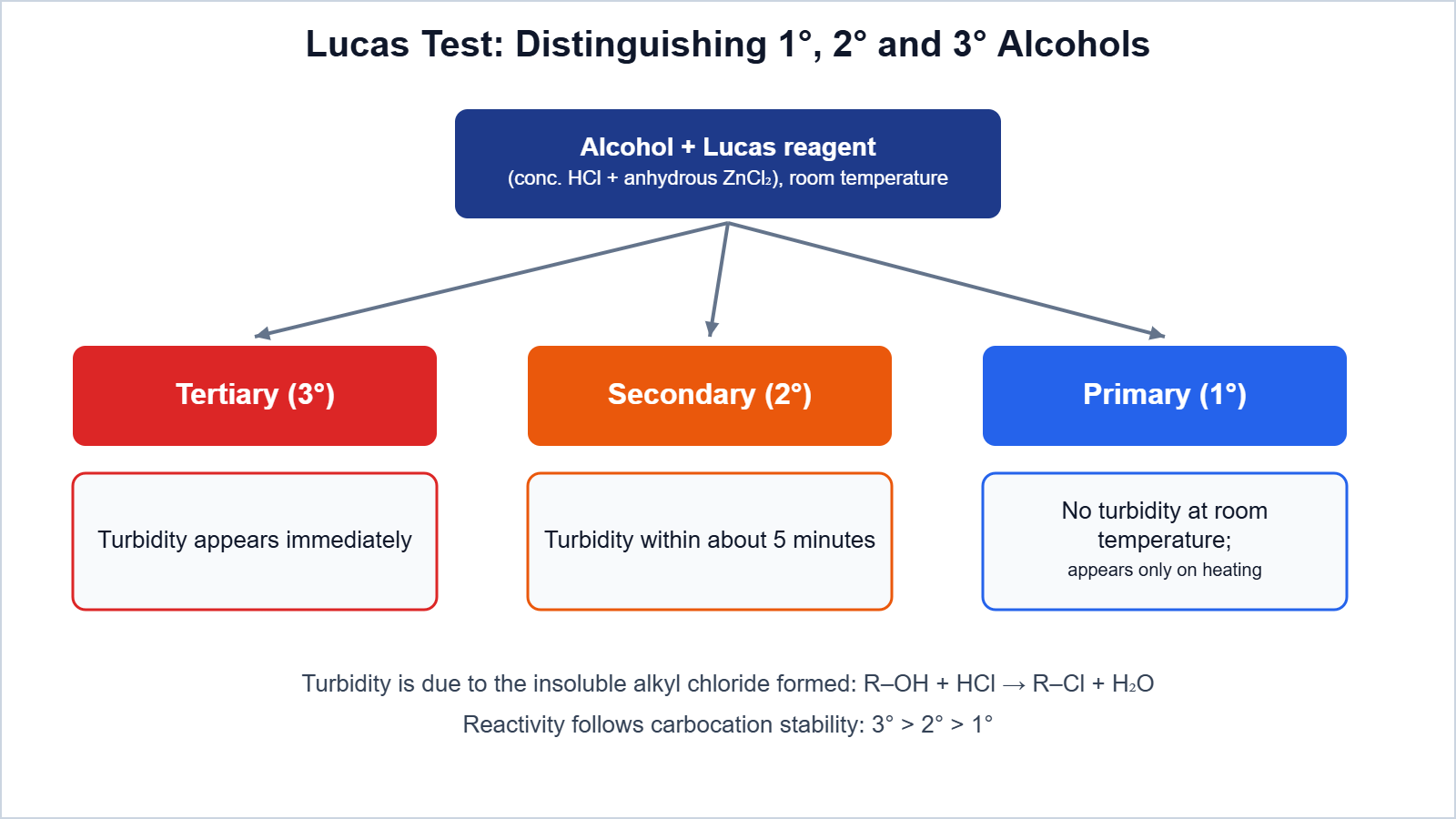
- With hydrogen halides: R-OH + HX → R-X + H2O; reactivity 3° > 2° > 1° (basis of Lucas test).
- With phosphorus halides and SOCl2: give alkyl halides (see Unit-6).
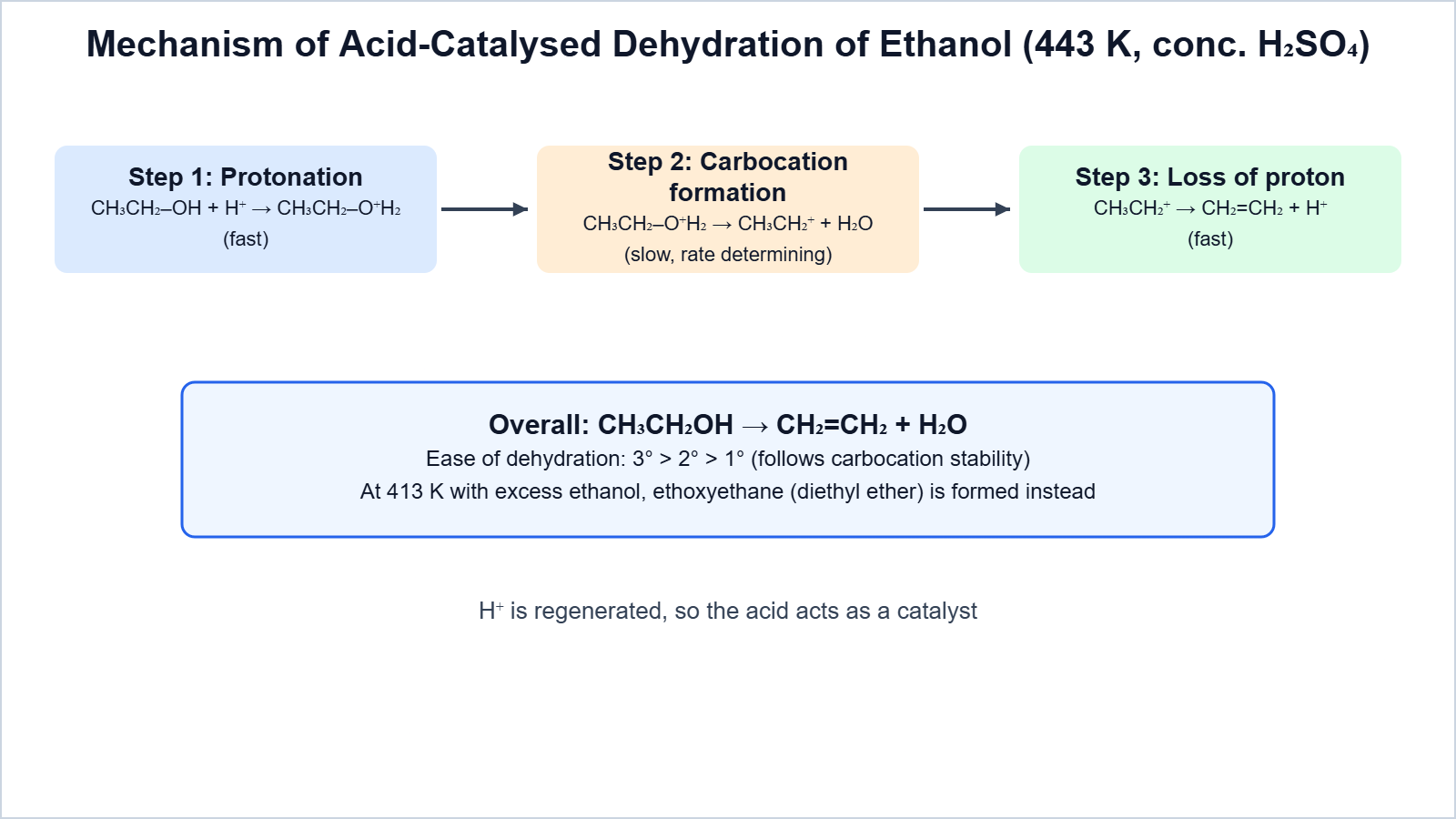
- Dehydration: ethanol with conc. H2SO4 at 443 K gives ethene; with excess ethanol at 413 K gives ethoxyethane.
(C) Oxidation: 1° alcohols are oxidised to aldehydes and then to carboxylic acids by acidified KMnO4 or K2Cr2O7. To stop at the aldehyde, pyridinium chlorochromate (PCC) or CrO3 in anhydrous medium is used. 2° alcohols give ketones; 3° alcohols resist oxidation under mild conditions. Dehydrogenation over heated copper at 573 K: 1° alcohol → aldehyde; 2° alcohol → ketone; 3° alcohol → alkene (dehydration).
6. Identification of Primary, Secondary and Tertiary Alcohols
Test | 1° alcohol | 2° alcohol | 3° alcohol |
|---|---|---|---|
Lucas test (conc. HCl + ZnCl2) | No turbidity at room temperature | Turbidity in about 5 minutes | Turbidity immediately |
Hot Cu at 573 K | Aldehyde | Ketone | Alkene |
Oxidation (K2Cr2O7/H+) | Aldehyde then acid (orange to green) | Ketone (orange to green) | No reaction under mild conditions (stays orange) |
7. Uses: Methanol and Ethanol
Methanol (wood spirit): produced by catalytic hydrogenation of carbon monoxide: CO + 2H2 → CH3OH (ZnO-Cr2O3, 573-673 K, 200-300 atm). Used as a solvent in paints and varnishes and for making formaldehyde. It is highly poisonous: small quantities can cause blindness and larger quantities death.
Ethanol: obtained by fermentation of sugars (molasses, sugarcane, fruits): C12H22O11 + H2O → C6H12O6 (glucose) + C6H12O6 (fructose) by invertase; C6H12O6 → 2C2H5OH + 2CO2 by zymase (from yeast). Used as a solvent, in medicines, in alcoholic beverages and as a fuel additive. Commercial alcohol is made unfit for drinking by adding copper sulphate and pyridine (denatured alcohol).
8. Phenols: Methods of Preparation
- From haloarenes: chlorobenzene + NaOH at 623 K and 300 atm gives sodium phenoxide; acidification gives phenol.
- From benzenesulphonic acid: fusion of sodium benzenesulphonate with NaOH, followed by acidification.
- From diazonium salts: warming benzenediazonium chloride with water: C6H5N2Cl + H2O → C6H5OH + N2 + HCl.
- From cumene (isopropylbenzene): air oxidation to cumene hydroperoxide, then treatment with dilute acid gives phenol and acetone (the main commercial method).
9. Phenols: Physical Properties and Acidic Nature
Phenol is a colourless crystalline solid that turns pink on exposure to air. It has a higher boiling point than hydrocarbons of similar mass (hydrogen bonding) and is moderately soluble in water.
Acidic nature: Phenol reacts with NaOH to form sodium phenoxide (alcohols do not), so phenol is more acidic than alcohols and water. Reasons: the -OH is attached to an sp2 carbon, which is more electronegative, and the phenoxide ion is stabilised by resonance (negative charge delocalised over the ring), whereas the alkoxide ion has no such stabilisation. Phenol is, however, weaker than carboxylic acids and does not react with NaHCO3.
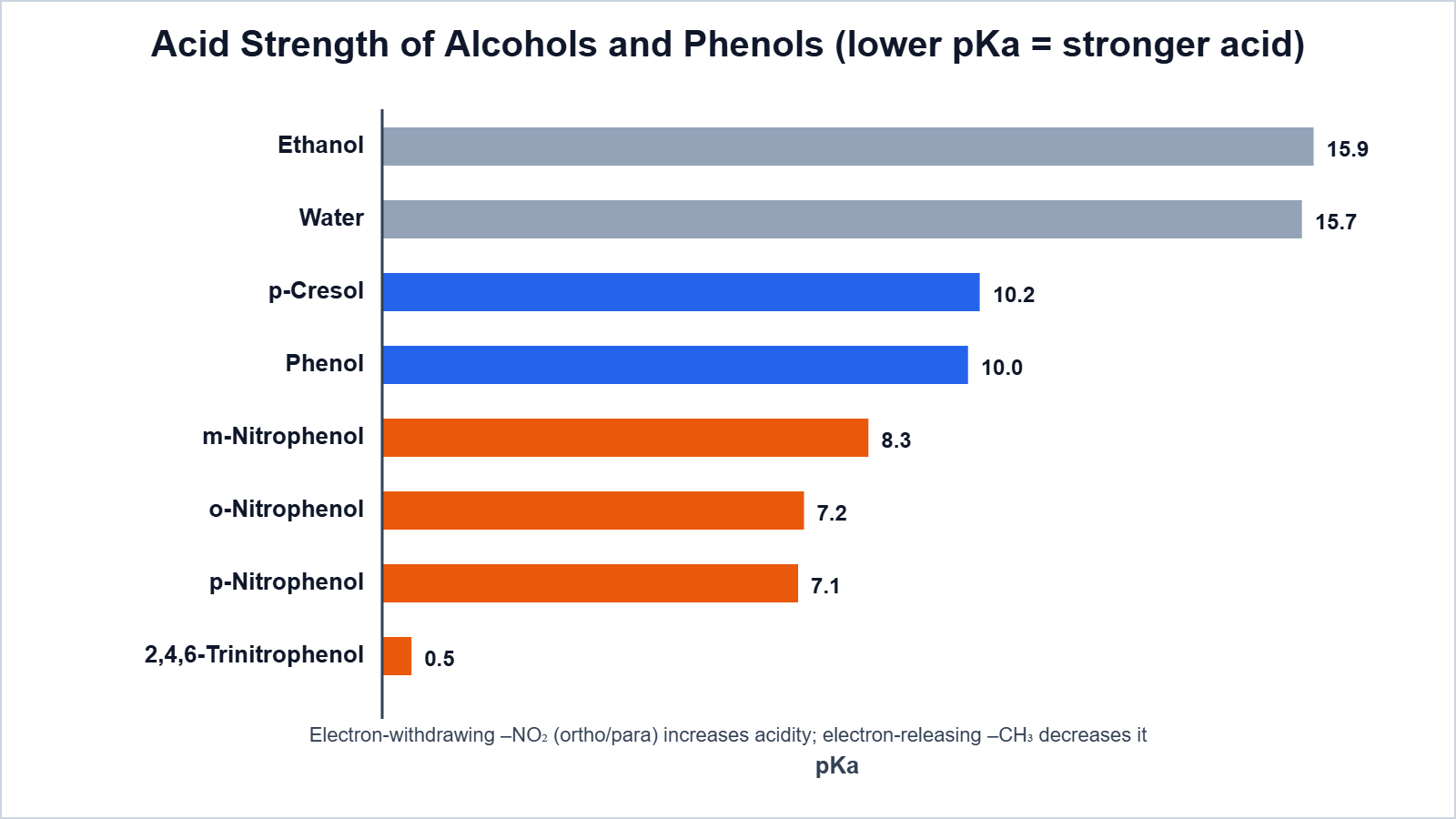
Effect of substituents: Electron-withdrawing groups (-NO2) at ortho and para positions stabilise the phenoxide ion and increase acidity; electron-releasing groups (-CH3) decrease acidity. Thus 2,4,6-trinitrophenol (picric acid) is a strong acid.
Easy Memory Trick: “Pull increases, Push decreases”: electron-pulling groups increase phenol acidity; electron-pushing groups decrease it.
10. Phenols: Chemical Properties and Electrophilic Substitution
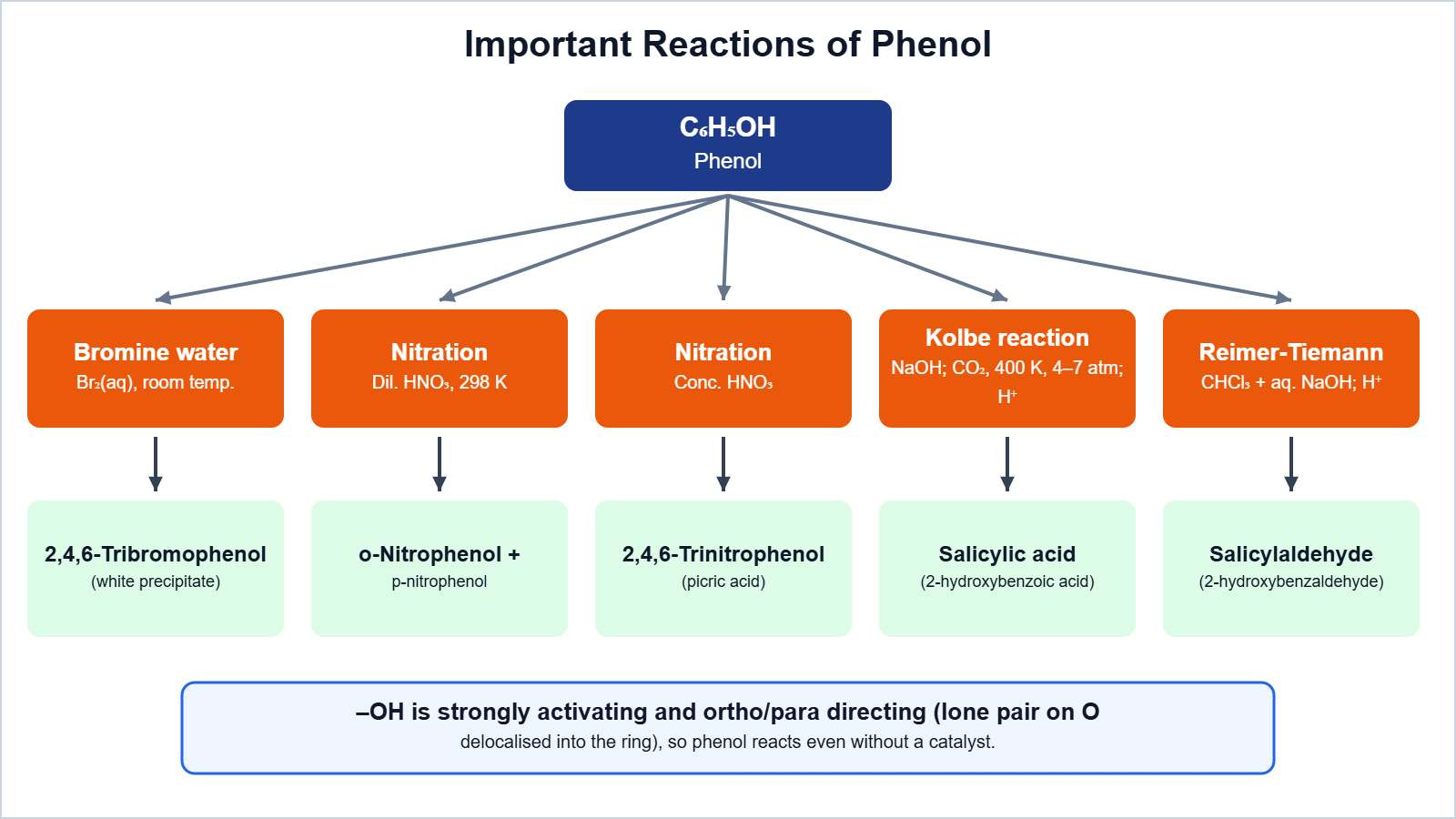
- Halogenation: with bromine water, phenol gives a white precipitate of 2,4,6-tribromophenol (test for phenol). With Br2 in CS2 or CHCl3 at low temperature, monobromophenols (mainly para) are formed.
- Nitration: dilute HNO3 at 298 K gives o- and p-nitrophenol, separated by steam distillation (o-nitrophenol is steam volatile due to intramolecular hydrogen bonding; p-nitrophenol is less volatile due to intermolecular hydrogen bonding). Concentrated HNO3 gives 2,4,6-trinitrophenol (picric acid).
- Kolbe reaction: sodium phenoxide heated with CO2 (400 K, 4-7 atm) gives sodium salicylate; acidification gives salicylic acid (2-hydroxybenzoic acid).
- Reimer-Tiemann reaction: phenol + CHCl3 + aqueous NaOH gives a substituted benzal chloride intermediate which is hydrolysed; acidification gives salicylaldehyde (2-hydroxybenzaldehyde).
- Reaction with zinc dust: phenol is reduced to benzene: C6H5OH + Zn → C6H6 + ZnO.
- Oxidation: with chromic acid, phenol gives benzoquinone.
Tests for phenol: (i) neutral FeCl3 gives a violet colour; (ii) bromine water gives a white precipitate.
Uses of phenols: manufacture of Bakelite and other resins, dyes, drugs (aspirin from salicylic acid), antiseptics and disinfectants (dilute phenol, carbolic acid) and nylon intermediates.
11. Ethers
Preparation:
- Dehydration of alcohols: 2C2H5OH (conc. H2SO4, 413 K) → C2H5OC2H5 + H2O. Suitable for simple ethers from 1° alcohols.
- Williamson synthesis: R-X + R’-ONa → R-O-R’ + NaX (SN2). A primary alkyl halide must be used; with tertiary halides elimination gives alkenes. E.g., (CH3)3C-ONa + CH3Br → (CH3)3C-O-CH3 + NaBr. Anisole: C6H5ONa + CH3I → C6H5OCH3 + NaI.
Physical properties: ethers have a small dipole moment; their boiling points are close to those of alkanes of similar mass and much lower than alcohols, because they cannot form hydrogen bonds between their own molecules. Their solubility in water is similar to alcohols of the same mass because the ether oxygen can form hydrogen bonds with water.
Chemical properties:
- Cleavage of C-O bond by HX (HI > HBr > HCl): R-O-R + HX → R-X + R-OH. For methyl alkyl ethers with a 1° or 2° group, the halide ion attacks the smaller (methyl) group (SN2): CH3-O-CH2CH3 + HI → CH3I + CH3CH2OH. If one group is tertiary, the tertiary halide forms (SN1). For anisole: C6H5OCH3 + HI → C6H5OH + CH3I (the O-aryl bond has partial double bond character).
- Electrophilic substitution in anisole (-OCH3 is ortho/para directing and activating): bromination with Br2 in ethanoic acid gives mainly p-bromoanisole; nitration gives 2- and 4-nitroanisole; Friedel-Crafts reactions with CH3Cl or CH3COCl (anhydrous AlCl3) give ortho and para products.
Uses: diethyl ether is a common laboratory and industrial solvent and was used as an anaesthetic; anisole is used in perfumery.
12. Important Conversions and Distinguishing Tests
- Propene to propan-2-ol: H2O/H+ (Markovnikov).
- Propene to propan-1-ol: B2H6, then H2O2/OH–.
- Phenol to salicylic acid: Kolbe reaction.
- Phenol to anisole: NaOH, then CH3I (Williamson).
- Ethanol vs phenol: phenol gives violet colour with neutral FeCl3 and white precipitate with bromine water; ethanol does not (ethanol gives a yellow iodoform precipitate with I2/NaOH).
- Propan-1-ol vs propan-2-ol: iodoform test, positive for propan-2-ol (contains CH3CH(OH)- group).
13. Important Questions
Q1. Why do alcohols have higher boiling points than ethers of comparable mass?
Ans. Alcohols form intermolecular hydrogen bonds; ethers cannot.
Q2. Write the mechanism of acid-catalysed dehydration of ethanol.
Ans. Protonation of -OH, loss of water to form carbocation (slow), loss of proton to form ethene (see diagram).
Q3. How will you distinguish 1°, 2° and 3° alcohols by the Lucas test?
Ans. 3° gives turbidity immediately, 2° in about 5 minutes, 1° only on heating.
Q4. Phenol is more acidic than ethanol. Why?
Ans. Phenoxide ion is stabilised by resonance; ethoxide is not, and the ethyl group destabilises it further.
Q5. Why is p-nitrophenol more acidic than phenol?
Ans. -NO2 withdraws electrons by -R and -I effects, stabilising the phenoxide ion.
Q6. Write the Kolbe reaction.
Ans. Sodium phenoxide + CO2 (400 K, 4-7 atm) → sodium salicylate; H+ gives salicylic acid.
Q7. Write the Reimer-Tiemann reaction.
Ans. Phenol + CHCl3 + aq. NaOH, then acid → salicylaldehyde.
Q8. What is Williamson synthesis? Why are 3° halides not used?
Ans. R-X + R’ONa → ROR’ + NaX; 3° halides undergo elimination to alkenes instead.
Q9. Give the products of reaction of anisole with HI.
Ans. Phenol and methyl iodide.
Q10. Why is methanol dangerous to drink?
Ans. It is poisonous; small amounts can cause blindness and larger amounts death.
Conclusion: The -OH group gives alcohols and phenols hydrogen bonding and characteristic acidic, substitution and oxidation reactions. Phenol is more acidic and highly reactive towards electrophiles, while ethers are relatively inert but are cleaved by HI.