Chapter – 5
Coordination Compounds
1. Introduction and Important Terms
Coordination compounds contain a central metal atom or ion bonded to a fixed number of ions or molecules (ligands) by coordinate bonds, e.g., K4[Fe(CN)6], [Co(NH3)6]Cl3. Unlike double salts (e.g., Mohr’s salt, potash alum), they do not dissociate completely into simple ions in water.
Term | Meaning | Example |
|---|---|---|
Coordination entity | Central metal plus attached ligands, written in square brackets | [Fe(CN)6]4- |
Central atom/ion | Metal accepting electron pairs (Lewis acid) | Fe2+ |
Ligand | Ion or molecule donating an electron pair (Lewis base) | CN–, NH3, H2O |
Coordination number | Number of donor atoms bonded to the metal | 6 in [Co(NH3)6]3+ |
Coordination sphere | Central atom and ligands inside the brackets; outside ions are counter ions | [Co(NH3)6] in [Co(NH3)6]Cl3 |
Oxidation number | Charge the metal would carry if all ligands were removed with their electron pairs | +2 for Fe in K4[Fe(CN)6] |
Homoleptic / heteroleptic | Only one kind / more than one kind of ligand | [Co(NH3)6]3+ / [Co(NH3)4Cl2]+ |
2. Ligands
- Unidentate: one donor atom, e.g., Cl–, H2O, NH3, CN–, CO.
- Bidentate: two donor atoms, e.g., ethane-1,2-diamine (en), oxalate (C2O42-).
- Polydentate: several donor atoms, e.g., EDTA4- (hexadentate: 2 N and 4 O).
- Ambidentate: can bind through either of two different atoms, e.g., NO2– (through N: nitrito-N; through O: nitrito-O) and SCN– (thiocyanato-S / isothiocyanato-N).
- Chelating ligand: a di- or polydentate ligand forming a ring with the metal; chelates are more stable than similar complexes of unidentate ligands (chelate effect).
3. Werner’s Theory
Alfred Werner (Nobel Prize 1913) proposed:
- Metals show two types of valency: primary valency (ionisable; equal to the oxidation state, satisfied by negative ions) and secondary valency (non-ionisable; equal to the coordination number, satisfied by ligands).
- Secondary valencies are directed in space, giving definite geometry (octahedral, tetrahedral, square planar).
Compound | Formulation | AgCl precipitated per mole (with excess AgNO3) |
|---|---|---|
CoCl3.6NH3 (yellow) | [Co(NH3)6]Cl3 | 3 |
CoCl3.5NH3 (purple) | [Co(NH3)5Cl]Cl2 | 2 |
CoCl3.4NH3 (green and violet forms) | [Co(NH3)4Cl2]Cl | 1 |
Limitation: Werner’s theory could not explain why only certain elements form complexes, the directional nature of bonds, or the colour and magnetic properties of complexes.
4. IUPAC Nomenclature of Mononuclear Coordination Compounds
- The cation is named first, then the anion.
- Within the coordination entity, ligands are named first in alphabetical order, then the metal.
- Anionic ligands end in -o (chlorido, cyanido, oxalato, hydroxido); neutral ligands keep their names except aqua (H2O), ammine (NH3), carbonyl (CO), nitrosyl (NO).
- Prefixes di, tri, tetra show number of simple ligands; bis, tris, tetrakis are used for complex ligand names such as (en).
- Oxidation state of the metal is shown by Roman numerals in brackets.
- If the complex ion is an anion, the metal name ends in -ate (ferrate, cuprate, argentate, aurate, plumbate, stannate for Fe, Cu, Ag, Au, Pb, Sn).
- Neutral complex: named as one word, e.g., [Ni(CO)4].
Formula | IUPAC name |
|---|---|
[Co(NH3)6]Cl3 | Hexa ammine cobalt(III) chloride |
[Co(NH3)5Cl]Cl2 | Penta ammine chlorido cobalt(III) chloride |
K4[Fe(CN)6] | Potassium hexa cyanido ferrate(II) |
K3[Fe(C2O4)3] | Potassium trioxalato ferrate(III) |
[Pt(NH3)2Cl2] | Diamminedichloridoplatinum(II) |
[Ni(CO)4] | Tetracarbonylnickel(0) |
[Cr(H2O)6]Cl3 | Hexaaquachromium(III) chloride |
[Co(en)3]3+ | Tris(ethane-1,2-diamine)cobalt(III) ion |
K2[HgI4] | Potassium tetraiodidomercurate(II) |
Worked example (oxidation number): In K4[Fe(CN)6]: 4(+1) + x + 6(-1) = 0, so x = +2. In [Co(NH3)5Cl]Cl2: the complex ion carries +2 charge, so x + 0 + (-1) = +2 and x = +3.
5. Effective Atomic Number (EAN)
Sidgwick suggested that the metal gains electrons from ligands until it reaches the electron count of the next noble gas. EAN = Z – oxidation number + 2 x (coordination number). Many stable complexes have EAN 36 (Kr), 54 (Xe) or 86 (Rn), but the rule has many exceptions.
Numerical 1: Calculate the EAN of iron in [Fe(CN)6]4-.
Given: Z(Fe) = 26; oxidation number = +2; coordination number = 6
Formula: EAN = Z – O.N. + 2 x C.N.
Solution: EAN = 26 – 2 + 12
Answer: EAN = 36 (equal to Kr)
Numerical 2: Calculate the EAN of Co in [Co(NH3)6]3+ and of Ni in [Ni(CO)4].
Given: Co: Z = 27, O.N. = +3, C.N. = 6; Ni: Z = 28, O.N. = 0, C.N. = 4
Formula: EAN = Z – O.N. + 2 x C.N.
Solution: Co: 27 – 3 + 12; Ni: 28 – 0 + 8
Answer: Both have EAN = 36
Numerical 3: Calculate the EAN of iron in [Fe(CN)6]3-. Does it obey the EAN rule?
Given: Z = 26; O.N. = +3; C.N. = 6
Formula: EAN = Z – O.N. + 2 x C.N.
Solution: EAN = 26 – 3 + 12
Answer: EAN = 35; it does not reach a noble gas count, yet the complex is stable (an exception to the rule)
6. Bonding: Valence Bond Theory (VBT)
The metal uses hybridised orbitals to accept electron pairs from ligands. The hybridisation decides the shape.
Coordination number | Hybridisation | Shape | Example |
|---|---|---|---|
4 | sp3 | Tetrahedral | [NiCl4]2-, [Ni(CO)4] |
4 | dsp2 | Square planar | [Ni(CN)4]2-, [Pt(NH3)2Cl2] |
6 | d2sp3 (inner orbital) | Octahedral | [Co(NH3)6]3+, [Fe(CN)6]4- |
6 | sp3d2 (outer orbital) | Octahedral | [CoF6]3-, [FeF6]3- |
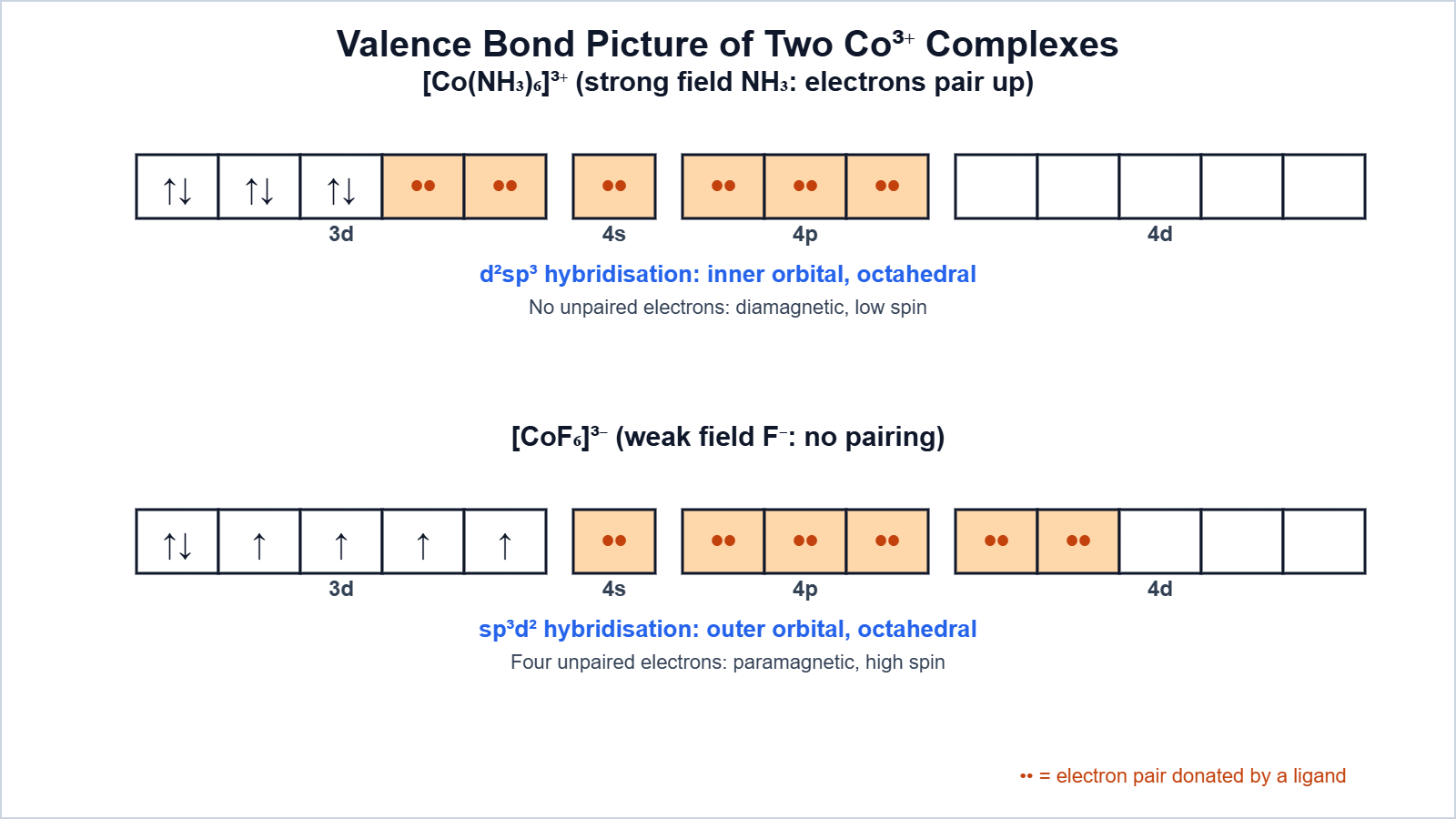
Limitations of VBT: it does not explain colour, does not distinguish quantitatively between weak and strong ligands, and gives no quantitative interpretation of magnetic data or of thermodynamic stability.
7. Crystal Field Theory (CFT)
CFT treats metal-ligand bonding as purely electrostatic, with ligands as point charges. In an isolated ion the five d orbitals are degenerate; the ligand field splits them. The energy gap is the crystal field splitting energy (Δo for octahedral, Δt for tetrahedral).
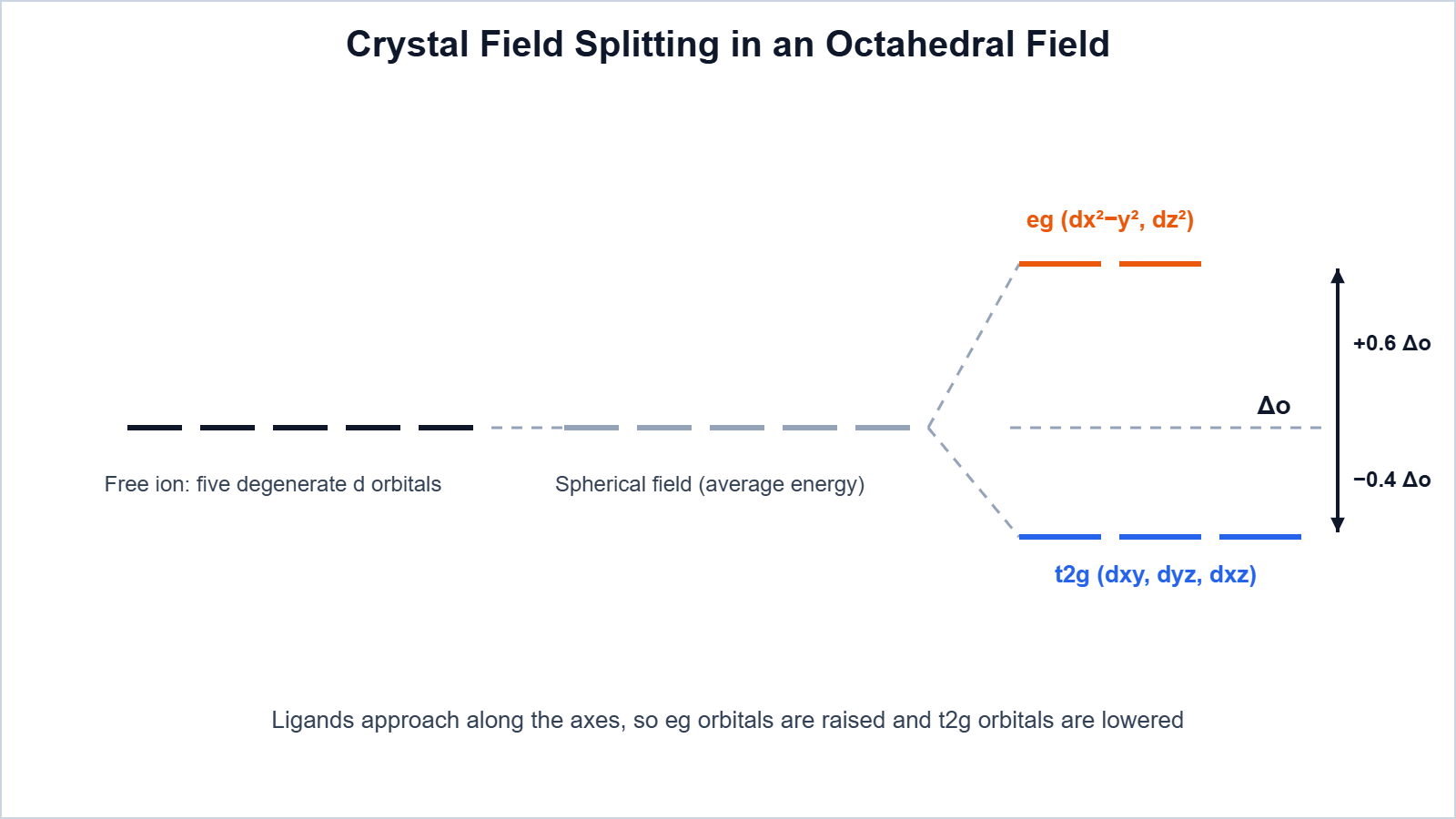
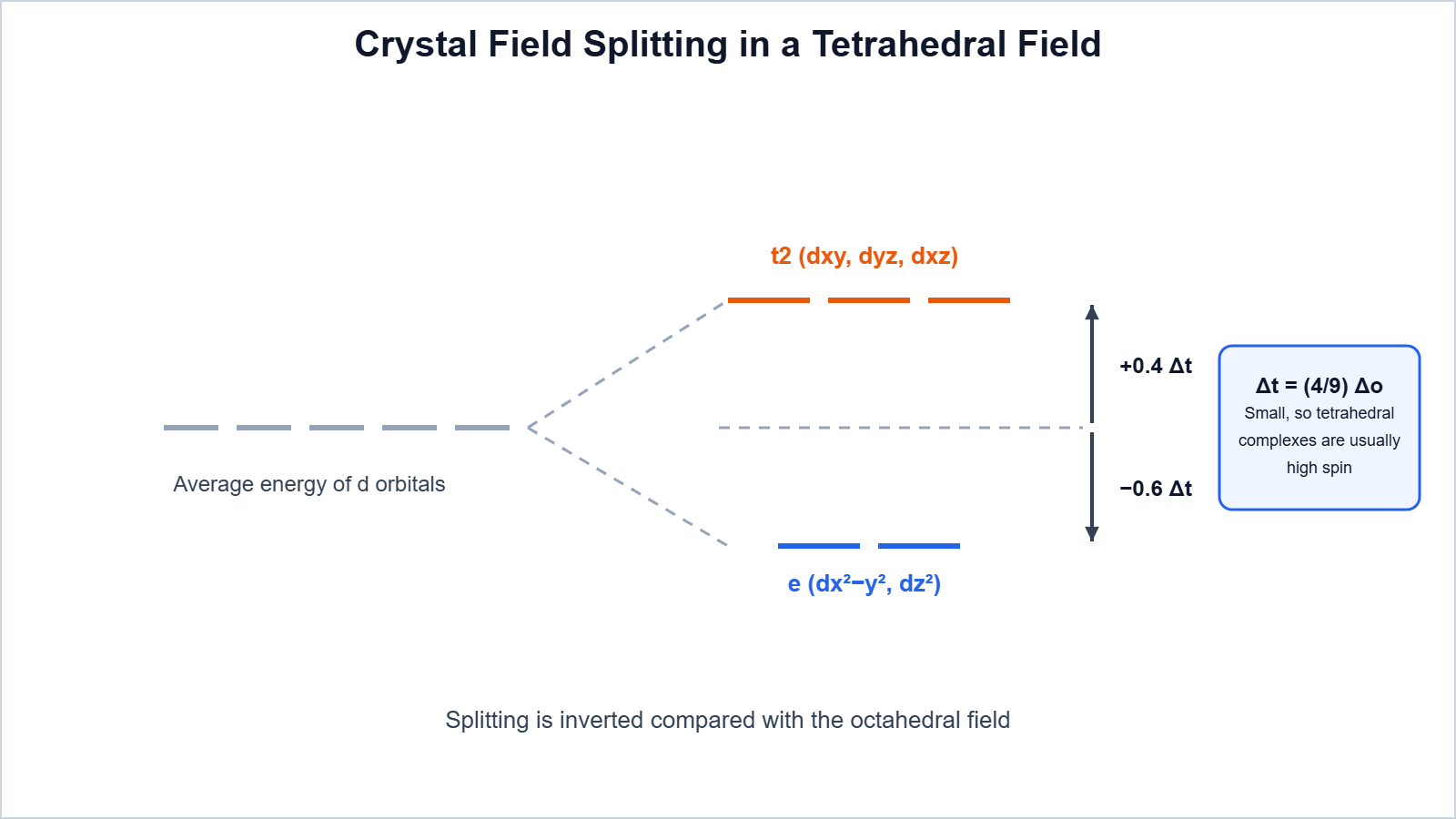
Spectrochemical series (increasing field strength): I– < Br– < SCN– < Cl– < S2- < F– < OH– < C2O42- < H2O < NCS– < edta4- < NH3 < en < CN– < CO.
High spin and low spin: For d4 to d7 ions, if Δo < P (pairing energy; weak field ligand) the fourth electron enters eg giving high spin; if Δo > P (strong field ligand) it pairs in t2g giving low spin.
CFSE (octahedral) = (-0.4 x number of t2g electrons + 0.6 x number of eg electrons) Δo, plus pairing energy terms (not included in the examples below).
Numerical 4: Calculate the CFSE of [Ti(H2O)6]3+ and [Cr(H2O)6]3+.
Given: Ti3+: 3d1 → t2g1; Cr3+: 3d3 → t2g3
Formula: CFSE = (-0.4 nt2g + 0.6 neg) Δo
Solution: Ti3+: -0.4 x 1; Cr3+: -0.4 x 3
Answer: -0.4 Δo and -1.2 Δo
Numerical 5: Compare the CFSE of Co3+ (d6) in [Co(NH3)6]3+ (strong field) and [CoF6]3- (weak field).
Given: Low spin: t2g6 eg0; high spin: t2g4 eg2
Formula: CFSE = (-0.4 nt2g + 0.6 neg) Δo
Solution: Low spin: -0.4 x 6 = -2.4 Δo; high spin: -0.4 x 4 + 0.6 x 2 = -0.4 Δo
Answer: -2.4 Δo (low spin, diamagnetic) and -0.4 Δo (high spin, 4 unpaired electrons)
Numerical 6: Find the number of unpaired electrons and spin-only magnetic moment of [CoF6]3- and [NiCl4]2-.
Given: [CoF6]3-: Co3+ d6 high spin, n = 4; [NiCl4]2-: Ni2+ d8, sp3, n = 2
Formula: μ = √[n(n+2)] BM
Solution: √(4 x 6) = √24; √(2 x 4) = √8
Answer: 4.90 BM and 2.83 BM
Example: [Ni(CN)4]2- is square planar (dsp2) and diamagnetic because the strong field CN– pairs the two unpaired d electrons, while [NiCl4]2- is tetrahedral and paramagnetic.
8. Colour and Magnetic Properties of Complexes
Colour: When visible light falls on a complex, an electron is promoted from t2g to eg (d-d transition) by absorbing light of energy Δo; the complementary colour is seen. E.g., [Ti(H2O)6]3+ absorbs green-yellow light and appears violet. Without ligands there is no splitting, so anhydrous CuSO4 is white while hydrated CuSO4.5H2O is blue. Changing the ligand changes Δo and so the colour.
Magnetic properties: Complexes with unpaired electrons are paramagnetic; magnetic moment measurements tell the number of unpaired electrons and help decide between high spin and low spin structures.
Limitations of CFT: it treats ligands as point charges and ignores covalent character of the bond; it cannot explain why anionic ligands such as F– and Cl– produce weaker splitting than neutral molecules such as NH3 and CO.
9. Shapes, Structure and Stereoisomerism
Structural isomerism:
Type | Description | Example |
|---|---|---|
Ionisation | Exchange of ions between coordination sphere and outside | [Co(NH3)5SO4]Br and [Co(NH3)5Br]SO4 |
Linkage | Ambidentate ligand bonds through different atoms | [Co(NH3)5(NO2)]Cl2 and [Co(NH3)5(ONO)]Cl2 |
Coordination | Exchange of ligands between cationic and anionic entities | [Co(NH3)6][Cr(CN)6] and [Cr(NH3)6][Co(CN)6] |
Solvate (hydrate) | Water inside or outside the coordination sphere | [Cr(H2O)6]Cl3 (violet) and [Cr(H2O)5Cl]Cl2.H2O (grey-green) |
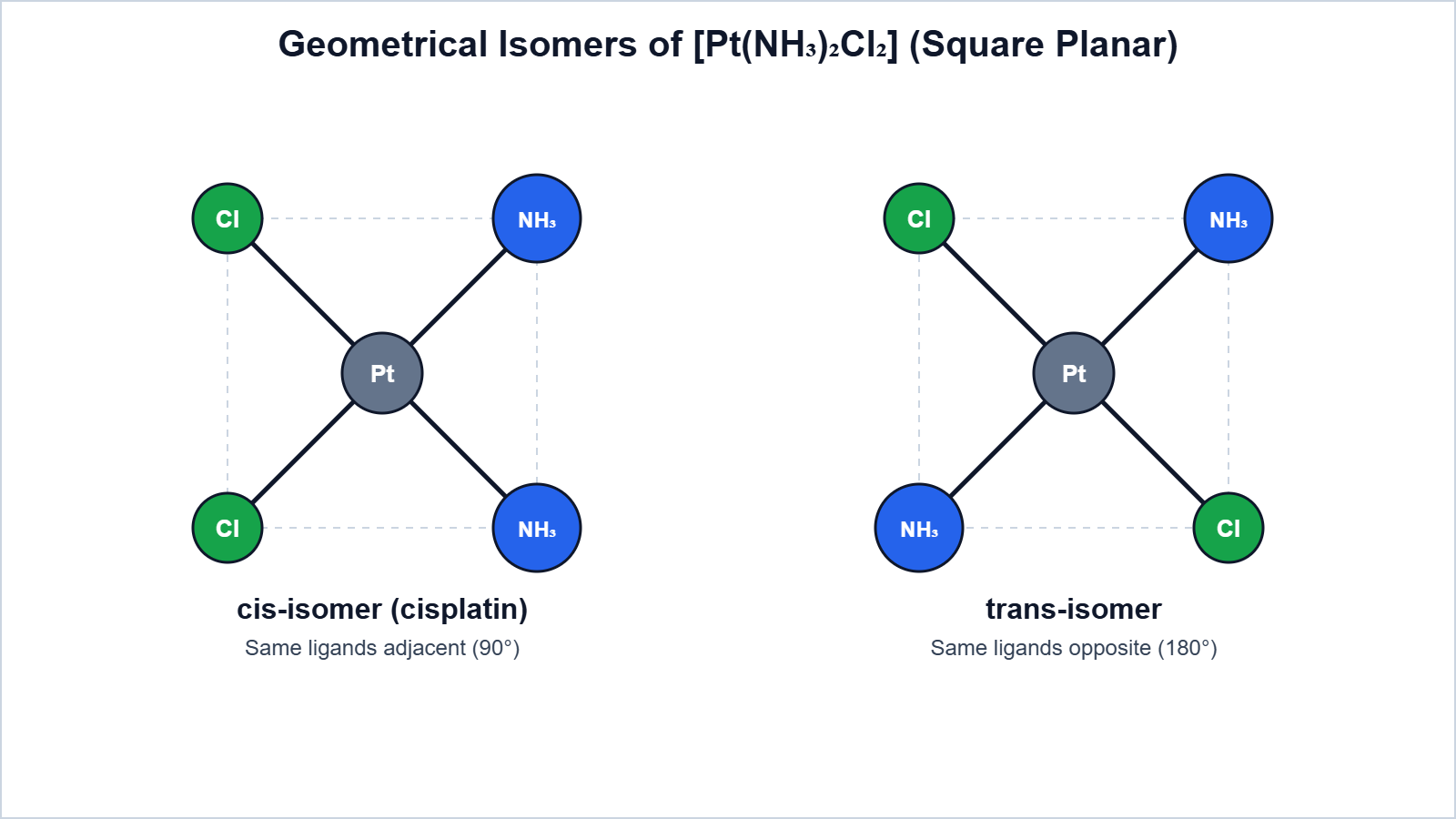
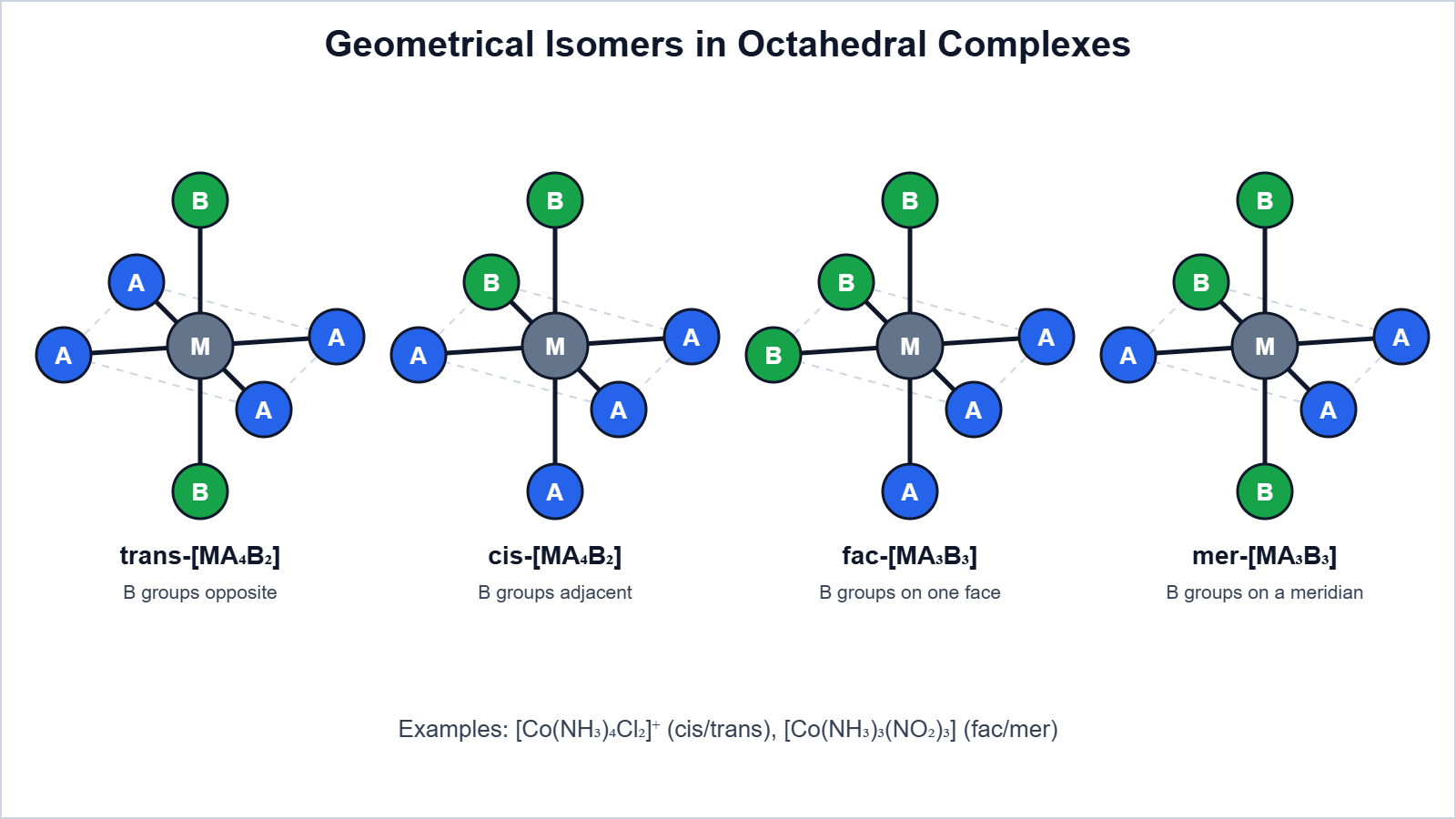
Stereoisomerism: (a) Geometrical isomerism arises in square planar (MA2B2) and octahedral (MA4B2, MA3B3) complexes. Tetrahedral complexes do not show geometrical isomerism.
(b) Optical isomerism: complexes whose mirror images are non-superimposable (chiral) exist as d and l forms (enantiomers) that rotate plane-polarised light in opposite directions. Common in octahedral complexes with bidentate ligands, e.g., [Co(en)3]3+ and cis-[PtCl2(en)2]2+ (the trans form is optically inactive).
Exam point: cis-[Pt(NH3)2Cl2] (cisplatin) is used as an anticancer drug; the trans isomer is not.
10. Importance of Coordination Compounds
- Qualitative analysis: Ni2+ gives a red precipitate with dimethylglyoxime; Cu2+ gives a deep blue [Cu(NH3)4]2+ with excess ammonia; Fe3+ gives Prussian blue with potassium hexacyanidoferrate(II).
- Extraction of metals: silver and gold are extracted by forming cyanide complexes, e.g., 4Au + 8CN– + 2H2O + O2 → 4[Au(CN)2]– + 4OH–, then reduced by zinc. Nickel is purified via [Ni(CO)4] (Mond process).
- Biological systems: chlorophyll (Mg complex) in photosynthesis, haemoglobin (Fe complex) carries oxygen, vitamin B12 (cyanocobalamin) contains Co.
- Other uses: estimation of water hardness with EDTA (Ca2+ and Mg2+ complexes); EDTA in treating lead poisoning; cisplatin in cancer treatment; Wilkinson’s catalyst [(Ph3P)3RhCl] in hydrogenation of alkenes; electroplating of silver and gold using [Ag(CN)2]– and [Au(CN)2]–.
Easy Memory Trick: “Strong field, Spin paired”: strong field ligands give low spin, inner orbital complexes.
11. Practice Problems (Answers Only)
- EAN of Cr in [Cr(CO)6] (Z = 24). Ans: 36
- Oxidation number of Co in [Co(NH3)5Cl]Cl2. Ans: +3
- CFSE of a d5 ion in a weak octahedral field. Ans: 0 Δo (t2g3 eg2)
- Hybridisation and magnetic nature of [Ni(CN)4]2-. Ans: dsp2, diamagnetic
- Number of moles of AgCl precipitated by 1 mol of [Co(NH3)5Cl]Cl2 with excess AgNO3. Ans: 2
12. Important Questions
Q1. Distinguish between a double salt and a coordination compound.
Ans. A double salt dissociates completely into simple ions in water; a coordination compound keeps its complex ion intact.
Q2. What are ambidentate ligands? Give an example.
Ans. Ligands that can bind through two different donor atoms, e.g., NO2– and SCN–.
Q3. Write the IUPAC name of K3[Fe(C2O4)3].
Ans. Potassium trioxalatoferrate(III).
Q4. State the postulates of Werner’s theory.
Ans. Metals have primary (ionisable) and secondary (non-ionisable) valencies; secondary valencies equal the coordination number and are directed in space.
Q5. [Fe(CN)6]4- is diamagnetic while [FeF6]3- is paramagnetic. Explain.
Ans. CN– is a strong field ligand that pairs all six d electrons of Fe2+ (d2sp3); F– is weak field, so Fe3+ keeps five unpaired electrons (sp3d2).
Q6. What is the spectrochemical series?
Ans. Arrangement of ligands in order of increasing crystal field splitting they produce.
Q7. Why are tetrahedral complexes generally high spin?
Ans. Δt is small (about 4/9 Δo), usually less than the pairing energy.
Q8. Draw the geometrical isomers of [Pt(NH3)2Cl2].
Ans. cis and trans square planar isomers (see diagram above).
Q9. Give two applications of coordination compounds in biology.
Ans. Haemoglobin (Fe) and chlorophyll (Mg); vitamin B12 (Co).
Q10. What is the chelate effect?
Ans. Complexes with chelating ligands are more stable than those with comparable unidentate ligands.
Conclusion: Coordination compounds are explained by Werner’s theory, VBT and CFT. Their geometry, colour, magnetism and isomerism follow from the metal, its oxidation state and the nature of ligands, and they are vital in analysis, metallurgy, medicine and living systems.