Solutions – Class 12 Chemistry Notes
Chapter – 1
Solutions
1. Types of Solutions
A solution is a homogeneous mixture of two or more substances. The component present in larger amount is the solvent; the other is the solute. A binary solution has two components.
Type | Solute | Solvent | Example |
|---|---|---|---|
Gaseous solutions | Gas / liquid / solid | Gas | Air (O2 in N2); chloroform vapour in N2; camphor in N2 |
Liquid solutions | Gas / liquid / solid | Liquid | O2 in water; ethanol in water; glucose in water |
Solid solutions | Gas / liquid / solid | Solid | H2 in palladium; amalgam of mercury with sodium; copper in gold |
2. Expressing Concentration of Solutions
Term | Formula | Unit |
|---|---|---|
Mass percentage (w/w) | (mass of component / total mass of solution) x 100 | % |
Volume percentage (V/V) | (volume of component / total volume) x 100 | % |
Mass by volume (w/V) | (mass of solute / volume of solution) x 100 | g per 100 mL |
Parts per million (ppm) | (parts of component / total parts) x 106 | ppm |
Mole fraction (x) | xA = nA / (nA + nB) | no unit |
Molarity (M) | moles of solute / volume of solution in L | mol L-1 |
Molality (m) | moles of solute / mass of solvent in kg | mol kg-1 |
Remember: Molality does not change with temperature (it depends on mass); molarity changes with temperature (volume changes).
Numerical 1: 4 g of NaOH is dissolved in water to make 250 mL of solution. Find its molarity.
Given: Mass of NaOH = 4 g; molar mass = 40 g mol-1; V = 250 mL = 0.25 L
Formula: M = n / V(L)
Solution: n = 4/40 = 0.1 mol; M = 0.1 / 0.25
Answer: 0.4 M
Numerical 2: Find the molality of a solution containing 18 g of glucose (C6H12O6) in 500 g of water.
Given: w = 18 g; M = 180 g mol-1; mass of water = 0.5 kg
Formula: m = n / mass of solvent (kg)
Solution: n = 18/180 = 0.1 mol; m = 0.1 / 0.5
Answer: 0.2 mol kg-1
Numerical 3: 46 g of ethanol is mixed with 36 g of water. Find the mole fraction of each.
Given: n(ethanol) = 46/46 = 1 mol; n(water) = 36/18 = 2 mol
Formula: x = n / total moles
Solution: x(ethanol) = 1/3; x(water) = 2/3
Answer: x(ethanol) = 0.333; x(water) = 0.667
3. Solubility of Gases in Liquids: Henry’s Law
Henry’s law: At constant temperature, the solubility of a gas in a liquid is directly proportional to the partial pressure of the gas: p = KH x, where x is the mole fraction of the gas and KH is Henry’s constant. A higher KH means lower solubility. Solubility of gases decreases with increase in temperature.
Example: Soft drink bottles are sealed under high CO2 pressure; scuba divers breathe air diluted with helium to avoid “bends”; climbers at high altitude suffer from anoxia due to low oxygen in blood.
4. Solid Solutions
In a solid solution the solvent is a solid. Examples: alloys such as brass (Cu + Zn) and bronze (Cu + Sn); hydrogen dissolved in palladium.
5. Raoult’s Law
Raoult’s law: For a solution of volatile liquids, the partial vapour pressure of each component is directly proportional to its mole fraction: p1 = p1° x1 and p2 = p2° x2; total pressure p = p1 + p2. For a solution of a non-volatile solute, the vapour pressure of the solution is proportional to the mole fraction of the solvent.
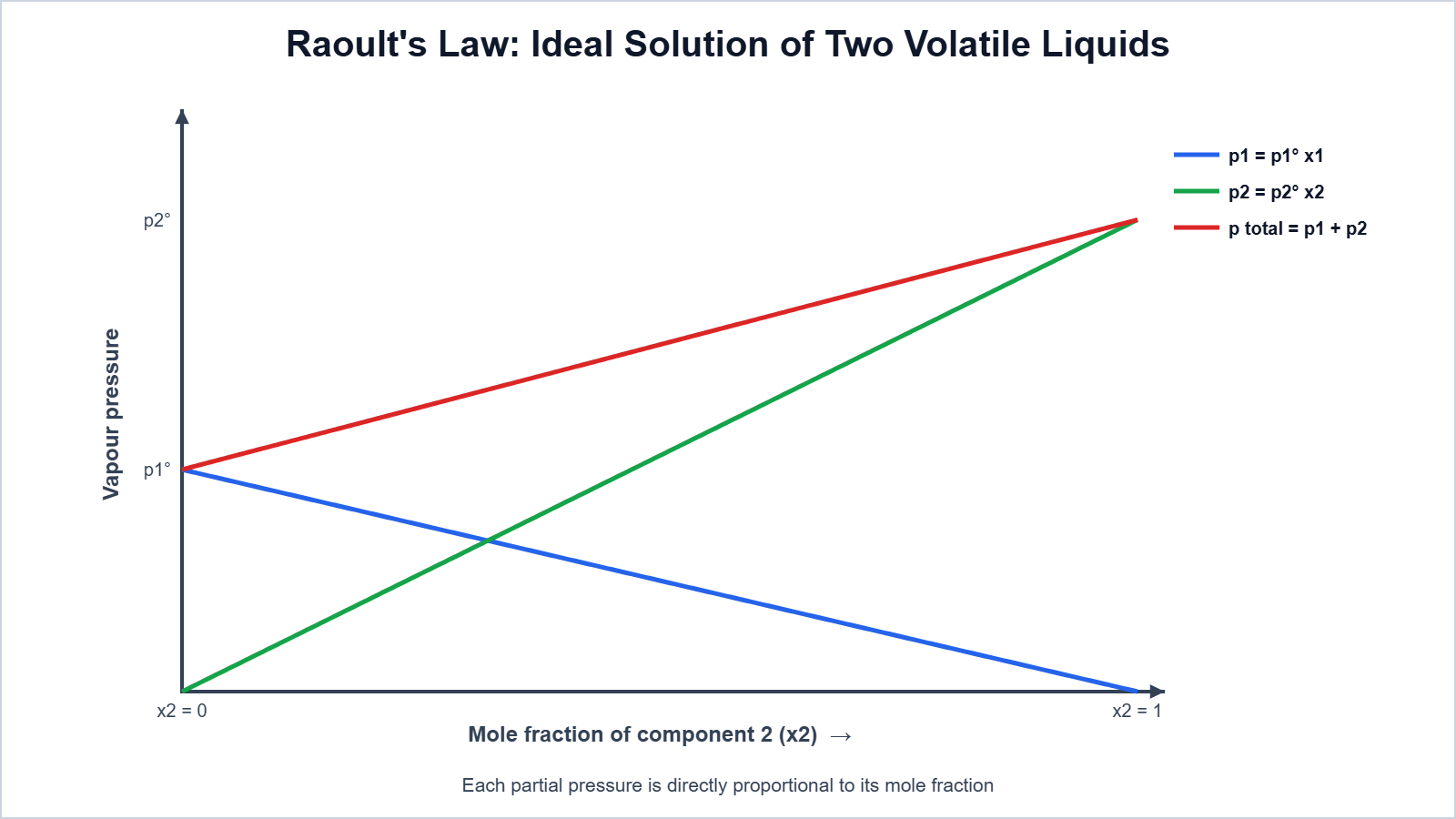
Numerical 4: Two liquids A and B form an ideal solution. p°A = 450 mm Hg, p°B = 700 mm Hg and xA = 0.4. Find the total vapour pressure and the mole fraction of A in the vapour.
Given: p°A = 450, p°B = 700 mm Hg; xA = 0.4, xB = 0.6
Formula: pA = p°AxA; yA = pA/ptotal
Solution: pA = 450 x 0.4 = 180; pB = 700 x 0.6 = 420; p = 600 mm Hg; yA = 180/600
Answer: p = 600 mm Hg; yA = 0.3
Ideal solution | Non-ideal: positive deviation | Non-ideal: negative deviation |
|---|---|---|
Obeys Raoult’s law at all concentrations | Vapour pressure higher than expected | Vapour pressure lower than expected |
ΔHmix = 0, ΔVmix = 0 | ΔHmix > 0, ΔVmix > 0 | ΔHmix < 0, ΔVmix < 0 |
A-B forces equal to A-A and B-B | A-B forces weaker | A-B forces stronger |
n-hexane + n-heptane; benzene + toluene | Ethanol + acetone; CS2 + acetone | Chloroform + acetone; HNO3 + water |
– | Forms minimum boiling azeotrope (e.g., ~95% ethanol + water) | Forms maximum boiling azeotrope (e.g., ~68% HNO3 + water) |

Exam point: Azeotropes are binary mixtures that boil at constant temperature with the same composition in liquid and vapour; they cannot be separated by fractional distillation.
6. Colligative Properties
Colligative properties depend only on the number of solute particles, not on their nature. They are: relative lowering of vapour pressure, elevation of boiling point, depression of freezing point and osmotic pressure.
(a) Relative lowering of vapour pressure: (p°1 – p1)/p°1 = x2; for dilute solutions, = (w2 x M1)/(M2 x w1).
Numerical 5: 10 g of a non-volatile solute dissolved in 90 g of water lowers the vapour pressure by 2% (relative lowering = 0.02). Find the molar mass of the solute.
Given: w2 = 10 g; w1 = 90 g; M1 = 18 g mol-1; relative lowering = 0.02
Formula: (p° – p)/p° = (w2M1)/(M2w1)
Solution: M2 = (10 x 18)/(90 x 0.02)
Answer: 100 g mol-1
(b) Elevation of boiling point: ΔTb = Kb m, where Kb is the ebullioscopic (molal elevation) constant (K kg mol-1).
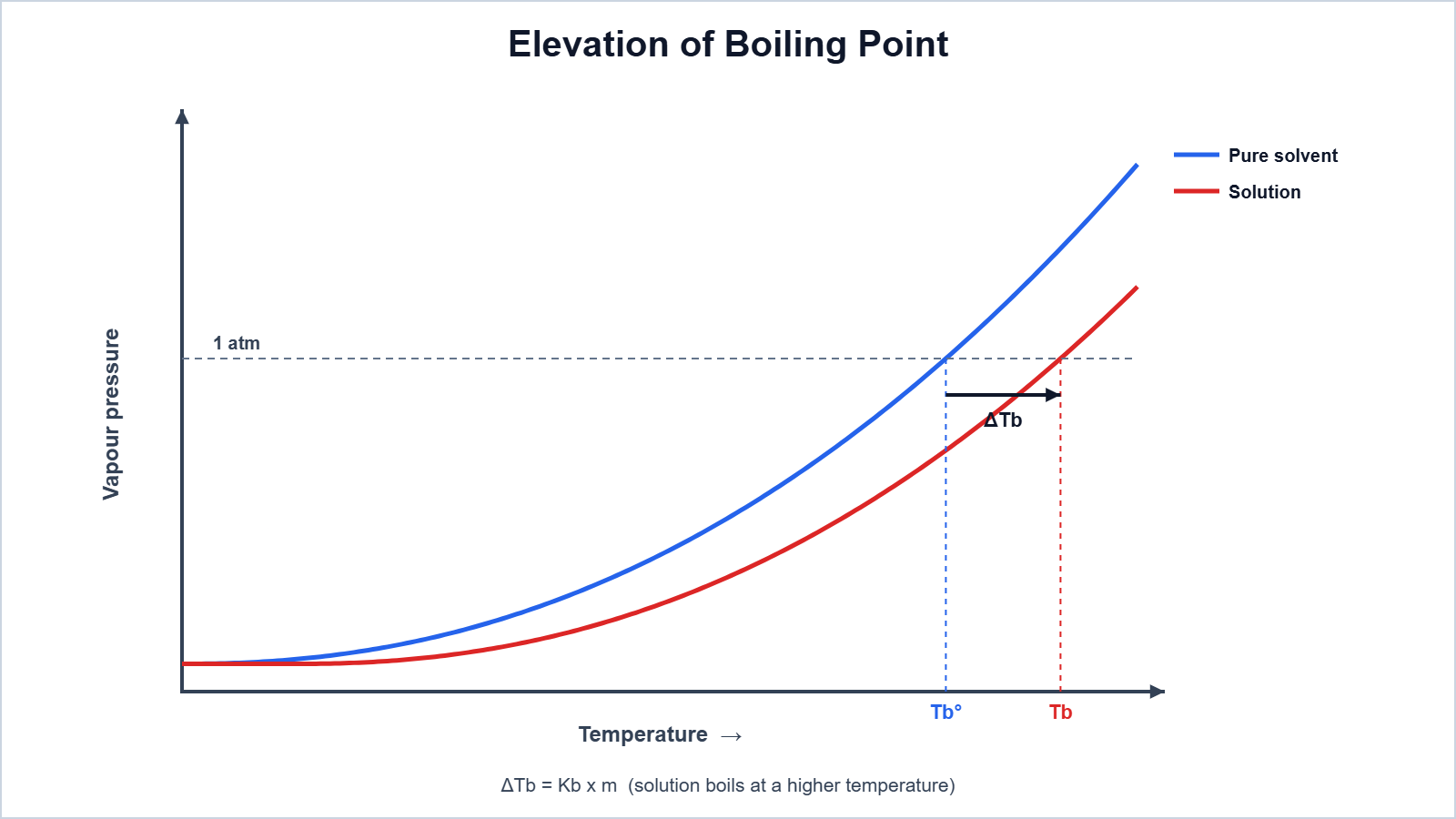
Numerical 6: Find the boiling point of a solution of 1.8 g glucose in 100 g water. (Kb = 0.52 K kg mol-1; boiling point of water = 373.15 K)
Given: w = 1.8 g; M = 180; mass of water = 0.1 kg
Formula: ΔTb = Kb m
Solution: m = (1.8/180)/0.1 = 0.1 mol kg-1; ΔTb = 0.52 x 0.1 = 0.052 K
Answer: Tb = 373.15 + 0.052 = 373.202 K
(c) Depression of freezing point: ΔTf = Kf m, where Kf is the cryoscopic constant. Molar mass: M2 = (Kf x w2 x 1000)/(ΔTf x w1).
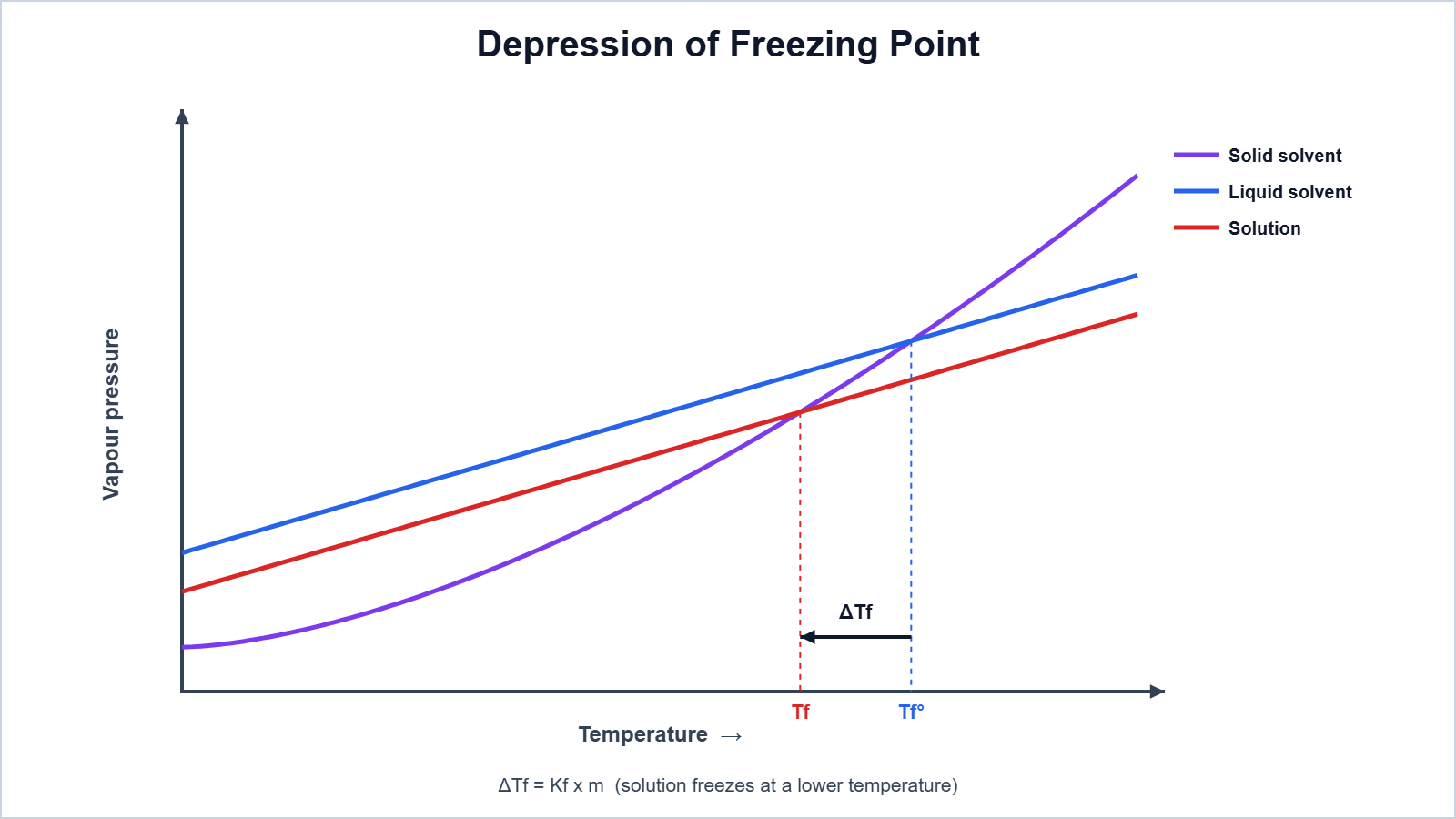
Numerical 7: 1.0 g of a non-electrolyte dissolved in 50 g of benzene lowers its freezing point by 0.40 K. Find the molar mass of the solute. (Kf of benzene = 5.12 K kg mol-1)
Given: w2 = 1.0 g; w1 = 50 g; ΔTf = 0.40 K; Kf = 5.12
Formula: M2 = (Kf x w2 x 1000)/(ΔTf x w1)
Solution: M2 = (5.12 x 1.0 x 1000)/(0.40 x 50)
Answer: 256 g mol-1
(d) Osmosis and osmotic pressure: Osmosis is the flow of solvent through a semipermeable membrane from pure solvent (or dilute solution) to a concentrated solution. Osmotic pressure (π) is the extra pressure that must be applied to stop osmosis: π = CRT = (n/V)RT. Osmotic pressure is the best method for finding molar masses of proteins and polymers, because it is measured at room temperature and gives large values even for dilute solutions.
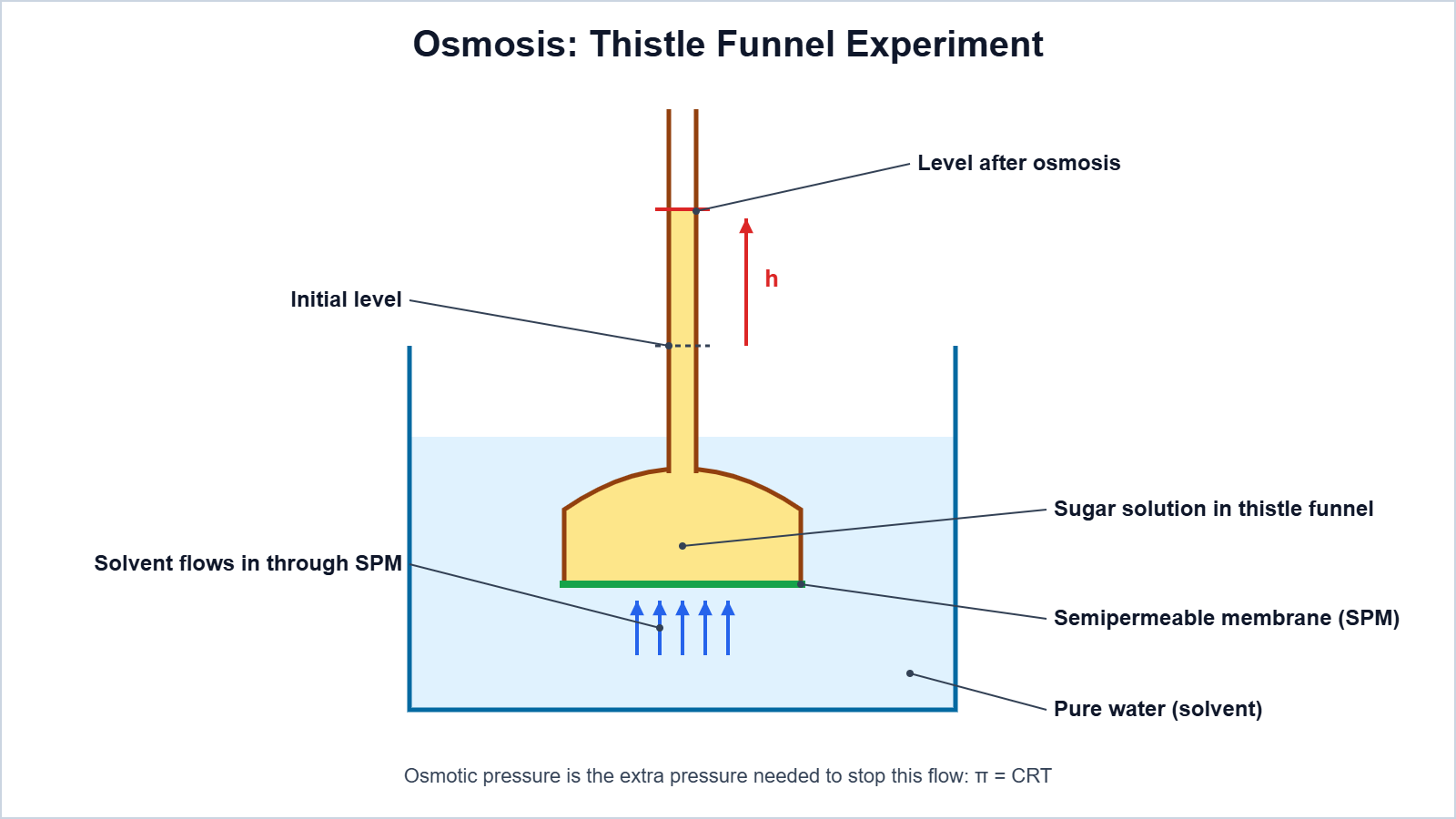
Numerical 8: Calculate the osmotic pressure of 0.1 M glucose solution at 300 K. Also find the molar mass of a protein if 2.0 g of it in 250 mL of solution shows an osmotic pressure of 3.0 x 10⁻³ bar at 300 K. (R = 0.0821 L atm K-1 mol-1 = 0.083 L bar K-1 mol-1)
Given: C = 0.1 M; T = 300 K; w = 2.0 g; V = 0.250 L; π = 3.0 x 10⁻³ bar
Formula: π = CRT; M = wRT/(πV)
Solution: (i) π = 0.1 x 0.0821 x 300 = 2.463 atm. (ii) M = (2.0 x 0.083 x 300)/(3.0 x 10-3 x 0.250)
Answer: (i) 2.463 atm; (ii) 66,400 g mol-1
Isotonic solutions have the same osmotic pressure (0.9% NaCl, normal saline, is isotonic with blood). In reverse osmosis, pressure greater than osmotic pressure pushes solvent from solution to pure solvent; it is used for desalination of sea water.
7. Abnormal Molar Mass and van’t Hoff Factor
When solutes dissociate or associate in solution, the number of particles changes and the observed molar mass differs from the calculated one. The van’t Hoff factor i = normal molar mass / observed molar mass = observed colligative property / calculated colligative property. Modified equations: ΔTf = iKfm; ΔTb = iKbm; π = iCRT.
Case | i | Example |
|---|---|---|
No change | 1 | Glucose, urea |
Dissociation | > 1 | NaCl (i ≈ 2), K2SO4 (i ≈ 3) |
Association | < 1 | Ethanoic acid dimerises in benzene (i ≈ 0.5) |
Numerical 9: Calculate the depression in freezing point of 0.1 m NaCl solution assuming complete dissociation. (Kf = 1.86 K kg mol-1)
Given: m = 0.1 mol kg-1; i = 2 (NaCl → Na+ + Cl–); Kf = 1.86
Formula: ΔTf = iKfm
Solution: ΔTf = 2 x 1.86 x 0.1
Answer: 0.372 K
Easy Memory Trick: Colligative properties “R-E-D-O”: Relative lowering, Elevation, Depression, Osmotic pressure.
8. Practice Problems (Answers Only)
- 5.85 g NaCl in 500 mL solution. Find molarity. Ans: 0.2 M
- 6 g urea in 200 g water. Find molality. Ans: 0.5 mol kg-1
- Find ΔTf of 0.2 m aqueous urea (Kf = 1.86). Ans: 0.372 K
- Osmotic pressure of 0.05 M glucose at 300 K (R = 0.0821). Ans: 1.23 atm
- van’t Hoff factor of K2SO4 on complete dissociation. Ans: 3
9. Important Questions
Q1. Why is molality preferred over molarity?
Ans. Because molality is based on mass, which does not change with temperature, while molarity depends on volume, which changes with temperature.
Q2. State Henry’s law. Give one application.
Ans. Solubility of a gas is directly proportional to its partial pressure (p = KHx); soft drink bottles are sealed under high CO2 pressure.
Q3. State Raoult’s law.
Ans. The partial vapour pressure of each volatile component is directly proportional to its mole fraction in solution.
Q4. What are ideal solutions? Give an example.
Ans. Solutions that obey Raoult’s law at all concentrations, with ΔHmix = 0 and ΔVmix = 0; e.g., benzene and toluene.
Q5. What is an azeotrope?
Ans. A liquid mixture that boils at constant temperature with the same composition in liquid and vapour.
Q6. Why are colligative properties so called?
Ans. Because they depend only on the number of solute particles, not on their nature.
Q7. Why is osmotic pressure preferred for finding molar mass of proteins?
Ans. It is measured at room temperature (proteins are not damaged) and gives measurable values even for very dilute solutions.
Q8. What is reverse osmosis? Give its use.
Ans. Flow of solvent from solution to solvent when pressure greater than osmotic pressure is applied; used for desalination of sea water.
Q9. What is the van’t Hoff factor for ethanoic acid in benzene, and why?
Ans. About 0.5, because ethanoic acid molecules associate to form dimers in benzene.
Q10. Why does a person feel thirsty after eating salty food?
Ans. Water moves out of body cells by osmosis to the salty surroundings, causing dehydration of cells.
Conclusion: Solutions are described by concentration terms, Henry’s and Raoult’s laws, and colligative properties. These properties, corrected by the van’t Hoff factor, help determine molar masses and explain many everyday phenomena.