Haloalkanes and Haloarenes – Class 12 Chemistry Notes
Chapter – 6
Haloalkanes and Haloarenes
1. Introduction and Classification
Replacement of hydrogen atom(s) of an aliphatic hydrocarbon by halogen gives haloalkanes (alkyl halides, R-X); replacement in an aromatic ring gives haloarenes (aryl halides, Ar-X).
- On the basis of number of halogen atoms: mono-, di-, tri- and polyhalogen compounds.
- Compounds with sp3 C-X bond: alkyl halides (1°, 2°, 3°), allylic halides (CH2=CH-CH2X) and benzylic halides (C6H5CH2X).
- Compounds with sp2 C-X bond: vinylic halides (CH2=CH-X) and aryl halides (C6H5X).
2. Nomenclature
Structure | Common name | IUPAC name |
|---|---|---|
CH3CH2CH2Br | n-Propyl bromide | 1-Bromopropane |
(CH3)2CHCl | Isopropyl chloride | 2-Chloropropane |
(CH3)3CBr | tert-Butyl bromide | 2-Bromo-2-methylpropane |
CH2=CHCl | Vinyl chloride | Chloroethene |
CH2=CHCH2Br | Allyl bromide | 3-Bromopropene |
C6H5CH2Cl | Benzyl chloride | (Chloromethyl)benzene |
CH2Cl2 | Methylene chloride | Dichloromethane |
CHCl3 | Chloroform | Trichloromethane |
C6H4Cl2 (para) | p-Dichlorobenzene | 1,4-Dichlorobenzene |
3. Nature of the C-X Bond
Halogens are more electronegative than carbon, so the C-X bond is polar: the carbon carries a partial positive charge and the halogen a partial negative charge. As the size of the halogen increases from F to I, the C-X bond length increases and the bond enthalpy decreases, so C-I bonds break most easily.
Bond | Bond length (pm) | Bond enthalpy (kJ mol-1) |
|---|---|---|
CH3-F | 139 | 452 |
CH3-Cl | 178 | 351 |
CH3-Br | 193 | 293 |
CH3-I | 214 | 234 |
4. Methods of Preparation of Haloalkanes
- From alcohols: R-OH + HCl (with anhydrous ZnCl2, Groove’s process) → R-Cl + H2O; 3R-OH + PCl3 → 3R-Cl + H3PO3; R-OH + PCl5 → R-Cl + POCl3 + HCl; R-OH + SOCl2 → R-Cl + SO2 + HCl (best method, as by-products are gases).
- From hydrocarbons: free radical halogenation of alkanes (CH4 + Cl2, UV light) gives a mixture; addition of HX to alkenes follows Markovnikov’s rule (CH3CH=CH2 + HBr → CH3CHBrCH3); in presence of peroxide, HBr adds against the rule (peroxide or Kharasch effect) giving 1-bromopropane.
- Finkelstein reaction: R-Cl or R-Br + NaI (dry acetone) → R-I + NaCl or NaBr. The reaction is pushed forward because NaCl and NaBr are insoluble in dry acetone.
- Swarts reaction: heating an alkyl chloride or bromide with a metallic fluoride such as AgF, Hg2F2, CoF2 or SbF3: CH3Br + AgF → CH3F + AgBr.
Preparation of haloarenes: (i) electrophilic substitution: benzene + Cl2 (anhydrous FeCl3, dark) → chlorobenzene + HCl; (ii) from benzene diazonium chloride by Sandmeyer reaction (CuCl/HCl or CuBr/HBr) or Gattermann reaction (Cu powder with HX) (see Unit-9).
5. Physical Properties
- Lower members (CH3Cl, CH3Br, C2H5Cl) are gases at room temperature; higher members are liquids or solids. Many have a sweet smell.
- Boiling point increases with molecular mass (RCl < RBr < RI) because van der Waals forces increase. For isomers, boiling point decreases with branching (e.g., 1-bromobutane > 2-bromobutane > 2-bromo-2-methylpropane).
- Density increases with number of carbon atoms, halogen atoms and atomic mass of halogen; bromo, iodo and polychloro compounds are denser than water.
- Solubility: slightly soluble in water (they cannot form strong hydrogen bonds with water) but soluble in organic solvents.
- Among dihalobenzenes, the para isomer has a higher melting point than ortho and meta because of its symmetry and better packing in the crystal.
6. Chemical Properties of Haloalkanes
(A) Nucleophilic substitution: Nu– + R-X → R-Nu + X–.
Reagent | Main product | Class |
|---|---|---|
NaOH (aqueous) / KOH (aq) | R-OH | Alcohol |
H2O | R-OH | Alcohol |
NaOR’ | R-O-R’ | Ether (Williamson synthesis) |
NaI | R-I | Alkyl iodide |
NH3 | R-NH2 | Primary amine |
KCN | R-CN | Nitrile (alkyl cyanide) |
AgCN | R-NC | Isocyanide |
KNO2 | R-O-N=O | Alkyl nitrite |
AgNO2 | R-NO2 | Nitroalkane |
R’COOAg | R’COOR | Ester |
LiAlH4 | R-H | Alkane |
Remember: KCN is predominantly ionic and gives nitriles (attack through C), while AgCN is mainly covalent and gives isocyanides (attack through N). Similarly KNO2 gives nitrites and AgNO2 gives nitroalkanes.
SN2 (substitution nucleophilic bimolecular):

SN1 (substitution nucleophilic unimolecular):
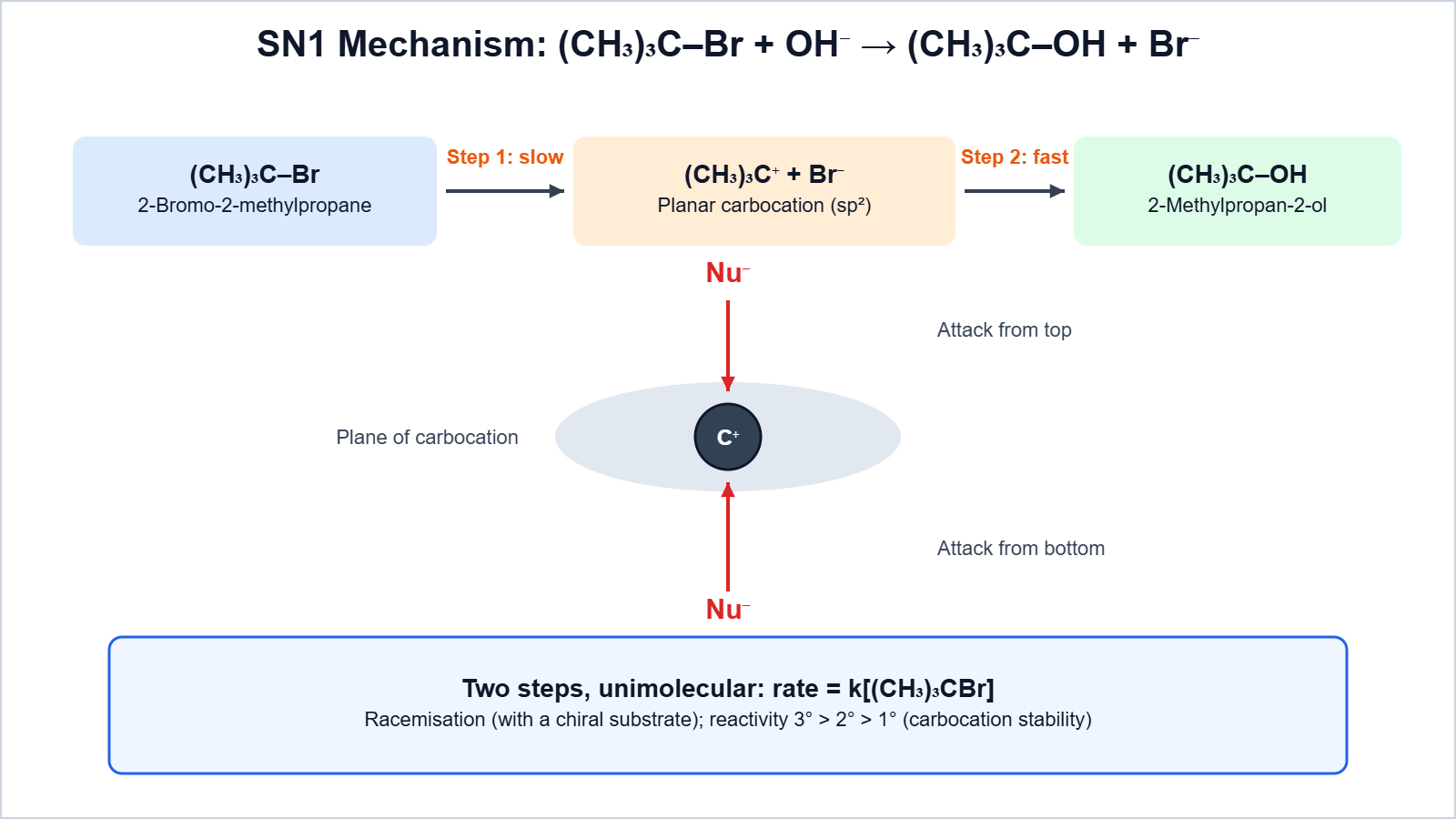

Feature | SN2 | SN1 |
|---|---|---|
Steps | One (concerted) | Two (carbocation intermediate) |
Rate law | rate = k[RX][Nu–] | rate = k[RX] |
Reactivity order | CH3X > 1° > 2° > 3° | 3° > 2° > 1° > CH3X |
Stereochemistry | Complete inversion | Racemisation (mostly) |
Favoured by | Strong nucleophile, aprotic solvent | Polar protic solvent, stable carbocation |
Exam point: Allylic and benzylic halides are very reactive towards SN1 because their carbocations are stabilised by resonance. For a given alkyl group, reactivity is R-I > R-Br > R-Cl > R-F in both mechanisms.
(B) Elimination (dehydrohalogenation): heating a haloalkane with alcoholic KOH removes HX and gives an alkene. Saytzeff (Zaitsev) rule: the more substituted alkene (with fewer hydrogens on the double-bonded carbons) is the major product. E.g., 2-bromobutane + alc. KOH → but-2-ene (major, about 80%) + but-1-ene (minor).
(C) Reaction with metals:
- Grignard reagent: R-X + Mg (dry ether) → R-Mg-X. It is very reactive and must be kept away from water: RMgX + H2O → R-H + Mg(OH)X.
- Wurtz reaction: 2R-X + 2Na (dry ether) → R-R + 2NaX; e.g., 2CH3Br + 2Na → CH3-CH3 + 2NaBr. Useful for preparing alkanes with an even number of carbon atoms.
7. Optical Rotation and Stereochemistry
Optical activity: the ability of a compound to rotate the plane of plane-polarised light, measured with a polarimeter. Dextrorotatory (d or +) compounds rotate it to the right; laevorotatory (l or -) to the left.
Chirality: a carbon atom bonded to four different groups is a chiral (asymmetric) centre. A chiral molecule is not superimposable on its mirror image; the two mirror image forms are enantiomers. An equimolar mixture of enantiomers is a racemic mixture and is optically inactive (external compensation); the process of converting an enantiomer into a racemic mixture is racemisation.

Examples of chiral molecules: butan-2-ol, 2-chlorobutane, lactic acid. Achiral examples: 2-chloropropane and propan-2-ol (two identical CH3 groups).
Retention and inversion: If the spatial arrangement of groups around the chiral centre stays the same after a reaction, it is retention; if it is reversed, it is inversion. SN2 gives inversion; SN1 gives a racemic product (often with slightly more inversion).
8. Haloarenes: Nature of the C-X Bond
Haloarenes are much less reactive than haloalkanes towards nucleophilic substitution because:
- Resonance: a lone pair on the halogen is delocalised into the ring, giving the C-Cl bond partial double bond character; it becomes shorter and stronger.
- sp2 hybridised carbon: more s-character makes the C-X bond shorter and stronger than in haloalkanes (sp3).
- Instability of phenyl cation: SN1 is not possible because the phenyl cation is not resonance stabilised.
- Repulsion: the electron-rich ring repels the incoming nucleophile.
Nucleophilic substitution under drastic conditions: chlorobenzene + NaOH at 623 K and 300 atm, followed by acidification, gives phenol (Dow’s process). Electron-withdrawing groups (-NO2) at ortho and para positions increase reactivity: 4-nitrochlorobenzene reacts with aqueous NaOH at 443 K; 2,4-dinitrochlorobenzene at 368 K; and 2,4,6-trinitrochlorobenzene even with warm water.
9. Substitution Reactions and Directive Influence of Halogen
In haloarenes, the halogen is ortho and para directing because its +R (resonance) effect increases electron density at the ortho and para positions. However, its strong -I effect withdraws electrons from the ring, so halogens are deactivating: haloarenes undergo electrophilic substitution more slowly than benzene.

Wurtz-Fittig reaction: Ar-X + 2Na + R-X (dry ether) → Ar-R + 2NaX; e.g., chlorobenzene + methyl chloride gives toluene. Fittig reaction: 2Ar-X + 2Na (dry ether) → Ar-Ar + 2NaX; e.g., chlorobenzene gives biphenyl.
Easy Memory Trick: “Wurtz = alkyl + alkyl, Fittig = aryl + aryl, Wurtz-Fittig = both”.
10. Uses and Environmental Effects of Polyhalogen Compounds
Compound | Uses | Environmental / health effects |
|---|---|---|
Dichloromethane (CH2Cl2) | Solvent, paint remover, propellant in aerosols, metal cleaning | Harms the central nervous system; skin and eye irritation |
Trichloromethane, chloroform (CHCl3) | Solvent for fats, alkaloids, iodine; earlier used as an anaesthetic | Depresses the central nervous system; oxidised by air and light to poisonous phosgene (COCl2), so stored in closed dark bottles filled to the brim |
Tetrachloromethane (CCl4) | Manufacture of refrigerants and propellants; solvent | Can cause liver damage; when released, contributes to ozone layer depletion |
Triiodomethane, iodoform (CHI3) | Antiseptic (due to iodine liberated on contact with skin) | Unpleasant smell; largely replaced by other iodine formulations |
Freons (chlorofluorocarbons, e.g., CCl2F2) | Refrigeration, air conditioning, aerosol propellants | Very stable; reach the stratosphere and break down ozone |
DDT (p,p’-dichlorodiphenyltrichloroethane) | Insecticide against malaria-carrying mosquitoes | Not easily broken down; accumulates in fatty tissues and food chains; banned or restricted in many countries |
11. Important Conversions
- Ethanol to ethyl chloride: C2H5OH + SOCl2 → C2H5Cl + SO2 + HCl
- Propene to 1-bromopropane: CH3CH=CH2 + HBr (peroxide) → CH3CH2CH2Br
- Ethyl bromide to ethyl iodide: C2H5Br + NaI (acetone) → C2H5I + NaBr (Finkelstein)
- Chlorobenzene to toluene: C6H5Cl + CH3Cl + 2Na (ether) → C6H5CH3 + 2NaCl (Wurtz-Fittig)
- Bromoethane to propanenitrile: C2H5Br + KCN → C2H5CN + KBr
- 2-Bromopropane to propene: (CH3)2CHBr + alc. KOH → CH3CH=CH2 + KBr + H2O
12. Important Questions
Q1. Why is the C-X bond in haloalkanes polar?
Ans. Halogen is more electronegative than carbon, so it pulls the shared electron pair towards itself.
Q2. Why are haloalkanes insoluble in water though polar?
Ans. The energy released in forming new attractions with water is less than that needed to break the hydrogen bonds in water.
Q3. Write the Finkelstein and Swarts reactions.
Ans. R-X + NaI (acetone) → R-I + NaX; CH3Br + AgF → CH3F + AgBr.
Q4. Give differences between SN1 and SN2 mechanisms.
Ans. SN1: two steps, first order, carbocation, racemisation, 3° most reactive. SN2: one step, second order, inversion, 1° most reactive.
Q5. Why does KCN give alkyl cyanide but AgCN gives isocyanide?
Ans. KCN is ionic and attacks through carbon; AgCN is covalent so only the nitrogen lone pair is available.
Q6. What is a racemic mixture? Why is it optically inactive?
Ans. An equimolar mixture of two enantiomers; the rotation by one enantiomer is cancelled by the other.
Q7. Why are haloarenes less reactive towards nucleophilic substitution?
Ans. Resonance gives partial double bond character, sp2 carbon, unstable phenyl cation, and repulsion between nucleophile and the electron-rich ring.
Q8. Halogens are deactivating but ortho-para directing. Explain.
Ans. The -I effect reduces overall electron density (deactivating), while the +R effect increases it at ortho and para positions.
Q9. What is the Wurtz reaction? Give one example.
Ans. 2R-X + 2Na (dry ether) → R-R + 2NaX; 2CH3Br gives ethane.
Q10. Why is chloroform stored in dark coloured bottles filled to the brim?
Ans. To prevent its oxidation by air in the presence of light to poisonous phosgene.
Conclusion: Haloalkanes undergo nucleophilic substitution (SN1 and SN2), elimination and reactions with metals, while haloarenes are less reactive and undergo ortho-para electrophilic substitution. Polyhalogen compounds are useful but many have serious environmental effects.