Chemical Kinetics – Class 12 Chemistry Notes
Chapter – 3
Chemical Kinetics
1. Rate of a Reaction: Average and Instantaneous
Chemical kinetics deals with the rates of reactions, the factors affecting them and the mechanisms. The rate of a reaction is the change in concentration of a reactant or product per unit time (unit: mol L-1 s-1).
For R → P: average rate = -Δ[R]/Δt = +Δ[P]/Δt; instantaneous rate = -d[R]/dt = d[P]/dt (slope of the tangent at a point).

For a general reaction aA + bB → cC + dD, rate = -(1/a) d[A]/dt = -(1/b) d[B]/dt = (1/c) d[C]/dt = (1/d) d[D]/dt.
Numerical 1: The concentration of a reactant falls from 0.08 M to 0.05 M in 10 minutes. Find the average rate.
Given: [R]1 = 0.08 M; [R]2 = 0.05 M; Δt = 10 min
Formula: Average rate = -Δ[R]/Δt
Solution: Rate = -(0.05 – 0.08)/10 = 0.03/10
Answer: 3 x 10⁻³ mol L-1 min-1
Numerical 2: For 2N2O5 → 4NO2 + O2, the rate of formation of O2 is 2.0 x 10⁻⁴ mol L-1 s-1. Find the rates of disappearance of N2O5 and formation of NO2.
Given: d[O2]/dt = 2.0 x 10⁻⁴ mol L-1 s-1
Formula: -(1/2) d[N2O5]/dt = (1/4) d[NO2]/dt = d[O2]/dt
Solution: -d[N2O5]/dt = 2 x 2.0 x 10-4; d[NO2]/dt = 4 x 2.0 x 10-4
Answer: 4.0 x 10⁻⁴ and 8.0 x 10⁻⁴ mol L-1 s-1
2. Factors Affecting Rate of Reaction
- Concentration of reactants: rate generally increases with concentration.
- Temperature: for most reactions, the rate nearly doubles for every 10 K rise in temperature.
- Catalyst: increases the rate by providing an alternative pathway with lower activation energy; it is not consumed.
- Nature of reactants and surface area (for heterogeneous reactions).
3. Rate Law, Rate Constant, Order and Molecularity
Rate law: rate = k[A]x[B]y, where k is the rate constant (specific reaction rate) and x + y is the order of the reaction. Order is found experimentally and can be zero, whole number or fraction.
Basis | Order | Molecularity |
|---|---|---|
Meaning | Sum of powers of concentrations in the rate law | Number of reacting species colliding in an elementary step |
Determined | Experimentally | Theoretically from the mechanism |
Values | Zero, integer or fraction | Only whole numbers (1, 2, 3; never zero) |
Applies to | Elementary and complex reactions | Only elementary reactions |
Order | Unit of k |
|---|---|
Zero | mol L-1 s-1 |
First | s-1 |
Second | L mol-1 s-1 |
Pseudo first-order reactions: reactions that appear first order because one reactant is in large excess, e.g., hydrolysis of ethyl acetate in acidic medium and inversion of cane sugar.
Numerical 3: For A + B → products, the following data were obtained: (i) [A] = 0.1, [B] = 0.1, rate = 2.0 x 10⁻³; (ii) [A] = 0.2, [B] = 0.1, rate = 8.0 x 10⁻³; (iii) [A] = 0.1, [B] = 0.2, rate = 4.0 x 10⁻³ (rates in mol L-1 s-1). Find the order and rate constant.
Given: Data from three experiments
Formula: rate = k[A]x[B]y
Solution: (ii)/(i): 2x = 4, so x = 2; (iii)/(i): 2y = 2, so y = 1. k = 2.0 x 10⁻³/((0.1)2 x 0.1)
Answer: Rate = k[A]2[B]; overall order 3; k = 2 L2 mol-2 s-1
4. Integrated Rate Equations and Half-life
Order | Integrated rate equation | Half-life |
|---|---|---|
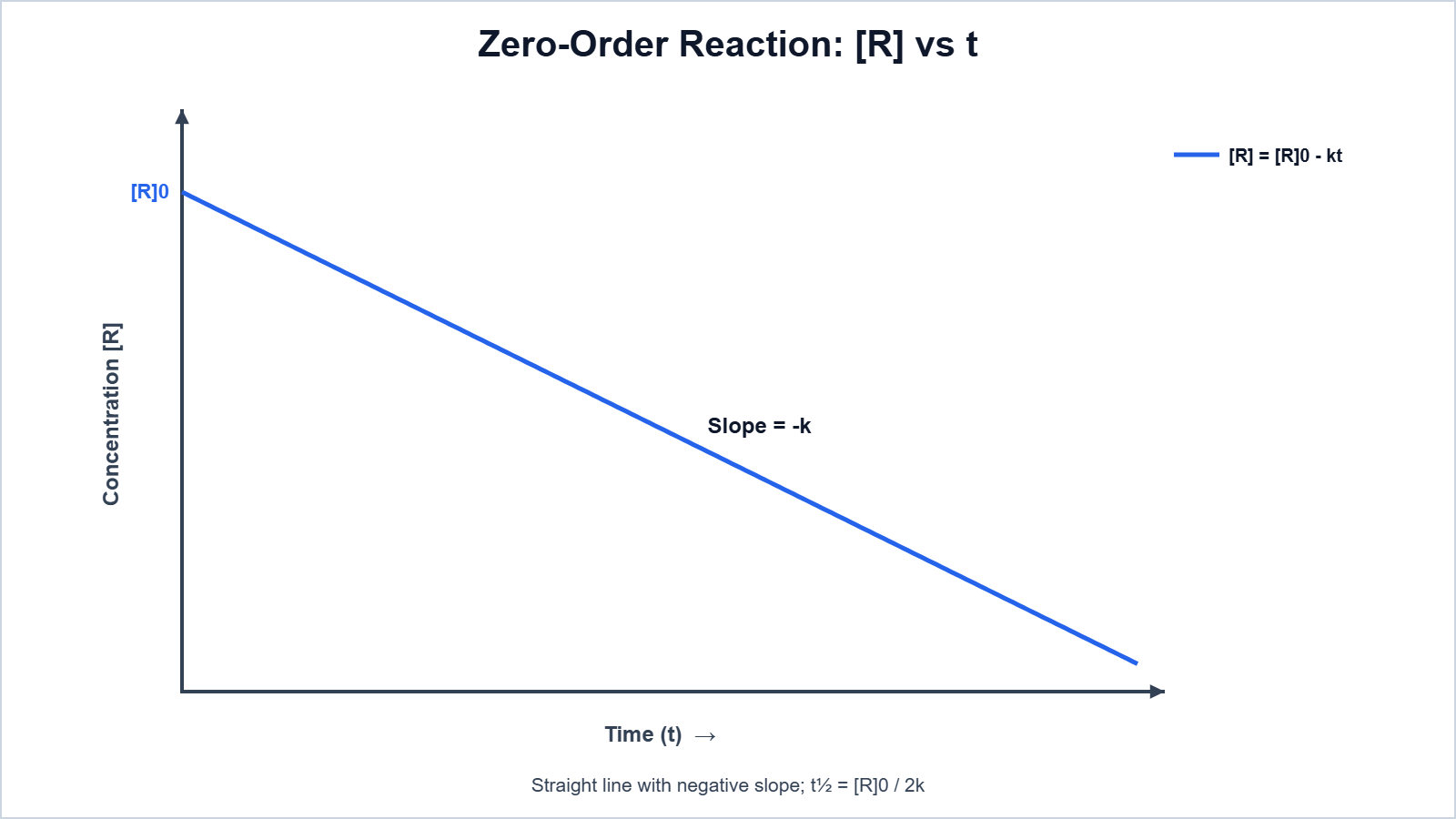
Zero | [R] = [R]0 – kt | t½ = [R]0 / 2k (depends on initial concentration) |
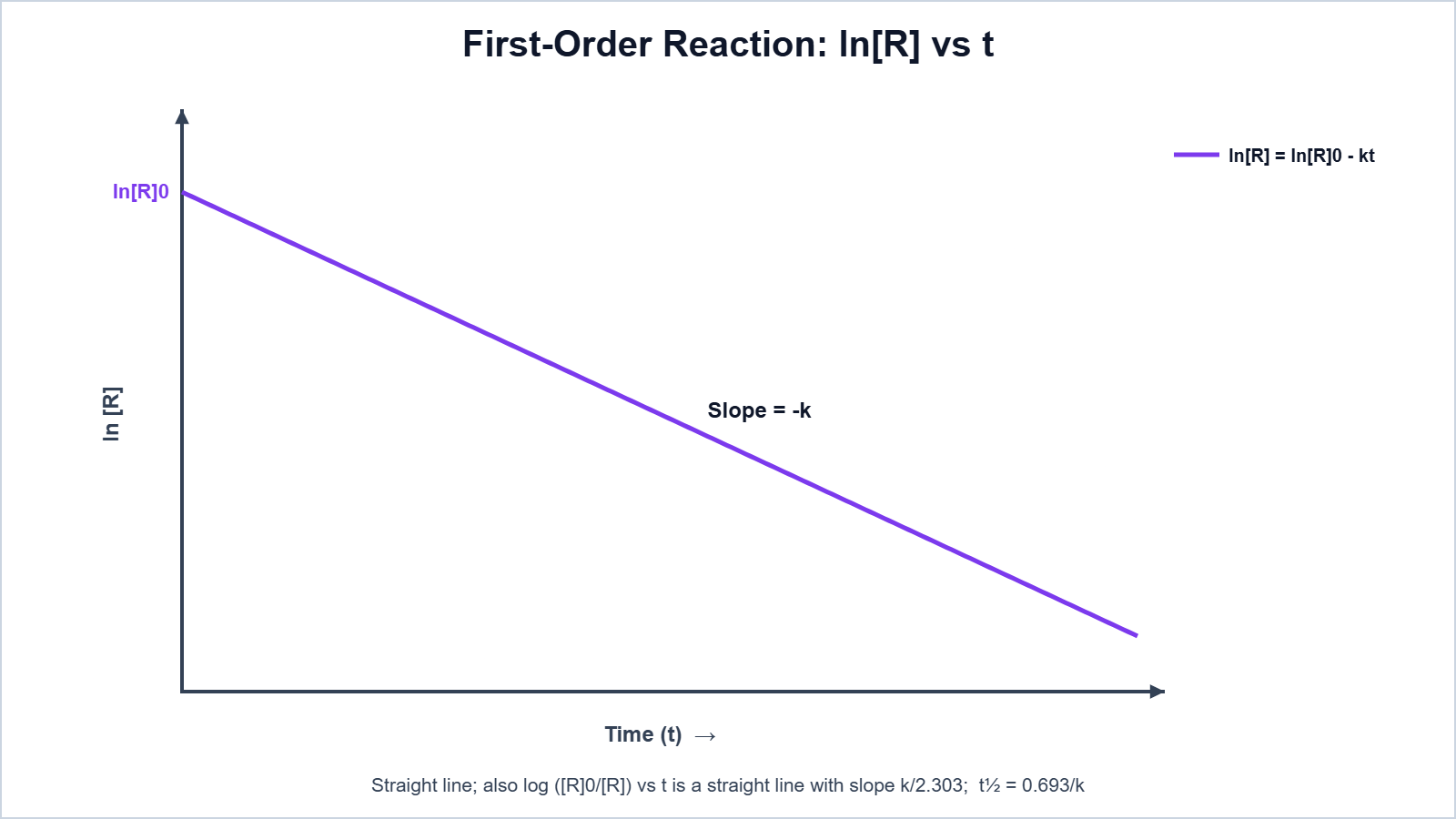
First | k = (2.303/t) log ([R]0/[R]) | t½ = 0.693/k (independent of initial concentration) |
Numerical 4: A zero-order reaction has k = 0.02 mol L-1 s-1 and [R]0 = 0.5 M. Find the time for [R] to fall to 0.1 M and the half-life.
Given: k = 0.02 mol L-1 s-1; [R]0 = 0.5 M; [R] = 0.1 M
Formula: t = ([R]0 – [R])/k; t½ = [R]0/2k
Solution: t = (0.5 – 0.1)/0.02; t½ = 0.5/(2 x 0.02)
Answer: t = 20 s; t½ = 12.5 s
Numerical 5: In a first-order reaction, the concentration falls from 0.8 M to 0.2 M in 30 minutes. Find k and t½.
Given: [R]0 = 0.8 M; [R] = 0.2 M; t = 30 min
Formula: k = (2.303/t) log ([R]0/[R]); t½ = 0.693/k
Solution: k = (2.303/30) log 4 = (2.303/30) x 0.602 = 0.0462 min-1; t½ = 0.693/0.0462
Answer: k = 0.0462 min-1; t½ = 15 min (two half-lives in 30 min, as 0.8 → 0.4 → 0.2)
Numerical 6: A first-order reaction has k = 5.0 x 10⁻³ s-1. Find its half-life and the time for 90% completion.
Given: k = 5.0 x 10⁻³ s-1; for 90% completion [R]0/[R] = 100/10 = 10
Formula: t½ = 0.693/k; t = (2.303/k) log ([R]0/[R])
Solution: t½ = 0.693/0.005; t = (2.303/0.005) x log 10
Answer: t½ = 138.6 s; t(90%) = 460.6 s
5. Collision Theory, Activation Energy and Arrhenius Equation
Collision theory: reactions occur when reactant molecules collide with energy equal to or greater than a threshold energy and with proper orientation (effective collisions). The extra energy needed above the average energy of reactants is the activation energy (Ea).

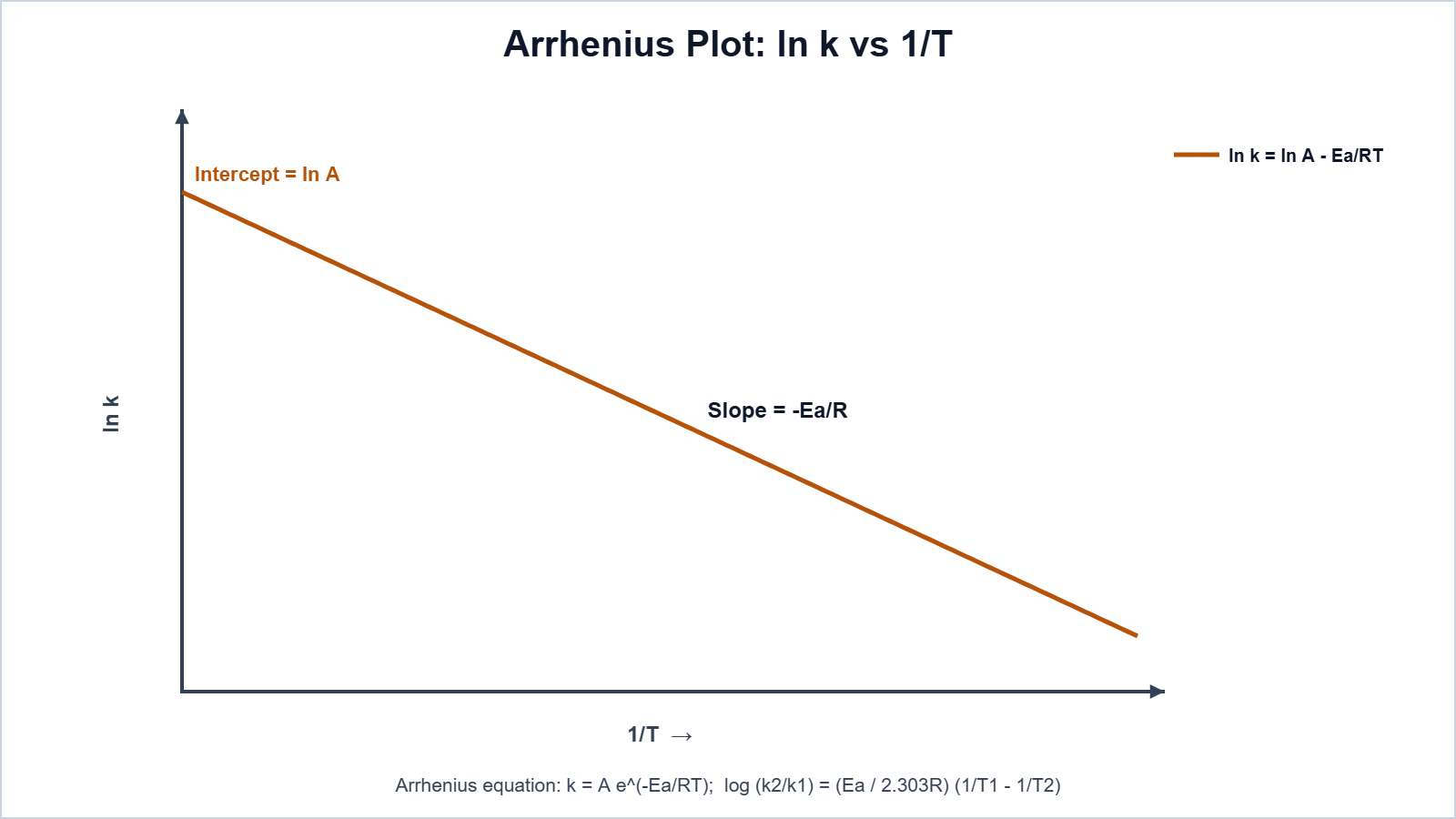
Arrhenius equation: k = A e-Ea/RT, where A is the frequency (pre-exponential) factor. Taking logs: ln k = ln A – Ea/RT. For two temperatures: log (k2/k1) = (Ea/2.303R) [(T2 – T1)/(T1T2)].
Numerical 7: The rate constant of a reaction doubles when temperature increases from 300 K to 310 K. Calculate Ea. (R = 8.314 J K-1 mol-1)
Given: k2/k1 = 2; T1 = 300 K; T2 = 310 K
Formula: log (k2/k1) = (Ea/2.303R) x (T2 – T1)/(T1T2)
Solution: 0.3010 = (Ea/(2.303 x 8.314)) x (10/(300 x 310)); Ea = 2.303 x 8.314 x 0.3010 x 9300
Answer: Ea ≈ 53,600 J mol-1 = 53.6 kJ mol-1
Exam point: A catalyst lowers Ea for both forward and backward reactions equally, so it does not change the equilibrium constant or ΔH.
Easy Memory Trick: “First-order half-life is fixed: 0.693/k”.
6. Practice Problems (Answers Only)
- A first-order reaction has k = 0.0693 min-1. Find t½. Ans: 10 min
- Time for 75% completion of a first-order reaction in terms of t½. Ans: 2 t½
- Zero-order reaction: [R]0 = 0.6 M, k = 0.03 mol L-1 min-1. Find t½. Ans: 10 min
- Rate doubles when T rises from 298 K to 308 K. Find Ea. Ans: about 52.9 kJ mol-1
- k has unit L mol-1 s-1. Find the order. Ans: Second order
7. Important Questions
Q1. Define rate of reaction.
Ans. The change in concentration of a reactant or product per unit time.
Q2. Distinguish between order and molecularity.
Ans. Order is experimental and can be zero or fractional; molecularity is theoretical, applies to elementary steps and is always a whole number.
Q3. What is a pseudo first-order reaction? Give an example.
Ans. A reaction that behaves as first order because one reactant is in excess; e.g., acid hydrolysis of ethyl acetate.
Q4. Write the integrated rate equation for a first-order reaction.
Ans. k = (2.303/t) log ([R]0/[R]).
Q5. Why is the half-life of a first-order reaction independent of initial concentration?
Ans. Because t½ = 0.693/k, which contains only the rate constant.
Q6. What is activation energy?
Ans. The minimum extra energy that reactant molecules must acquire to form the activated complex and react.
Q7. How does a catalyst increase the rate of reaction?
Ans. It provides an alternative pathway with lower activation energy.
Q8. Write the Arrhenius equation and explain its terms.
Ans. k = A e-Ea/RT; A is the frequency factor, Ea the activation energy, R the gas constant and T the temperature.
Q9. What are effective collisions?
Ans. Collisions in which molecules have enough energy (at least threshold energy) and proper orientation to react.
Q10. What is the slope of the plot of ln k vs 1/T?
Ans. -Ea/R.
Conclusion: Chemical kinetics explains how fast reactions occur. Rate laws, integrated rate equations, half-life, activation energy and the Arrhenius equation help predict and control the rates of reactions.