Chapter – 4
The d- and f-Block Elements
1. General Introduction and Electronic Configuration
The d-block elements occupy groups 3 to 12 of the periodic table; their last electron enters the (n-1)d orbitals. They form four series: 3d (Sc to Zn), 4d (Y to Cd), 5d (La, Hf to Hg) and 6d. The f-block elements (lanthanoids and actinoids) are placed separately at the bottom of the table and are called inner transition elements.
Transition element: an element which has an incompletely filled d subshell in its ground state or in any of its common oxidation states. General configuration: (n-1)d1-10 ns1-2.
Element | Z | Configuration | Element | Z | Configuration |
|---|---|---|---|---|---|
Sc | 21 | [Ar] 3d1 4s2 | Fe | 26 | [Ar] 3d6 4s2 |
Ti | 22 | [Ar] 3d2 4s2 | Co | 27 | [Ar] 3d7 4s2 |
V | 23 | [Ar] 3d3 4s2 | Ni | 28 | [Ar] 3d8 4s2 |
Cr | 24 | [Ar] 3d5 4s1 | Cu | 29 | [Ar] 3d10 4s1 |
Mn | 25 | [Ar] 3d5 4s2 | Zn | 30 | [Ar] 3d10 4s2 |
Remember: Cr and Cu show exceptional configurations because half-filled (d5) and completely filled (d10) subshells are extra stable.
Important: Zn, Cd and Hg have the configuration (n-1)d10 ns2 in the ground state and in their common oxidation state (+2), so they are not regarded as transition elements, though they are studied with them.
2. Occurrence and General Characteristics
Transition metals occur mostly as oxides, sulphides and carbonates, e.g., iron as haematite (Fe2O3) and magnetite (Fe3O4), copper as copper pyrites (CuFeS2), zinc as zinc blende (ZnS), and chromium as chromite (FeCr2O4).
- They are hard, lustrous metals with high melting and boiling points and good conductors of heat and electricity.
- They show variable oxidation states.
- They form coloured ions and compounds.
- Many are paramagnetic.
- They and their compounds act as catalysts.
- They form complex compounds, interstitial compounds and alloys.
3. Trends in Properties of the First Row (3d) Transition Metals
(a) Metallic character: All are metals with strong metallic bonding because both (n-1)d and ns electrons take part. Melting points rise to a maximum near the middle of the series (about d5) and then fall, since more unpaired d electrons give stronger metallic bonds. (Mn is an exception with a lower value.)
(b) Ionisation enthalpy: increases gradually from left to right because nuclear charge increases while the added electrons go into the inner d subshell. The increase is smaller than in the s- and p-block elements.
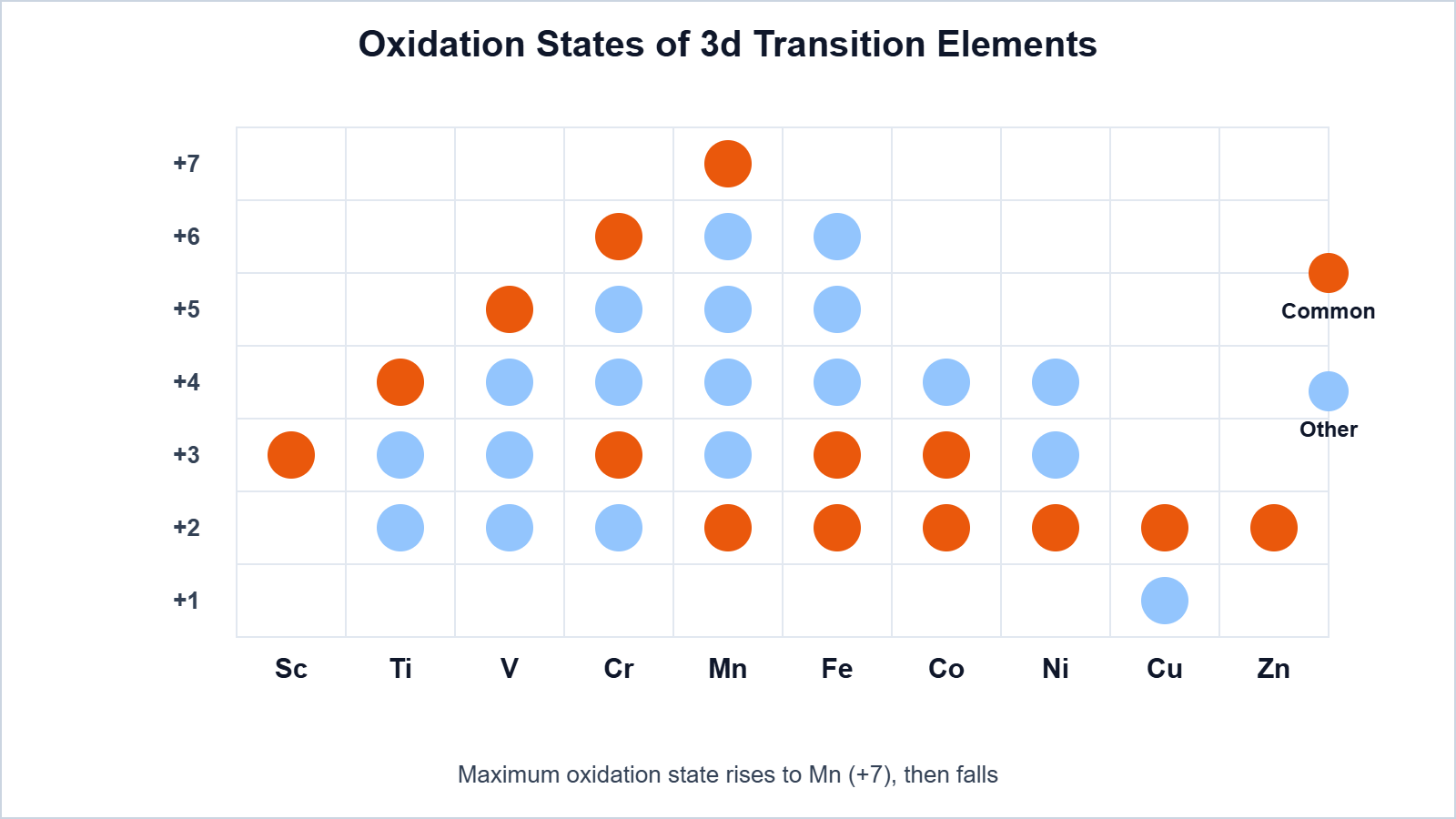
(c) Oxidation states: Transition metals show variable oxidation states because the energies of (n-1)d and ns electrons are close, so both can be lost. The number of oxidation states is greatest in the middle (Mn shows +2 to +7). Higher oxidation states are stabilised by oxide and fluoride ions.
(d) Atomic and ionic radii: Radii decrease across the series as nuclear charge increases, but the decrease is small in the middle because the added d electrons shield the outer electrons. Ions of the same charge show a steady decrease in radius with increasing atomic number.
(e) Colour: Most transition metal ions are coloured because of d-d transitions: an electron absorbs visible light and jumps from a lower to a higher energy d orbital; the complementary colour is seen. Ions with d0 (Sc3+, Ti4+) or d10 (Zn2+, Cu+) configuration are colourless.
Ion | Configuration | Colour |
|---|---|---|
Ti3+ | 3d1 | Purple |
V3+ | 3d2 | Green |
Cr3+ | 3d3 | Violet |
Mn2+ | 3d5 | Pale pink |
Fe2+ | 3d6 | Pale green |
Co2+ | 3d7 | Pink |
Ni2+ | 3d8 | Green |
Cu2+ | 3d9 | Blue |
Sc3+, Zn2+ | 3d0, 3d10 | Colourless |
(f) Catalytic property: due to variable oxidation states and their ability to provide a surface for adsorption and form intermediate compounds. Examples: Fe in the Haber process, V2O5 in the Contact process, finely divided Ni in hydrogenation of oils.
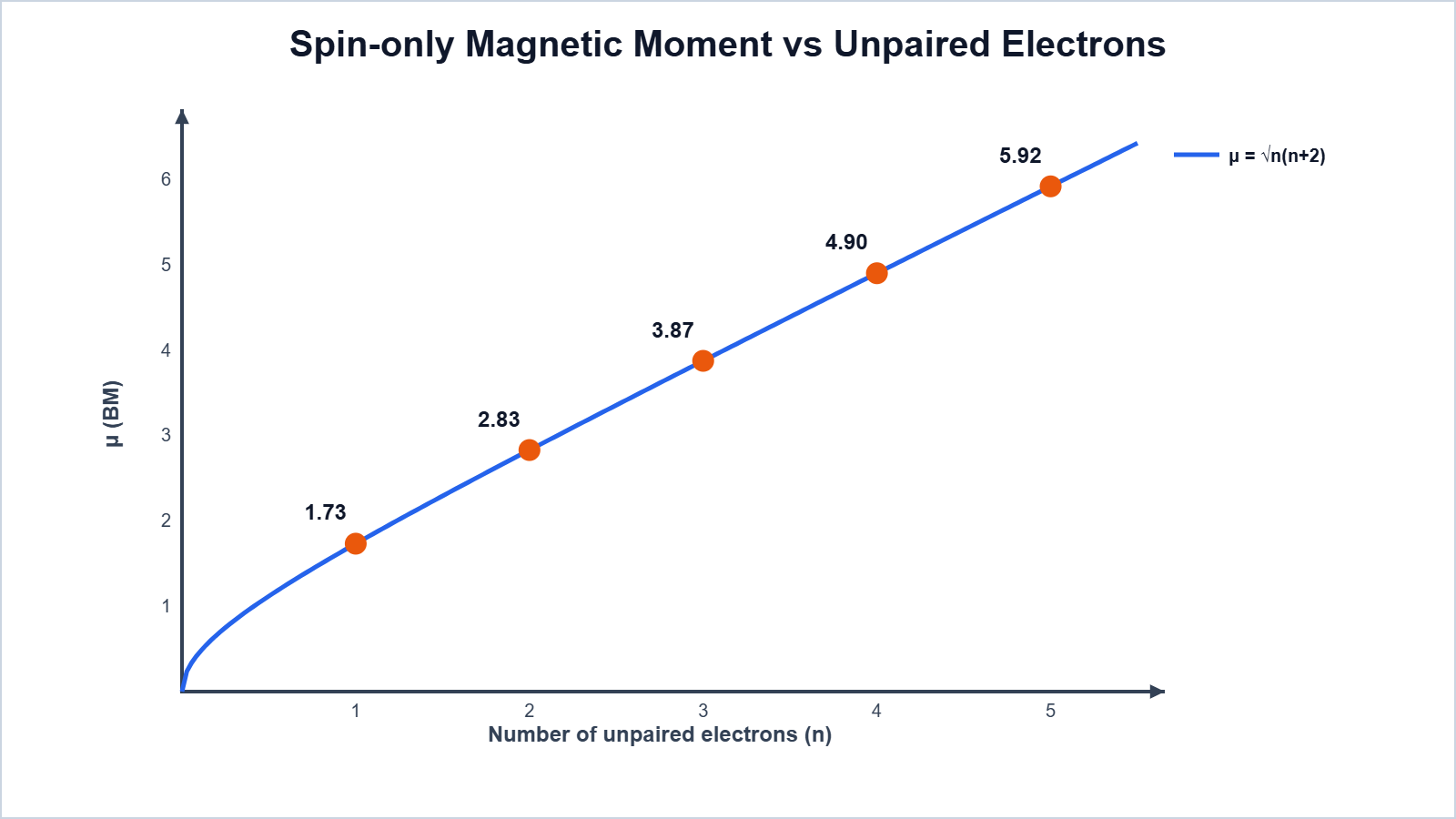
(g) Magnetic properties: Substances with unpaired electrons are paramagnetic (attracted by a magnetic field); those with all electrons paired are diamagnetic. The spin-only magnetic moment is μ = √[n(n+2)] BM, where n is the number of unpaired electrons.
Numerical 1: Calculate the spin-only magnetic moment of Mn2+ (Z = 25).
Given: Mn2+ = [Ar] 3d5; unpaired electrons n = 5
Formula: μ = √[n(n+2)] BM
Solution: μ = √(5 x 7) = √35
Answer: μ = 5.92 BM
Numerical 2: Calculate the spin-only magnetic moment of Fe2+ (Z = 26).
Given: Fe2+ = [Ar] 3d6; n = 4
Formula: μ = √[n(n+2)] BM
Solution: μ = √(4 x 6) = √24
Answer: μ = 4.90 BM
Numerical 3: Which of Cu2+ and Zn2+ is paramagnetic? Find its magnetic moment.
Given: Cu2+ = 3d9 (n = 1); Zn2+ = 3d10 (n = 0)
Formula: μ = √[n(n+2)] BM
Solution: Cu2+: μ = √(1 x 3) = √3; Zn2+: μ = 0
Answer: Cu2+ is paramagnetic, μ = 1.73 BM; Zn2+ is diamagnetic
Numerical 4: A divalent ion of a 3d metal has a magnetic moment of 2.84 BM. Find the number of unpaired electrons and identify the ion.
Given: μ = 2.84 BM
Formula: μ = √[n(n+2)]
Solution: n(n+2) = 2.842 ≈ 8.07; n2 + 2n – 8 ≈ 0, so n = 2. A 3d8 configuration gives 2 unpaired electrons
Answer: n = 2; the ion is Ni2+ (3d8)
Unpaired electrons (n) | 1 | 2 | 3 | 4 | 5 |
|---|---|---|---|---|---|
μ (BM) | 1.73 | 2.83 | 3.87 | 4.90 | 5.92 |
Examples | Ti3+, Cu2+ | V3+, Ni2+ | Cr3+, Co2+ | Fe2+, Mn3+ | Mn2+, Fe3+ |
(h) Interstitial compounds: formed when small atoms such as H, C or N are trapped in the spaces of metal crystal lattices, e.g., TiC, Mn4N, Fe3H, TiH1.7. They are non-stoichiometric, very hard, have high melting points (higher than the pure metals), retain metallic conductivity and are chemically inert.
(i) Alloy formation: Because their atomic radii are similar, transition metals readily replace one another in the lattice and form alloys. Examples: brass (Cu + Zn), bronze (Cu + Sn), stainless steel (Fe + Cr + Ni).
Easy Memory Trick: The properties of transition metals spell “CC-MAIV”: Colour, Catalysis, Magnetism, Alloys, Interstitial compounds, Variable oxidation states.
4. Potassium Dichromate, K2Cr2O7
Preparation from chromite ore (FeCr2O4):
- Fusion of chromite with sodium carbonate in free access of air: 4FeCr2O4 + 8Na2CO3 + 7O2 → 8Na2CrO4 + 2Fe2O3 + 8CO2
- Acidification of the yellow sodium chromate solution: 2Na2CrO4 + 2H+ → Na2Cr2O7 + 2Na+ + H2O
- Treatment with KCl gives orange crystals of potassium dichromate: Na2Cr2O7 + 2KCl → K2Cr2O7 + 2NaCl
Effect of pH: chromate and dichromate are interconvertible: 2CrO42- (yellow) + 2H+ ⇌ Cr2O72- (orange) + H2O. Acid favours dichromate; alkali favours chromate. The oxidation state of Cr is +6 in both.
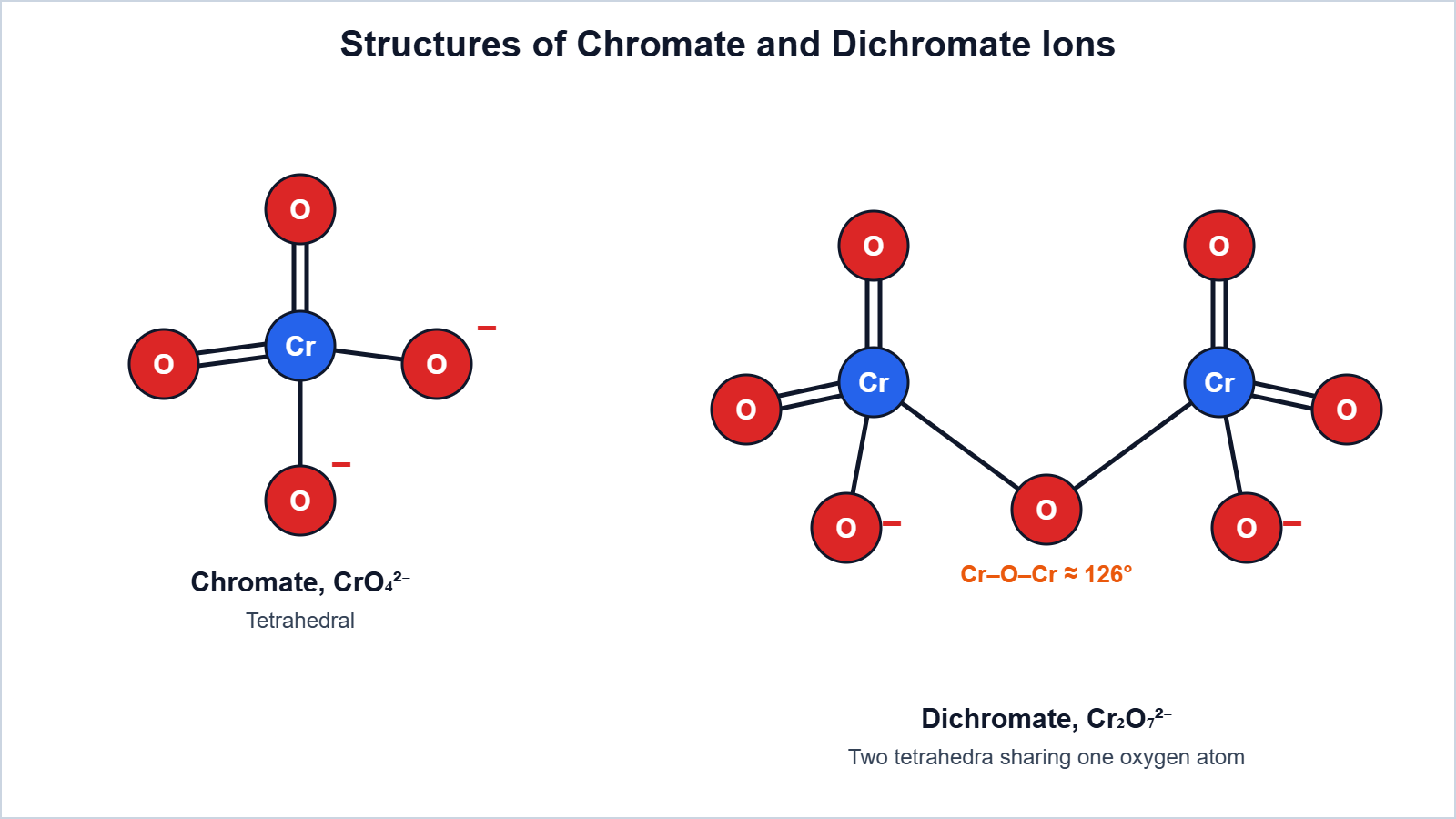
Oxidising action in acidic medium: Cr2O72- + 14H+ + 6e– → 2Cr3+ + 7H2O (orange to green). It oxidises:
- Iodide to iodine: 6I– → 3I2 + 6e–
- Iron(II) to iron(III): 6Fe2+ → 6Fe3+ + 6e–
- Hydrogen sulphide to sulphur: 3H2S → 6H+ + 3S + 6e–
- Tin(II) to tin(IV): 3Sn2+ → 3Sn4+ + 6e–
Uses: oxidising agent in volumetric analysis, in leather tanning and in the preparation of azo compounds.
5. Potassium Permanganate, KMnO4
Preparation: Pyrolusite (MnO2) is fused with KOH in the presence of an oxidising agent (air or KNO3) to give dark green potassium manganate: 2MnO2 + 4KOH + O2 → 2K2MnO4 + 2H2O. Manganate disproportionates in neutral or acidic solution to permanganate: 3MnO42- + 4H+ → 2MnO4– + MnO2 + 2H2O. Commercially, manganate is oxidised electrolytically in alkaline solution to permanganate.
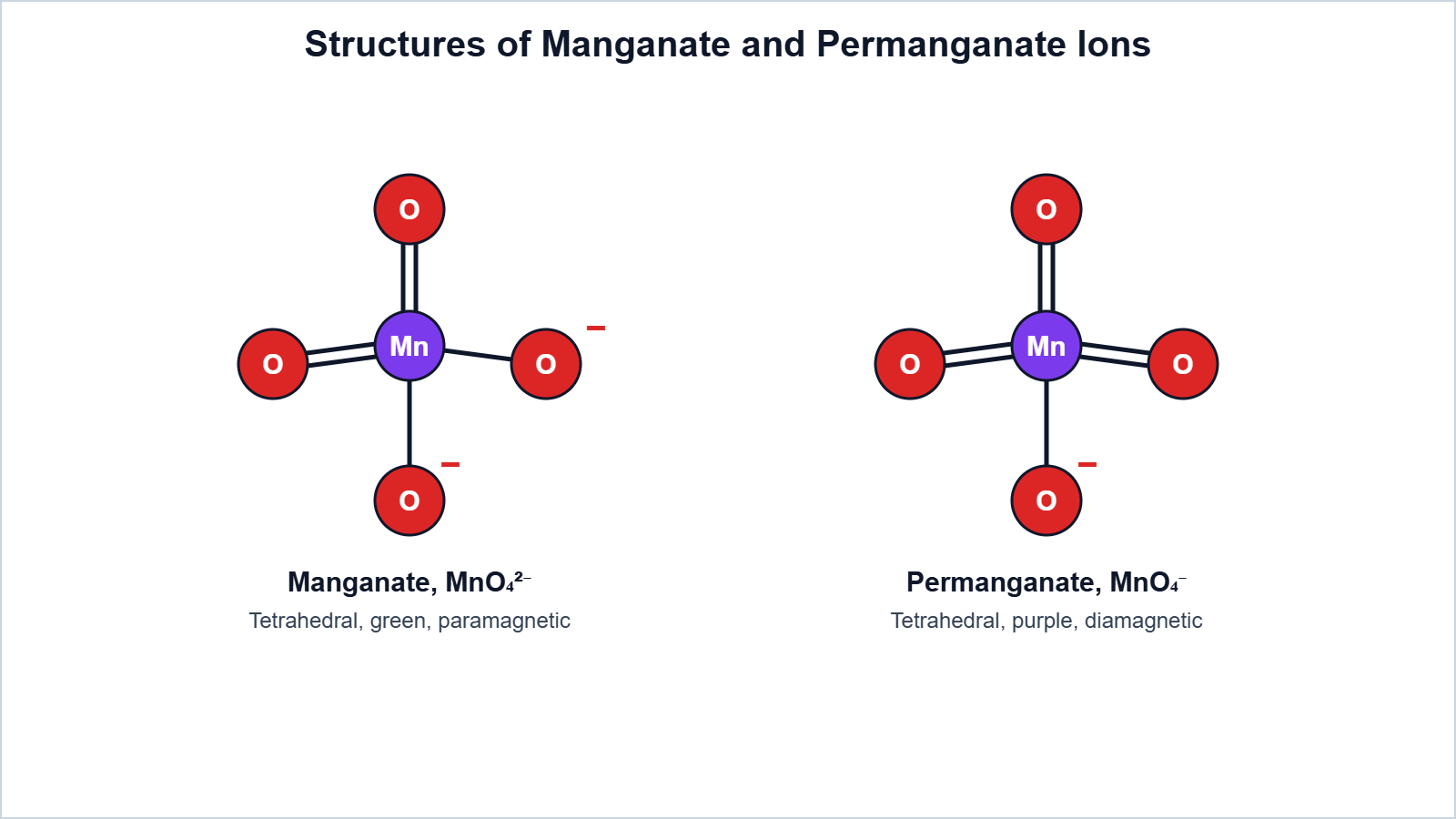
Properties: dark purple crystals, moderately soluble in water. MnO4– (Mn +7, d0) is diamagnetic; its intense colour is due to charge transfer, not d-d transition. Manganate (Mn +6, d1) is green and paramagnetic.
Medium | Half reaction | Examples of oxidation |
|---|---|---|
Acidic | MnO4– + 8H+ + 5e– → Mn2+ + 4H2O | I– → I2; Fe2+ → Fe3+; C2O42- → CO2; H2S → S; SO32- → SO42-; NO2– → NO3– |
Neutral or faintly alkaline | MnO4– + 2H2O + 3e– → MnO2 + 4OH– | I– → IO3–; S2O32- → SO42-; Mn2+ → MnO2 |
Exam point: In titrations KMnO4 acts as a self-indicator; dilute H2SO4 (not HCl) is used for acidification because HCl is oxidised to chlorine.
Uses: oxidising agent in the laboratory and industry, disinfectant, bleaching of wool, cotton and silk, and in volumetric analysis.
6. Lanthanoids
Electronic configuration: The fourteen elements after lanthanum (Ce, Z = 58 to Lu, Z = 71) are lanthanoids. General configuration: [Xe] 4f1-14 5d0-1 6s2.
Oxidation states: The common and most stable oxidation state is +3. Some show +2 and +4 when this leads to f0, f7 or f14 configurations: Ce4+ (4f0) and Tb4+ (4f7) are oxidising agents; Eu2+ (4f7) and Yb2+ (4f14) are reducing agents.
Chemical reactivity: Lanthanoids are reactive metals similar to calcium. They tarnish in air, burn in oxygen to form Ln2O3, react with dilute acids and water to liberate hydrogen, combine with halogens to form LnX3, with nitrogen on heating to form LnN, and with carbon at high temperature to form carbides. Their hydroxides Ln(OH)3 are basic.
Lanthanoid contraction: the steady decrease in atomic and ionic (Ln3+) radii from La to Lu. Cause: the 4f electrons shield one another and the outer electrons poorly from the increasing nuclear charge, so the effective nuclear charge rises and the size decreases.
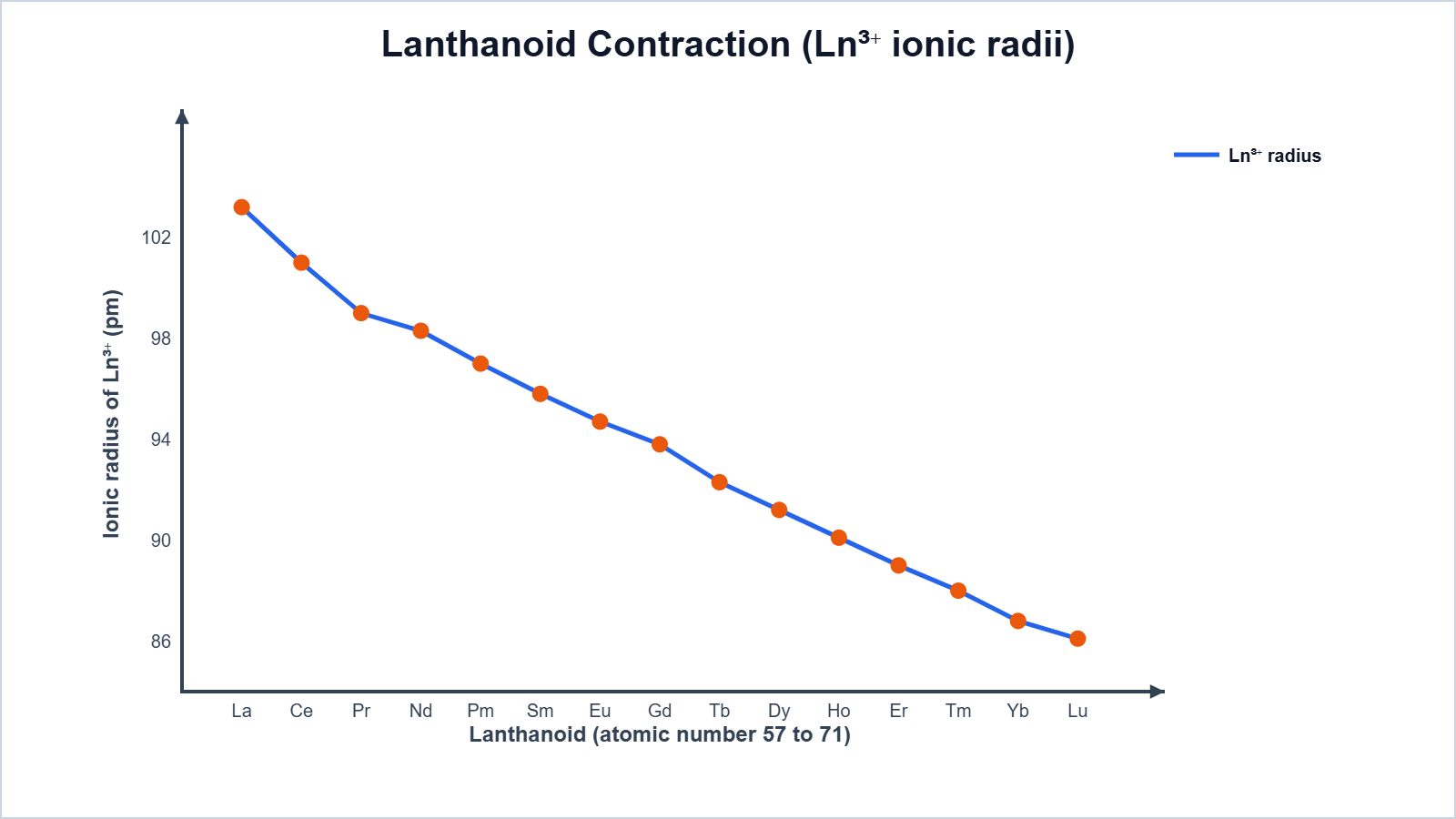
Consequences of lanthanoid contraction:
- The second (4d) and third (5d) transition series elements of a group have almost equal radii, e.g., Zr (160 pm) and Hf (159 pm); they are very similar in properties and occur together in nature.
- Lanthanoids are very similar to each other, making their separation difficult.
- Basic strength of the hydroxides decreases from La(OH)3 to Lu(OH)3.
7. Actinoids and Comparison with Lanthanoids
Electronic configuration: The fourteen elements after actinium (Th, Z = 90 to Lr, Z = 103). General configuration: [Rn] 5f1-14 6d0-1 7s2. All actinoids are radioactive; elements after uranium are man-made.
Oxidation states: +3 is common, but actinoids show a much wider range because 5f, 6d and 7s levels are close in energy; e.g., U shows up to +6 and Np and Pu up to +7.
Basis | Lanthanoids | Actinoids |
|---|---|---|
Electrons enter | 4f orbitals | 5f orbitals |
Oxidation states | Mainly +3 (some +2, +4) | +3 and many others, up to +7 |
Radioactivity | Mostly non-radioactive (except Pm) | All radioactive |
Complex formation | Less tendency | Greater tendency |
Contraction | Lanthanoid contraction | Actinoid contraction (greater, due to poorer shielding by 5f electrons) |
Oxocations | Do not form | Form oxocations such as UO22+ and PuO22+ |
8. Practice Problems (Answers Only)
- Spin-only magnetic moment of Cr3+ (Z = 24). Ans: 3.87 BM
- Spin-only magnetic moment of Ti3+ (Z = 22). Ans: 1.73 BM
- Number of unpaired electrons in Fe3+ (Z = 26). Ans: 5
- Oxidation state of Mn in KMnO4. Ans: +7
- Oxidation state of Cr in K2Cr2O7. Ans: +6
9. Important Questions
Q1. Why are Zn, Cd and Hg not regarded as transition elements?
Ans. They have completely filled d orbitals (d10) in the ground state and in their common oxidation state.
Q2. Why do transition metals show variable oxidation states?
Ans. Because the (n-1)d and ns electrons have nearly the same energy, so different numbers of them can be lost.
Q3. Why are most transition metal ions coloured?
Ans. Due to d-d transitions of unpaired electrons when visible light is absorbed.
Q4. Why is Sc3+ colourless while Ti3+ is coloured?
Ans. Sc3+ has no d electron (3d0); Ti3+ has one (3d1) which can undergo a d-d transition.
Q5. What are interstitial compounds? Give two properties.
Ans. Compounds formed when small atoms like H, C, N occupy voids in metal lattices; they are very hard and have high melting points.
Q6. Write the effect of pH on dichromate ion.
Ans. In alkaline medium dichromate changes to yellow chromate; in acid medium chromate changes to orange dichromate.
Q7. Write the ionic equation for the reaction of KMnO4 with Fe2+ in acidic medium.
Ans. MnO4– + 5Fe2+ + 8H+ → Mn2+ + 5Fe3+ + 4H2O
Q8. What is lanthanoid contraction? Give its two consequences.
Ans. The steady decrease in size from La to Lu due to poor shielding by 4f electrons; Zr and Hf have similar radii, and lanthanoids are hard to separate.
Q9. Why do actinoids show more oxidation states than lanthanoids?
Ans. The 5f, 6d and 7s orbitals are of comparable energies.
Q10. Why do transition metals act as good catalysts?
Ans. Because of variable oxidation states, a large surface area for adsorption and the ability to form unstable intermediates.
Conclusion: The d- and f-block elements show variable oxidation states, colour, magnetism, catalytic activity and complex formation because of their partly filled d or f orbitals. KMnO4 and K2Cr2O7 are important oxidising agents, while lanthanoid contraction strongly influences the chemistry of the heavier elements.