Aldehydes, Ketones and Carboxylic Acids – Class 12 Chemistry Notes
Chapter – 8
Aldehydes, Ketones and Carboxylic Acids
1. Nomenclature
Aldehydes (R-CHO) and ketones (R-CO-R’) contain the carbonyl group (>C=O); carboxylic acids contain the carboxyl group (-COOH).
Structure | Common name | IUPAC name |
|---|---|---|
HCHO | Formaldehyde | Methanal |
CH3CHO | Acetaldehyde | Ethanal |
C6H5CHO | Benzaldehyde | Benzenecarbaldehyde (benzaldehyde) |
CH3COCH3 | Acetone (dimethyl ketone) | Propan-2-one (propanone) |
CH3COCH2CH3 | Ethyl methyl ketone | Butan-2-one |
C6H5COCH3 | Acetophenone | 1-Phenylethan-1-one |
HCOOH | Formic acid | Methanoic acid |
CH3COOH | Acetic acid | Ethanoic acid |
HOOC-COOH | Oxalic acid | Ethanedioic acid |
C6H5COOH | Benzoic acid | Benzenecarboxylic acid (benzoic acid) |
2. Nature of the Carbonyl Group
The carbonyl carbon is sp2 hybridised and forms three σ bonds in a plane (bond angles about 120°) and a π bond with oxygen. Oxygen is more electronegative, so the C=O bond is polar: the carbon is electrophilic (δ+) and the oxygen is nucleophilic (δ-). Hence carbonyl compounds undergo nucleophilic addition and have considerable dipole moments.
3. Methods of Preparation of Aldehydes and Ketones
- Oxidation of alcohols: 1° alcohols give aldehydes (PCC); 2° alcohols give ketones (K2Cr2O7/H+).
- Dehydrogenation of alcohols: vapours passed over heated Cu at 573 K.
- Ozonolysis of alkenes: O3, then Zn/H2O gives aldehydes and/or ketones.
- Hydration of alkynes: ethyne + H2O (dil. H2SO4, HgSO4) → ethanal; other alkynes give ketones.
- Rosenmund reduction: RCOCl + H2 (Pd-BaSO4) → RCHO + HCl. BaSO4 poisons Pd so the aldehyde is not reduced further.
- Stephen reaction: RCN + SnCl2 + HCl → RCH=NH (imine), which is hydrolysed to RCHO.
- DIBAL-H reduction of nitriles and esters gives aldehydes.
- Etard reaction: toluene + chromyl chloride (CrO2Cl2) in CS2 gives a chromium complex that is hydrolysed to benzaldehyde.
- Gattermann-Koch reaction: benzene + CO + HCl in presence of anhydrous AlCl3/CuCl → benzaldehyde.
- Ketones from nitriles: RCN + R’MgX, then hydrolysis → R-CO-R’. Friedel-Crafts acylation: C6H6 + RCOCl (anhydrous AlCl3) → C6H5COR.

4. Physical Properties
- Methanal is a gas; ethanal is a volatile liquid; other lower aldehydes and ketones are liquids.
- Boiling points are higher than those of hydrocarbons and ethers of similar mass (dipole-dipole attractions) but lower than those of alcohols (no intermolecular hydrogen bonding).
- Lower members are miscible with water because they form hydrogen bonds with water; solubility falls with increasing alkyl chain.
5. Chemical Properties of Aldehydes and Ketones
(A) Nucleophilic addition reactions:

Aldehydes are more reactive than ketones because (i) alkyl groups in ketones reduce the positive charge on the carbonyl carbon (+I effect) and (ii) two alkyl groups crowd the approach of the nucleophile (steric effect).
Reagent | Product | Remarks |
|---|---|---|
HCN (base catalyst) | Cyanohydrin, R2C(OH)CN | Useful synthetic intermediate |
NaHSO3 | Bisulphite addition compound (crystalline) | Used to separate and purify aldehydes |
Grignard reagent, then H2O | Alcohols | HCHO → 1°, RCHO → 2°, ketones → 3° |
Alcohol (dry HCl) | Hemiacetal → acetal (aldehydes); ketals from ketones with ethylene glycol | Protection of carbonyl group |
NH2-Z (ammonia derivatives) | >C=N-Z | Addition followed by elimination of water |
Z in NH2-Z | Reagent | Product |
|---|---|---|
-OH | Hydroxylamine | Oxime |
-NH2 | Hydrazine | Hydrazone |
-NHC6H5 | Phenylhydrazine | Phenylhydrazone |
-NHC6H3(NO2)2 | 2,4-Dinitrophenylhydrazine (2,4-DNP) | 2,4-DNP derivative (yellow/orange precipitate; test for carbonyl group) |
-NHCONH2 | Semicarbazide | Semicarbazone |
(B) Reduction:
- To alcohols: NaBH4, LiAlH4 or H2/Ni; aldehydes give 1° and ketones give 2° alcohols.
- Clemmensen reduction: >C=O → >CH2 with zinc amalgam and concentrated HCl.
- Wolff-Kishner reduction: >C=O → >CH2 with hydrazine (NH2NH2), then heating with KOH in ethylene glycol.
(C) Oxidation: Aldehydes are easily oxidised to carboxylic acids even by mild oxidising agents; ketones are oxidised only by strong agents at high temperature with breaking of C-C bonds.
Test | Reagent | Positive result | Given by |
|---|---|---|---|
Tollens’ test | Ammoniacal silver nitrate | Silver mirror | All aldehydes (not ketones) |
Fehling’s test | Fehling’s solutions A (CuSO4) + B (sodium potassium tartrate in NaOH) | Red-brown precipitate of Cu2O | Aliphatic aldehydes (not benzaldehyde) |
Iodoform test | I2 + NaOH (sodium hypoiodite) | Yellow precipitate of CHI3 | Compounds with CH3CO- or CH3CH(OH)- group (ethanal, methyl ketones, ethanol) |
Tollens’ reaction: RCHO + 2[Ag(NH3)2]+ + 3OH– → RCOO– + 2Ag + 2H2O + 4NH3.
(D) Reactions due to α-hydrogen: The α-hydrogen of aldehydes and ketones is acidic because of the electron-withdrawing carbonyl group and resonance stabilisation of the conjugate base (enolate).

- Aldol reaction: aldehydes and ketones with at least one α-hydrogen, in dilute alkali, give β-hydroxy aldehydes (aldols) or β-hydroxy ketones (ketols), which lose water on heating to give α,β-unsaturated compounds (aldol condensation).
- Cross aldol condensation: between two different aldehydes and/or ketones; gives a mixture of four products if both have α-hydrogens.
- Cannizzaro reaction: aldehydes without α-hydrogen (HCHO, C6H5CHO) with concentrated alkali undergo self oxidation-reduction: 2HCHO + conc. KOH → CH3OH + HCOOK; 2C6H5CHO + conc. NaOH → C6H5CH2OH + C6H5COONa.
(E) Electrophilic substitution: the -CHO group in benzaldehyde is deactivating and meta directing; nitration gives m-nitrobenzaldehyde.
Uses: formalin (40% methanal) preserves biological specimens; methanal makes Bakelite and other resins; ethanal is used to make ethanoic acid; acetone and ethyl methyl ketone are industrial solvents; benzaldehyde is used in perfumes and dyes.
Easy Memory Trick: “Clemmensen = Zn-Hg + HCl (acid); Wolff-Kishner = hydrazine + KOH (base)”. Both convert C=O to CH2.
6. Carboxylic Acids: Methods of Preparation
- From 1° alcohols and aldehydes: oxidation with KMnO4 (alkaline, neutral or acidic) or K2Cr2O7/H+.
- From alkylbenzenes: vigorous oxidation with alkaline KMnO4 or chromic acid gives benzoic acid; the whole side chain becomes -COOH irrespective of length (if it has a benzylic hydrogen).
- From nitriles and amides: hydrolysis with dilute acid or alkali: RCN → RCONH2 → RCOOH.
- From Grignard reagents: RMgX + CO2 (dry ice), then H3O+ → RCOOH.
- From acyl halides, anhydrides and esters: hydrolysis gives the acid.
7. Carboxylic Acids: Physical Properties
Lower aliphatic acids (up to C9) are liquids with unpleasant smells; higher ones are wax-like solids. They have higher boiling points than aldehydes, ketones and even alcohols of comparable mass because of extensive hydrogen bonding; in the vapour and in non-polar solvents they exist as dimers. Lower acids are miscible with water; benzoic acid is nearly insoluble in cold water.

8. Acidic Nature of Carboxylic Acids
Carboxylic acids ionise in water: RCOOH + H2O ⇌ RCOO– + H3O+. They are stronger acids than alcohols and phenols because the carboxylate ion is stabilised by resonance: the negative charge is delocalised equally over two oxygen atoms. They react with metals, alkalis and also with weak bases such as NaHCO3, giving brisk effervescence of CO2 (test for -COOH).
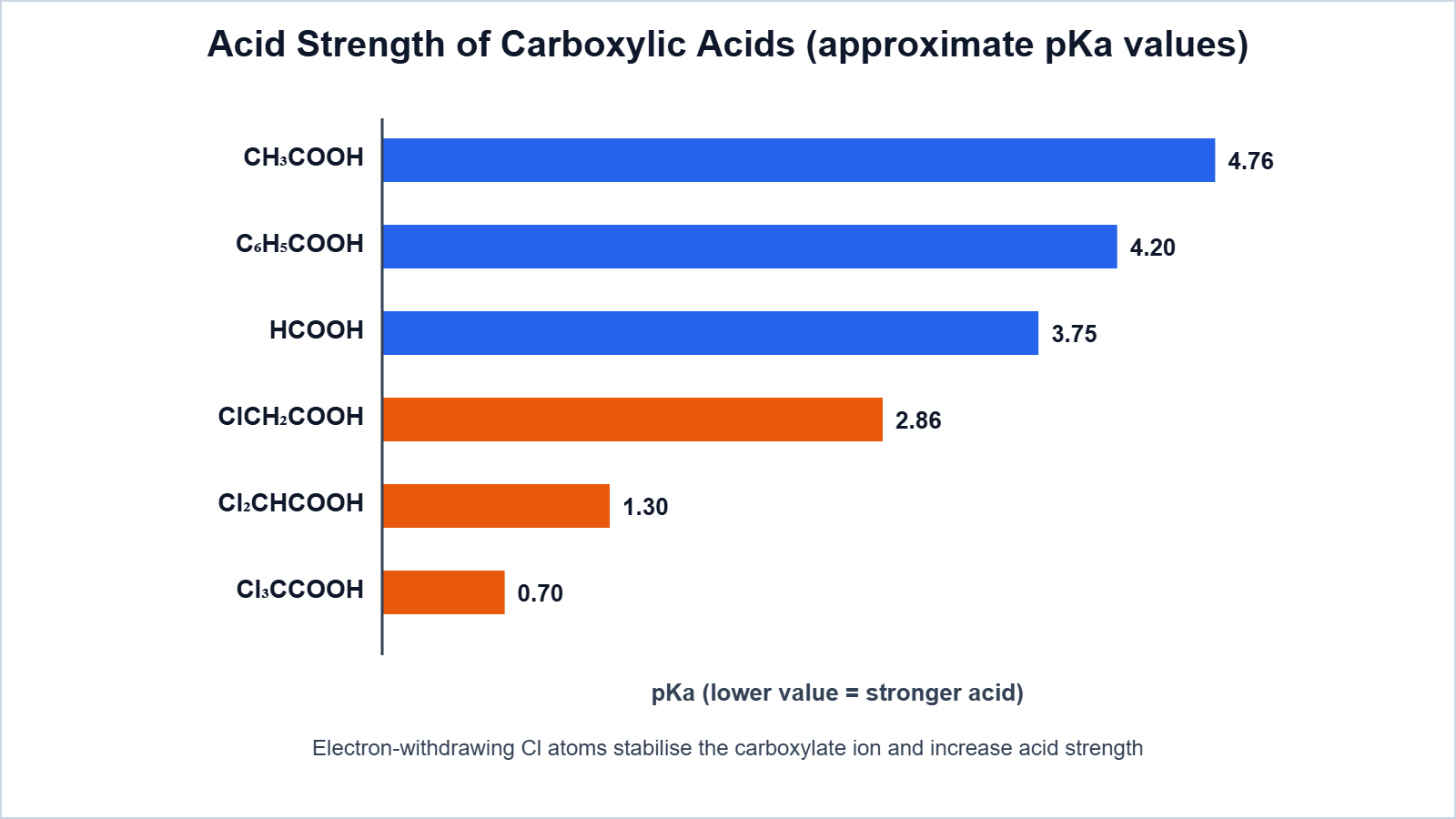
- Electron-withdrawing groups (-Cl, -F, -NO2, -CN) increase acidity; the effect increases with number of such groups and decreases with distance from -COOH. Order: CF3COOH > CCl3COOH > CHCl2COOH > ClCH2COOH > HCOOH > CH3COOH.
- Electron-releasing groups (alkyl) decrease acidity: HCOOH is stronger than CH3COOH.
- Benzoic acid (pKa about 4.2) is stronger than ethanoic acid (about 4.76).
Remember: acidity order: carboxylic acids > phenols > water > alcohols.
9. Chemical Properties of Carboxylic Acids
- Formation of anhydrides: heating with P2O5 or conc. H2SO4: 2CH3COOH → (CH3CO)2O + H2O.
- Esterification: RCOOH + R’OH ⇌ RCOOR’ + H2O (conc. H2SO4).
- With PCl5, PCl3 or SOCl2: RCOOH → RCOCl (acyl chloride). SOCl2 is preferred as by-products are gases.
- With ammonia: RCOOH + NH3 ⇌ RCOO–NH4+, which on heating gives the amide RCONH2.
- Reduction: LiAlH4 or B2H6 reduce -COOH to -CH2OH (1° alcohol).
- Decarboxylation: sodium salt heated with soda lime (NaOH + CaO): RCOONa → R-H + Na2CO3. Kolbe electrolysis of aqueous sodium or potassium salts gives alkanes with twice the alkyl group: 2CH3COO– → CH3-CH3 + 2CO2 (at anode).
- Hell-Volhard-Zelinsky (HVZ) reaction: acids with α-hydrogen, treated with Cl2 or Br2 in presence of a small amount of red phosphorus, give α-halo acids: RCH2COOH → RCHXCOOH.
- Ring substitution: -COOH is deactivating and meta directing; benzoic acid gives m-nitrobenzoic acid on nitration and m-bromobenzoic acid on bromination (FeBr3). Benzoic acid does not undergo Friedel-Crafts reaction.
Uses: methanoic acid in rubber, textile, dyeing and leather industries; ethanoic acid as vinegar and solvent; benzoic acid esters in perfumery and sodium benzoate as a food preservative; higher fatty acids for soaps and detergents.
10. Important Conversions and Distinguishing Tests
- Ethanal to propan-2-ol: CH3MgBr, then H2O.
- Benzene to benzaldehyde: Gattermann-Koch reaction (CO + HCl, AlCl3/CuCl).
- Toluene to benzaldehyde: Etard reaction.
- Propanone to propane: Clemmensen or Wolff-Kishner reduction.
- Ethanoic acid to 2-chloroethanoic acid: Cl2/red P (HVZ).
- Benzoic acid to benzene: soda lime decarboxylation of sodium benzoate.
- Ethanal vs propanone: Tollens’ and Fehling’s tests positive for ethanal only (both give iodoform test).
- Benzaldehyde vs acetophenone: Tollens’ test positive for benzaldehyde; iodoform test positive for acetophenone.
- Propanal vs propanone: Tollens’/Fehling’s positive for propanal; iodoform positive for propanone.
- Phenol vs benzoic acid: benzoic acid gives effervescence with NaHCO3; phenol gives violet colour with neutral FeCl3.
11. Important Questions
Q1. Why are aldehydes more reactive than ketones towards nucleophilic addition?
Ans. Due to the smaller +I effect and less steric hindrance in aldehydes.
Q2. Write the Rosenmund reduction.
Ans. RCOCl + H2 over Pd-BaSO4 → RCHO + HCl.
Q3. What is the Cannizzaro reaction? Give an example.
Ans. Self oxidation-reduction of aldehydes without α-H in conc. alkali; 2HCHO → CH3OH + HCOOK.
Q4. Write the aldol condensation of ethanal.
Ans. 2CH3CHO (dil. NaOH) → CH3CH(OH)CH2CHO; on heating gives CH3CH=CHCHO.
Q5. Distinguish between Clemmensen and Wolff-Kishner reductions.
Ans. Both convert C=O to CH2; Clemmensen uses Zn-Hg/conc. HCl, Wolff-Kishner uses hydrazine and KOH in ethylene glycol.
Q6. Why are carboxylic acids more acidic than phenols?
Ans. The carboxylate ion has two equivalent resonance structures with the charge on two oxygen atoms; in phenoxide the charge is also on less electronegative carbon atoms.
Q7. What is the HVZ reaction?
Ans. α-Halogenation of carboxylic acids having α-hydrogen with X2 and red phosphorus.
Q8. Why do carboxylic acids have high boiling points?
Ans. Strong intermolecular hydrogen bonding and dimer formation.
Q9. Arrange in increasing acid strength: CH3COOH, ClCH2COOH, Cl3CCOOH, HCOOH.
Ans. CH3COOH < HCOOH < ClCH2COOH < Cl3CCOOH.
Q10. Write the Etard reaction.
Ans. Toluene + CrO2Cl2 (CS2) gives a complex; hydrolysis gives benzaldehyde.
Conclusion: The polar carbonyl group makes aldehydes and ketones undergo nucleophilic addition, reduction, oxidation and α-hydrogen reactions such as aldol condensation. Carboxylic acids are acidic because of resonance-stabilised carboxylate ions and form many derivatives through name reactions like HVZ and Kolbe electrolysis.