Chapter – 9
Amines
1. Introduction, Structure and Classification
Amines are derivatives of ammonia in which one, two or all three hydrogen atoms are replaced by alkyl or aryl groups.
Type | General formula | Example |
|---|---|---|
Primary (1°) | R-NH2 | CH3NH2, C6H5NH2 |
Secondary (2°) | R2NH | (CH3)2NH |
Tertiary (3°) | R3N | (CH3)3N |
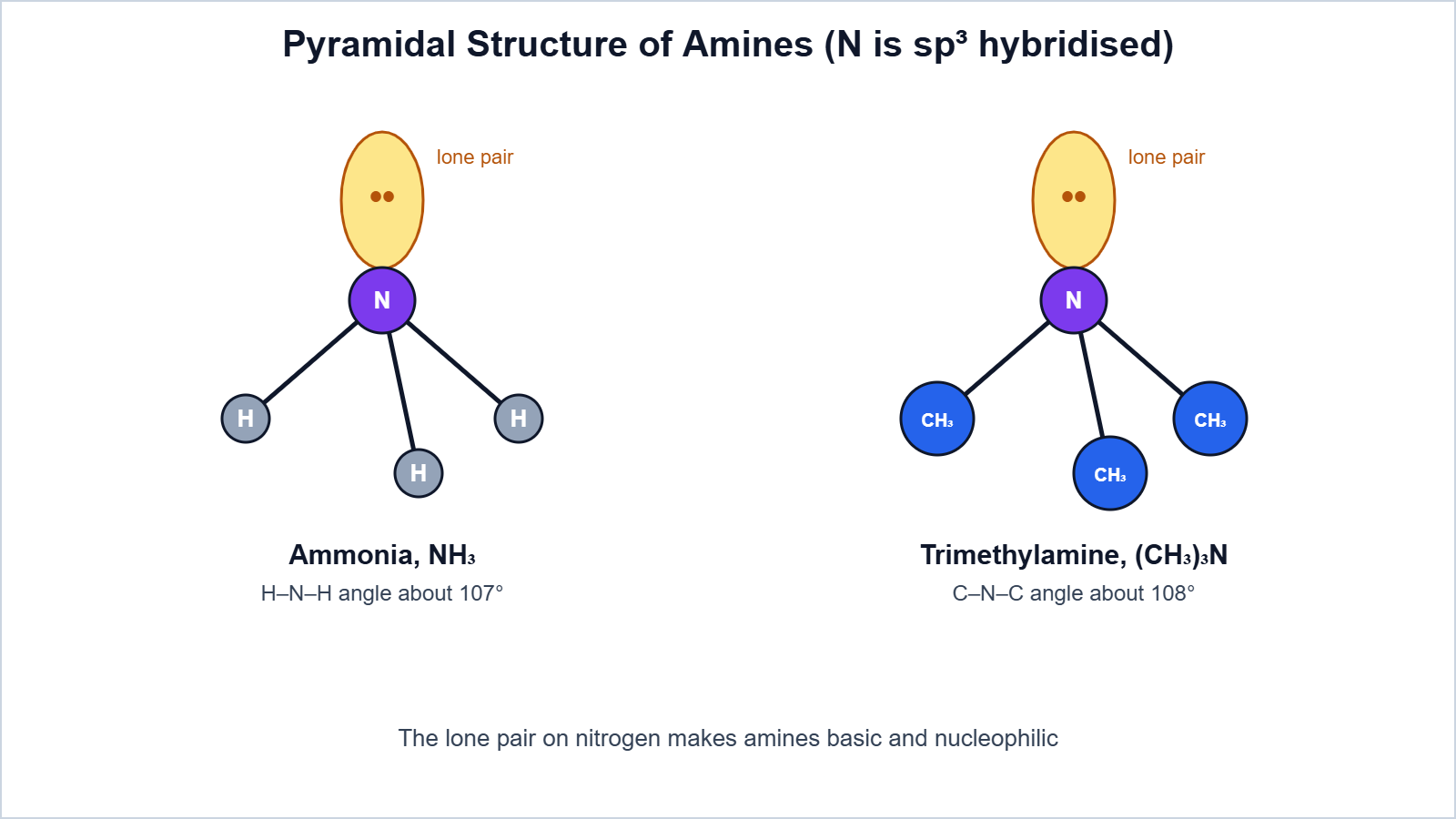
Structure: Nitrogen is sp3 hybridised; three orbitals form bonds and the fourth holds a lone pair, so amines are pyramidal. Bond angles are slightly less than 109.5° (about 108° in trimethylamine) because of lone pair repulsion.
2. Nomenclature
Amine | Common name | IUPAC name |
|---|---|---|
CH3CH2NH2 | Ethylamine | Ethanamine |
CH3CH2CH2NH2 | n-Propylamine | Propan-1-amine |
(CH3)2CHNH2 | Isopropylamine | Propan-2-amine |
CH3NHCH2CH3 | Ethylmethylamine | N-Methylethanamine |
(CH3)3N | Trimethylamine | N,N-Dimethylmethanamine |
H2N-(CH2)6-NH2 | Hexamethylenediamine | Hexane-1,6-diamine |
C6H5NH2 | Aniline | Aniline (benzenamine) |
C6H5N(CH3)2 | N,N-Dimethylaniline | N,N-Dimethylbenzenamine |
3. Methods of Preparation
- Reduction of nitro compounds: H2/Ni, Pt or Pd, or metal and acid (Sn/HCl, Fe/HCl): C6H5NO2 + 6[H] → C6H5NH2 + 2H2O. Fe scrap and HCl is preferred industrially, as the FeCl2 formed is hydrolysed, releasing HCl.
- Ammonolysis of alkyl halides: R-X + NH3 → R-NH2 + HX; further reaction gives 2° and 3° amines and quaternary ammonium salts. A large excess of NH3 favours the 1° amine.
- Reduction of nitriles: R-CN + 4[H] (LiAlH4 or H2/Ni, or Na/C2H5OH, Mendius reduction) → R-CH2NH2 (ascent in the series by one carbon).
- Reduction of amides: R-CONH2 (LiAlH4, then H2O) → R-CH2NH2.
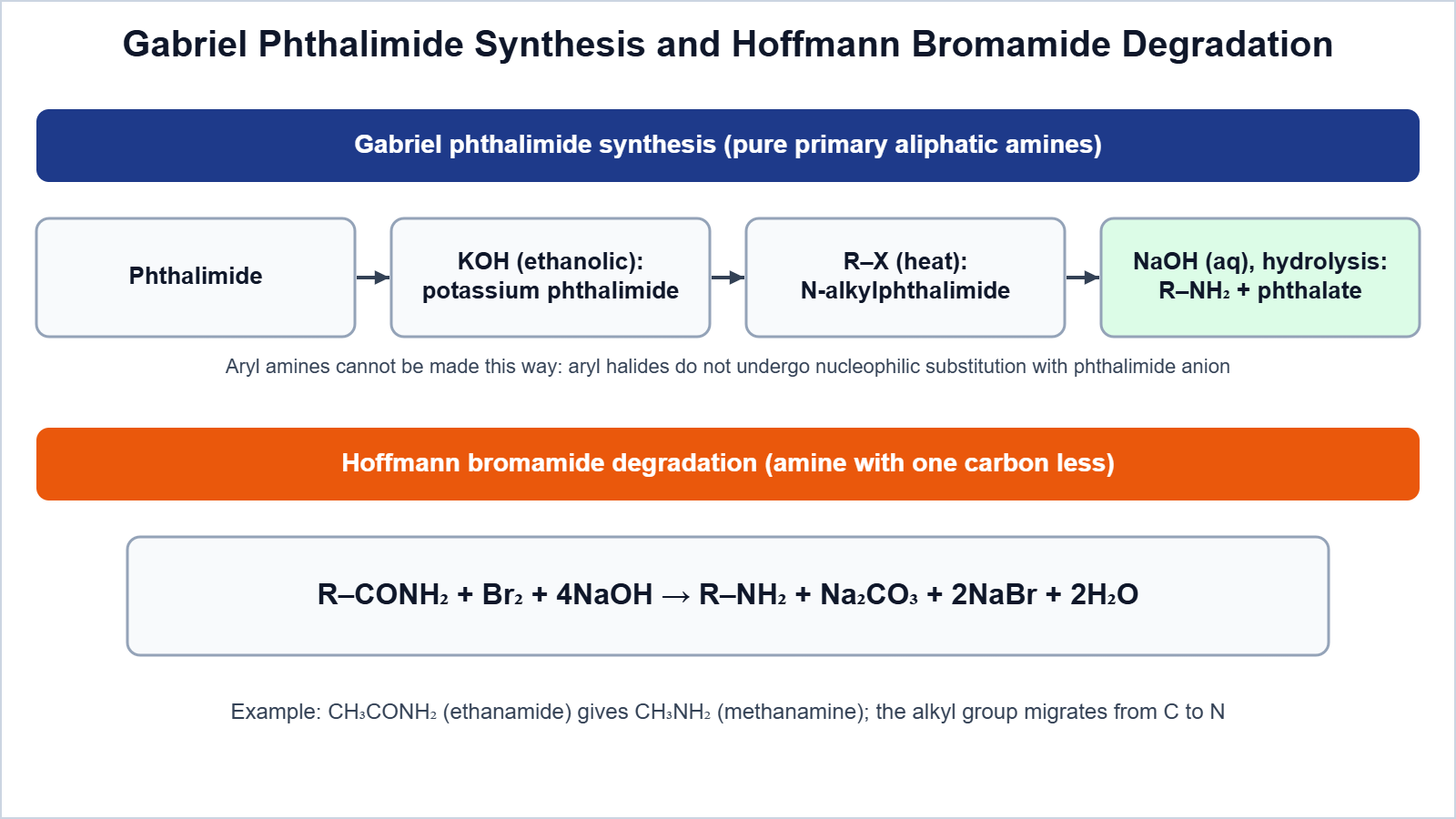
- Gabriel phthalimide synthesis: gives pure 1° aliphatic amines.
- Hoffmann bromamide degradation: amide + Br2 + NaOH gives a 1° amine with one carbon atom less than the amide.
4. Physical Properties
- Lower aliphatic amines are gases with a fishy smell; 1° amines with three or more carbons are liquids; higher ones are solids. Aniline is a colourless liquid that darkens on storage due to atmospheric oxidation.
- Lower aliphatic amines are soluble in water (hydrogen bonding); solubility falls with increasing molar mass. Aryl amines are nearly insoluble.
- Boiling points: 1° > 2° > 3° for isomeric amines because the extent of intermolecular hydrogen bonding decreases (3° amines have no H on nitrogen). Amines boil lower than alcohols of similar mass because N-H…N hydrogen bonds are weaker than O-H…O bonds.
5. Chemical Properties
(A) Basic character: amines accept a proton because of the lone pair on nitrogen: R-NH2 + H2O ⇌ R-NH3+ + OH–; they form salts with acids. A smaller pKb means a stronger base.
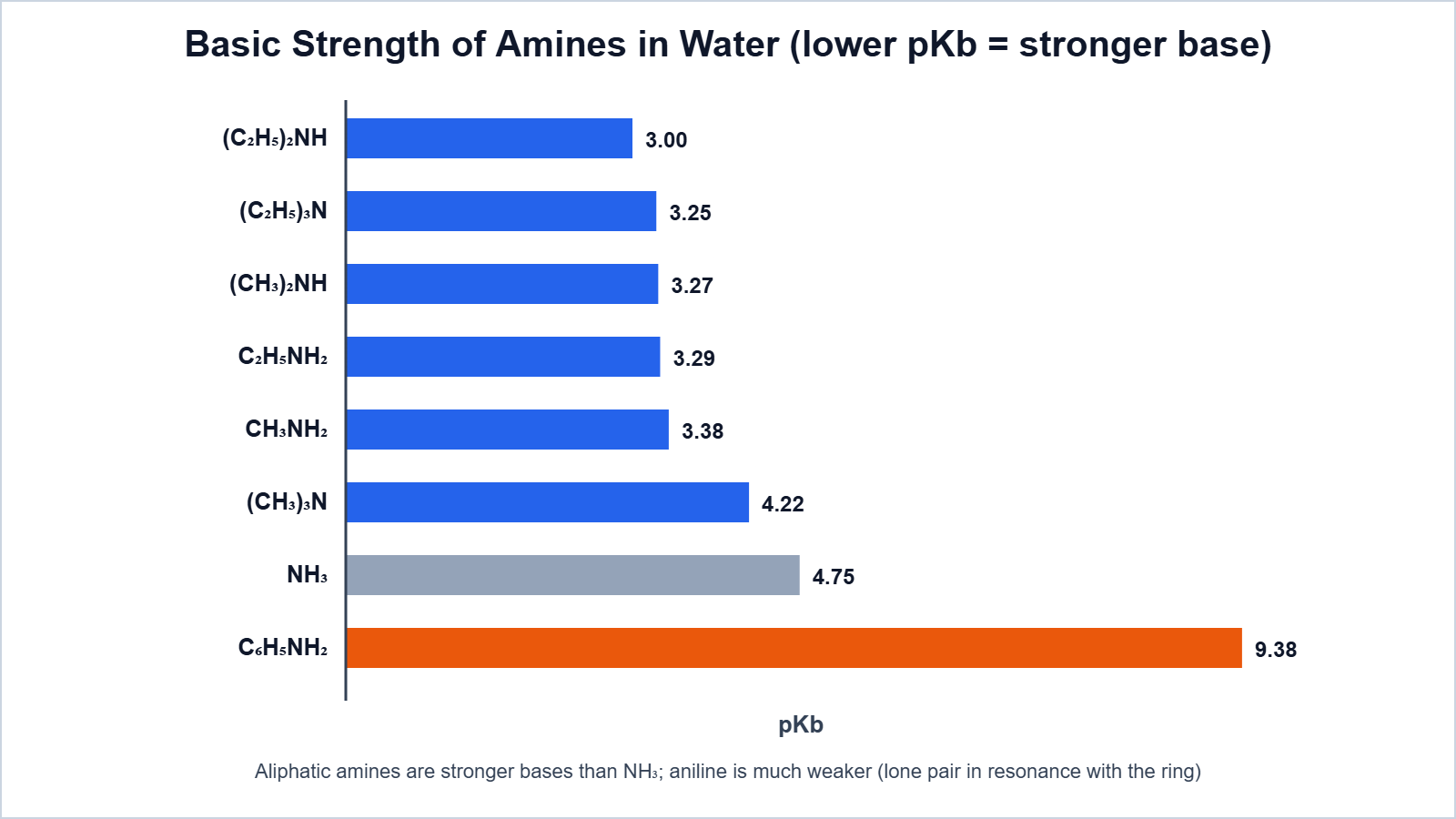
- Aliphatic amines are stronger bases than ammonia because the +I effect of alkyl groups increases electron density on nitrogen.
- In the gas phase the order is 3° > 2° > 1° > NH3. In water, solvation (hydrogen bonding of the ammonium ion with water) and steric hindrance also matter: for methyl amines the order is (CH3)2NH > CH3NH2 > (CH3)3N > NH3, and for ethyl amines (C2H5)2NH > (C2H5)3N > C2H5NH2 > NH3.
- Aryl amines are weaker bases than ammonia because the lone pair on nitrogen is delocalised into the benzene ring and is less available; the anilinium ion has fewer resonance structures than aniline. Electron-releasing groups (-CH3, -OCH3) increase and electron-withdrawing groups (-NO2) decrease the basicity of aniline.
(B) Alkylation: amines react with alkyl halides to give higher amines and finally quaternary ammonium salts.
(C) Acylation: 1° and 2° amines react with acid chlorides, anhydrides or esters (nucleophilic substitution) to give amides; e.g., C6H5NH2 + CH3COCl → C6H5NHCOCH3 (acetanilide) + HCl, carried out in pyridine. Benzoylation with C6H5COCl gives benzamides.
(D) Carbylamine reaction (isocyanide test): only 1° amines (aliphatic and aromatic), heated with chloroform and ethanolic KOH, give foul-smelling isocyanides: R-NH2 + CHCl3 + 3KOH → R-NC + 3KCl + 3H2O.
(E) Reaction with nitrous acid (NaNO2 + HCl): 1° aliphatic amines give unstable diazonium salts that decompose to alcohols with brisk evolution of N2; 1° aromatic amines at 273-278 K give stable diazonium salts (diazotisation).
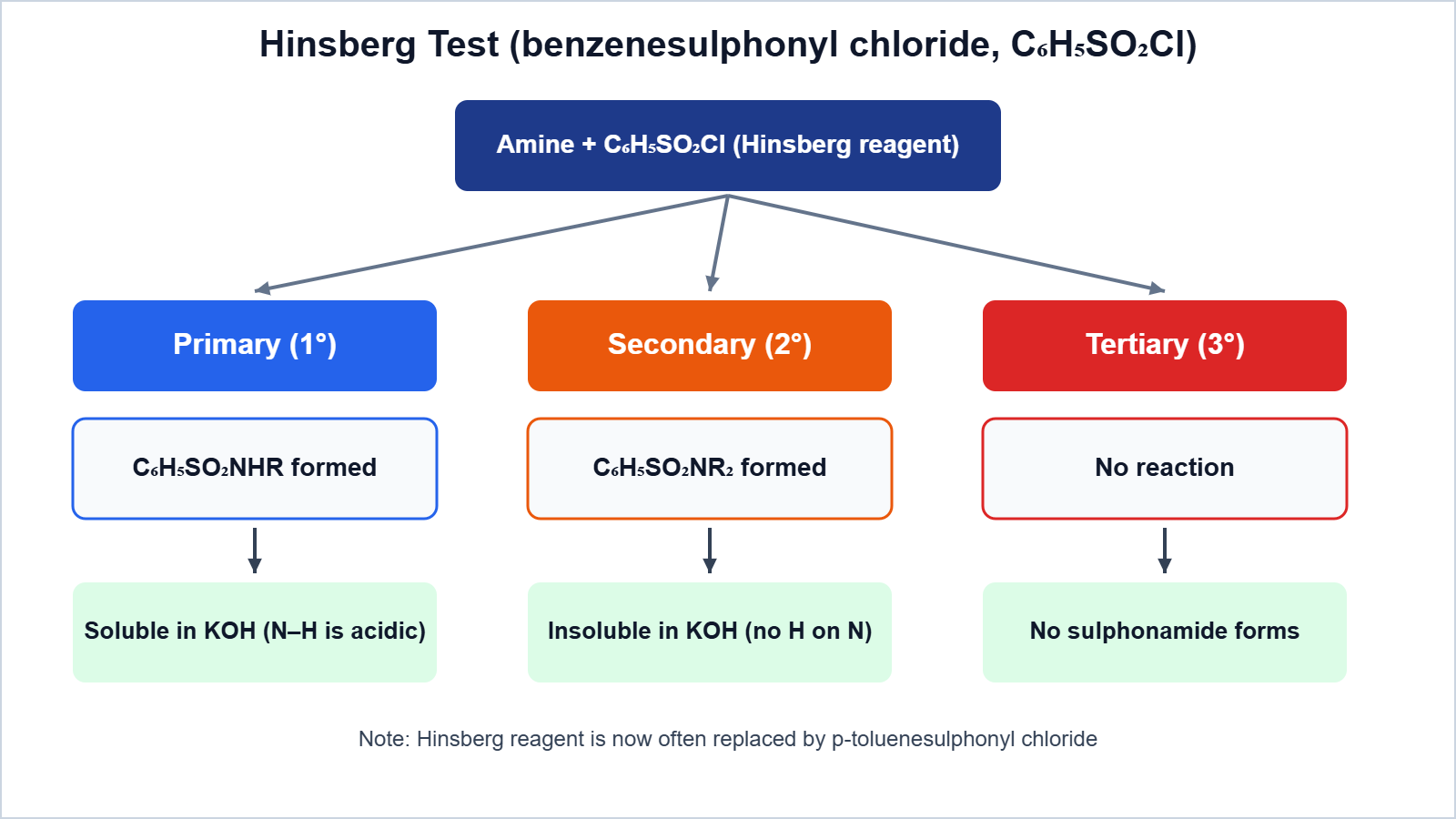
(F) Reaction with arylsulphonyl chloride (Hinsberg test):
(G) Electrophilic substitution in aniline: -NH2 is strongly activating and ortho/para directing.
- Bromination: aniline + bromine water at room temperature gives a white precipitate of 2,4,6-tribromoaniline. To get a monobromo product, the -NH2 group is first protected by acetylation (acetanilide), brominated (mainly para) and then hydrolysed.
- Nitration: direct nitration gives tarry oxidation products and a significant amount of the meta isomer, because in strongly acidic medium aniline is protonated to the anilinium ion, which is meta directing. Protection by acetylation gives mainly p-nitroaniline after hydrolysis.
- Sulphonation: aniline + conc. H2SO4 gives anilinium hydrogen sulphate, which on heating at 453-473 K gives p-aminobenzenesulphonic acid (sulphanilic acid), existing as a zwitter ion.
- Aniline does not undergo Friedel-Crafts reaction because it forms a salt with the Lewis acid AlCl3; nitrogen then carries a positive charge and deactivates the ring.
6. Identification of Primary, Secondary and Tertiary Amines
Test | 1° amine | 2° amine | 3° amine |
|---|---|---|---|
Hinsberg reagent | Sulphonamide soluble in alkali | Sulphonamide insoluble in alkali | No reaction |
Carbylamine test | Foul-smelling isocyanide | No reaction | No reaction |
Nitrous acid | Aliphatic: N2 evolved, alcohol formed; aromatic (cold): diazonium salt | Yellow oily N-nitrosoamine | Aliphatic: forms a soluble nitrite salt |
7. Diazonium Salts: Preparation
Diazonium salts have the general formula ArN2+X–. Benzenediazonium chloride is prepared by treating aniline with NaNO2 and HCl at 273-278 K (diazotisation): C6H5NH2 + NaNO2 + 2HCl → C6H5N2+Cl– + NaCl + 2H2O. It is used immediately because it is unstable above this temperature (it is stable only in cold solution). Arenediazonium ions are more stable than alkyl diazonium ions because of resonance with the ring.
8. Chemical Reactions of Diazonium Salts
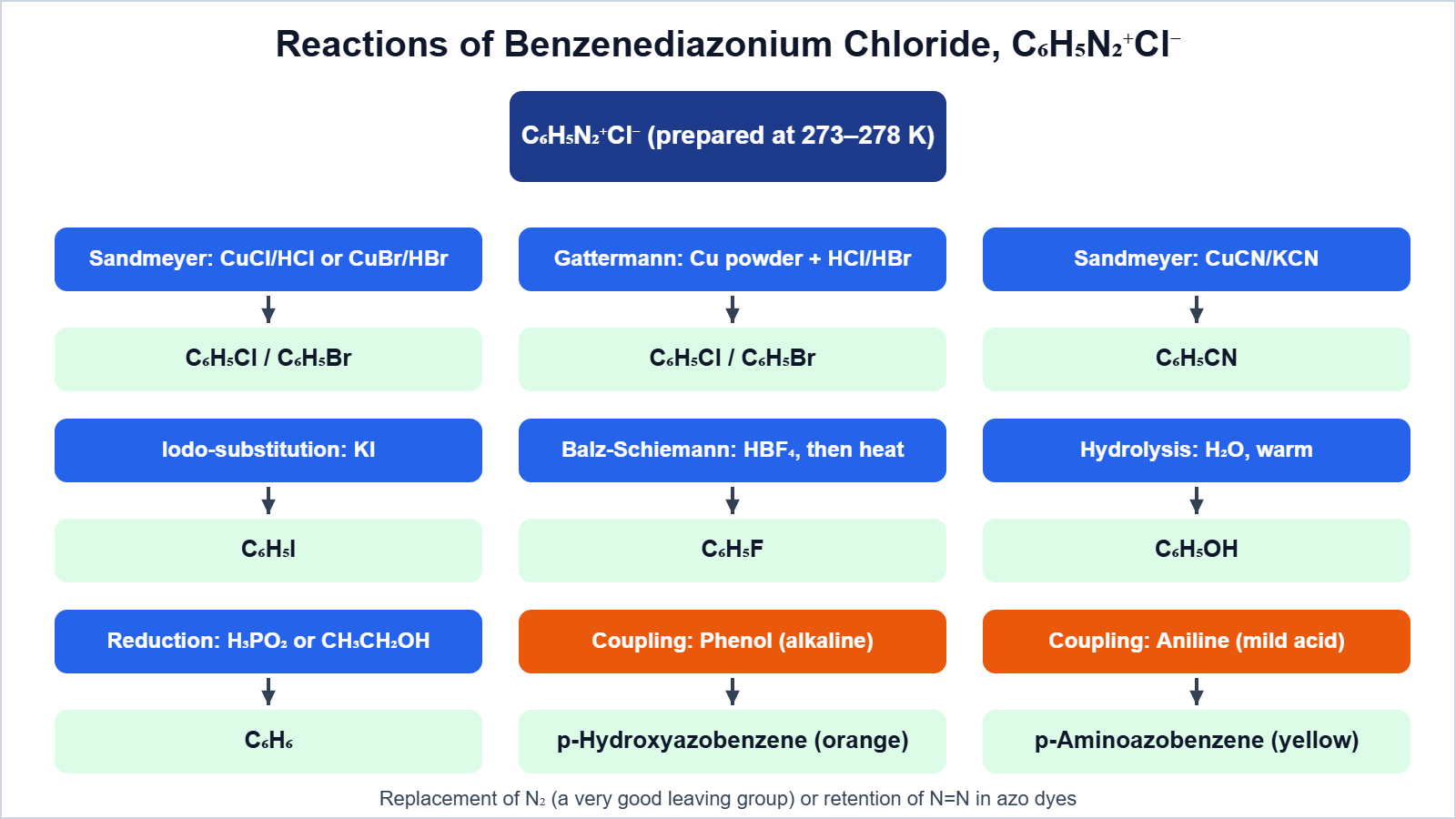
(A) Reactions with displacement of nitrogen:
- Sandmeyer reaction: C6H5N2Cl + CuCl/HCl → C6H5Cl + N2; with CuBr/HBr gives bromobenzene; with CuCN/KCN gives benzonitrile (C6H5CN).
- Gattermann reaction: copper powder with HCl or HBr gives chlorobenzene or bromobenzene.
- Iodide: C6H5N2Cl + KI → C6H5I + KCl + N2.
- Fluoride (Balz-Schiemann): with fluoroboric acid the diazonium fluoroborate precipitates; heating gives fluorobenzene.
- Hydrogen: hypophosphorous acid (H3PO2) or ethanol reduces it to benzene.
- Hydroxyl: warming with water gives phenol.
- Nitro group: diazonium fluoroborate heated with NaNO2 and copper gives nitrobenzene.
(B) Reactions retaining the diazo group (coupling): diazonium salts react with phenol (in alkaline medium) to give the orange dye p-hydroxyazobenzene, and with aniline (in mildly acidic medium) to give the yellow dye p-aminoazobenzene. These are electrophilic substitution reactions; the -N=N- (azo) group is the chromophore.
Importance in synthetic organic chemistry: diazonium salts allow the introduction of -F, -Cl, -Br, -I, -CN, -OH, -NO2 and -H into the benzene ring, including groups that cannot be introduced by direct substitution (e.g., fluorobenzene, iodobenzene, 1,3,5-tribromobenzene from 2,4,6-tribromoaniline). They are also used to prepare azo dyes.
Easy Memory Trick: “Sandmeyer uses Cu salts; Gattermann uses Cu powder”.
9. Uses of Amines
- Aniline is used to manufacture dyes, drugs and rubber chemicals.
- Quaternary ammonium salts are used as surfactants (detergents).
- Hexane-1,6-diamine is used to make nylon-6,6.
- Many drugs (antihistamines, local anaesthetics) and natural products (alkaloids) contain amine groups.
10. Important Conversions
- Benzene to aniline: nitration (conc. HNO3 + conc. H2SO4), then Sn/HCl.
- Ethanamide to methanamine: Br2 + NaOH (Hoffmann bromamide).
- Methyl bromide to ethanamine: KCN, then LiAlH4.
- Aniline to chlorobenzene: NaNO2/HCl at 273-278 K, then CuCl/HCl (Sandmeyer).
- Aniline to phenol: diazotisation, then warm with water.
- Aniline to fluorobenzene: diazotisation, HBF4, then heat.
- Aniline to p-bromoaniline: acetylation, bromination, hydrolysis.
- Nitrobenzene to benzoic acid: Sn/HCl, NaNO2/HCl, CuCN/KCN, then hydrolysis of benzonitrile.
11. Important Questions
Q1. Why are amines basic?
Ans. Due to the lone pair of electrons on nitrogen which can accept a proton.
Q2. Why is aniline a weaker base than ammonia?
Ans. The lone pair on nitrogen is delocalised into the benzene ring by resonance.
Q3. Arrange in order of basic strength in water: (CH3)2NH, CH3NH2, (CH3)3N, C6H5NH2.
Ans. (CH3)2NH > CH3NH2 > (CH3)3N > C6H5NH2.
Q4. Write the Hoffmann bromamide degradation reaction.
Ans. RCONH2 + Br2 + 4NaOH → RNH2 + Na2CO3 + 2NaBr + 2H2O.
Q5. Why can’t aromatic primary amines be prepared by Gabriel synthesis?
Ans. Aryl halides do not undergo nucleophilic substitution with the phthalimide anion.
Q6. What is the carbylamine reaction?
Ans. 1° amines heated with CHCl3 and alcoholic KOH give foul-smelling isocyanides.
Q7. How does the Hinsberg test distinguish 1°, 2° and 3° amines?
Ans. 1° gives alkali-soluble, 2° gives alkali-insoluble sulphonamide; 3° does not react.
Q8. Why is the -NH2 group of aniline acetylated before nitration?
Ans. To protect it from oxidation and to control the reaction so that mainly the para product forms.
Q9. Write the Sandmeyer reaction.
Ans. C6H5N2Cl + CuCl/HCl → C6H5Cl + N2.
Q10. What is a coupling reaction? Give an example.
Ans. Reaction of diazonium salt with phenol or aniline to give azo dyes; with phenol it gives orange p-hydroxyazobenzene.
Conclusion: Amines are basic, nucleophilic nitrogen compounds whose basic strength depends on inductive, solvation, steric and resonance effects. Aromatic amines give diazonium salts, which are versatile intermediates for introducing many groups into the benzene ring and for making azo dyes.