Chemical Coordination and Integration – Class 11 Biology Notes
Chapter – 19
Chemical Coordination and Integration
1. Introduction
The neural system provides point-to-point rapid coordination among organs. Neural coordination is fast but short-lived. Since nerve fibres do not innervate all cells of the body and cellular functions need to be continuously regulated, a special kind of coordination and integration has to be provided. This function is carried out by hormones. The neural system and the endocrine system jointly coordinate and regulate the physiological functions in the body.
2. Endocrine Glands and Hormones
- Endocrine glands lack ducts and are hence called ductless glands. Their secretions are called hormones.
- The classical definition: hormones are chemicals produced by endocrine glands, released into the blood and transported to a distantly located target organ.
- The current scientific definition: hormones are non-nutrient chemicals which act as intercellular messengers and are produced in trace amounts.
- Invertebrates possess very simple endocrine systems with few hormones, whereas a large number of chemicals act as hormones and provide coordination in vertebrates.
3. Human Endocrine System
The endocrine glands and hormone-producing diffused tissues/cells located in different parts of our body constitute the endocrine system. Pituitary, pineal, thyroid, adrenal, pancreas, parathyroid, thymus and gonads (testis in males and ovary in females) are the organised endocrine bodies. In addition, other organs like the gastrointestinal tract, liver, kidney and heart also produce hormones.
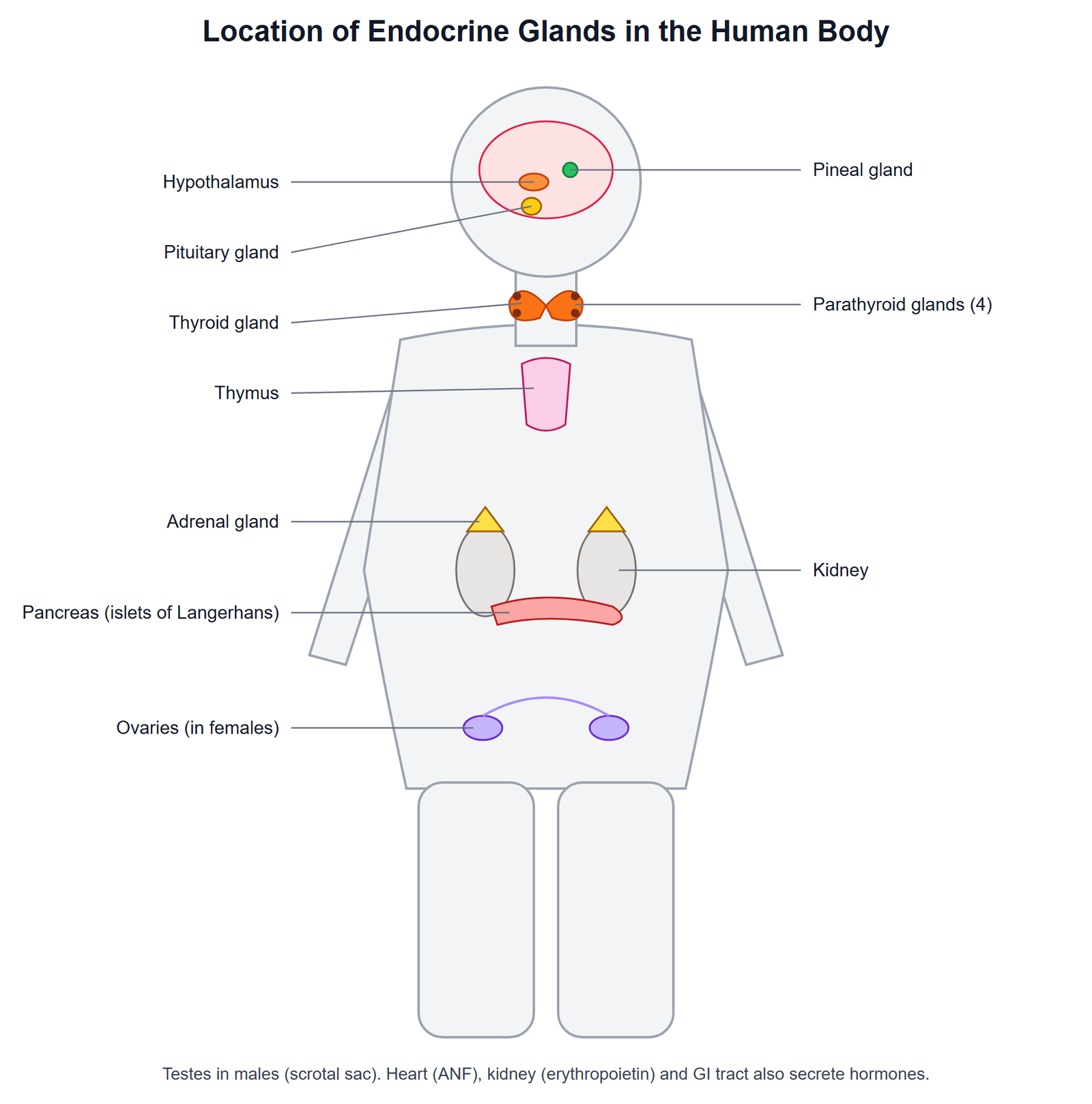
4. The Hypothalamus
- The hypothalamus is the basal part of the diencephalon (forebrain) and regulates a wide spectrum of body functions.
- It contains several groups of neurosecretory cells called nuclei, which produce hormones. These hormones regulate the synthesis and secretion of pituitary hormones.
- The hormones produced by the hypothalamus are of two types: releasing hormones (which stimulate secretion of pituitary hormones) and inhibiting hormones (which inhibit secretion of pituitary hormones).
- Example: Gonadotrophin releasing hormone (GnRH) from the hypothalamus stimulates the pituitary synthesis and release of gonadotrophins. Somatostatin from the hypothalamus inhibits the release of growth hormone from the pituitary.
- These hormones originating in the hypothalamic neurons pass through axons and are released from their nerve endings. They reach the pituitary gland through a portal circulatory system and regulate the functions of the anterior pituitary.
- The posterior pituitary is under the direct neural regulation of the hypothalamus.
5. The Pituitary Gland
The pituitary gland is located in a bony cavity called the sella turcica and is attached to the hypothalamus by a stalk. It is divided anatomically into an adenohypophysis and a neurohypophysis.
- The adenohypophysis consists of two portions: the pars distalis (commonly called the anterior pituitary) and the pars intermedia.
- The neurohypophysis (pars nervosa), also known as the posterior pituitary, stores and releases two hormones called oxytocin and vasopressin, which are actually synthesised by the hypothalamus and transported axonally to the neurohypophysis.
- The pars intermedia secretes only one hormone called melanocyte stimulating hormone (MSH). However, in humans, the pars intermedia is almost merged with the pars distalis.
Hormone (pars distalis) | Function |
|---|---|
Growth hormone (GH) | Growth of the body. Over-secretion stimulates abnormal growth (gigantism); low secretion results in stunted growth (pituitary dwarfism). Excess secretion in adults, especially in middle age, can result in severe disfigurement, especially of the face (acromegaly) |
Prolactin (PRL) | Regulates the growth of the mammary glands and formation of milk in them |
Thyroid stimulating hormone (TSH) | Stimulates the synthesis and secretion of thyroid hormones from the thyroid gland |
Adrenocorticotrophic hormone (ACTH) | Stimulates the synthesis and secretion of steroid hormones called glucocorticoids from the adrenal cortex |
Luteinizing hormone (LH) | In males, stimulates the synthesis and secretion of hormones called androgens from the testis. In females, induces ovulation of fully mature follicles (Graafian follicles) and maintains the corpus luteum formed from the remnants of the Graafian follicles after ovulation |
Follicle stimulating hormone (FSH) | In males, FSH and androgens regulate spermatogenesis. In females, FSH stimulates the growth and development of the ovarian follicles |
LH and FSH stimulate gonadal activity and hence are called gonadotrophins.
Hormone | Function |
|---|---|
MSH (pars intermedia) | Acts on the melanocytes (melanin-containing cells) and regulates pigmentation of the skin |
Oxytocin (posterior pituitary) | Acts on the smooth muscles of our body and stimulates their contraction. In females, it stimulates a vigorous contraction of the uterus at the time of childbirth and milk ejection from the mammary gland |
Vasopressin / ADH (posterior pituitary) | Acts mainly at the kidney and stimulates resorption of water and electrolytes by the distal tubules, thereby reducing loss of water through urine (diuresis). Hence it is also called the anti-diuretic hormone (ADH). Impairment affecting its synthesis or release results in diminished ability of the kidney to conserve water, leading to water loss and dehydration. This condition is known as Diabetes Insipidus |
6. The Pineal Gland
The pineal gland is located on the dorsal side of the forebrain. It secretes a hormone called melatonin, which plays a very important role in the regulation of the 24-hour (diurnal) rhythm of our body. For example, it helps in maintaining the normal rhythms of the sleep-wake cycle and body temperature. Melatonin also influences metabolism, pigmentation, the menstrual cycle and our defence capability.
7. The Thyroid Gland
- The thyroid gland is composed of two lobes located on either side of the trachea. Both lobes are interconnected with a thin flap of connective tissue called the isthmus.
- It is composed of follicles and stromal tissues. Each thyroid follicle is composed of follicular cells enclosing a cavity.
- These follicular cells synthesise two hormones: tetraiodothyronine or thyroxine (T4) and triiodothyronine (T3).
- Iodine is essential for the normal rate of hormone synthesis in the thyroid.
- The thyroid gland also secretes a protein hormone called thyrocalcitonin (TCT), which regulates blood calcium levels.
Functions of thyroid hormones: They play an important role in the regulation of the basal metabolic rate. They also support the process of red blood cell formation, control the metabolism of carbohydrates, proteins and fats, and influence the maintenance of water and electrolyte balance.
Disorder | Cause and effects |
|---|---|
Goitre | Deficiency of iodine in our diet results in hypothyroidism and enlargement of the thyroid gland |
Cretinism | Hypothyroidism during pregnancy causes defective development and maturation of the growing baby, leading to stunted growth, mental retardation, low intelligence quotient, abnormal skin, deaf-mutism, etc. |
Hypothyroidism in adult women | May cause the menstrual cycle to become irregular |
Hyperthyroidism | Due to cancer of the thyroid gland or the development of nodules, the rate of synthesis and secretion of thyroid hormones increases to abnormally high levels, adversely affecting body physiology |
Exophthalmic goitre (Graves’ disease) | A form of hyperthyroidism characterised by enlargement of the thyroid gland, protrusion of the eyeballs, increased basal metabolic rate and weight loss |
8. The Parathyroid Gland
- In humans, four parathyroid glands are present on the back side of the thyroid gland, one pair each in the two lobes of the thyroid gland.
- They secrete a peptide hormone called parathyroid hormone (PTH). The secretion of PTH is regulated by the circulating levels of calcium ions.
- PTH increases the Ca2+ levels in the blood. It acts on bones and stimulates the process of bone resorption (dissolution/demineralisation). PTH also stimulates reabsorption of Ca2+ by the renal tubules and increases Ca2+ absorption from the digested food.
- It is thus a hypercalcemic hormone, and along with TCT, it plays a significant role in calcium balance in the body.
Remember: PTH raises blood calcium (hypercalcemic), while TCT from the thyroid lowers it (hypocalcemic).
9. The Thymus
- The thymus gland is a lobular structure located between the lungs, behind the sternum, on the ventral side of the aorta.
- It plays a major role in the development of the immune system. It secretes peptide hormones called thymosins.
- Thymosins play a major role in the differentiation of T-lymphocytes, which provide cell-mediated immunity. In addition, thymosins also promote production of antibodies to provide humoral immunity.
- The thymus is degenerated in old individuals, resulting in decreased production of thymosins. As a result, the immune responses of old persons become weak.
10. The Adrenal Gland
Our body has one pair of adrenal glands, one at the anterior part of each kidney. The gland is composed of two types of tissues: the centrally located adrenal medulla and outside this, the adrenal cortex.
(a) Adrenal medulla: Secretes two hormones called adrenaline or epinephrine and noradrenaline or norepinephrine. These are commonly called catecholamines.
- Adrenaline and noradrenaline are rapidly secreted in response to stress of any kind and during emergency situations, and are called emergency hormones or hormones of Fight or Flight.
- These hormones increase alertness, pupillary dilation, piloerection (raising of hairs), sweating, etc.
- Both hormones increase the heart beat, the strength of heart contraction and the rate of respiration.
- Catecholamines also stimulate the breakdown of glycogen, resulting in increased concentration of glucose in blood. In addition, they stimulate the breakdown of lipids and proteins.
(b) Adrenal cortex: Divided into three layers: the inner zona reticularis, middle zona fasciculata and outer zona glomerulosa. It secretes many hormones commonly called corticoids.
- Glucocorticoids (involved in carbohydrate metabolism), mainly cortisol: Stimulate gluconeogenesis, lipolysis and proteolysis; inhibit cellular uptake and utilisation of amino acids. Cortisol is also involved in maintaining the cardiovascular system as well as kidney functions. Glucocorticoids, particularly cortisol, produce anti-inflammatory reactions and suppress the immune response. Cortisol stimulates RBC production.
- Mineralocorticoids (regulate the balance of water and electrolytes), mainly aldosterone: Acts mainly at the renal tubules and stimulates the reabsorption of Na+ and water and excretion of K+ and phosphate ions. Thus, aldosterone helps in the maintenance of electrolytes, body fluid volume, osmotic pressure and blood pressure.
- Small amounts of androgenic steroids are also secreted by the adrenal cortex, which play a role in the growth of axial hair, pubic hair and facial hair during puberty.
Exam point: Underproduction of hormones by the adrenal cortex alters carbohydrate metabolism, causing acute weakness and fatigue, leading to a disease called Addison’s disease.
11. The Pancreas
The pancreas is a composite gland that acts as both an exocrine and an endocrine gland. The endocrine pancreas consists of islets of Langerhans. There are about 1 to 2 million islets in a normal human pancreas, representing only 1 to 2% of the pancreatic tissue.
Feature | Glucagon | Insulin |
|---|---|---|
Secreted by | α-cells | β-cells |
Nature | Peptide hormone | Peptide hormone |
Main action site | Liver cells (hepatocytes) | Hepatocytes and adipocytes (fat cells) |
Effect | Stimulates glycogenolysis and gluconeogenesis, increasing blood sugar (hyperglycemia); reduces cellular glucose uptake and utilisation | Enhances cellular glucose uptake and utilisation; stimulates conversion of glucose to glycogen (glycogenesis), decreasing blood sugar (hypoglycemia) |
Important: Glucagon is a hyperglycemic hormone and insulin is a hypoglycemic hormone. Glucose homeostasis in blood is maintained jointly by these two hormones. Prolonged hyperglycemia leads to a complex disorder called diabetes mellitus, which is associated with loss of glucose through urine and formation of harmful compounds known as ketone bodies. Diabetic patients are successfully treated with insulin therapy.
12. Testis and Ovary
Testis: A pair of testes is present in the scrotal sac (outside the abdomen) of males. The testis performs dual functions as a primary sex organ as well as an endocrine gland. It is composed of seminiferous tubules and stromal or interstitial tissue. The Leydig cells or interstitial cells, present in the intertubular spaces, produce a group of hormones called androgens, mainly testosterone.
- Androgens regulate the development, maturation and functions of the male accessory sex organs like the epididymis, vas deferens, seminal vesicles, prostate gland, urethra, etc.
- They stimulate muscular growth, growth of facial and axillary hair, aggressiveness, low pitch of voice, etc.
- Androgens play a major stimulatory role in the process of spermatogenesis (formation of spermatozoa).
- They act on the CNS and influence male sexual behaviour (libido).
- They produce anabolic (synthetic) effects on protein and carbohydrate metabolism.
Ovary: Females have a pair of ovaries located in the abdomen. The ovary is the primary female sex organ, which produces one ovum during each menstrual cycle. In addition, the ovary produces two groups of steroid hormones called estrogen and progesterone.
- The ovary is composed of ovarian follicles and stromal tissues. Estrogen is synthesised and secreted mainly by the growing ovarian follicles.
- After ovulation, the ruptured follicle is converted into a structure called the corpus luteum, which secretes mainly progesterone.
- Estrogens produce wide-ranging actions such as stimulation of growth and activities of female secondary sex organs, development of growing ovarian follicles, appearance of female secondary sex characters (e.g. high pitch of voice), mammary gland development, and regulation of female sexual behaviour.
- Progesterone supports pregnancy. It also acts on the mammary glands and stimulates the formation of alveoli (sac-like structures that store milk) and milk secretion.
13. Hormones of Heart, Kidney and Gastrointestinal Tract
- Heart: The atrial wall secretes a peptide hormone called atrial natriuretic factor (ANF), which decreases blood pressure. When blood pressure is increased, ANF is secreted, which causes dilation of the blood vessels and reduces the blood pressure.
- Kidney: The juxtaglomerular cells of the kidney produce a peptide hormone called erythropoietin, which stimulates erythropoiesis (formation of RBCs).
- Gastrointestinal tract: Endocrine cells present in different parts of the GI tract secrete four major peptide hormones:
- Gastrin: Acts on the gastric glands and stimulates the secretion of hydrochloric acid and pepsinogen.
- Secretin: Acts on the exocrine pancreas and stimulates the secretion of water and bicarbonate ions.
- Cholecystokinin (CCK): Acts on both the pancreas and gall bladder and stimulates the secretion of pancreatic enzymes and bile juice respectively.
- Gastric inhibitory peptide (GIP): Inhibits gastric secretion and motility.
- Several other non-endocrine tissues secrete hormones called growth factors. These factors are essential for the normal growth of tissues and their repair/regeneration.
14. Mechanism of Hormone Action
Hormones produce their effects on target tissues by binding to specific proteins called hormone receptors, located in the target tissues only. Each receptor is specific to one hormone only, and hence receptors are specific. Hormone-receptor binding leads to the formation of a hormone-receptor complex, which leads to certain biochemical changes in the target tissue.
Feature | Membrane-bound receptors | Intracellular receptors |
|---|---|---|
Location | Present on the cell membrane of target cells | Present inside the target cell (mostly nuclear receptors) |
Hormones | Hormones that do not enter the target cell, e.g. protein/peptide hormones (insulin, glucagon, pituitary and hypothalamic hormones) and amino acid derivatives (epinephrine) | Hormones that enter the cell, e.g. steroids (cortisol, testosterone, estradiol, progesterone) and iodothyronines (thyroid hormones) |
Mechanism | Generate second messengers (e.g. cyclic AMP, IP3, Ca++), which in turn regulate cellular metabolism | Hormone-receptor complex interacts with the genome; mostly regulates gene expression or chromosome function |
Chemical nature of hormones:
- Peptide, polypeptide and protein hormones: e.g. insulin, glucagon, pituitary hormones, hypothalamic hormones, etc.
- Steroids: e.g. cortisol, testosterone, estradiol and progesterone.
- Iodothyronines: thyroid hormones.
- Amino acid derivatives: e.g. epinephrine.
Easy Memory Trick: “Steroids Slip inside” — steroid and thyroid hormones cross the membrane and bind intracellular receptors, while protein hormones stay outside and use second messengers.
Conclusion: The endocrine system provides chemical coordination through hormones, which are non-nutrient chemical messengers produced in trace amounts. The hypothalamus controls the pituitary, which in turn regulates the thyroid, adrenal cortex and gonads. Other glands include the pineal, parathyroid, thymus and pancreas, and the heart, kidney and GI tract also secrete hormones. Hormones act by binding to specific membrane-bound or intracellular receptors.