Respiration in Plants – Class 11 Biology Notes
Chapter – 12
Respiration in Plants
1. Introduction
All living organisms need energy for activities such as absorption, transport, movement, reproduction and even breathing. This energy comes from the oxidation of food molecules.
Cellular respiration is the breaking of C–C bonds of complex compounds through oxidation within the cells, leading to the release of a considerable amount of energy. The compounds oxidised are called respiratory substrates; usually carbohydrates, but proteins, fats and even organic acids can be used in some plants under certain conditions.
- The energy is not released in one step; it is released in a series of slow, step-wise reactions controlled by enzymes and trapped as chemical energy in ATP.
- ATP acts as the energy currency of the cell.
- The carbon skeletons produced during respiration are used as precursors for the biosynthesis of other molecules in the cell.
2. Do Plants Breathe?
Yes, plants need O2 for respiration and give out CO2, but unlike animals they have no specialised organs for gaseous exchange. They use stomata and lenticels. Reasons why plants manage without respiratory organs:
- Each plant part takes care of its own gas-exchange needs; there is very little transport of gases from one part to another.
- Plants do not have great demands for gas exchange. Roots, stems and leaves respire at rates far lower than animals. Only during photosynthesis are large volumes of gases exchanged, and each leaf is well adapted for this.
- The distance gases must diffuse is small. Most living cells of a plant are close to the surface; in stems, living cells are in thin layers under the bark, which has lenticels. Loosely packed parenchyma cells create an interconnected network of air spaces.
Complete combustion of glucose:
C6H12O6 + 6O2 → 6CO2 + 6H2O + Energy
3. Overview of Respiration
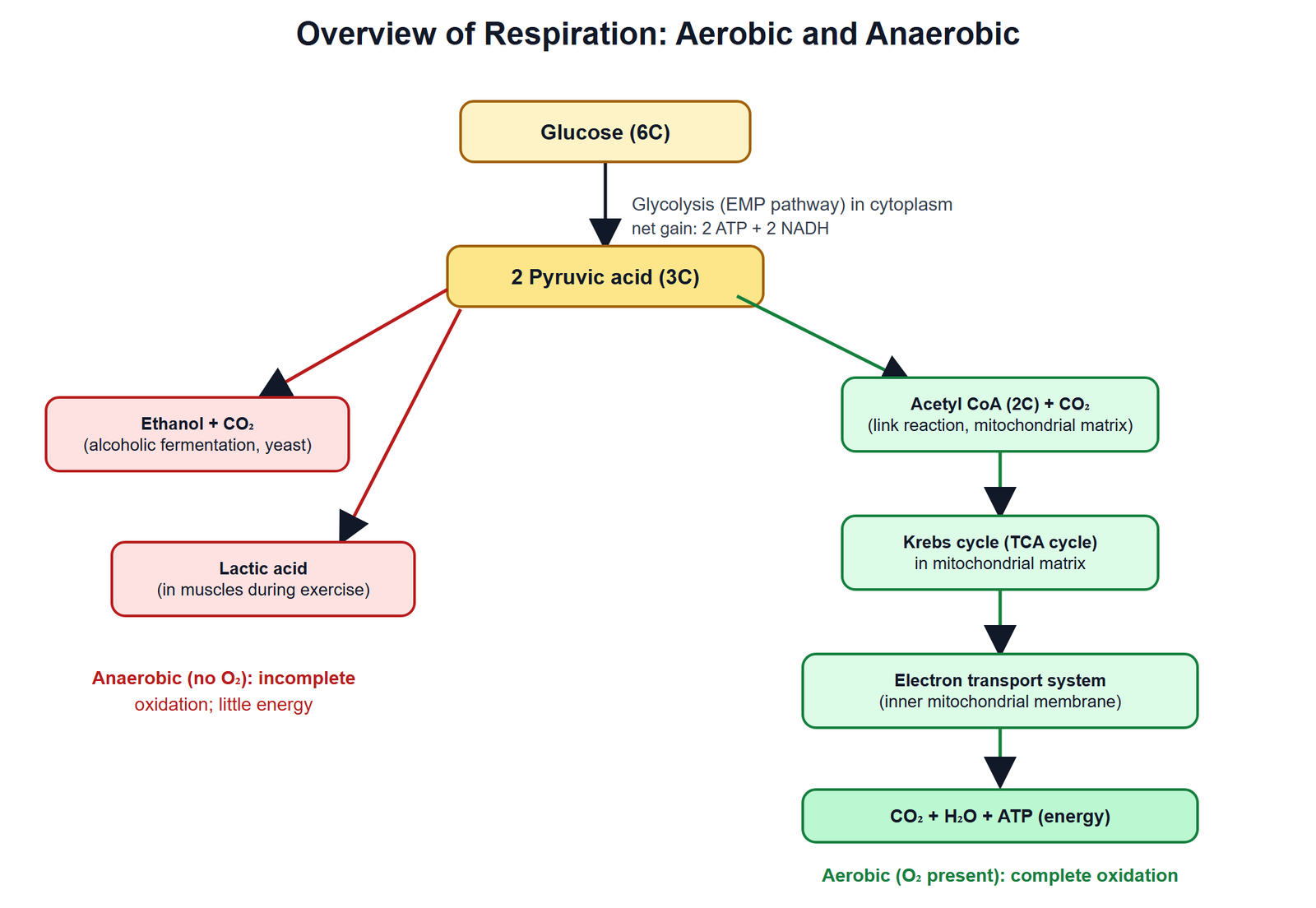
The first step, glycolysis, is common to all organisms. The fate of pyruvic acid then depends on the cellular need and availability of oxygen:
- Lactic acid fermentation (e.g. in muscles when oxygen is inadequate).
- Alcoholic fermentation (e.g. in yeast).
- Aerobic respiration, which leads to complete oxidation of organic substances in the presence of oxygen and releases CO2, water and a large amount of energy.
4. Glycolysis (EMP Pathway)
The term glycolysis comes from the Greek words glycos (sugar) and lysis (splitting). The scheme was given by Gustav Embden, Otto Meyerhof and J. Parnas, so it is also called the EMP pathway.
- It occurs in the cytoplasm of all living organisms.
- It is the only process of respiration in anaerobic organisms.
- Glucose undergoes partial oxidation to form two molecules of pyruvic acid.
- In plants, glucose comes from sucrose (broken into glucose and fructose by invertase) or from storage carbohydrates.
Main steps:
- Glucose is phosphorylated to glucose-6-phosphate by the enzyme hexokinase (1 ATP used).
- Glucose-6-phosphate is isomerised to fructose-6-phosphate.
- Fructose-6-phosphate is phosphorylated to fructose-1,6-bisphosphate (1 ATP used).
- Fructose-1,6-bisphosphate splits into dihydroxyacetone phosphate (DHAP) and 3-phosphoglyceraldehyde (PGAL).
- PGAL is oxidised to 1,3-bisphosphoglycerate (BPGA), forming NADH + H+ from NAD+.
- BPGA is converted to 3-phosphoglyceric acid (PGA), producing ATP.
- PGA is converted to 2-PGA, then to phosphoenolpyruvate (PEP).
- PEP is converted to pyruvic acid, producing ATP.
Exam point: In glycolysis, 2 ATP are used and 4 ATP are produced, so the net gain is 2 ATP, along with 2 NADH, per glucose molecule.
5. Fermentation (Anaerobic Respiration)
- Alcoholic fermentation (yeast): Incomplete oxidation of glucose under anaerobic conditions. Pyruvic acid is converted to CO2 and ethanol by the enzymes pyruvic acid decarboxylase and alcohol dehydrogenase.
- Lactic acid fermentation: In some bacteria and in animal muscle cells during exercise when oxygen is inadequate, pyruvic acid is reduced to lactic acid by lactate dehydrogenase.
In both, the reducing agent NADH + H+ is reoxidised to NAD+.
Important: In fermentation, less than 7% of the energy in glucose is released, and not all of it is trapped as ATP. The products (acid or alcohol) are hazardous; yeasts poison themselves to death when the alcohol concentration reaches about 13%.
6. Aerobic Respiration
Aerobic respiration takes place within the mitochondria. It involves two crucial events:
- Complete oxidation of pyruvate by stepwise removal of all hydrogen atoms, leaving three molecules of CO2 (in the matrix).
- Passing the electrons removed as part of hydrogen atoms to O2, with simultaneous synthesis of ATP (on the inner membrane).
Link reaction (oxidative decarboxylation of pyruvate): Pyruvate enters the mitochondrial matrix and undergoes oxidative decarboxylation by the pyruvic dehydrogenase complex, which requires coenzymes including NAD+ and Coenzyme A.
Pyruvic acid + CoA + NAD+ → Acetyl CoA + CO2 + NADH + H+ (Mg2+, pyruvate dehydrogenase)
Two molecules of NADH are produced from the two pyruvic acid molecules of one glucose.
7. Tricarboxylic Acid (TCA) Cycle / Krebs Cycle
The cycle was first worked out by Hans Krebs. It takes place in the mitochondrial matrix.
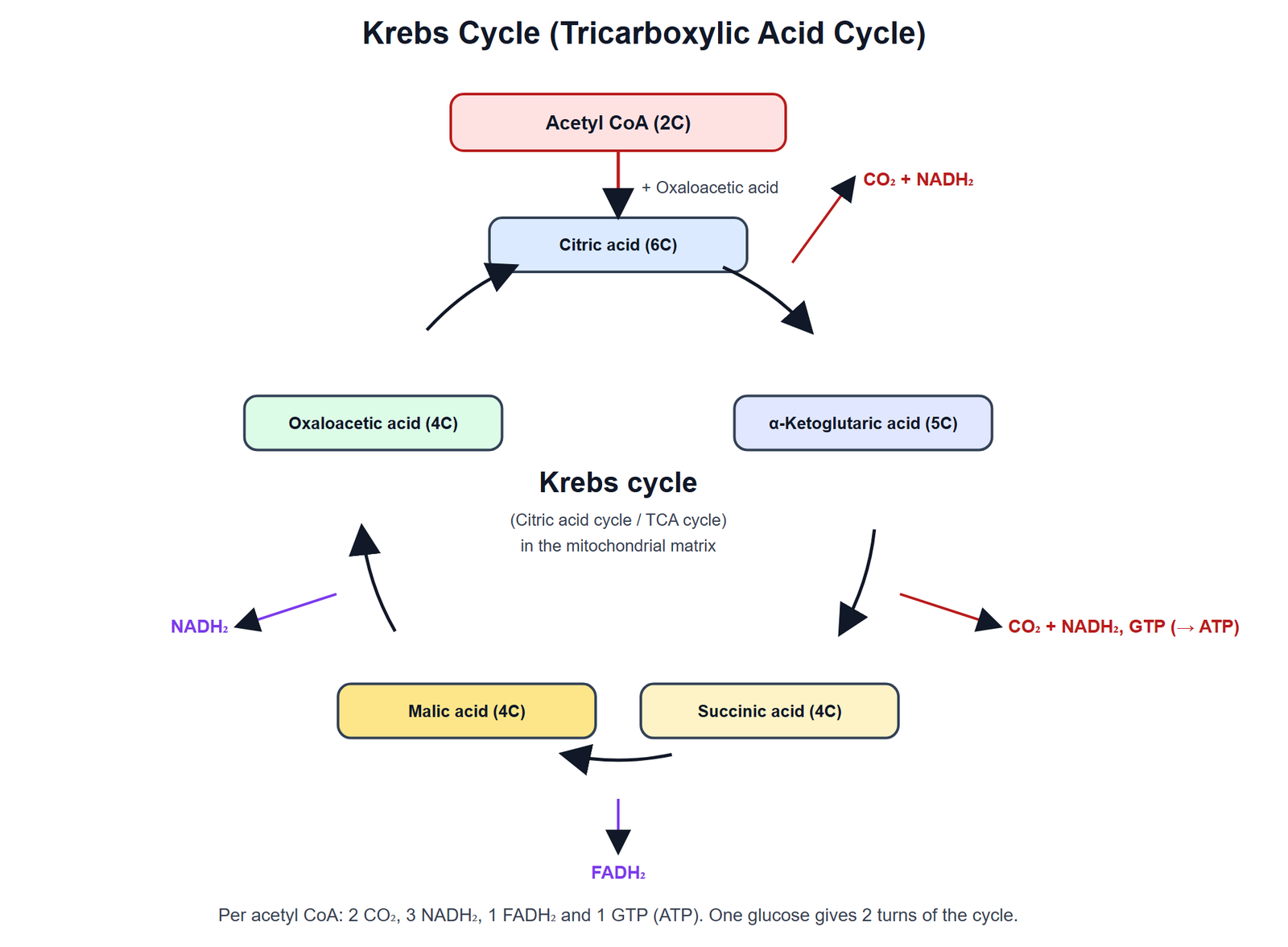
- The acetyl group condenses with oxaloacetic acid (OAA, 4C) and water to form citric acid (6C), catalysed by citrate synthase; CoA is released.
- Citrate is isomerised to isocitrate.
- Two successive decarboxylations form α-ketoglutaric acid (5C) and then succinyl CoA (4C).
- Succinyl CoA is oxidised to succinic acid; one GTP is synthesised (substrate-level phosphorylation). GTP is converted to ATP (via GDP).
- Succinic acid → fumaric acid → malic acid → OAA, allowing the cycle to continue.
During the cycle, NAD+ is reduced to NADH + H+ at three points, and FAD+ is reduced to FADH2 at one point.
Summary equation:
Pyruvic acid + 4NAD+ + FAD+ + 2H2O + ADP + Pi → 3CO2 + 4NADH + 4H+ + FADH2 + ATP
Remember: One glucose gives two pyruvates, so the link reaction and the Krebs cycle run twice per glucose molecule.
8. Electron Transport System (ETS) and Oxidative Phosphorylation
The energy stored in NADH + H+ and FADH2 is released when they are oxidised through the electron transport system, and electrons are passed on to O2, forming H2O. The ETS is present in the inner mitochondrial membrane.
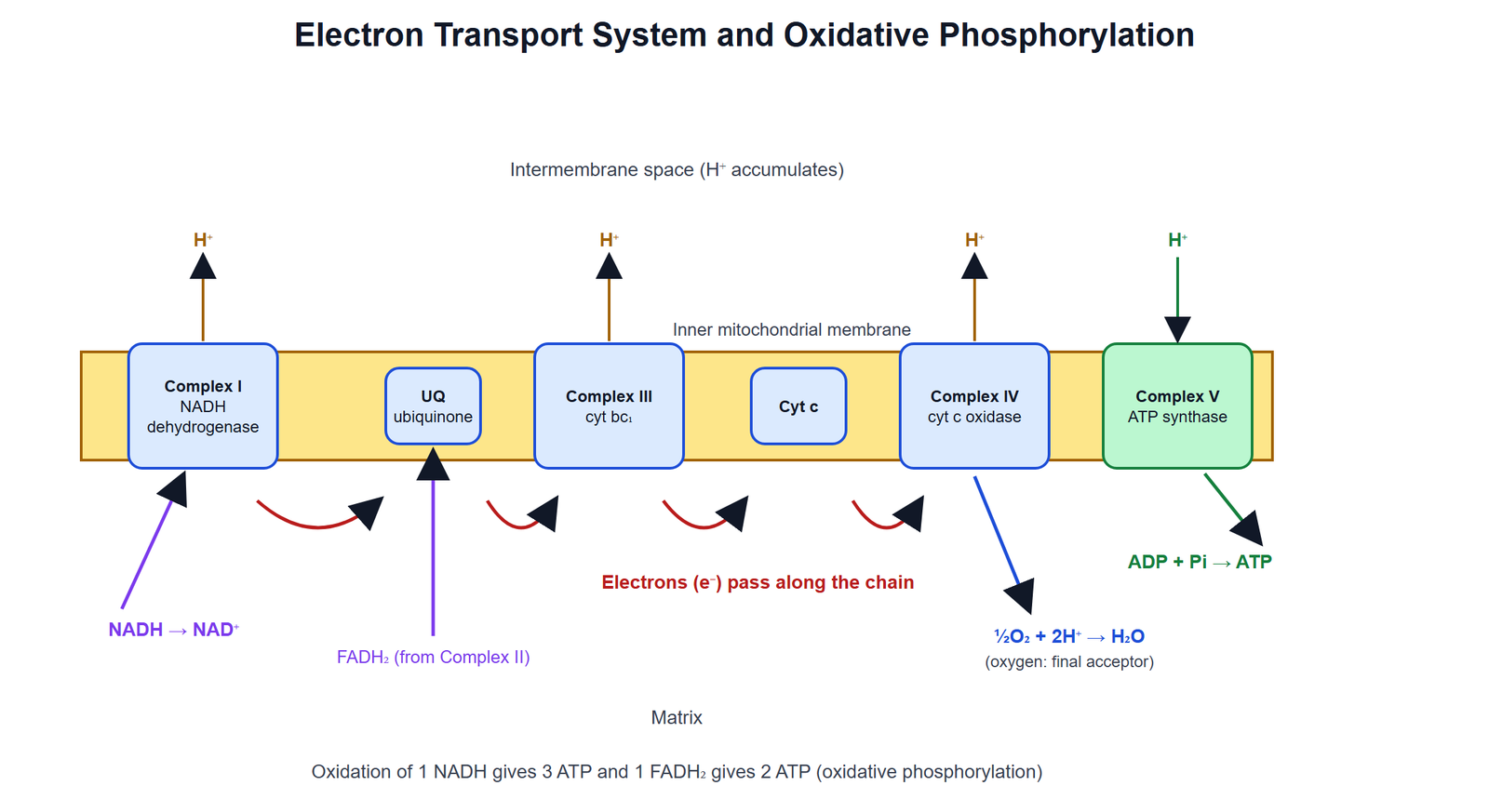
- Electrons from NADH produced in the matrix are oxidised by NADH dehydrogenase (Complex I) and transferred to ubiquinone.
- Ubiquinone also receives reducing equivalents from FADH2 (Complex II), generated during oxidation of succinate.
- Reduced ubiquinone (ubiquinol) is oxidised by transferring electrons to cytochrome c via the cytochrome bc1 complex (Complex III).
- Cytochrome c is a small protein attached to the outer surface of the inner membrane that acts as a mobile carrier between Complex III and Complex IV (cytochrome c oxidase, containing cytochromes a and a3 and two copper centres).
- Oxygen is the final hydrogen (electron) acceptor; it combines with electrons and protons to form water.
- As electrons pass through Complexes I to IV, the energy is coupled to ATP synthase (Complex V) to make ATP from ADP and inorganic phosphate.
ATP synthase (Complex V): It has two major components:
- F1 headpiece: A peripheral membrane protein complex that is the site of ATP synthesis from ADP and inorganic phosphate.
- F0: An integral membrane protein complex that forms the channel through which protons cross the inner membrane.
For each ATP produced, 2H+ pass through F0 from the intermembrane space to the matrix down the electrochemical proton gradient. Since this ATP synthesis uses energy from oxidation-reduction, it is called oxidative phosphorylation.
Exam point: One NADH gives 3 ATP and one FADH2 gives 2 ATP. In photophosphorylation, light energy creates the proton gradient; in oxidative phosphorylation, the energy of oxidation-reduction is used.
9. The Respiratory Balance Sheet
The net gain of ATP from one glucose can be calculated only on certain assumptions:
- There is a sequential, orderly pathway: glycolysis → TCA cycle → ETS.
- The NADH made in glycolysis is transferred into the mitochondria and undergoes oxidative phosphorylation.
- None of the intermediates is used to make another compound.
- Only glucose is respired; no alternative substrates enter the pathway.
Stage | Direct ATP | NADH | FADH2 | Total ATP |
|---|---|---|---|---|
Glycolysis | 2 | 2 (= 6 ATP) | – | 8 |
Link reaction (×2) | – | 2 (= 6 ATP) | – | 6 |
Krebs cycle (×2) | 2 | 6 (= 18 ATP) | 2 (= 4 ATP) | 24 |
Total |
|
|
| 38 ATP |
Remember: These assumptions are not really valid in a living system. All pathways work simultaneously, substrates enter and leave as needed and ATP is used as required, so 38 ATP is a theoretical maximum.
Feature | Aerobic respiration | Fermentation |
|---|---|---|
Oxidation of glucose | Complete, to CO2 and H2O | Partial, to ethanol + CO2 or lactic acid |
Net ATP per glucose | 38 (theoretical) | 2 |
NADH oxidation | Vigorous, through ETS | Very slow |
Site | Cytoplasm and mitochondria | Cytoplasm only |
10. Amphibolic Pathway
Glucose is the favoured substrate, but other substrates can enter respiration:
- Fats are broken down into glycerol and fatty acids. Glycerol enters as PGAL; fatty acids are degraded to acetyl CoA.
- Proteins are broken down by proteases into amino acids, which (after deamination) enter at pyruvic acid, acetyl CoA or within the Krebs cycle.
When the organism needs to synthesise fatty acids, acetyl CoA is withdrawn from the pathway; when it needs proteins, respiratory intermediates are used. Since the respiratory pathway is involved in both breakdown (catabolism) and synthesis (anabolism), it is better considered an amphibolic pathway rather than a purely catabolic one.
11. Respiratory Quotient (RQ)
The ratio of the volume of CO2 evolved to the volume of O2 consumed in respiration is called the respiratory quotient (RQ) or respiratory ratio.
RQ = Volume of CO2 evolved / Volume of O2 consumed
Substrate | RQ | Reason |
|---|---|---|
Carbohydrates | 1 | Equal amounts of CO2 and O2 (6CO2 / 6O2) |
Fats (e.g. tripalmitin) | Less than 1 (about 0.7) | 102CO2 / 145O2 = 0.7 |
Proteins | About 0.9 | More O2 used than CO2 released |
Organic acids | More than 1 | Already partly oxidised |
Example: For tripalmitin, 2(C51H98O6) + 145O2 → 102CO2 + 98H2O + energy, so RQ = 102/145 = 0.7.
Easy Memory Trick: “Glycolysis in the Gel, Krebs in the Kitchen, ETS on the Edge” — glycolysis in the cytoplasm, Krebs cycle in the matrix, ETS on the inner membrane.
Conclusion: Respiration releases the energy of food step by step and stores it as ATP. Glycolysis in the cytoplasm gives pyruvate; without oxygen, it forms ethanol or lactic acid, while with oxygen it is completely oxidised in the mitochondria through the link reaction, Krebs cycle and ETS, giving up to 38 ATP per glucose. The pathway is amphibolic, and the RQ tells us which substrate is being respired.