Photosynthesis in Higher Plants – Class 11 Biology Notes
Chapter – 11
Photosynthesis in Higher Plants
1. What is Photosynthesis?
Photosynthesis is a physico-chemical process by which green plants use light energy to drive the synthesis of organic compounds (carbohydrates) from carbon dioxide and water. It is the primary source of all food on earth and is also responsible for the release of oxygen into the atmosphere.
Overall equation:
6CO2 + 12H2O → C6H12O6 + 6H2O + 6O2 (in the presence of light and chlorophyll)
Early experiments:
- Joseph Priestley (1770): Showed that a candle burning or a mouse breathing in a closed bell jar “damaged” the air, and a mint plant could restore it. He discovered oxygen in 1774.
- Jan Ingenhousz: Showed that sunlight is essential for the plant to purify the air, and that only the green parts of plants release oxygen.
- Julius von Sachs (1854): Found that glucose is made in green parts and is usually stored as starch; chlorophyll is located in chloroplasts.
- T.W. Engelmann: Using a prism and aerobic bacteria on Cladophora, he plotted the first action spectrum of photosynthesis; bacteria gathered mainly in the blue and red regions.
- Cornelius van Niel: Working with purple and green sulphur bacteria, showed that photosynthesis is a light-dependent reaction in which hydrogen from a suitable oxidisable compound reduces CO2. He inferred that the O2 evolved by green plants comes from H2O, not CO2. This was later proved using radioisotopes.
Important: The oxygen released in photosynthesis comes from water. This is why 12H2O appears in the balanced equation.
2. Where Does Photosynthesis Take Place?
Photosynthesis occurs in the green leaves and also in other green parts of the plant. Within the leaf, it occurs mainly in the mesophyll cells, which contain a large number of chloroplasts.
- Grana (thylakoid membranes): Trap light energy and make ATP and NADPH. These are the sites of the light reactions.
- Stroma: Contains enzymes that reduce CO2 to sugars. This is the site of the dark reactions (biosynthetic phase). The dark reaction does not mean it happens in darkness; it is not directly light-driven but depends on the products of the light reaction.
3. Pigments Involved in Photosynthesis
Paper chromatography of leaf pigments separates four pigments:
Pigment | Colour on chromatogram | Role |
|---|---|---|
Chlorophyll a | Bright or blue-green | Chief pigment; reaction centre |
Chlorophyll b | Yellow-green | Accessory pigment |
Xanthophylls | Yellow | Accessory pigment |
Carotenoids | Yellow to yellow-orange | Accessory pigment; protects chlorophyll a from photo-oxidation |
- Absorption spectrum: Chlorophyll a absorbs maximum light in the blue and red regions.
- Action spectrum: The rate of photosynthesis is also highest in the blue and red regions, which shows that chlorophyll a is the chief pigment.
- The accessory pigments absorb light of other wavelengths and transfer the energy to chlorophyll a, so a wider range of light can be used.
4. Light Reaction (Photochemical Phase)
The light reaction includes light absorption, water splitting, oxygen release, and formation of the high-energy chemical intermediates ATP and NADPH.
Light harvesting complexes (LHC): Pigments are organised into two discrete photochemical LHCs called Photosystem I (PS I) and Photosystem II (PS II). Each LHC is made of hundreds of pigment molecules bound to proteins (the antenna) and has a single chlorophyll a molecule that forms the reaction centre.
- PS I reaction centre: absorption peak at 700 nm, called P700.
- PS II reaction centre: absorption peak at 680 nm, called P680.
Remember: The photosystems are named in the order of their discovery, not in the order in which they work during the light reaction. PS II acts first.
The electron transport (Z-scheme):
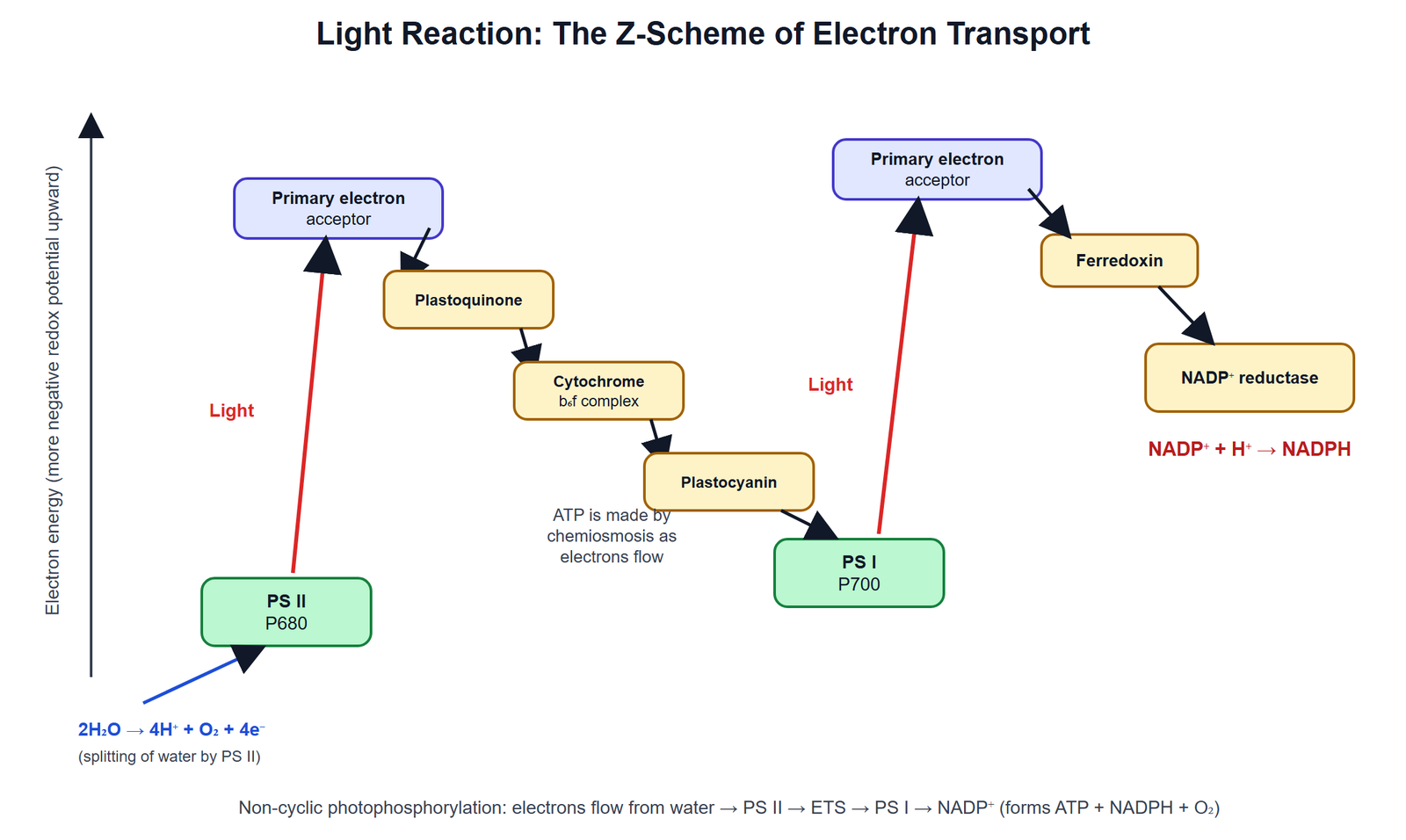
- The reaction centre of PS II absorbs 680 nm red light. Its electrons become excited and are accepted by a primary electron acceptor.
- The electrons pass through the electron transport chain of cytochromes (plastoquinone → cytochrome b6f complex → plastocyanin). This movement is downhill in terms of redox potential.
- The electrons reach PS I. At the same time, electrons in the reaction centre of PS I are excited by 700 nm light and transferred to another acceptor with greater redox potential.
- These electrons move downhill again to a molecule of NADP+, reducing it to NADPH + H+.
The whole scheme of electron transfer, starting from PS II, uphill to the acceptor, down the chain to PS I, excitation and transfer to another acceptor and finally to NADP+, has a characteristic shape and is called the Z scheme.
Splitting of water (photolysis): PS II continuously replaces the electrons it loses by splitting water. The water-splitting complex is associated with PS II on the inner side of the thylakoid membrane.
2H2O → 4H+ + O2 + 4e−
5. Photophosphorylation
The synthesis of ATP from ADP and inorganic phosphate in the presence of light is called photophosphorylation.
Feature | Non-cyclic | Cyclic |
|---|---|---|
Photosystems involved | PS II and PS I | Only PS I |
Electron flow | Water → PS II → PS I → NADP+ | Electrons from PS I return to PS I |
Products | ATP, NADPH and O2 | Only ATP |
Photolysis of water | Occurs | Does not occur |
Location | Grana lamellae | Stroma lamellae (lack PS II and NADP reductase) |
Cyclic photophosphorylation also occurs when only light of wavelengths beyond 680 nm is available for excitation.
Chemiosmotic hypothesis (how ATP is made): ATP synthesis is linked to the development of a proton gradient across the thylakoid membrane. The protons accumulate inside the thylakoid lumen because:
- Splitting of water occurs on the inner side of the membrane, releasing H+ into the lumen.
- As electrons move through the photosystems, protons are carried across the membrane by the primary acceptor of electrons, which is located on the outer side.
- NADP reductase is located on the stroma side. Protons removed from the stroma to reduce NADP+ lower the H+ concentration in the stroma.
The breakdown of this gradient releases energy. Protons move back to the stroma through the channel (CF0) of the ATP synthase. The CF1 part of the enzyme undergoes a change in shape and makes ATP.
6. Biosynthetic Phase: The Calvin Cycle (C3 Pathway)
The ATP and NADPH from the light reaction are used to fix CO2 into carbohydrates. Melvin Calvin used radioactive 14C in algal photosynthesis and found that the first CO2 fixation product was a 3-carbon organic acid, 3-phosphoglyceric acid (PGA). Plants with this pathway are called C3 plants.
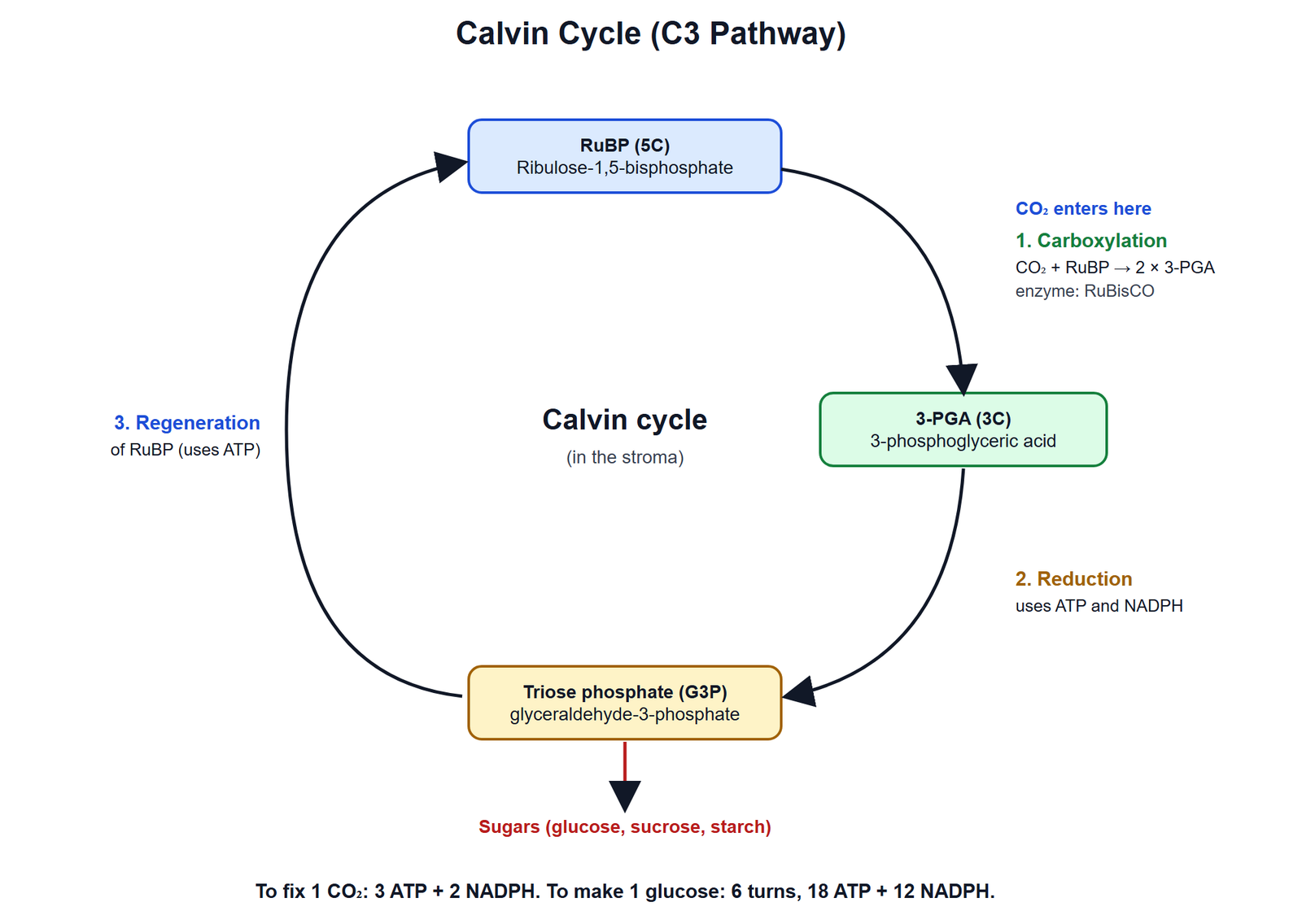
The Calvin cycle has three stages:
- Carboxylation: The most crucial step. CO2 combines with the acceptor RuBP (ribulose-1,5-bisphosphate, a 5-carbon ketose sugar) to form two molecules of 3-PGA. The enzyme is RuBisCO (RuBP carboxylase-oxygenase), the most abundant enzyme in the world.
- Reduction: 3-PGA is reduced to triose phosphate (glyceraldehyde-3-phosphate) and then to glucose, using 2 ATP and 2 NADPH for every CO2 fixed.
- Regeneration: The CO2 acceptor RuBP is regenerated so the cycle can continue. This requires one ATP per CO2.
| In | Out |
|---|---|---|
For 1 glucose (6 turns) | 6 CO2, 18 ATP, 12 NADPH | 1 glucose, 18 ADP, 12 NADP |
Exam point: To fix one molecule of CO2, the Calvin cycle needs 3 ATP and 2 NADPH. Six turns of the cycle are needed to make one molecule of glucose.
7. The C4 Pathway (Hatch and Slack Pathway)
Plants adapted to dry tropical regions, such as maize, sorghum and sugarcane, have the C4 pathway. Their first CO2 fixation product is a 4-carbon compound, oxaloacetic acid (OAA). They still use the Calvin cycle as the main biosynthetic pathway.
Kranz anatomy: C4 leaves have large bundle sheath cells arranged in a wreath around the vascular bundles. These cells have a large number of chloroplasts, thick walls impervious to gas exchange and no intercellular spaces.
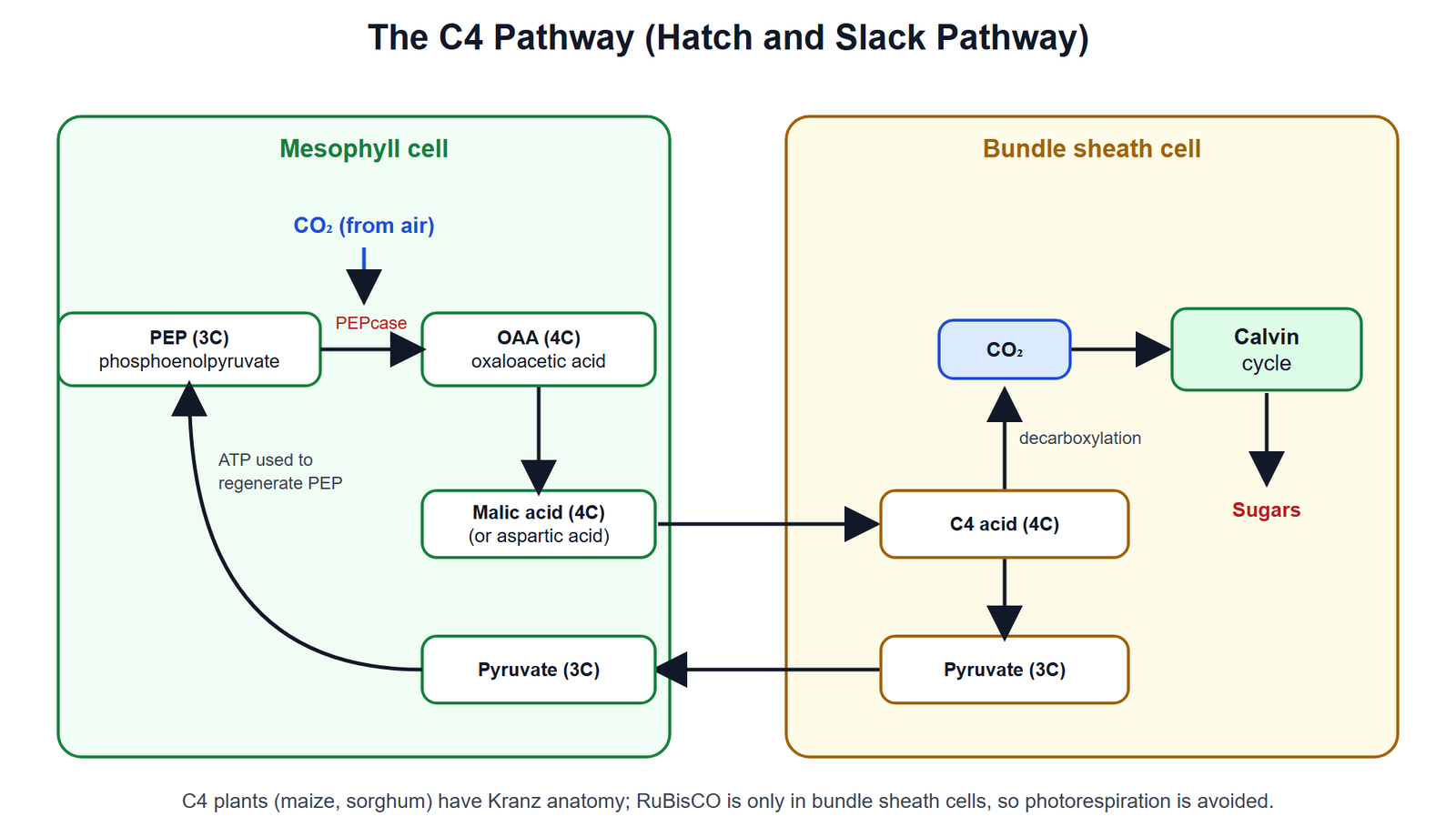
- In mesophyll cells, the primary CO2 acceptor PEP (phosphoenolpyruvate, 3C) combines with CO2 to form OAA. The enzyme is PEP carboxylase (PEPcase). Mesophyll cells lack RuBisCO.
- OAA forms other 4-carbon acids such as malic acid or aspartic acid, which move to the bundle sheath cells.
- In the bundle sheath cells, the C4 acids are broken down to release CO2 and a 3-carbon molecule.
- The released CO2 enters the Calvin cycle. Bundle sheath cells are rich in RuBisCO but lack PEPcase.
- The 3-carbon molecule is transported back to the mesophyll cells and converted to PEP again.
8. Photorespiration
RuBisCO can bind both CO2 and O2, but it has a much greater affinity for CO2 when the CO2 : O2 ratio is nearly equal. At high O2 concentration, RuBP binds with O2 instead (oxygenase activity). This is called photorespiration.
- RuBP + O2 → one molecule of PGA + one molecule of phosphoglycolate.
- There is no synthesis of sugars, ATP or NADPH. Instead, ATP is used and CO2 is released.
- Photorespiration is therefore a wasteful process.
- In C4 plants, photorespiration does not occur because they have a mechanism that increases the CO2 concentration at the enzyme site (in bundle sheath cells). So the productivity and yield of C4 plants are better.
Feature | C3 plants | C4 plants |
|---|---|---|
Cell types for Calvin cycle | Mesophyll | Bundle sheath |
First stable product | 3-PGA (3C) | OAA (4C) |
Primary CO2 acceptor | RuBP (5C) | PEP (3C) |
Carboxylating enzyme | RuBisCO | PEPcase (mesophyll) and RuBisCO (bundle sheath) |
Kranz anatomy | Absent | Present |
Photorespiration | Present | Negligible |
Optimum temperature | 20–25 °C | 30–40 °C |
Examples | Wheat, rice, potato | Maize, sugarcane, sorghum |
9. Factors Affecting Photosynthesis
Blackman’s Law of Limiting Factors (1905): If a chemical process is affected by more than one factor, its rate is determined by the factor nearest to its minimal value. It is the factor that directly affects the process if its quantity is changed.
Example: A plant with green leaves, optimal light and CO2 may still not photosynthesise if the temperature is very low. It will start photosynthesising once the temperature is raised to an optimum.
- Internal (plant) factors: Number, size, age and orientation of leaves; mesophyll cells and chloroplasts; internal CO2 concentration; amount of chlorophyll.
- Light: The rate increases linearly with incident light at low intensity. At higher intensity, the rate does not increase further because other factors become limiting. Light saturation occurs at about 10% of full sunlight, so light is rarely limiting in nature except for plants in shade or dense forests. Very high light causes breakdown of chlorophyll.
- Carbon dioxide: CO2 is the major limiting factor because its atmospheric concentration is very low (0.03–0.04%). An increase up to 0.05% raises the rate. C4 plants saturate at about 360 µL/L, while C3 plants respond to higher concentrations and saturate beyond 450 µL/L. This is used in greenhouses, where crops like tomatoes and bell peppers are grown in CO2-enriched air for higher yields.
- Temperature: The dark reactions are enzymatic and controlled by temperature. C4 plants respond to higher temperatures and have a higher optimum than C3 plants.
- Water: Its effect is mostly indirect. Water stress causes stomata to close, reducing CO2 availability, and wilting reduces the surface area of leaves and their metabolic activity.
Easy Memory Trick: “Light makes the Power, Stroma makes the Sugar” — the light reaction in the grana makes ATP and NADPH, and the Calvin cycle in the stroma uses them to make sugar.
Conclusion: Photosynthesis has two phases. The light reaction in the thylakoids splits water, releases O2 and makes ATP and NADPH through the Z-scheme and chemiosmosis. The Calvin cycle in the stroma uses these to fix CO2 into sugars. C4 plants concentrate CO2 in bundle sheath cells, avoid photorespiration and are more productive in hot, dry conditions.