Chapter – 3
Plant Kingdom
1. Introduction
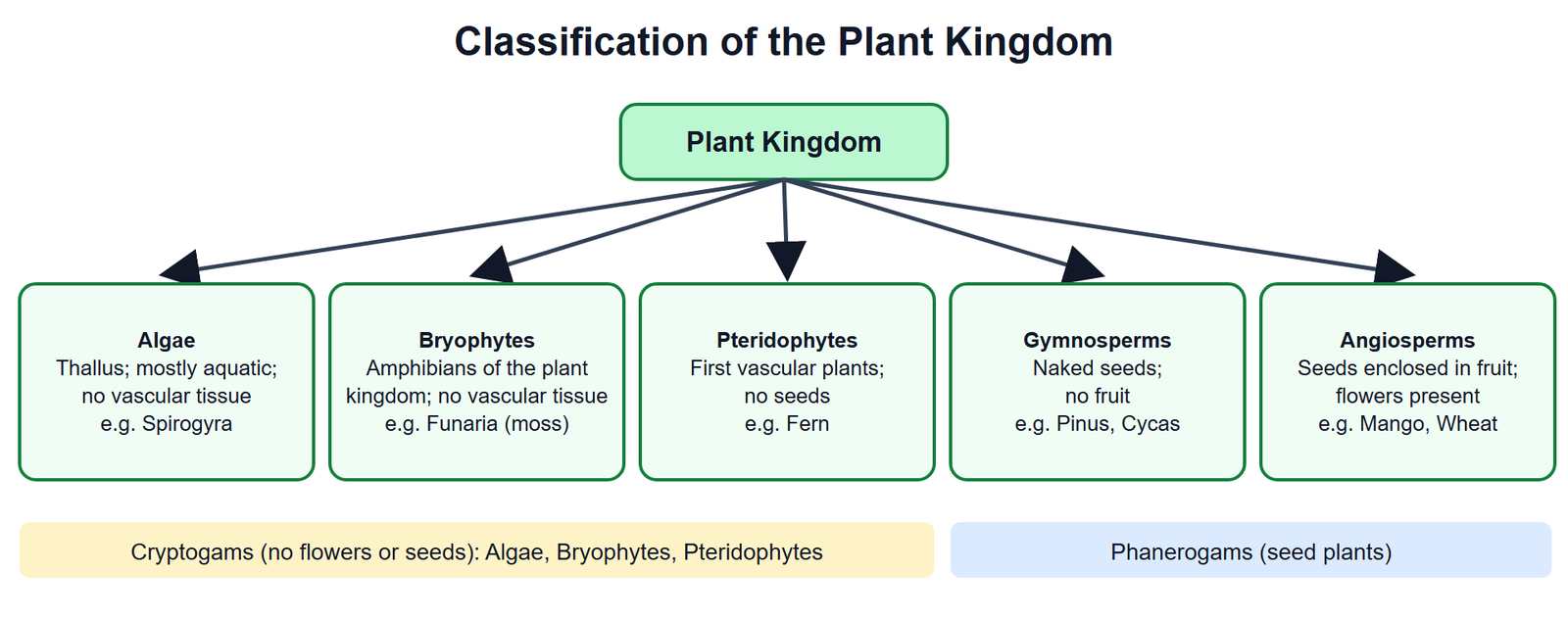
Kingdom Plantae includes algae, bryophytes, pteridophytes, gymnosperms and angiosperms. Earlier classification systems were artificial (based on a few morphological characters like habit, colour and number of leaves). Later, natural systems used natural affinities (external features plus anatomy, embryology and phytochemistry). Today, phylogenetic systems are based on evolutionary relationships.
2. Algae
Algae are chlorophyll-bearing, simple, thalloid, autotrophic and largely aquatic (fresh water and marine) organisms. They also occur in moist stones, soils and wood, and some live with fungi (lichens) or animals (on sloth bear).
- Size varies from microscopic unicellular forms (Chlamydomonas) to colonial forms (Volvox) and filamentous forms (Ulothrix, Spirogyra). Some marine forms like kelps form massive plant bodies.
- Vegetative reproduction: by fragmentation.
- Asexual reproduction: by spores, most commonly zoospores (flagellated and motile).
- Sexual reproduction: Isogamous (gametes similar in size, e.g. Ulothrix, Spirogyra), anisogamous (gametes dissimilar in size, e.g. Eudorina) or oogamous (large non-motile female gamete and small motile male gamete, e.g. Volvox, Fucus).
Uses of algae: At least half of the total carbon dioxide fixation on Earth is carried out by algae. Many marine algae (Porphyra, Laminaria, Sargassum) are used as food. Algin (brown algae) and carrageen (red algae) are used commercially. Agar, obtained from Gelidium and Gracilaria, is used to grow microbes and in ice creams and jellies. Chlorella is a protein-rich food supplement, even used by space travellers.
Feature | Chlorophyceae (green algae) | Phaeophyceae (brown algae) | Rhodophyceae (red algae) |
|---|---|---|---|
Major pigments | Chlorophyll a, b | Chlorophyll a, c, fucoxanthin | Chlorophyll a, d, phycoerythrin |
Stored food | Starch | Mannitol, laminarin | Floridean starch |
Cell wall | Cellulose | Cellulose and algin | Cellulose, pectin and polysulphate esters |
Flagella | 2–8, equal, apical | 2, unequal, lateral | Absent |
Habitat | Fresh water, brackish, salt water | Mostly marine | Mostly marine |
Examples | Chlamydomonas, Volvox, Ulothrix, Spirogyra, Chara | Ectocarpus, Dictyota, Laminaria, Sargassum, Fucus | Polysiphonia, Porphyra, Gracilaria, Gelidium |
Remember: Brown algae have a body differentiated into a holdfast (for attachment), a stipe (stalk) and a frond (leaf-like photosynthetic part).
3. Bryophytes
Bryophytes include liverworts and mosses. They live in moist shaded areas, especially in hills. They are called the “amphibians of the plant kingdom” because they live in soil but depend on water for sexual reproduction.
- The plant body is more differentiated than algae. It is thallus-like and prostrate or erect, attached to the soil by unicellular or multicellular rhizoids. True roots, stem and leaves are absent; they have root-like, leaf-like or stem-like structures.
- The main plant body is haploid. It produces gametes and is called the gametophyte.
- The male sex organ is the antheridium (produces biflagellate antherozoids). The female sex organ is the archegonium (flask-shaped, produces a single egg).
- Antherozoids reach the archegonium through water and fuse with the egg to form a zygote. The zygote develops into a multicellular sporophyte, which is not free-living; it remains attached to the gametophyte and gets nourishment from it.
- Some cells of the sporophyte undergo meiosis to form haploid spores, which germinate to form new gametophytes.
- Liverworts: Grow in moist, shady places. The body is thalloid (e.g. Marchantia). Asexual reproduction is by fragmentation or by gemmae (green, multicellular buds formed in gemma cups).
- Mosses: The predominant stage is the gametophyte, which has two stages: the protonema (creeping, green, filamentous, formed from a spore) and the leafy stage. Examples: Funaria, Polytrichum, Sphagnum.
Economic importance: Some mosses provide food for herbivorous mammals and birds. Sphagnum provides peat, used as fuel and as packing material for trans-shipment of living material because of its water-holding capacity. Mosses, along with lichens, are the first organisms to colonise rocks (pioneer species). They also prevent soil erosion.
4. Pteridophytes
Pteridophytes include horsetails and ferns. They are the first terrestrial plants to have vascular tissues (xylem and phloem). They grow in cool, damp, shady places.
- The main plant body is a sporophyte, differentiated into true root, stem and leaves.
- Leaves may be small (microphylls, as in Selaginella) or large (macrophylls, as in ferns).
- Sporangia are borne on leaf-like appendages called sporophylls. In some, sporophylls form compact structures called strobili or cones (Selaginella, Equisetum).
- Spores germinate to form inconspicuous, small, multicellular, free-living, mostly photosynthetic thalloid gametophytes called prothallus. Water is needed for fertilisation.
- Most pteridophytes produce similar spores (homosporous). Genera like Selaginella and Salvinia produce two kinds of spores, macro (large) and micro (small) spores; they are heterosporous. Heterospory is a precursor to the seed habit.
- Examples: Psilotum, Selaginella, Lycopodium, Equisetum, Dryopteris, Pteris, Adiantum.
5. Gymnosperms
Gymnosperms (gymnos: naked; sperma: seed) are plants in which the ovules are not enclosed by an ovary wall and remain exposed before and after fertilisation. The seeds are naked.
- They include medium-sized trees, tall trees and shrubs. The giant redwood tree Sequoia is one of the tallest trees.
- Roots are generally tap roots. In Pinus, roots have fungal association (mycorrhiza). In Cycas, small specialised roots called coralloid roots are associated with nitrogen-fixing cyanobacteria.
- Leaves may be simple or compound. In conifers, the needle-like leaves have a thick cuticle and sunken stomata, which reduce water loss.
- Gymnosperms are heterosporous. Microspores and megaspores are produced in microsporangia and megasporangia, borne on sporophylls arranged in male and female cones (strobili).
- Pollen grains are carried by air currents to the ovules. The male and female gametophytes do not have an independent free-living existence; they remain within the sporangia.
- Examples: Cycas, Pinus, Ginkgo.
6. Angiosperms
Angiosperms (flowering plants) produce pollen grains and ovules in specialised structures called flowers. Their seeds are enclosed in fruits.
- They are the largest group of plants and occupy a wide range of habitats.
- They range from the tiny Wolffia to tall trees of Eucalyptus (over 100 metres).
- They are divided into two classes: dicotyledons (two cotyledons in the seed) and monocotyledons (one cotyledon).
- They show double fertilisation: one male gamete fuses with the egg (forming the zygote) and the other fuses with the secondary nucleus (forming the triploid primary endosperm nucleus).
Basis | Gymnosperms | Angiosperms |
|---|---|---|
Ovules / seeds | Naked, not enclosed in ovary | Enclosed in ovary; seeds inside fruit |
Flowers | Absent (cones present) | Present |
Double fertilisation | Absent | Present |
Endosperm | Haploid (formed before fertilisation) | Triploid (formed after fertilisation) |
Examples | Cycas, Pinus | Mango, wheat |
7. Plant Life Cycles and Alternation of Generations
In plants, both haploid and diploid cells can divide by mitosis. This gives two plant bodies: a haploid gametophyte (produces gametes) and a diploid sporophyte (produces spores by meiosis). The alternation between these two phases is called alternation of generations.
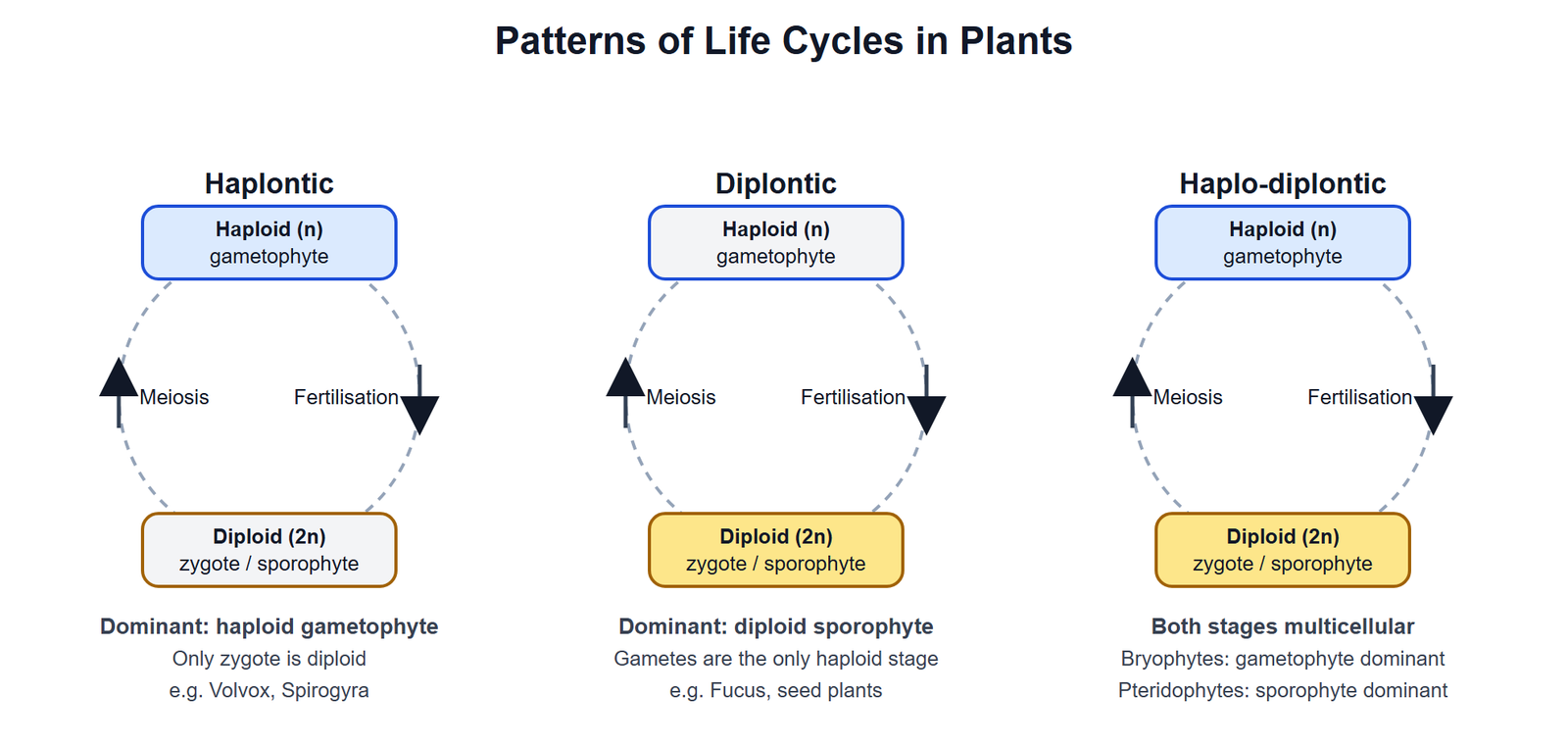
- Haplontic: The sporophytic generation is only the one-celled zygote. The free-living gametophyte is dominant. Meiosis in the zygote forms haploid spores. Example: Volvox, Spirogyra, some species of Chlamydomonas.
- Diplontic: The diploid sporophyte is the dominant, photosynthetic, independent phase. The gametophyte is represented by a few-celled haploid stage. Example: all seed plants (gymnosperms and angiosperms), and the alga Fucus.
- Haplo-diplontic: Both phases are multicellular. In bryophytes, the gametophyte is dominant and the sporophyte depends on it. In pteridophytes, the sporophyte is dominant and the gametophyte is a short-lived, free-living prothallus. Algae like Ectocarpus, Polysiphonia and kelps also show this pattern.
Easy Memory Trick: Algae and bryophytes: gametophyte (n) is the main plant. Pteridophytes, gymnosperms and angiosperms: sporophyte (2n) is the main plant.
Conclusion: The plant kingdom ranges from simple thalloid algae to complex flowering plants. Bryophytes are the amphibians of the plant kingdom, pteridophytes are the first vascular plants, gymnosperms have naked seeds and angiosperms have seeds enclosed in fruits. Plants show alternation of generations between haploid gametophyte and diploid sporophyte.