Biomolecules – Class 11 Biology Notes
Chapter – 9
Biomolecules
1. How to Analyse Chemical Composition
To find the organic compounds in living tissue, the tissue is ground in trichloroacetic acid (Cl3CCOOH) and filtered. This gives two fractions:
- Acid-soluble fraction (filtrate): Contains thousands of small organic compounds (molecular weight 18 to about 800 daltons), called biomicromolecules: amino acids, sugars, nucleotides, etc.
- Acid-insoluble fraction (retentate): Contains four types of organic compounds: proteins, nucleic acids, polysaccharides and lipids. Except lipids, these have molecular weights above ten thousand daltons and are called biomacromolecules.
Lipids are not strictly macromolecules (their molecular weight does not exceed 800 Da), but they appear in the acid-insoluble fraction because, when tissue is ground, cell membranes break into vesicles that are not water-soluble.
Elemental analysis gives the elements present (C, H, O, N, etc.). Ash analysis (after burning the tissue) gives inorganic elements such as calcium, magnesium, sulphate and phosphate.
Primary and secondary metabolites: Primary metabolites (amino acids, sugars, etc.) have identifiable functions in normal physiological processes. Secondary metabolites are found in plants, fungi and microbes; examples are pigments (carotenoids, anthocyanins), alkaloids (morphine, codeine), terpenoids (monoterpenes, diterpenes), essential oils (lemon grass oil), toxins (abrin, ricin), lectins (concanavalin A), drugs (vinblastine, curcumin), polymeric substances (rubber, gums, cellulose).
2. Amino Acids and Proteins
Amino acids are organic compounds with an amino group and an acidic (carboxyl) group as substituents on the same carbon, the α-carbon. The fourth substituent is a variable group, R.

- Based on the R group, there are many amino acids; those that occur in proteins are only of twenty-one types.
- Amino acids may be acidic (glutamic acid), basic (lysine) or neutral (valine). Aromatic amino acids include tyrosine, phenylalanine and tryptophan.
- In solutions of different pH, amino acids exist in different ionisable forms. At a particular pH, the molecule carries both a positive and a negative charge and is called a zwitterion.
Proteins are polypeptides: linear chains of amino acids linked by peptide bonds. A protein is a heteropolymer (made of different monomers).
- Essential amino acids must be obtained from food; non-essential amino acids are made by the body.
- Functions: transport of nutrients across membranes, fighting infectious organisms (antibodies), hormones (insulin), enzymes (trypsin), receptors (sensory reception: smell, taste), and structural roles.
- Collagen is the most abundant protein in the animal world. RuBisCO (Ribulose bisphosphate carboxylase-oxygenase) is the most abundant protein in the whole biosphere.
Structure of proteins:
- Primary structure: The sequence of amino acids in the polypeptide. The first amino acid is the N-terminal amino acid and the last is the C-terminal amino acid.
- Secondary structure: The protein thread folds into a helix. In proteins, only right-handed helices are observed.
- Tertiary structure: The long polypeptide chain folds upon itself like a hollow woollen ball, giving a 3-dimensional view. This is essential for the biological activity of many proteins.
- Quaternary structure: The arrangement of more than one polypeptide (subunit) with respect to each other. Example: adult human haemoglobin has four subunits (two α and two β).
3. Polysaccharides (Carbohydrates)
Polysaccharides are long chains of sugars (monosaccharides) linked by glycosidic bonds.
- Cellulose: A homopolymer of glucose; the main component of plant cell walls. Cotton fibre is cellulose.
- Starch: A store-house of energy in plants. Starch forms helical secondary structures and can hold iodine (I2) in the helical portion, giving a blue colour. Cellulose does not contain complex helices and cannot hold iodine.
- Glycogen: The storage polysaccharide in animals.
- Inulin: A polymer of fructose.
- Chitin: A complex polysaccharide forming the exoskeleton of arthropods; contains amino sugars (e.g. glucosamine, N-acetyl galactosamine).
In a polysaccharide chain, the right end is called the reducing end and the left end the non-reducing end.
4. Nucleic Acids
Nucleic acids (DNA and RNA) are polynucleotides. A nucleotide has three components:
- A heterocyclic nitrogenous base: purines (adenine, guanine) or pyrimidines (cytosine, uracil, thymine).
- A monosaccharide (pentose) sugar: ribose (in RNA) or 2-deoxyribose (in DNA).
- A phosphate group (phosphoric acid).
- Base + sugar = nucleoside (e.g. adenosine, guanosine, thymidine, uridine, cytidine).
- Nucleoside + phosphate = nucleotide (e.g. adenylic acid, thymidylic acid).
- Nucleotides are linked by phosphodiester bonds (a phosphate links the 3′-carbon of one sugar to the 5′-carbon of the next).
- DNA exists as a double helix (Watson and Crick model): two antiparallel polynucleotide strands with bases paired by hydrogen bonds: A with T (two hydrogen bonds) and G with C (three hydrogen bonds).
Feature | DNA | RNA |
|---|---|---|
Sugar | Deoxyribose | Ribose |
Bases | A, G, C, T | A, G, C, U |
Strands | Usually double-stranded | Usually single-stranded |
5. Lipids
Lipids are generally water-insoluble.
- Fatty acids: Have a carboxyl group attached to an R group, which may be methyl, ethyl or a long chain of methylene groups (1 to 19 carbons). Example: palmitic acid has 16 carbons including the carboxyl carbon; arachidonic acid has 20 carbons. Fatty acids may be saturated (no double bonds) or unsaturated (one or more C=C double bonds).
- Glycerol: Trihydroxy propane.
- Glycerides: Fatty acids esterified with glycerol: monoglycerides, diglycerides and triglycerides. Based on melting point, they are fats (solid at room temperature) or oils (liquid, e.g. gingelly oil).
- Phospholipids: Have phosphorus and a phosphorylated organic compound. Example: lecithin, found in cell membranes.
- Some tissues, especially neural tissue, have lipids with more complex structures.
6. Nature of Bonds Linking Monomers
Polymer | Monomers | Bond | Formed between |
|---|---|---|---|
Protein | Amino acids | Peptide bond | Carboxyl group of one amino acid and amino group of the next (water removed) |
Polysaccharide | Monosaccharides | Glycosidic bond | Two carbon atoms of adjacent monosaccharides (dehydration) |
Nucleic acid | Nucleotides | Phosphodiester bond | Phosphate and the hydroxyl groups of sugars of adjacent nucleotides |
Glyceride (lipid) | Fatty acids + glycerol | Ester bond | Carboxyl group of fatty acid and hydroxyl group of glycerol |
Dynamic state of body constituents: Biomolecules are constantly being changed into other biomolecules and also made from other biomolecules. This breaking and making through chemical reactions is called metabolism. Each reaction is catalysed by an enzyme. Linked reactions form metabolic pathways: anabolic pathways build complex molecules and consume energy; catabolic pathways break them down and release energy. ATP is the energy currency of living systems.
7. Enzymes
Almost all enzymes are proteins. Some nucleic acids behave like enzymes; these are called ribozymes.
- An enzyme has a tertiary structure with crevices or pockets where the substrate fits. This is called the active site.
- Enzymes speed up reactions by lowering the activation energy. The substrate binds the active site to form an enzyme–substrate complex (ES), which is short-lived and changes into the enzyme–product complex, releasing the product and the unchanged enzyme.
- Enzymes from organisms living in very high temperatures (hot vents, sulphur springs) are stable at temperatures as high as 80–90 °C (thermostable enzymes).
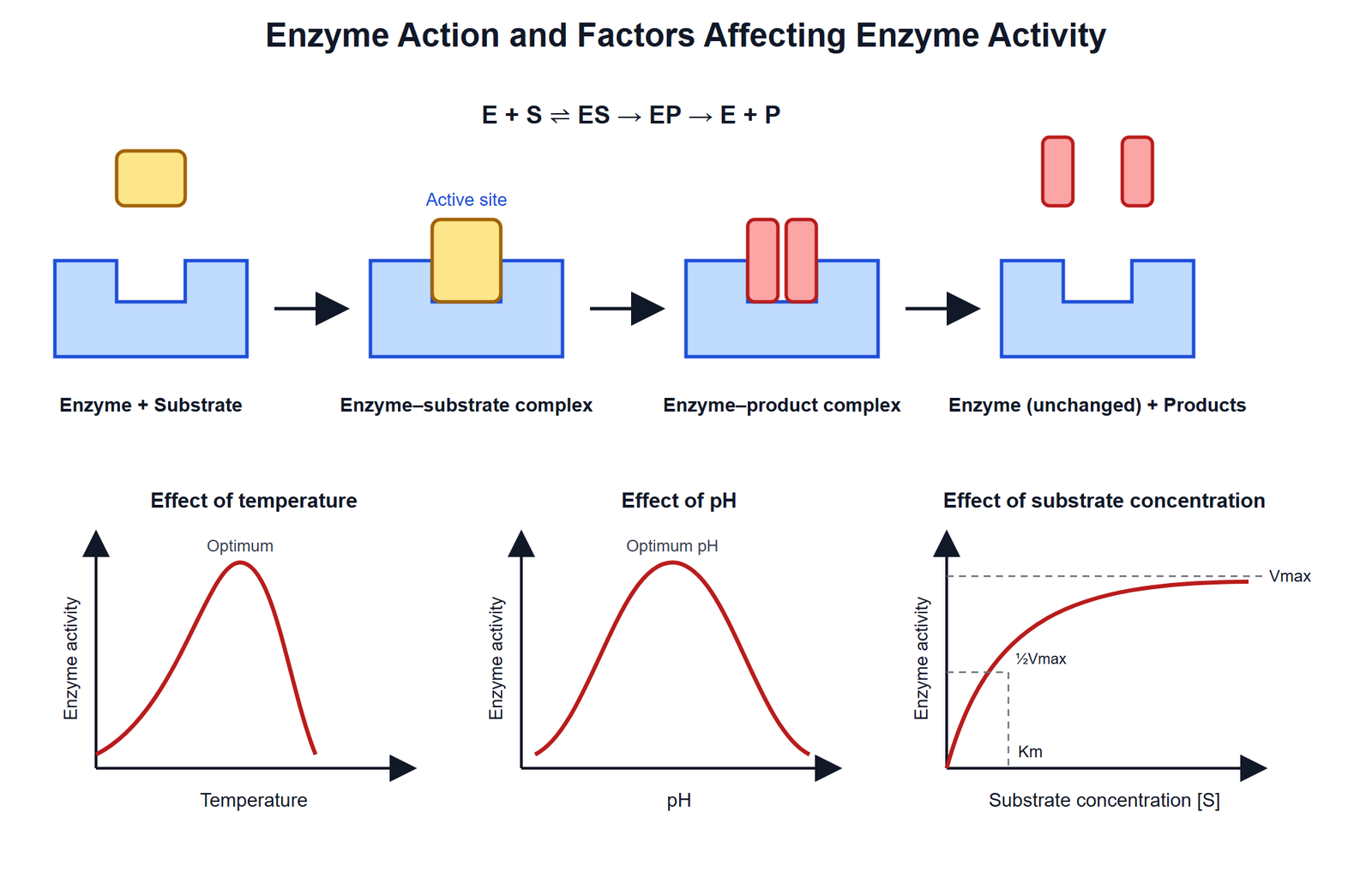
Factors affecting enzyme activity:
- Temperature and pH: Each enzyme shows its highest activity at a particular temperature and pH, called the optimum. Activity declines above and below the optimum. Low temperature temporarily inactivates the enzyme, while high temperature destroys enzymatic activity because proteins are denatured by heat.
- Substrate concentration: As the substrate concentration increases, the velocity of the reaction rises at first and then reaches a maximum (Vmax), which is not exceeded by any further rise in concentration, because all enzyme molecules are occupied. Km is the substrate concentration at which the reaction attains half its maximum velocity.
- Inhibitors: When an inhibitor closely resembles the substrate in molecular structure, it competes with the substrate for the active site (competitive inhibition). Example: malonate inhibits succinic dehydrogenase because it resembles the substrate succinate. Competitive inhibitors are used to control bacterial pathogens.
Classification of enzymes (six classes):
Class | Reaction catalysed |
|---|---|
Oxidoreductases / dehydrogenases | Oxidation–reduction between two substrates |
Transferases | Transfer of a group (other than hydrogen) between substrates |
Hydrolases | Hydrolysis of ester, ether, peptide, glycosidic, C–C, C–halide or P–N bonds |
Lyases | Removal of groups from substrates by mechanisms other than hydrolysis, leaving double bonds |
Isomerases | Inter-conversion of optical, geometric or positional isomers |
Ligases | Linking together of two compounds (e.g. joining C–O, C–S, C–N, P–O bonds) |
Co-factors: Many enzymes need a non-protein constituent called a co-factor. The protein part is then called the apoenzyme.
- Prosthetic groups: Organic compounds tightly bound to the apoenzyme. Example: haem in peroxidase and catalase (which break down hydrogen peroxide).
- Co-enzymes: Organic compounds whose association with the apoenzyme is transient. Many co-enzymes contain vitamins. Example: NAD and NADP contain the vitamin niacin.
- Metal ions: Form coordination bonds with side chains at the active site and with the substrate. Example: zinc is a co-factor for the proteolytic enzyme carboxypeptidase.
Exam point: Catalytic activity is lost when the co-factor is removed from the enzyme, which shows that co-factors play a crucial role.
Conclusion: Living tissues contain small biomolecules (amino acids, sugars, nucleotides, fatty acids) and large biomacromolecules (proteins, polysaccharides, nucleic acids). Their monomers are linked by peptide, glycosidic, phosphodiester and ester bonds. Enzymes, mostly proteins, speed up metabolic reactions by lowering activation energy, and their activity depends on temperature, pH, substrate concentration, inhibitors and co-factors.