Animal Kingdom – Class 11 Biology Notes
Chapter – 4
Animal Kingdom
1. Basis of Classification
Although animals differ in structure and form, some fundamental features are common to many of them. These features are used as the basis of classification.
- Levels of organisation:
- Cellular level: cells are arranged as loose aggregates (sponges).
- Tissue level: cells performing the same function form tissues (coelenterates).
- Organ level: tissues are grouped to form organs (Platyhelminthes).
- Organ system level: organs form systems for specific functions (Annelids, Arthropods, Molluscs, Echinoderms and Chordates).
- Circulatory system: Open type (blood is pumped out of the heart and bathes cells and tissues directly) or closed type (blood flows through a series of vessels).
- Digestive system: Incomplete (only one opening, which serves as both mouth and anus, e.g. Platyhelminthes) or complete (two openings: mouth and anus).
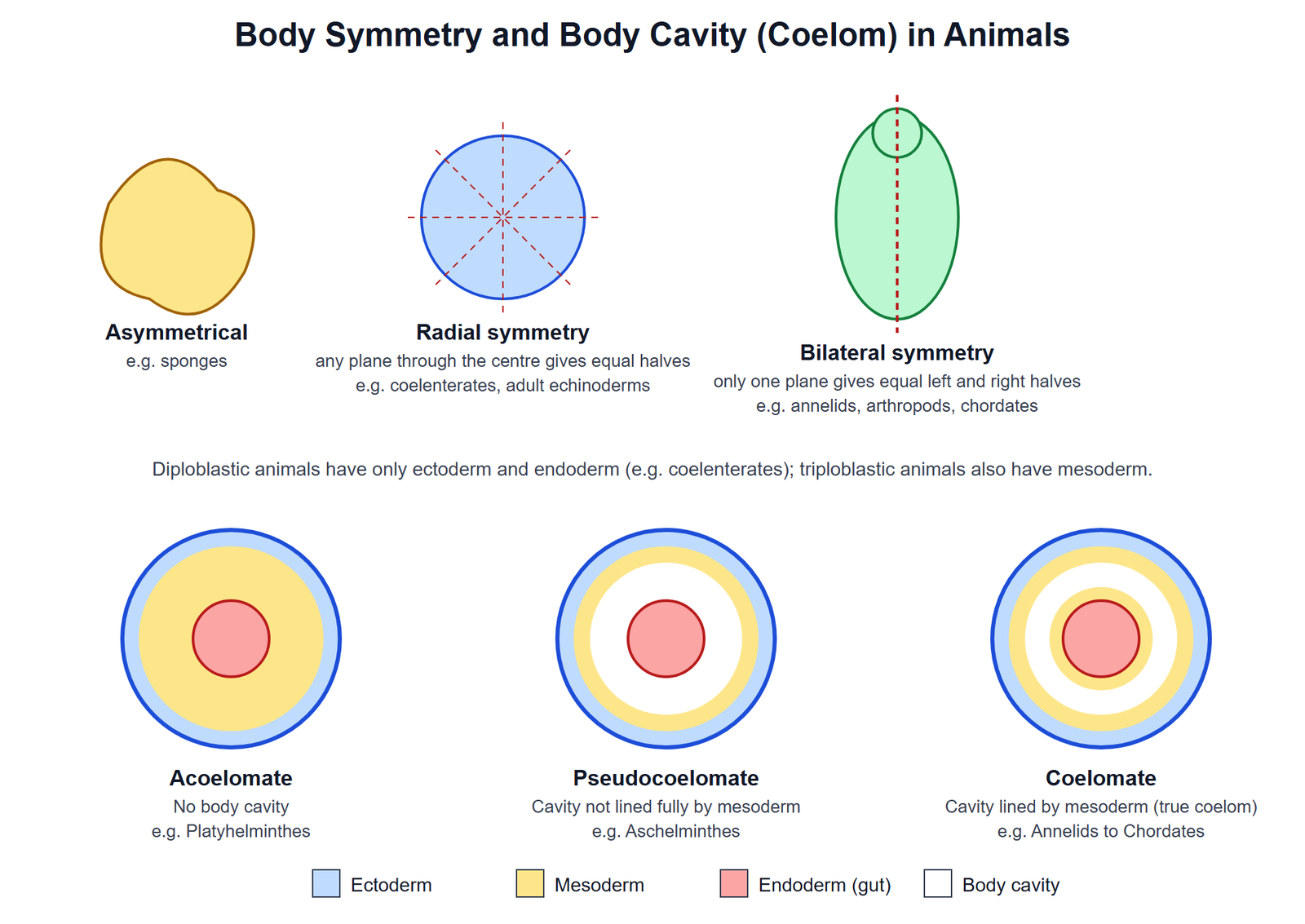
- Symmetry: Asymmetrical (sponges), radial (coelenterates, ctenophores, echinoderms) or bilateral (annelids, arthropods, etc.).
- Germ layers: Diploblastic (two layers: external ectoderm and internal endoderm with an undifferentiated mesoglea between them, e.g. coelenterates) or triploblastic (three layers: ectoderm, mesoderm and endoderm, e.g. Platyhelminthes to chordates).
- Coelom (body cavity lined by mesoderm): Coelomates (annelids, molluscs, arthropods, echinoderms, hemichordates, chordates), pseudocoelomates (mesoderm present as scattered pouches, e.g. Aschelminthes) and acoelomates (no body cavity, e.g. Platyhelminthes).
- Segmentation: In some animals the body is externally and internally divided into segments with serial repetition of some organs. This is called metameric segmentation (metamerism). Example: earthworm.
- Notochord: A mesodermally derived rod-like structure formed on the dorsal side during embryonic development. Animals with a notochord are chordates; those without it are non-chordates.
2. Classification of Non-chordates (Phyla)
Phylum | Level / symmetry / coelom | Key features | Examples |
|---|---|---|---|
Porifera (sponges) | Cellular; asymmetrical | Water canal system; ostia, spongocoel, osculum; choanocytes (collar cells); skeleton of spicules or spongin fibres; hermaphrodite | Sycon (Scypha), Spongilla, Euspongia (bath sponge) |
Coelenterata (Cnidaria) | Tissue; radial; diploblastic | Cnidoblasts (stinging cells) on tentacles; gastrovascular cavity with one opening (hypostome); polyp and medusa forms (metagenesis in Obelia) | Physalia (Portuguese man-of-war), Adamsia (sea anemone), Pennatula, Gorgonia, Meandrina (brain coral), Hydra, Aurelia |
Ctenophora (comb jellies, sea walnuts) | Tissue; radial; diploblastic | Eight external rows of ciliated comb plates for locomotion; bioluminescence; only sexual reproduction | Pleurobrachia, Ctenoplana |
Platyhelminthes (flatworms) | Organ; bilateral; triploblastic; acoelomate | Dorso-ventrally flattened; mostly endoparasites; hooks and suckers; flame cells for excretion; high regeneration in Planaria | Taenia (tapeworm), Fasciola (liver fluke), Planaria |
Aschelminthes (roundworms) | Organ system; bilateral; triploblastic; pseudocoelomate | Circular in cross section; complete alimentary canal with muscular pharynx; sexes separate (dioecious), females longer than males | Ascaris (roundworm), Wuchereria (filarial worm), Ancylostoma (hookworm) |
Annelida | Organ system; bilateral; triploblastic; coelomate | Metamerically segmented body; longitudinal and circular muscles; closed circulatory system; nephridia for excretion; Nereis has parapodia | Nereis, Pheretima (earthworm), Hirudinaria (blood-sucking leech) |
Arthropoda (largest phylum) | Organ system; bilateral; triploblastic; coelomate | Chitinous exoskeleton; jointed appendages; body of head, thorax, abdomen; open circulatory system; respiration by gills, book gills, book lungs or tracheae; Malpighian tubules | Apis (honey bee), Bombyx (silkworm), Laccifer (lac insect), Anopheles, Culex, Aedes (mosquitoes), Locusta, Limulus (king crab, living fossil) |
Mollusca (second largest phylum) | Organ system; bilateral; triploblastic; coelomate | Calcareous shell; unsegmented body with head, muscular foot and visceral hump; mantle; feather-like gills; radula (file-like rasping organ) | Pila (apple snail), Pinctada (pearl oyster), Sepia (cuttlefish), Loligo (squid), Octopus (devil fish) |
Echinodermata | Organ system; adults radial, larvae bilateral; triploblastic; coelomate | Spiny calcareous endoskeleton; all marine; water vascular system with tube feet; no excretory system | Asterias (star fish), Echinus (sea urchin), Antedon (sea lily), Cucumaria (sea cucumber), Ophiura (brittle star) |
Hemichordata | Organ system; bilateral; triploblastic; coelomate | Worm-like marine animals; body of proboscis, collar and trunk; stomochord (not true notochord); gill slits | Balanoglossus, Saccoglossus |
Exam point: Arthropoda is the largest phylum (about two-thirds of all named species on Earth are arthropods). Mollusca is the second largest phylum.
3. Phylum Chordata
Chordates have three fundamental characters:
- A notochord (rod-like supporting structure on the dorsal side).
- A dorsal, hollow, single nerve cord.
- Paired pharyngeal gill slits.
They are bilaterally symmetrical, triploblastic, coelomate, with organ system level of organisation, a closed circulatory system and a post-anal tail.
Chordates | Non-chordates |
|---|---|
Notochord present | Notochord absent |
Central nervous system is dorsal, hollow and single | Central nervous system is ventral, solid and double |
Pharynx perforated by gill slits | Gill slits absent |
Heart is ventral | Heart is dorsal (if present) |
A post-anal tail is present | Post-anal tail absent |
Subphyla of Chordata:
- Urochordata (Tunicata): Notochord present only in the larval tail. Examples: Ascidia, Salpa, Doliolum.
- Cephalochordata: Notochord extends from head to tail and persists throughout life. Example: Branchiostoma (Amphioxus or lancelet).
- Vertebrata: Notochord present in the embryo is replaced by a cartilaginous or bony vertebral column in the adult. So all vertebrates are chordates, but all chordates are not vertebrates.
4. Classes of Vertebrates
Class | Key features | Heart chambers | Examples |
|---|---|---|---|
Cyclostomata | Jawless; circular sucking mouth; ectoparasites on fishes; cartilaginous skeleton; migrate to fresh water to spawn | 2 | Petromyzon (lamprey), Myxine (hagfish) |
Chondrichthyes | Marine; cartilaginous endoskeleton; ventral mouth; gill slits without operculum; placoid scales; no air bladder; cold-blooded | 2 | Scoliodon (dog fish), Pristis (saw fish), Carcharodon (great white shark), Trygon (sting ray), Torpedo (electric ray) |
Osteichthyes | Marine and fresh water; bony endoskeleton; four pairs of gills covered by operculum; cycloid / ctenoid scales; air bladder present; cold-blooded | 2 | Labeo (Rohu), Catla, Clarias (Magur), Exocoetus (flying fish), Hippocampus (sea horse), Betta (fighting fish) |
Amphibia | Live in water and on land; two pairs of limbs; moist skin without scales; tympanum; cloaca; respiration by gills, lungs and skin; cold-blooded | 3 | Bufo (toad), Rana (frog), Hyla (tree frog), Salamandra, Ichthyophis (limbless amphibian) |
Reptilia | Mostly terrestrial; creeping or crawling; dry cornified skin with epidermal scales or scutes; tympanum represents ear; cold-blooded; snakes and lizards shed scales as skin cast | 3 (4 in crocodiles) | Chelone (turtle), Testudo (tortoise), Chameleon, Calotes (garden lizard), Crocodilus, Naja (cobra), Vipera (viper) |
Aves (birds) | Feathers; forelimbs modified into wings; beak; long bones hollow with air cavities (pneumatic); air sacs; warm-blooded | 4 | Corvus (crow), Columba (pigeon), Psittacula (parrot), Struthio (ostrich), Pavo (peacock), Aptenodytes (penguin) |
Mammalia | Mammary glands; hair on skin; external ears (pinna); different types of teeth; mostly viviparous; warm-blooded | 4 | Ornithorhynchus (platypus, oviparous), Macropus (kangaroo), Pteropus (flying fox), Camelus, Macaca (monkey), Rattus, Canis (dog), Felis (cat), Elephas, Equus (horse), Delphinus (dolphin), Balaenoptera (blue whale), Panthera tigris, Panthera leo |
Remember: Cyclostomata are jawless (Agnatha). All other vertebrates have jaws (Gnathostomata). Fishes (Chondrichthyes and Osteichthyes) belong to superclass Pisces; Amphibia, Reptilia, Aves and Mammalia belong to superclass Tetrapoda.
Easy Memory Trick: Heart chambers: fish 2, amphibians and reptiles 3 (crocodile 4), birds and mammals 4. Birds and mammals are warm-blooded (homoiothermous); the rest are cold-blooded (poikilothermous).
Conclusion: Animals are classified on the basis of levels of organisation, symmetry, germ layers, coelom, segmentation and notochord. Non-chordates are placed in phyla from Porifera to Hemichordata, while chordates have a notochord, a dorsal hollow nerve cord and pharyngeal gill slits, and include the vertebrate classes from Cyclostomata to Mammalia.